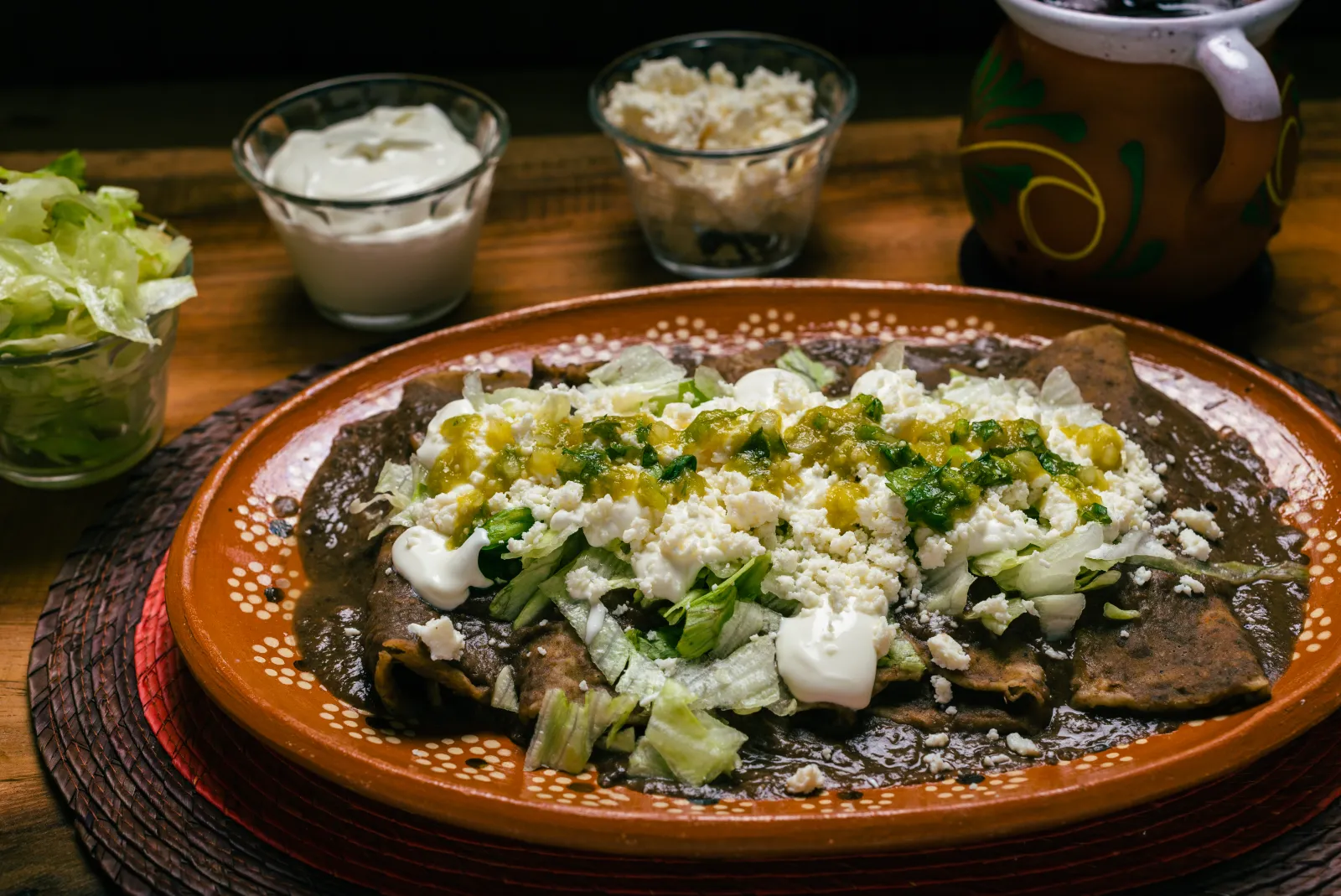

Take an enchilada, swap its chile sauce for 3 cups of beans blended smooth, and you have an enfrijolada (en-free-ho-LAH-dah). Corn tortillas are flash-fried, dragged through hot black or pinto bean sauce, folded around a little crumbled cheese and topped with crema, more cheese and raw onion. Mexican families eat them for breakfast or a light supper, and they are one of the cheapest ways I know to turn leftover beans into a meal. The whole dish rides on one number, which I’ll give you below along with canned-bean sodium figures, US and UK swaps and the cost per plate.
What are enfrijoladas, and how are they different from enchiladas?
How do you make enfrijoladas? Blend 3 cups (520 g) of cooked black beans with 2 cups (480 ml) of their cooking liquid, sautéed onion and garlic and a chipotle, then simmer the sauce for 8 minutes until it coats a spoon. Fry 12 corn tortillas for 10 seconds per side, dip each in the sauce for 2 to 3 seconds, fill with queso fresco, fold, and top with crema and onion. Ready in 30 minutes for 4 servings.
The only difference is the sauce. Cookbook author Nancy Zaslavsky groups enfrijoladas with enchiladas, entomatadas in tomato sauce and enmoladas (mole) as the same dish built on four different sauces: tortilla through oil, through sauce, folded. If you know green chicken enchiladas or red enchiladas, the technique will feel familiar. Enchiladas suizas are the creamy, baked cousin. What sets enfrijoladas apart is the price and the fact that they start from beans you probably already have.
Black beans are the rule in Oaxaca, Veracruz and the southeast, and pale bayo beans in Mexico City and Jalisco, according to El Diario NY. Pinto beans, the closest thing to bayo in a US store, work just as well.
Is it worth it? Yes, especially on a weeknight with cooked beans in the fridge. It takes 30 minutes, about 25 of them hands-on, and the only skills are judging the sauce and timing the tortillas. From dried beans, add an overnight soak and 60 to 90 minutes of simmering, as in these Mexican pot beans with epazote.
Who might skip it. Anyone after a light meal: between the frying oil, cheese and crema, a plate of three comes to about 690 kcal (the variations below bring it down to about 510). And anyone without corn tortillas, since flour ones go soggy within seconds.
Ingredients, and what to buy outside Mexico
The full list is in the recipe card: 3 cups (520 g) of cooked beans, 2 cups (480 ml) of liquid, 12 corn tortillas, 160 g (5½ oz) of queso fresco and ½ cup (120 ml) of crema for 4 people. Everything has a supermarket stand-in in the US and UK.
Corn tortillas. Use 6-inch (15 cm) tortillas of about 24 g each. In the US they’re in every supermarket; in the UK, look for soft corn tortillas from Mexican food shops online. Flour tortillas work in a pinch, but they soak through fast and taste of wheat.
Queso fresco. A mild, crumbly, slightly salty fresh cheese. Most US supermarkets carry it near the other Latin dairy. In the UK, a mild feta rinsed under cold water gets close, saltier and firmer.
Chipotle in adobo. Smoked jalapeños in a tangy red sauce, sold in small cans in the US. One chile gives a gentle heat, about 1 out of 5 in my kitchen; two take it to 2. In the UK, a teaspoon of chipotle paste does the same job with less smoke.
Avocado leaf and epazote. Both are optional. Only leaves from the Mexican avocado tree carry the anise-like aroma; Hass leaves taste of almost nothing, and Rick Bayless suggests a bay leaf with a pinch of anise instead. Leave them out and the dish is still very good.
Equipment. A blender, a wide 10-11 in (26-28 cm) skillet for the sauce, a small skillet for the oil, tongs and paper towels. No blender? An immersion blender in the pan works; a potato masher and a sieve give a slightly rougher sauce.
Canned or home-cooked beans, and the salt problem
Either works, but canned beans already carry the salt. Canned black beans with their liquid hold 384 mg of sodium per 100 g (USDA SR Legacy); the same beans cooked at home without salt, just 1 mg. Draining and rinsing removes around 41 % of the sodium, according to a study by Duyff, Mount and Jones in the Journal of Culinary Science & Technology.
My rule: with canned beans, either blend them with the can liquid and add no salt, or drain, rinse, blend with stock and salt at the very end. Two 15-oz (425 g) cans give roughly the 520 g of drained beans this recipe needs, the same as 230 g (8 oz) of dried beans, since a pound of dried beans yields about 6 cups cooked according to University of Nebraska-Lincoln Extension. Home-cooked beans blended with their own liquid give the deepest flavor, and they’re the version I make when I have a pot going.
Black or pinto? Black beans make an almost black, earthier sauce; pinto beans a lighter brown, milder one. Nutritionally they’re close: cooked without salt, pinto beans have 143 kcal per 100 g and black beans 132 (USDA).
The bean sauce ratio, and how to tell it’s right
2 cups (480 ml) of liquid for every 3 cups (520 g) of cooked beans. That gives just under 1 liter (about 4 cups) of sauce, enough to dip 12 tortillas and spoon more over the plates. The 8-minute simmer cooks out the raw, blended-bean taste and thickens it a little; it keeps thickening as it cools, so on the plate it will always be denser than in the pan.
How it should look at each stage:
- Blended → no flecks of skin when the sauce runs off a spoon. If you see them, blend another minute.
- Simmered → it coats the back of a spoon and a finger-line stays open. If it pours in a thin stream, simmer longer; if it sits like paste, add warm stock.
- On the plate → the sauce covers the tortilla in one even layer, with no puddle.
How to keep corn tortillas from breaking
Hot oil seals the surface of the tortilla so the sauce can’t soak straight in. Chef Jorge Guzmán told Food Republic that anywhere from 10 to 45 seconds in the oil does the job. I give each side the minimum, 10 seconds, so the tortilla stays pliable enough to fold without cracking. If it browns, it turns into a tostada and snaps. Then a quick dip in the hot sauce, two or three seconds and no longer.
The oil is ready when the edge of a tortilla bubbles the instant it goes in. Cold oil is the reason enfrijoladas turn greasy: the tortilla sits there and soaks up twice as much.
Make-ahead plan and timing
The day before. Cook the beans, or make the whole sauce and refrigerate it. It firms up overnight; reheat it gently with warm stock, 2 tablespoons at a time, until it coats a spoon again. Fry, dip and assemble the tortillas only when you’re ready to eat.
Scaling up. Allow 3 enfrijoladas and about ⅔ cup (130 g) of cooked beans per person.
| People | Tortillas | Cooked beans | Dried beans | 15-oz cans | Liquid | Queso fresco | Crema |
|---|---|---|---|---|---|---|---|
| 4 | 12 | 3 cups (520 g) | 8 oz (230 g) | 2 | 2 cups (480 ml) | 5½ oz (160 g) | ½ cup (120 ml) |
| 6 | 18 | 4½ cups (780 g) | 12 oz (345 g) | 3 | 3 cups (720 ml) | 8½ oz (240 g) | ¾ cup (180 ml) |
| 12 | 36 | 9 cups (1.56 kg) | 1½ lb (690 g) | 6 | 6 cups (1.44 l) | 1 lb (480 g) | 1½ cups (360 ml) |
| 20 | 60 | 15 cups (2.6 kg) | 2½ lb (1.15 kg) | 10 | 10 cups (2.4 l) | 1¾ lb (800 g) | 2½ cups (600 ml) |
For 12 or more, dipping plate by plate falls apart. Fill and fold the tortillas into 9×13 in (23×33 cm) baking dishes, 12 per dish, pour the sauce over, cover with foil and bake at 375°F (190°C) for 10 to 15 minutes. Add the crema and onion after baking. They come out softer than the dipped version, but everyone eats at once.
Mistakes that ruin enfrijoladas
- Tortillas tear in the sauce → the sauce is too thick or has cooled, or the tortilla skipped the oil. Thin it with warm stock and keep it on the lowest heat.
- Tortillas fall apart on the plate → they sat in the sauce more than 3 seconds, or the sauce is watery. Simmer 2 to 3 minutes more and dip fast.
- Too salty → canned beans plus the recipe’s salt. Blend in unsalted stock or a handful of unsalted beans, and salt only at the end.
- Tastes flat, like raw blended beans → the sauce wasn’t simmered. It needs the full 8 minutes.
- Gritty sauce → not blended long enough. A full minute on high; strain thick-skinned black beans if needed.
- Greasy plates → cold oil. Wait for the bubbles.
Spice level, 1 out of 5 with one chipotle; 0 without it. Kids usually love them without the chipotle. Allergens: dairy in the cheese and crema. Corn tortillas are naturally gluten-free, but check the label for coeliac guests, since some brands add wheat flour.
Variations worth making
- Weeknight shortcut → canned beans blended with their liquid, no added salt: about 20 minutes.
- Leftover beans → home-cooked beans go straight in with their liquid. Got refried beans? Blend 1 cup with about ¾ cup (180 ml) of stock, since they’re already thick and rich. With leftover charro beans, lift out the meat first and use it as filling.
- Lighter → warm the tortillas on a dry pan instead of frying, about 550 kcal per plate instead of 690. Dip them for just 1 second, because they tear more easily.
- Vegan → vegetable stock, no cheese or crema, sliced avocado on top: about 510 kcal per plate.
- With chicken → 300 g (10½ oz) of cooked shredded chicken breast as filling, cheese only on top: about 710 kcal and 40 g of protein per plate.
- With eggs → fill them with huevos a la mexicana, or slide a fried egg on top of each plate.
- Oaxaca style → black beans scented with avocado leaf, folded with no filling at all.
What enfrijoladas cost
About $5.10 for 4, or $1.28 a plate, before the oil and chipotle:
| Ingredient | Amount | Price | Source | Cost |
|---|---|---|---|---|
| Cheese (cheddar as reference) | 160 g (5½ oz) | $5.98/lb | BLS average price, Aug 2026 | $2.11 |
| Mexican crema | 120 ml (½ cup) | $0.26/oz | H-E-B, Cacique 15 oz | $1.10 |
| Dried black beans | 230 g (8 oz) | $1.63/lb | BLS average price, Aug 2026 | $0.83 |
| Corn tortillas | 12 | $1.91 for 30 | H-E-B white corn, 30 ct | $0.76 |
| White onion | 110 g (4 oz) | $1.22/lb | USDA AMS retail ads, Oct 9 2026 | $0.30 |
The cheese and crema are almost two-thirds of the bill; the beans, which make up half the dish, cost less than the tortillas and onion together. Leave out the dairy and you’re at $1.89 for four. In Mexico the beans, tortillas, onion and garlic come to about 15.47 pesos for 4 using SNIIM prices (Mexico City wholesale market in October for the beans, onion and garlic, the April national average for tortillas); cheese and crema aren’t in that data, so I won’t guess a total.
Storing and reheating
The USDA FSIS rules for leftovers: no more than 2 hours at room temperature, and 3 to 4 days in the fridge at 40°F (4°C) or below. Store the sauce on its own, because assembled enfrijoladas go mushy overnight. The sauce freezes well for 3 to 4 months; I freeze it in 2-cup (500 ml) bags, half a batch each. Assembled enfrijoladas don’t freeze: the tortillas disintegrate when thawed.
Reheat the sauce over low heat with a splash of stock, stirring, to 165°F (74°C), then fry and dip fresh tortillas. If they’re already assembled, cover with foil and warm at 350°F (180°C) for 10 minutes; the microwave turns them soft.
Enfrijoladas FAQ
What are enfrijoladas? Corn tortillas dipped in a sauce of blended beans and chile, folded, sometimes filled with cheese, chicken or egg, and topped with crema, cheese and onion. A Mexican breakfast or light supper.
Are enfrijoladas the same as bean enchiladas? Close, but not quite. In the US, “bean enchiladas” often means tortillas rolled around beans under red sauce. Enfrijoladas put the beans in the sauce itself.
Can I use canned beans? Yes, two 15-oz (425 g) cans for 4 people. Blend them with their liquid and skip the salt, or drain, rinse and blend with stock, which removes about 41 % of the sodium.
Black beans or pinto beans? Both are traditional. Black beans give a darker, earthier sauce; pinto beans a lighter, milder one.
Why do my tortillas break? The sauce is too thick or too cool, or the tortillas weren’t fried first. Ten seconds per side in hot oil, and a hot sauce made with 2 cups (480 ml) of liquid per 3 cups (520 g) of beans.
Can I make enfrijoladas with refried beans? Yes. Warm about ¾ cup (180 ml) of stock, blend it with a cup of refried beans and heat through. The sauce will be a little richer and thicker.
Are enfrijoladas vegan? They can be: vegetable stock, no cheese or crema, and check that the tortillas are made without lard.
Can I make them ahead? The sauce keeps up to 4 days in the fridge, or as long as 4 months in the freezer. Fry, dip and fold the tortillas just before eating.
How many enfrijoladas per person? Three as a main, two alongside eggs or meat.
Nutrition per serving
Per serving of 3 enfrijoladas with cheese and crema, calculated ingredient by ingredient from USDA FoodData Central (SR Legacy) at the quantities above, using home-cooked unsalted beans plus the recipe’s salt, about 60 g (2 oz) of oil absorbed by the 12 tortillas (my own estimate) and sour cream as the stand-in for Mexican crema:
- Calories: 688 kcal
- Protein: 24 g
- Carbohydrates: 69 g
- Fat: 37 g, of which 11 g saturated
- Fiber: 16 g
- Sugars: 4 g
- Sodium: 776 mg
The beans are the biggest share, about 172 kcal per plate, with the oil close behind at 166 (about 135 from what the tortillas absorb and 31 from the tablespoon in the sauce), then the tortillas (157), queso fresco (120) and crema (59). The 16 g of fiber per plate is more than half the FDA’s 28 g Daily Value, almost all of it from the beans and corn.
Where I grew up in Venezuela, a Sunday pot of black beans became Venezuelan caraotas on Monday and something fried on Tuesday, and enfrijoladas gave me a third way out that I’d never thought of. Now, when there’s a pot left over, I blend it with its own liquid and whatever chipotle is in the fridge, and supper is done in half an hour. What took me longest was trusting a sauce that looks too thin in the pan. Josnaisis.