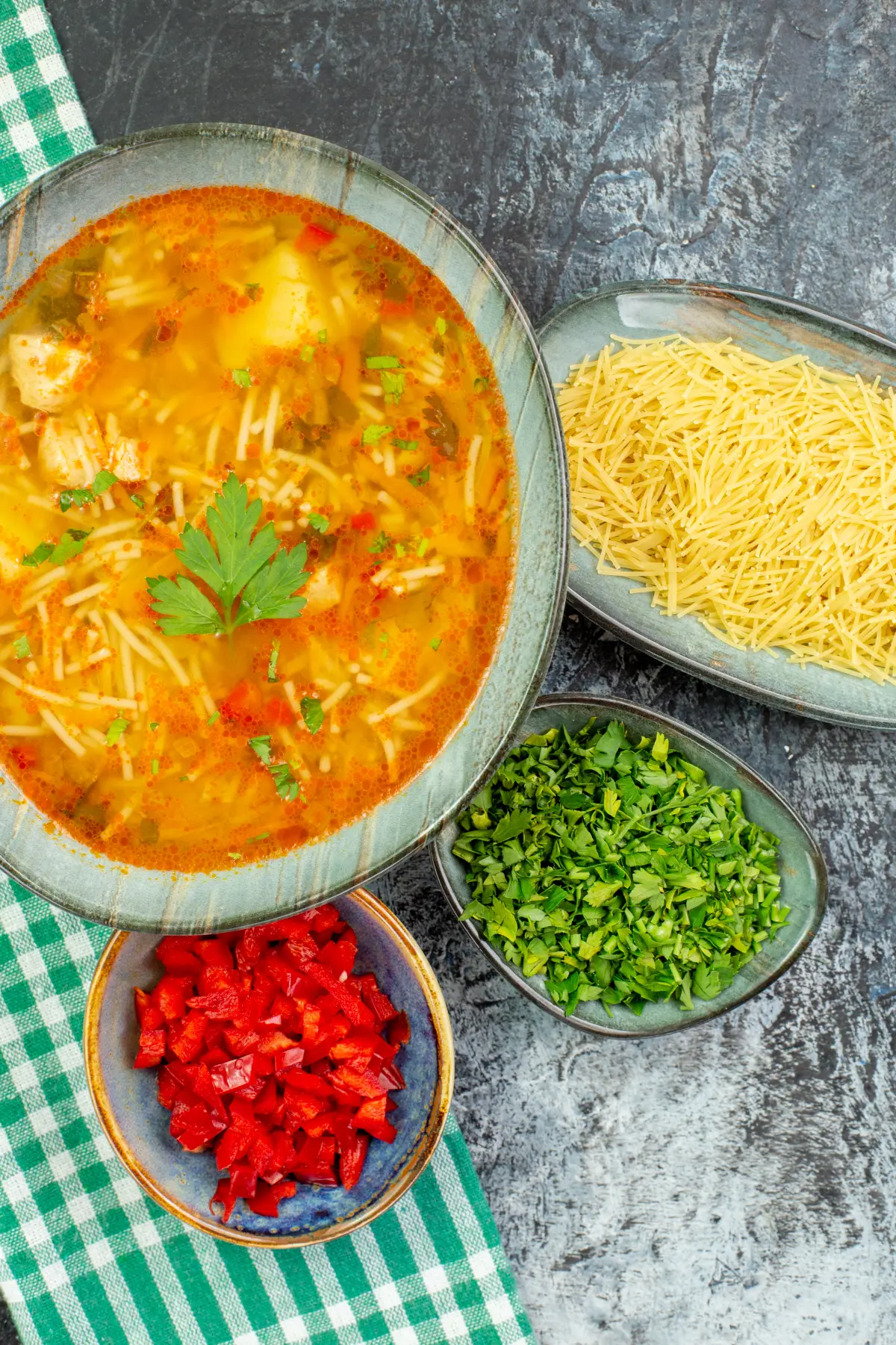

Fideo (fee-DEH-oh) is the Spanish word for a short, very thin wheat noodle, and sopa de fideo is the soup Mexican home cooks make with it on an ordinary weekday: the noodles are toasted in a little oil until amber, then simmered in chicken stock with a fried puree of tomato, onion and garlic. Picture chicken noodle soup with a red, faintly toasty broth and lime squeezed on top. It costs about a dollar a bowl, takes 30 minutes, and the one thing that decides whether it’s good is how far you toast the noodles.
Is sopa de fideo worth making?
How do you make sopa de fideo? Toast thin fideo noodles in 2 tablespoons of oil over medium heat, stirring constantly, until evenly amber, about 5 to 6 minutes. Fry a strained puree of tomato, onion and garlic over them for 4 minutes, pour in hot chicken stock and simmer 8 minutes until the noodles are tender. Serve with lime, queso fresco and avocado. 30 minutes for 4 bowls.
Yes, especially on a weeknight. It’s a pantry soup with one technique worth learning: toasting dry pasta in oil before any liquid goes in, the same move behind Mexican red rice. The toasting gives the broth a nutty, browned-bread flavor that boiled pasta never has, and it keeps the noodles from turning the broth cloudy.
When it shines. A quick lunch or light supper, a cold evening, picky kids, or a first course before tacos or a stew. In Mexico it’s the sopa aguada, the brothy soup that opens the main meal of the day.
When to skip it. If you want a high-protein one-bowl meal: a plain bowl has 17 g of protein and is mostly pasta. If you’re cooking on Sunday to eat on Wednesday without any extra step, because the noodles drink the broth overnight (there’s an easy fix below). And for gluten-free diets, unless you use rice or gluten-free noodles.
Real time and difficulty. 30 minutes start to finish, about 22 of them hands-on. Easy, with one moment that needs your full attention: the 6 minutes of toasting.
What you need, and what to buy in a US or UK supermarket
Exact amounts are in the recipe card: 7 oz (200 g) of noodles, 14 oz (400 g) of tomatoes, a quarter of an onion, a garlic clove, 2 tablespoons of oil and 1.5 liters (6⅓ cups) of stock for 4 deep bowls. Nothing on the list needs a specialty store.
The noodles
Mexican fideo comes in 7 oz (200 g) bags, sold by number: No. 0 is the thinnest and No. 2 slightly thicker. In the US, those bags sit in the Hispanic foods aisle of most supermarkets. If you can’t find them, angel hair or thin vermicelli, broken into 1 inch (2.5 cm) pieces inside the bag so they don’t fly across the kitchen, does the same job. Angel hair is a little finer than fideo, so it toasts about a minute faster; watch the color.
In the UK, look for vermicelli nests in the pasta aisle or Spanish fideos in a Spanish deli. Skip the thick fideos sold for fideuà, which take twice as long and don’t give the same delicate soup.
Tomatoes
Use ripe Roma (plum) tomatoes; they blend thicker and less watery than salad tomatoes. Out of season, a 14 oz (400 g) can of whole tomatoes is the better choice: the broth comes out darker and slightly sweeter. Tomato passata works too, 1 cup (240 ml), no straining needed. Avoid jarred pasta sauce, which brings its own herbs and sugar.
Stock, and the bouillon sodium trap
A common shortcut is water and a spoonful of chicken bouillon powder. It works, but here’s what it does to the salt, using USDA SR Legacy data for 375 ml (about 1½ cups) of liquid, which is one bowl’s worth:
| Stock | Sodium per bowl, stock only | Notes |
|---|---|---|
| Low-sodium canned chicken broth | about 110 mg | add salt to taste |
| Homemade chicken stock | about 540 mg | the recipe’s ½ tsp salt adds 290 mg |
| Reduced-sodium carton broth | about 870 mg | skip the added salt |
| Regular carton or canned broth | about 1,390 mg | skip the added salt |
| Bouillon powder or cubes, made up with water | about 1,500 mg | skip the salt and taste first |
Homemade stock also brings body: compared with bouillon, each bowl gets about 8 g more protein and 120 more calories from the chicken. If you have an afternoon, a pot of caldo de pollo with corn and chayote leaves enough extra stock for two batches of this soup, and it freezes well.
Equipment
A heavy 3 quart (3 liter) pot, a flat spatula that reaches the corners, a blender and a fine sieve. A second pot for the stock is optional but saves time. No blender? Grate the tomatoes on the coarse side of a box grater, cut side first, and mince the onion and garlic; the broth is a bit more rustic. No sieve? Blend longer; a few flecks of skin won’t hurt anyone.
How to plan it, and what each stage should look like
The order. Stock on to heat. Blend and strain. Oil and noodles in the pot, and from then on you stay put. Puree, then stock. During the last 8 minutes, set out the lime, cheese and avocado.
Toasting the noodles, and the color to stop at
With only 2 tablespoons of oil for 7 oz (200 g) of noodles, you aren’t frying them, you’re toasting them, so keep them moving so every strand touches the pan. On my stove, over medium heat:
| Minute | What you see | What it means |
|---|---|---|
| 0 | white, dry | raw |
| about 2 | opaque, ivory | not there yet: pale, starchy soup |
| about 4 | light gold, smells toasty | close |
| 5 to 6 | even amber | stop here |
| about 8 | dark brown strands | bitter; start over |
A pale noodle releases starch and makes the soup cloudy and slightly gummy. A burnt one makes the whole pot bitter, and nothing fixes that. If only a few strands go dark, pick them out before the puree goes in; if it’s half the pot, toast a fresh batch. The noodles are the cheapest thing in the recipe.
How much noodle to broth
This recipe uses 7 oz (200 g) of noodles for 1.5 liters (6⅓ cups) of stock, plus about 2 cups of tomato puree, roughly 130 g per liter. That gives a properly brothy soup. For a lighter first course, use 5 oz (150 g) of noodles. For a thicker, spoon-friendly soup for kids, keep 7 oz and cut the stock to 1.2 liters (5 cups). Much less than 1 liter (4 cups) and the noodles absorb nearly everything; that’s fideo seco, a different, drier dish.
Scaling it up
| Servings | Noodles | Tomatoes | Onion | Oil | Stock | Pot |
|---|---|---|---|---|---|---|
| 4 | 200 g (7 oz) | 400 g (14 oz) | 60 g (2 oz) | 2 tbsp | 1.5 L (6⅓ cups) | 3 qt (3 L) |
| 8 | 400 g (14 oz) | 800 g (1¾ lb) | 120 g (4 oz) | 4 tbsp | 3 L (12⅔ cups) | 5 qt (5 L) |
| 12 | 600 g (1⅓ lb) | 1.2 kg (2⅔ lb) | 180 g (6 oz) | 6 tbsp | 4.5 L (4¾ qt) | 8 qt (8 L) |
| 20 | 1 kg (2.2 lb) | 2 kg (4.4 lb) | 300 g (10½ oz) | 10 tbsp | 7.5 L (8 qt) | 12 qt (12 L) or two pots |
For more than 8, toast the noodles in batches of 14 oz (400 g): with 2 lb in one pot, the bottom layer burns before the top one colors. Once the pot holds more than about 4½ liters, the final simmer runs a little longer, closer to ten minutes.
What you can do ahead
The strained puree keeps in a covered jar in the fridge until the next day, and the stock can be made days ahead and frozen. The noodles can’t be toasted ahead; they go soft and lose the toastiness. With puree and stock ready, it’s a 15 minute soup.
Before you start, mistakes, heat, kids and allergens
The mistakes that matter.
- Cloudy, gummy soup → the noodles weren’t toasted enough. Go to amber next time.
- Bitter soup → the noodles went brown. No fix; start the noodles again.
- No broth left the next day → the noodles kept absorbing. Store them separately (see below), or add ½ cup (120 ml) of stock per bowl when reheating.
- Pale, watery broth → the puree wasn’t fried. Give it the full 4 minutes until brick red; if it’s too late, simmer uncovered 5 minutes more.
- Noodles stuck to the bottom → the heat was too high. Medium heat and a flat spatula.
Heat level, 0 out of 5. The base soup isn’t spicy. Chopped serrano or jalapeño goes on the table, or simmer a whole serrano in the broth and pull it out for a gentle warmth. One chipotle in adobo blended with the tomatoes makes it smoky and genuinely hot.
For kids. Use the thinnest noodles or alphabet or star pasta, toasted the same way (elbows work too, and the rest of the bag makes a creamy Mexican macaroni salad), skip the chili and lime, make it thicker with 1.2 liters (5 cups) of stock, and use homemade or low-sodium stock with no added salt. A spoonful of crumbled cheese or shredded chicken adds some protein.
Allergens. Wheat (gluten) from the noodles. Store-bought broth and bouillon can contain celery, soy or milk depending on the brand (celery is a declared allergen in the UK), so read the label. Cheese and sour cream add dairy at the table.
Which version should you make?
- Short on time → canned tomatoes or passata and ready-made stock, no straining: 20 minutes. With bouillon, hold the salt.
- Vegetarian or vegan → vegetable stock, or water with an extra 3½ oz (100 g) of tomato; no cheese makes it vegan. It’s lighter and tangier; a drizzle of olive oil at the end rounds it out.
- Lighter → 1 tbsp of oil instead of 2 (it toasts faster, so watch it) and no added salt: about 31 calories and 290 mg sodium less per bowl.
- More filling → stir in 5 oz (150 g) of shredded chicken or browned ground beef when the stock boils. Leftover Mexican picadillo works too.
- Smoky → one chipotle in adobo blended with the tomatoes.
How much it costs
With homemade stock made from chicken legs, the pot comes to about $4.35, or $1.09 a bowl, using BLS US city average prices for August 2026 (bone-in chicken legs $1.670/lb, field-grown tomatoes $1.977/lb, spaghetti and macaroni $1.374/lb) and USDA AMS retail data for the onion. Oil, garlic, salt and toppings are left out. With bouillon instead of chicken, the cost drops by almost half and the sodium nearly triples, as the table above shows. In the UK the same basket is a supermarket-basics shop; I don’t have an official price series to quote.
Yield. 4 deep bowls of about 450 ml (2 cups) as a light main, or 6 cups as a first course.
What to expect, how to serve it and how to store it
Taste and texture. A light, orange-red broth that tastes of fried tomato and chicken with a toasty background, and soft noodles in separate strands. Lime adds the sour note, queso fresco the salty one.
How it’s served. Piping hot in a deep bowl, with lime, crumbled queso fresco, avocado and chili on the table; some families add a spoonful of crema or sour cream. In a full Mexican midday meal it comes first, followed by rice (Mexican red rice is the classic), then a main dish with refried beans and tortillas. If you like this, Mexican tortilla soup builds on a similar tomato broth with pasilla chile. To drink, agua de jamaica.
Why leftovers turn into a noodle block. Cooked pasta keeps absorbing liquid as long as it sits in it, fridge included. By the next day the broth is mostly gone. The fix is to strain the noodles out of the leftover broth while it’s still warm and store them in separate containers.
Fridge. Leftovers, according to USDA FSIS, go into the fridge within 2 hours, kept at 40 °F (4 °C) or below, and eaten within 3 to 4 days. Shallow containers, under 3 inches (7.5 cm) deep, cool fastest.
Freezer. The tomato broth without noodles freezes well for 2 to 3 months. Frozen cooked noodles come back soft and broken, so toast a fresh 7 oz (200 g) when you thaw the broth; it’s 15 minutes.
Reheating. Bring the broth to a boil and add the stored noodles for the last minute, just to heat through. If everything was stored together, add ½ cup (120 ml) of stock or water per bowl, heat over medium and bring it to a boil, which covers the FSIS guideline of 165 °F (74 °C). In the microwave, covered, in 1 minute bursts, stirring in between.
Sopa de fideo FAQ
What is fideo? A short, very thin wheat noodle used in Mexican and Spanish cooking, similar to angel hair or vermicelli cut into 1 inch (2.5 cm) pieces. In the US it’s sold in small bags in the Hispanic aisle.
Can I use angel hair or spaghetti instead of fideo? Yes. Break angel hair, vermicelli or thin spaghetti into 1 inch (2.5 cm) pieces. Angel hair toasts about a minute faster; thin spaghetti is thicker and needs a couple of extra minutes of simmering, so taste a strand.
Why do you toast the noodles first? For flavor and texture. Toasting gives the broth a nutty, browned flavor and makes the noodles release less starch, so the soup stays clear and the strands stay separate.
How do I know the noodles are toasted enough? When every strand is an even amber and the pot smells like toast. Over medium heat that takes me five or six minutes. Dark brown strands mean they’ve gone too far.
Is sopa de fideo the same as chicken noodle soup? Close in spirit, different in flavor. The noodles are toasted before cooking, the broth is built on fried tomato, onion and garlic, and it’s finished with lime and cheese rather than carrots and celery.
Why does my leftover fideo soup have no broth? The noodles keep absorbing it in the fridge. Store noodles and broth separately, or add ½ cup (120 ml) of stock per bowl when you reheat.
Can I freeze sopa de fideo? Freeze the tomato broth on its own, for up to three months, and toast fresh noodles when you reheat it.
Is sopa de fideo good for kids? It’s mild, not spicy and easy to eat with a spoon. Use low-sodium or homemade stock with no added salt, and the thinnest noodles or alphabet pasta.
Nutrition per serving
Per bowl (about 450 ml / 2 cups, without cheese, cream or avocado), calculated ingredient by ingredient from USDA FoodData Central (SR Legacy) with this recipe’s amounts, homemade chicken stock and ½ tsp of salt:
- Calories: 408 kcal
- Protein: 17 g
- Carbohydrates: 56 g, almost all from the noodles
- Fat: 13 g, of which 2 g saturated, mostly the toasting oil
- Fiber: 3 g
- Sugars: 11 g
- Sodium: 836 mg
Made with bouillon and no added salt, a bowl drops to about 290 kcal and 9 g of protein while sodium rises to about 1,510 mg. An ounce (30 g) of queso fresco adds about 90 kcal.
I grew up in Venezuela, where noodle soup meant noodles and potato in plain chicken broth, so the Mexican version took me a few tries. My mistake was fear: I pulled the noodles off the heat while they were still pale, and the soup tasted of nothing much. Now I take them all the way to amber, keep stock in the freezer for nights like this, and always strain out the noodles from whatever’s left. Josnaisis.