
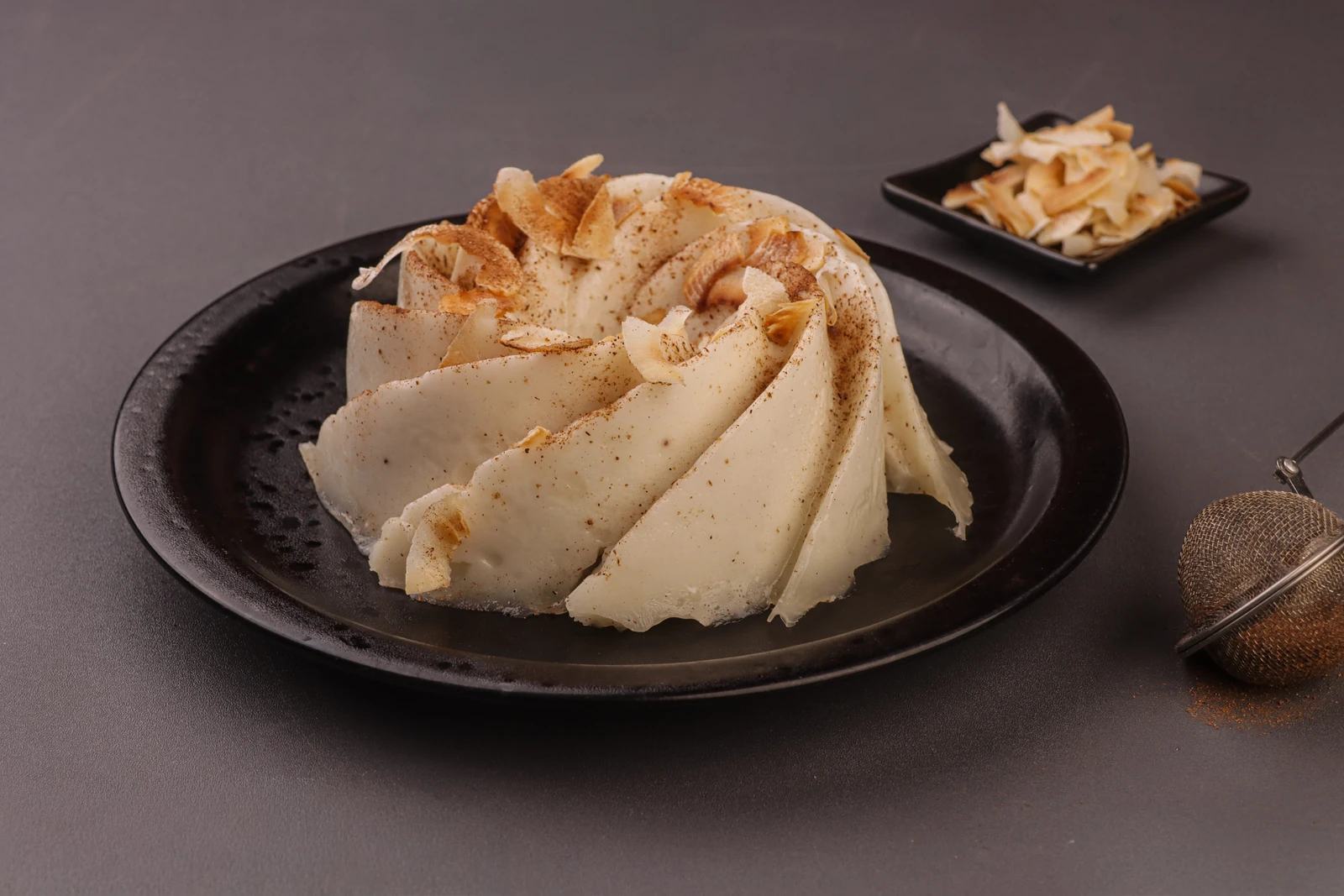

Tembleque (tem-BLEH-keh) is a Puerto Rican coconut pudding: coconut milk sweetened, thickened with cornstarch, poured into a mold and chilled until it turns out whole and trembles on the plate, which is what the name means. There’s no egg, no dairy and no oven, so it’s closer to a firm blancmange than to flan, with ground cinnamon on top instead of caramel. It’s one of the island’s Christmas desserts, served cold next to coquito, the Puerto Rican coconut eggnog. If you’ve had a tembleque that was runny or tasted floury, the fix is one small step most people skip, and it’s in the method below.
How to make tembleque
How do you make tembleque? Whisk ½ cup (64 g) of cornstarch into one can of cold coconut milk. Warm a second can with ⅔ cup (130 g) of sugar, salt and a cinnamon stick, remove the cinnamon and whisk in the cornstarch until it thickens, then let it bubble gently for 2 more minutes. Pour into a wet mold and chill at least 4 hours. 260 minutes for 8 servings.
About 20 minutes of hands-on time, then 4 hours in the fridge or overnight. Easy: the only rule is to keep whisking from the moment the cornstarch goes in.
What it tastes like, and how it compares
Cold tembleque is smooth and set at the edges, softer in the middle, and tastes of coconut and not much else, which is the point. It’s rich, because canned coconut milk is about one-fifth fat, but not very sweet.
- Flan sets with eggs, is baked in a water bath and sits under caramel. If that’s what you’re after, try the Colombian flan.
- Venezuelan majarete is its closest relative: coconut milk too, but thickened with corn flour and sweetened with raw cane sugar, so it tastes of corn and caramel and slices firmer.
- Colombian natilla is a cornstarch pudding made with cow’s milk and panela, no coconut.
Ingredients and what to buy
| Ingredient | Metric | US | UK and shopping notes |
|---|---|---|---|
| Coconut milk, full-fat, unsweetened | 800 ml | two 13.5 fl oz cans | Standard 400 ml cans in the world foods or Asian aisle |
| Cornstarch | 64 g | ½ cup, spooned in, not packed | Called cornflour in the UK |
| Granulated sugar | 130 g | ⅔ cup | Caster sugar works the same |
| Salt | 1.5 g | ¼ tsp | |
| Cinnamon stick, lime or lemon peel | 1 each | 1 each | The peel is optional |
| Ground cinnamon | 2.6 g | 1 tsp | For the top |
The batch makes about 3½ cups (850 ml), eight servings of a little over 3½ fl oz (105 ml).
Coconut milk, coconut cream or cream of coconut
These three cans sit side by side and they aren’t interchangeable.
- Coconut milk, canned, full-fat. The one in the recipe. The fat rises and goes solid in the can, so shake it hard before opening or whisk the contents in a bowl until smooth. Light coconut milk makes a softer, less creamy pudding.
- Coconut milk in a carton, the drink sold next to almond milk. Don’t use it: it has about a tenth of the fat, and the pudding comes out watery.
- Cream of coconut (Coco López and similar, the sweet syrup for piña coladas). Far too sweet to swap one for one; it has its own version below, with whole milk.
- Coconut cream, unsweetened, or the UK creamed coconut block. Neither is in the classic recipe. Stick to coconut milk.
How much cornstarch, depending on the mold
For the 800 ml (two cans) of coconut milk in the recipe:
| Cornstarch | Texture | Use it for |
|---|---|---|
| ¼ cup (32 g) | Spoonable cream, won’t unmold | Glasses or cups |
| ½ cup (64 g), this recipe | Unmolds whole and wobbles | Ramekins or a 1-quart (1 liter) mold |
| ½ cup + 1 to 2 tbsp (72 to 80 g) | Firmer, slices cleanly | A tall or bundt-style mold, or a warm buffet table |
I stop at 80 g. Past that it turns pasty and tastes of starch. Cornstarch packs down in the bag, so spoon it into the cup and level it rather than scooping, or weigh it.
Equipment. A heavy 2-quart (2 liter) saucepan, a whisk, a wooden spoon or silicone spatula, and the mold. Silicone molds release almost on their own. Disposable foil pans tend to stick and leave marks, so serve straight from those. No ramekins? An 8 × 8 in (20 × 20 cm) dish gives 9 squares.
Step by step, and the 2 minutes that make it set
- Cold cornstarch. Whisk it into one can of coconut milk that’s cold or at room temperature. Hot liquid cooks the outside of each clump instantly and seals dry powder inside, and those lumps won’t whisk out.
- Warm the second can with the sugar, salt, cinnamon and peel for about 5 minutes, until it steams. Fish out the aromatics.
- Stream in the cornstarch while whisking, over medium heat. For the first few minutes nothing seems to happen, then it thickens almost all at once.
- Keep going for 2 minutes. Drop to medium-low, swap the whisk for a spoon and let it bubble gently. The bubbles are thick and spit, so mind your hand. It’s done when it goes from matte white to glossy and a line drawn across the bottom of the pan fills in slowly.
That last step is where most runny tembleques come from. When the mixture first thickens, the starch hasn’t finished swelling: pulled off the heat then, it tastes raw and sets weak. Two minutes of gentle bubbling finishes it. Cooking it much longer, or whisking hard once it’s thick, breaks the starch down and thins it again, so stir slowly.
How long it takes to set
Pour it while it’s still fluid into the mold you rinsed with cold water; the film of water helps it release. Leave it on the counter until it stops steaming, 20 minutes or so, then press plastic wrap onto the surface so no skin forms, and refrigerate.
- 4 fl oz (120 ml) ramekins: 3 to 4 hours.
- 1-quart (1 liter) mold: at least 4 hours, better overnight. The bigger the mold, the longer the center takes.
Don’t speed it up in the freezer. The outside firms, the middle stays liquid, and it slumps when you turn it out.
Unmolding in one piece
Run the tip of a thin knife around the edge, about ½ in (1 cm) down, to let air in. Put the serving plate upside down on the mold, flip both and give a gentle shake. If it doesn’t drop, dip the mold in hot water for 5 seconds, no longer, or the surface melts and looks wet. Dust with cinnamon at the table.
Why tembleque doesn’t set, and other fixes
- It didn’t set. Usually the heat went off as soon as it thickened, without the 2 minutes of bubbling. Other causes: too little cornstarch for the mold, light or carton coconut milk, or under 4 hours of chilling. Still soft after 6 hours? Scrape it back into the pan, add 1 tbsp (8 g) cornstarch whisked into 2 tbsp cold water, bring it back to a bubble for 2 minutes while whisking, and pour it into the mold again. That only works if it has stayed in the fridge the whole time, and the texture ends up a little less silky than a first-time set. If it sat out for more than 2 hours, throw it away.
- It’s lumpy. The cornstarch hit hot liquid, or the whisking stopped. Take the pan off the heat and whisk hard for 30 seconds. Whatever’s left, push the hot mixture through a fine sieve straight into the mold.
- It tastes floury. Not cooked long enough after thickening, or too much cornstarch.
- It’s gummy or pasty. More than 80 g of cornstarch for two cans, or cooked down too far.
- It cracked or collapsed when unmolded. Turned out too soon, or it went in the freezer. For tall molds, use 72 to 80 g of cornstarch.
- It tastes scorched. The bottom caught. Don’t scrape: pour the top into a clean pan and finish it there.
- A little liquid on day three. Normal for a cornstarch pudding. Pour it off; if it’s been kept cold, it’s fine.
Allergens and kids. No egg, dairy or gluten in the recipe as written, so it suits dairy-free guests. It does contain coconut, which some people are allergic to. It isn’t spicy, and kids generally like it; at about 16 g of sugar per serving, small ramekins are a better size for them.
Variations
- With cream of coconut and whole milk. One 15 oz (425 g) can of cream of coconut, 1⅞ cups (450 ml) whole milk, ½ cup (64 g) cornstarch, ¼ cup (50 g) sugar and a pinch of salt. Dissolve the cornstarch in a cup of the cold milk and follow the same method. It’s sweeter and milkier, with less coconut flavor, and needs 8 hours to set. About 280 kcal and 37 g sugar per serving, and it’s no longer dairy-free.
- Lighter. Use one can of coconut milk plus 1¼ cups (300 ml) water instead of two cans, with the same cornstarch, sugar and salt. It’s less creamy and more jelly-like, at about 190 kcal a serving.
- Orange blossom water. Replace the citrus peel with 1 tsp orange blossom water, stirred in off the heat. It’s strong; don’t add more.
- Fresh coconut milk. One 2¼ lb (1 kg) coconut gives about 14 oz (400 g) of meat. Blend it for 2 minutes with 3⅓ cups (800 ml) hot water and squeeze it through a cloth to get about 800 ml. It tastes fresher and comes out whiter, but sets a little softer, so add 1 tbsp (8 g) extra cornstarch.
- No cornstarch. Arrowroot or tapioca starch set it at the same weight, 64 g, though the texture shifts a little. Try it in ramekins first.
- Vanilla or toasted coconut. 1 tsp vanilla extract off the heat, or toasted shredded coconut on top.
Scaling. For 12, multiply by 1½: 1.2 liters (three cans), 96 g (¾ cup) cornstarch and 195 g (1 scant cup) sugar, in a 3-quart pan. For 16, double it and use two 1-quart molds; it takes a minute or two longer to thicken, and your arm will know.
Make ahead and storage
Make ahead. Make it the day before and leave it in its mold, covered, until you serve. It turns out cleaner after a night in the fridge.
Fridge. Into the fridge within 2 hours of cooking, then 3 to 4 days, covered, at 40°F (4°C) or below. If it’s already unmolded, press plastic wrap onto it so the surface doesn’t dry out. On the table, no more than 2 hours.
Freezer. No. Freezing breaks the starch, and it thaws spongy, grainy and watery.
Serving. Cold, unmolded, with cinnamon. At a Puerto Rican Christmas it comes after a plate of Puerto Rican pasteles, with small glasses of coquito alongside.
FAQs
Does tembleque have eggs or milk? The classic one doesn’t: just coconut milk, cornstarch, sugar and salt. The cream of coconut version above adds cow’s milk, but none has eggs.
Can I use a 15 oz can of coconut milk? Yes, but check what you actually have, because “15 oz” on a can is often the weight, not the volume. Pour both cans into a measuring jug: if they come to about 3¾ cups (900 ml), roughly 10% more than this recipe, add 1 tbsp (8 g) extra cornstarch to keep the same set; if it is close to 800 ml, make the recipe as written.
Why is my tembleque gray or off-white? Some brands of canned coconut milk are grayer or more yellow than others. It’s the can, not your cooking. Fresh coconut milk gives the whitest result.
Can I make it less sweet? Yes, you can cut the sugar to about ½ cup (100 g). It will taste more of coconut.
Nutrition per serving
Per serving, one-eighth of the batch (about 3½ fl oz / 105 ml), calculated ingredient by ingredient with full-fat canned coconut milk:
- Calories: 280 kcal
- Protein: 2 g
- Carbohydrates: 27 g, of which 16 g sugars
- Fat: 20 g, of which 18 g saturated
- Fiber: 0 g
- Sodium: 86 mg
The coconut milk accounts for about 180 kcal a serving and nearly all the fat. Brands vary a lot in fat content, so yours may come in a little higher or lower.
I make mine in silicone ramekins the night before, even though 4 hours is enough, so there’s no rush to unmold and they come out of the fridge right before dessert. Coming to it from Venezuelan majarete, what surprised me was how little it asks for: four ingredients, one pan, and two minutes of bubbling that look unnecessary and aren’t. Josnaisis.