
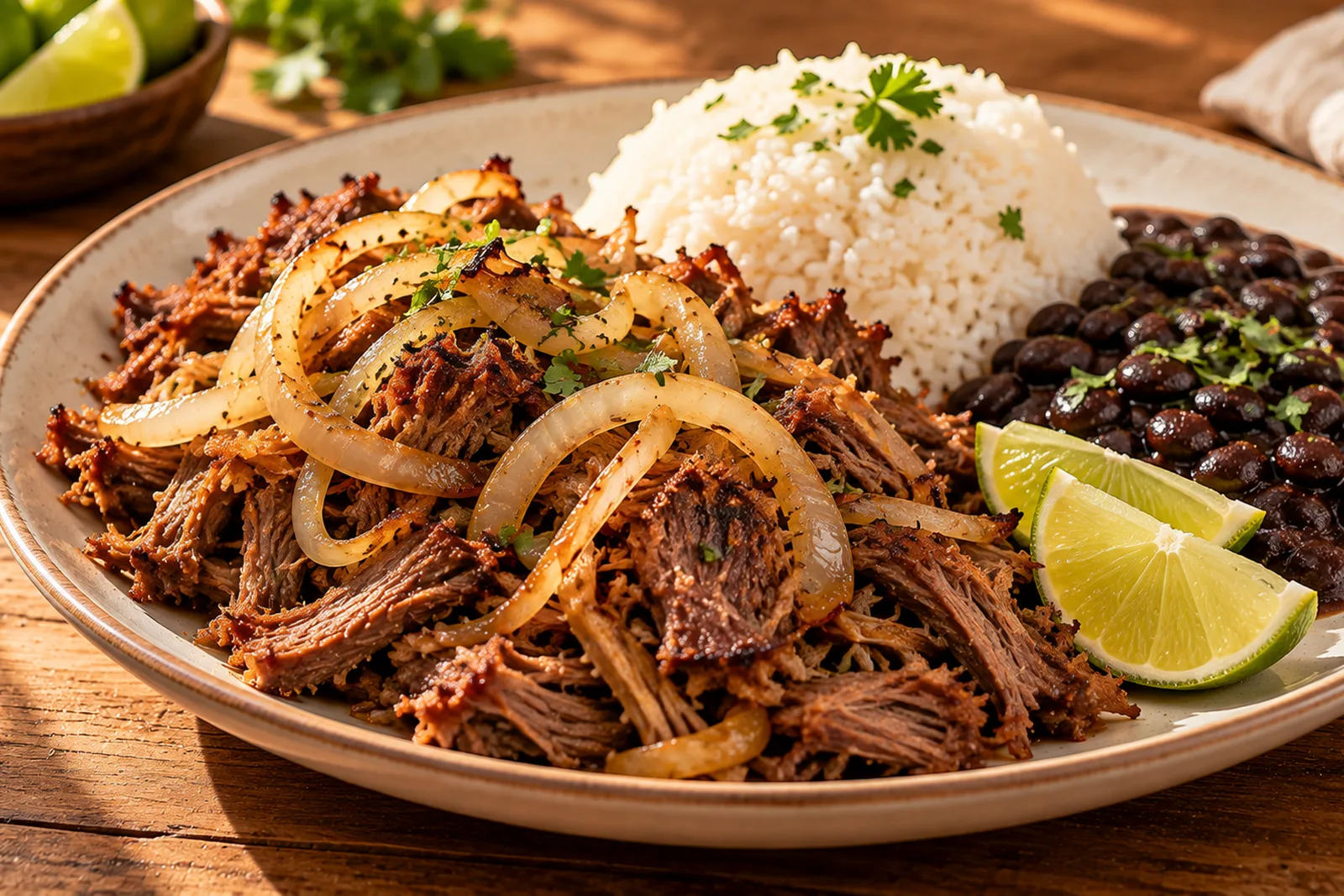

Vaca frita (VAH-kah FREE-tah, “fried cow” in Spanish) is Cuban crispy shredded beef: flank steak simmered for 2 hours until it falls apart, pulled into thin shreds, tossed in sour orange juice and garlic, then fried in a very hot skillet until the edges turn brown and brittle. It’s served under a heap of soft onions with rice, black beans and plantains, and a lime wedge to squeeze over. Whether it crisps or turns limp comes down to two things, dry beef and a pan that isn’t crowded, and both are covered below, along with what to buy in a US or UK supermarket and how to split the work over two days.
What vaca frita is, and how it differs from ropa vieja
How do you make vaca frita? Simmer 2¼ lb (1 kg) of flank steak for 2 hours in water with onion, garlic and bay leaf, or 45 minutes under pressure, then shred it and let it air-dry for 10 minutes. Marinate it 30 minutes in ½ cup (120 ml) of sour orange juice with garlic and salt, squeeze it dry and fry it in two batches in a very hot skillet, 4 to 5 minutes untouched and 3 to 4 on the other side. Toss with golden onions. 190 minutes for 4 servings.
It tastes beefy, garlicky and sharp, with crunchy, almost charred tips and juicy strands underneath. There’s no tomato, no sauce and no chile heat.
Two shredded beef dishes on this site start the same way and end up very different:
- Cuban ropa vieja uses the same simmered flank, but stews it in tomato with strips of bell pepper, cumin and dry cooking wine. It’s saucy and soft; vaca frita is dry and crisp.
- Colombian shredded beef is stewed in a chopped tomato and onion hogao with annatto, and mostly goes into arepas and empanadas.
Time. 3 hours 10 minutes start to finish, about 45 of them hands-on; the beef spends 2 hours on its own in the pot. With the beef cooked the day before, dinner is 1 hour. Easy. The frying is the only part that needs your attention.
Ingredients and what to buy
This makes 4 servings from 2¼ lb (1 kg) of raw flank, which gives about 1½ lb (650 g) once simmered and shredded. It loses more moisture in the pan, so these are generous plates; with rice, beans and plantains it stretches to 5. For 8, double everything and fry in 4 batches.
| Ingredient | Metric | US | UK |
|---|---|---|---|
| Flank steak | 1 kg | 2¼ lb, any supermarket | Ask a butcher for flank, often sold as bavette |
| Sour orange juice | 120 ml | ½ cup, fresh or bottled in the Latin aisle | Seville oranges in January, or orange plus lime |
| White onions | 400 g | 2 large | 2 large white or brown onions |
| Garlic | 18 g | 6 cloves | 6 cloves |
| Neutral oil | 54 g | 4 tbsp canola or vegetable | 4 tbsp rapeseed or sunflower |
Flank, skirt or chuck
- Flank steak, as written. Long, clear fibers that pull into thin shreds, and thin shreds are what crisp. It’s lean, so overfrying turns it into tough threads.
- Skirt steak. Similar grain, a little fattier and pricier. Simmer it like flank but start checking at 1½ hours.
- Chuck roast (UK braising steak). Juicier and usually cheaper. The shreds are shorter and thicker and crisp less. Give it 2½ hours in the pot.
Cut the steak across into pieces about 4 in (10 cm) wide before simmering. The strands come out as long as the piece, so they don’t tangle in the pan. The beef is the expensive part, and chuck is the way to bring the cost down; the trade-off is texture, not flavor.
Sour orange, and what to use instead
Sour orange (naranja agria) is the citrus behind Cuban mojo: as tart as a lemon, with an orange perfume. In the US it’s sold fresh in Latin markets and bottled in the Hispanic aisle; if you use bottled, check the label for salt before salting the beef. In the UK, the same fruit is the Seville orange, in shops for a few weeks around January.
- Orange plus lime. Two parts orange juice to one part lime, ⅓ cup (80 ml) and 2½ tbsp (40 ml). The closest match, and what I use most of the year.
- Lime only. Also traditional, sharper and without the orange aroma. Start with ¼ cup (60 ml) instead of ½ cup and taste: lime on its own is much more acidic.
Equipment. A 5-quart (5-liter) pot for the beef and an 11 to 12 in (28 to 30 cm) skillet, ideally cast iron or heavy stainless, which holds its heat when the beef goes in. Nonstick works but browns more slowly. A colander for draining the marinade.
How to make vaca frita, step by step
Simmer until the beef falls apart
Water to cover, onion, garlic, bay leaf and salt, a gentle simmer, lid on, for 2 hours. It’s ready when a fork slides in with no resistance and a piece pressed against the side of the pot falls into strands. At 1½ hours flank is cooked but breaks into chunks: give it another 20 to 30 minutes.
Strain the leftover broth, about 6 cups, and use it within 3 to 4 days for cooking rice or soup, or freeze it.
Shred thin, then let it dry
Shred the beef while warm, along the grain, as thin as you can: more surface means more crunch. Spread it on a sheet pan for 10 minutes, uncovered. You’ll see steam rising; when it stops, the surface is dry. It’s the step people skip, and you can taste the difference.
A short marinade, 30 minutes
Garlic paste, sour orange, salt, pepper and cumin get tossed through the beef by hand so every strand is coated. 30 minutes is enough, because cooked beef soaks it up quickly. Cook the onions while it sits.
Then squeeze the beef dry in a colander and save the juice for the end. If the marinade goes into the pan with the beef, the beef simmers in it and never browns.
Fry in two batches, and don’t stir
This is the step that makes the dish:
- Very hot pan. High heat, oil shimmering before the beef goes in. If a test shred doesn’t sizzle hard, wait.
- Half the beef, thin layer. A full pan drops in temperature, the beef releases water and steams. With 2¼ lb (1 kg) of flank in an 11 in (28 cm) skillet, that’s two batches.
- Press and leave it. Flatten it with a spatula and don’t touch it for 4 to 5 minutes. At the edges you’ll see the shreds go from grey to dark brown; lift a corner, and it should be browned and stiff.
- Turn it in sections and fry 3 to 4 minutes more. A few nearly black tips are what you want; the middle of the layer stays juicy.
Keep the first batch on a sheet pan, uncovered: covered, it sweats and goes soft. At the end everything goes back in with the onions and 2 tbsp of the reserved juice for 1 minute over high heat, just enough for the citrus to come through without wetting the beef.
Make-ahead plan and the Instant Pot
| Plan | When | What you do | Time on the day |
|---|---|---|---|
| All on the day | 3 hours ahead | Simmer, shred, marinate, fry | 3 hr 10 min, 45 hands-on |
| Instant Pot or pressure cooker | 2 hours ahead | 45 minutes at high pressure, 15-minute natural release | about 2 hours |
| Day before | The day before | Simmer and shred; refrigerate the beef in a sealed container, without the marinade | 1 hour: marinade, onions, frying |
The simmered, shredded beef keeps in the fridge for up to 2 days before frying. Straight from the fridge it’s drier and browns better, which is why the day-before plan is my favorite. Add the marinade when you take it out, not the night before.
Leftover pot roast or soup beef. If you simmered flank or chuck for soup, it works as is: 1½ lb (650 g) cooked beef equals this recipe. Start at the shredding step.
Why vaca frita goes wrong, and how to fix it
- Grey and soft, not brown. Wet beef or a crowded pan. Squeeze it in the colander, blot it, fry in batches.
- Sticks and breaks into crumbs. It was moved too soon. Wait out the 4 to 5 minutes; once the crust has formed, it releases on its own.
- Tough, stringy shreds. Undercooked in the pot or overfried in the pan. If it resists when you shred it, put it back in the broth for 20 minutes; in the skillet, take it off as soon as both sides are browned.
- Too sour. Too much lime or bottled sour orange. With lime only, use half; if you’ve overdone it, more golden onion balances it.
- Bitter garlic. It burned in the pan. Crush it to a paste rather than leaving pieces, and if the shreds darken too fast, drop to medium-high.
- Too salty. Salted bottled sour orange, or beef simmered in very salty water. Taste before adding the ½ tsp in the marinade.
Heat, kids and allergens. Not spicy. Kids tend to like it for the crunch; for them, go lighter on garlic and lime. No gluten, dairy, egg or nuts; check the label on bottled sour orange.
Variations, from chicken to a crowd
- Chicken vaca frita. Simmered, shredded chicken thighs or breast, the same marinade and the same frying. It’s milder and browns faster, so watch it from the first minute. Thighs stay juicier than breast.
- With green pepper. Some cooks brown 1 green bell pepper in strips with the onions. It adds sweetness and pushes it toward a stir-fry; still no sauce.
- For 8 to 12. Simmer the beef in one big pot, same timing. The skillet is what doesn’t scale: fry in batches of about ¾ lb (325 g) cooked beef, or use two pans at once, and bring it all together with the onions at the end.
- Not from leftover ropa vieja. Ropa vieja is already stewed in tomato, and that sauce sticks and burns before the beef browns. For vaca frita, the beef should be simmered in plain water only.
What to serve with vaca frita, storing and reheating
Serve. The usual plate is fluffy white rice, black beans and fried sweet plantains. For the beans, Venezuelan black beans work well, and for the plantains, fried sweet plantains. For rice and beans cooked together, serve it with Cuban congrí; instead of sweet plantains, crispy tostones, or boiled yuca with garlic and sour orange mojo. Allow about 1 cup of cooked rice per person and put the lime wedges on the table. As a starter, a few just-fried Cuban ham croquettes open the meal. For dessert, a tray of Cuban guava and cream cheese pastries with strong coffee keeps the whole meal Cuban.
- Fridge. Into a sealed container within 2 hours, then 3 to 4 days at 40°F (4°C) or below. It won’t be as crisp the next day, but a hot pan brings it back.
- Freezer. Freeze the beef simmered and shredded, not fried, in flat bags, for 2 to 3 months. Thaw it overnight in the fridge, dry it well and start from the marinade. Fried vaca frita freezes too, but loses its crunch.
- Reheating without drying it out. Skillet over medium heat with 1 tsp oil and 1 tbsp broth, covered for 1 minute so it heats through; then uncover, turn up the heat and leave it 2 to 3 minutes without stirring, until it browns again and reaches 165°F (74°C). The microwave makes it soft and chewy.
Frequently asked questions
Why isn’t my vaca frita crispy? Almost always water: beef that wasn’t squeezed or dried, or too much in the pan. Squeeze it, fry in two batches and don’t move it until the underside is dark.
Can I marinate the raw steak instead? Some cooks rub the raw flank with garlic and salt for a few hours before simmering. It adds flavor, but the cooking water carries some of it away; the citrus comes through more clearly on shredded beef, as in this recipe.
Can I use a nonstick skillet? Yes. It browns more slowly, so give it 1 to 2 minutes more per side and don’t overload it; a crowded nonstick pan steams even more than cast iron.
Nutrition
Per serving (a quarter of the recipe, no rice or sides), worked out ingredient by ingredient from the quantities above:
- Calories: 566 kcal
- Protein: 55 g
- Carbohydrates: 14 g
- Fat: 32 g, of which 8 g saturated
- Fiber: 2 g
- Sugars: 6 g
- Sodium: 430 mg
The beef brings about 390 kcal a serving and the oil about 120; all of the oil is counted, even though some stays in the pan. The sodium leaves out the salt in the simmering water, which mostly stays in the broth. A cup of cooked white rice adds about 200 kcal.
At home the shredded beef I grew up with was always stewed, so vaca frita changed what I thought a pot of simmered flank could become. Now when I cook flank I keep some back, unstewed, in the fridge, and fry it the next day with plenty of onion and lime. Cold from the fridge is when it crisps best for me. Josnaisis.