
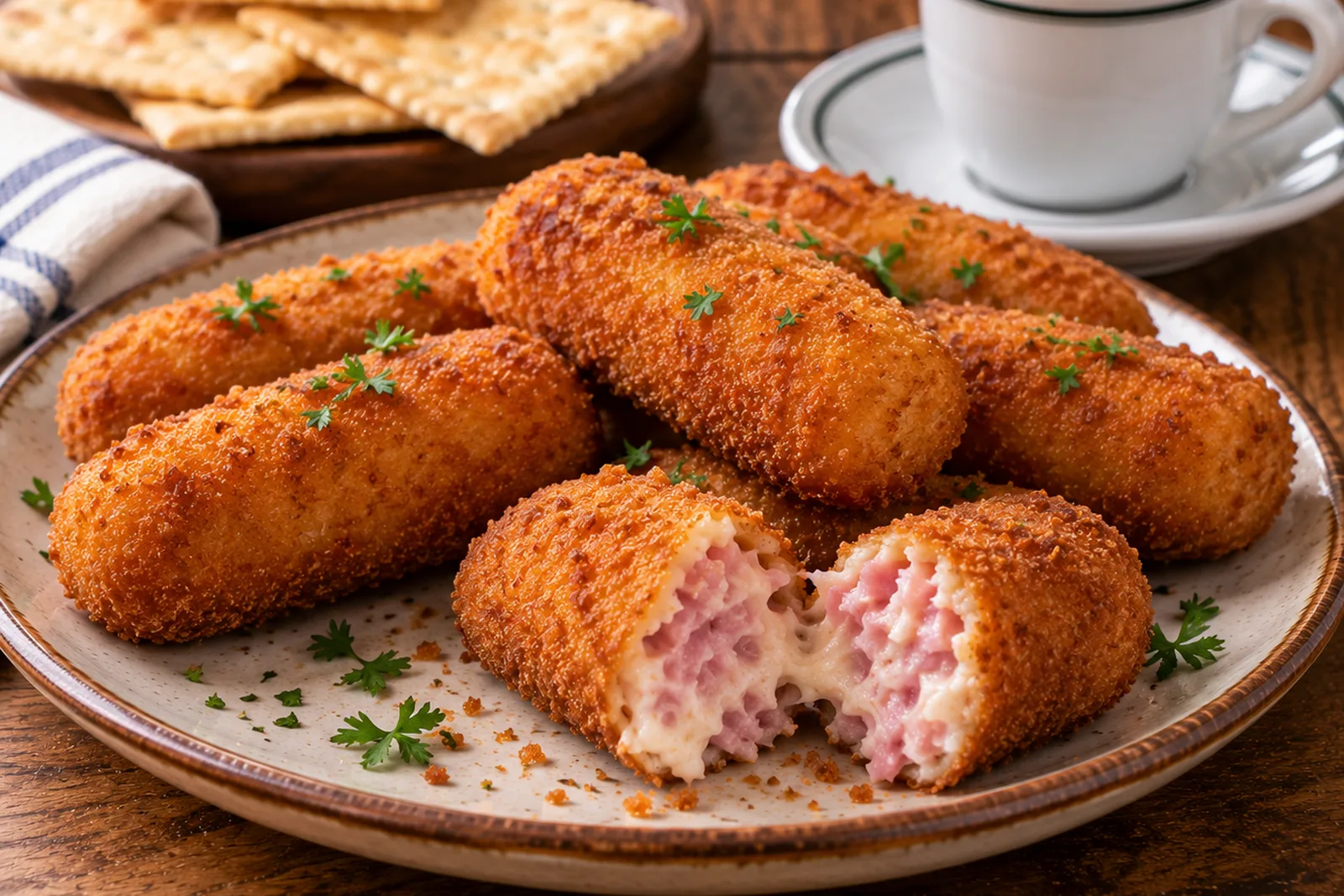

Croquetas de jamón (kroh-KEH-tahs deh hah-MOHN) are the small fried ham logs sold all day at the walk-up coffee windows of Miami’s Cuban cafés, next to the cafecito: a crisp, pale-gold shell of cracker crumbs around a soft filling of finely ground ham bound in a very thick béchamel. They aren’t the round potato croquettes you may know from a British plate, and they’re firmer than Spanish croquetas. Here’s how to make 24 of them, how thick the filling has to be, why it needs a long chill, how to fry them without a blowout, and how to freeze a batch raw for later.
What Cuban croquetas are, and how long they take
How do you make Cuban ham croquettes? Make a very thick white sauce with 4 tbsp (56 g) butter, ½ cup (65 g) flour and 1¼ cups (300 ml) milk, stir in 1 lb (450 g) of finely ground ham and cook for 5 minutes until the mixture leaves the pan in one mass. Chill it for at least 2 hours, shape 3 in (7.5 cm) logs, coat them in egg and cracker meal and fry at 355°F (180°C) for 3 to 4 minutes. 220 minutes for 8 servings (24 croquetas).
Each one is about the size of a finger. The flavor is ham, butter and a little nutmeg, with no heat at all. People in Miami buy them by the dozen for parties and eat them for breakfast pressed into bread.
Cuban versus Spanish croquetas. Spanish ham croquetas, usually made with cured Serrano ham, are round or oval and almost molten inside, because their béchamel uses far more milk for each spoonful of flour. The Cuban version uses cooked ham, more ham than sauce, ground fine, so the filling stays put even when you squash a croqueta inside a sandwich.
Time. 220 minutes, of which about 70 are hands-on: 15 for the filling, 2 hours in the fridge, 25 to shape and bread, 30 to rest, and around 30 to heat the oil and fry. Medium difficulty. The technique is easy; what takes attention is the thickness of the filling and the oil temperature.
Ingredients for 24 croquetas, and what to buy in the US and UK
This makes 24 croquetas of about 1¼ oz (35 g), three each as a snack for 8, or two each for 12 at breakfast.
The ham
- US. Cuban cooks use a cooking ham: a chunk of cooked or smoked ham, sometimes slightly sweet. Ask the deli counter for a single thick piece, or look in the Latin aisle. Leftover holiday ham, smoked or glazed, is a classic use; a very sweet glaze will make sweeter croquetas.
- UK. A thick piece of cooked ham or cooked gammon from the deli counter, not wafer-thin slices.
- Prosciutto or Serrano on their own don’t work. They’re dry and very salty. For their flavor, swap no more than a quarter of the cooked ham and skip the salt.
Grind the ham to the texture of coarse sand. Visible bits make the filling crack when you roll it, and the croqueta splits there in the oil. Ground to a paste, it turns gummy. With no food processor, a meat grinder on the fine plate or very fine chopping with a knife will do.
Cracker meal, and what to use instead
Cracker meal is finely ground saltine crackers, and it’s what gives Cuban croquetas their thin, even, light-golden crust. In US supermarkets it sits near the breadcrumbs, or in Latin shops as galleta molida.
- Saltines or soda crackers ground at home. About 6 oz (170 g), processed until no piece is bigger than a grain of rice. In the UK, plain cream crackers or water biscuits work the same way.
- Fine dried breadcrumbs. They work, but the crust comes out darker, thicker and tastes of toast.
- Panko, ground. Mixed half and half with cracker meal it gives more crunch; on its own it coats unevenly and browns faster.
The wine and the milk
Cuban cooks use vino seco, a dry cooking wine; dry sherry tastes very close. Leave it out if you’d rather not use alcohol and the filling only loses a little aroma. Use whole milk at room temperature: cold milk is more likely to form lumps in the sauce.
Equipment. A food processor, a heavy saucepan, a whisk, an 8 in (20 cm) square glass dish, a deep pot or fryer and, ideally, a deep-fry or instant-read thermometer. A slotted spoon and a wire rack.
How to make Cuban ham croquettes, step by step
The filling, until it leaves the pan in 15 minutes
The onion gets 2 minutes in the butter without browning, and the flour 2 minutes more, until the paste bubbles and smells like crackers, so the sauce won’t taste of raw flour. The milk goes in three additions while you whisk; poured in all at once, it forms lumps you won’t get out.
The sauce has to be much thicker than the one for a mac and cheese: the whisk leaves a trail that’s slow to close. Once the ham is in, 5 minutes over low heat dries it a little until it pulls off the bottom and sides of the pan as one mass. That’s the point you want. If it still clings to the bottom like mashed potatoes, keep going for another two or three minutes.
Taste before salting. Ham is already salty and it rarely needs more.
Chill it for at least 2 hours
The butter and cooked flour only set firm when cold. Warm filling flattens, sticks to your hands and bursts in the oil. Two hours minimum, overnight is better.
Spread it ¾ to 1 in (2 to 3 cm) thick so it cools quickly and evenly, and press plastic wrap onto the surface so it doesn’t form a skin. Don’t leave it on the counter longer than it takes to stop steaming. Covered in the fridge, the filling keeps up to 2 days, so it can be made a day or two before a party.
Shape and bread, ends included
Two tablespoons of filling (about 1¼ oz / 35 g) make one log 3 in (7.5 cm) long and 1 in (2.5 cm) thick. Roll it between your palms and tap the ends flat on the counter so the crumbs cover them well. Keep them all the same size so they fry in the same time.
Dip each one in egg, let it drip, then roll it in cracker meal, pressing lightly so it sticks. Check the ends: they’re the part most often left bare, and a bare patch is where the filling escapes.
Then 30 minutes in the fridge. The egg sets, the crust holds better and the croqueta goes into the oil cold.
Fry at 355°F (180°C), five at a time
Use at least 2 in (5 cm) of oil in a deep pot so the croquetas float and color evenly. Heat it to 355°F (180°C); it drops a few degrees when the batch goes in and should stay between 350 and 355°F (175 and 180°C). In 3 to 4 minutes they’re golden all over, and that’s it. The filling is already cooked: the oil only has to crisp the crust and heat the center.
No thermometer? Drop in a pinch of cracker meal: it should sizzle immediately and float. Fry one test croqueta first; if it browns in 3 to 4 minutes without splitting, the oil is right. Dark in under 2 minutes means too hot; still pale at 5, too cool.
A wire rack keeps the bottoms crisper than paper towels. They’re best straight from the oil and stay crunchy for a good while as they cool.
Why croquetas burst, and other mistakes
- They burst in the oil. Nearly always warm or soft filling, gaps in the coating, or too long in the fryer. Cold filling, crumbs on every bit of the surface, and out as soon as they’re golden.
- The filling is too soft to shape. It wasn’t cooked long enough or didn’t chill long enough. If it’s still sticky after 2 hours, leave it overnight. If that doesn’t do it, put it back in the pan over low heat and keep stirring, pressing and folding until it pulls away from the bottom in one mass again. If it’s still soft after that, work in 1 or 2 tbsp of cracker meal or fine dry breadcrumbs; go easy, because too much makes them dry.
- Dry or floury inside. Too much flour, or the sauce cooked too long. A filling that sticks slightly to your hands is better.
- Dark outside, cold inside. The oil is too hot. Drop to 350°F (175°C) and fry smaller batches.
- Greasy and pale. The oil was too cool, or too many went in at once and the temperature crashed. Five at a time, and let it recover to 355°F (180°C) between batches.
- Too salty. The ham brings plenty of salt. Don’t salt the filling until you’ve tasted it.
Allergens and heat. Contains wheat/gluten (flour and cracker meal), milk and egg. No chili heat, and most kids like them.
How to freeze them raw and fry in 4 minutes
This is the best thing about Cuban croquetas: they freeze breaded and raw, and fry with no thawing.
- Lay the breaded croquetas on a parchment-lined tray, not touching, and freeze for an hour or two, until hard.
- Move them to freezer bags, press out the air and write the date. They keep up to 3 months.
- Fry them straight from frozen at 350°F (175°C), five at a time, 3 to 4 minutes, until golden and hot in the center. Fry a single test one first and break it open: if the middle is still cold, lower the heat slightly, give it another minute, and fry the rest for that time.
Don’t thaw them first: straight from the freezer they hold their shape better in the oil.
Air fryer, in a sandwich, or for a party of 20
- Air fryer. Spray them all over with oil and cook at 355°F (180°C) for 10 to 12 minutes, turning halfway; a few minutes more from frozen. They brown, but the crust is paler and drier and less crunchy than deep-fried. It’s the best way to reheat them.
- Croqueta preparada. A Cuban sandwich with 2 or 3 just-fried croquetas squashed inside along with the ham, Swiss cheese, pickles and mustard, then pressed. On sweet, soft medianoche bread, watch it sooner, because it browns faster.
- On Cuban bread. Split a piece of Cuban bread or a soft sub roll, spread with butter or mustard, and press in 2 hot croquetas with a fork. A coffee-window breakfast.
- Chicken. The same filling with 1 lb (450 g) of cooked chicken, ground. Chicken doesn’t carry the salt of ham, so season the filling: start with ½ tsp salt and taste.
- Gluten-free. A gluten-free flour blend for the sauce and gluten-free crumbs or crackers for the coating. Check the ham label too.
- For a party of 20. I make two batches of filling rather than one double one, because a mixture this thick is hard work to stir in quantity. 48 croquetas gives 2 or 3 each with other food on the table. Make the filling a day or two ahead, shape and bread the day before, freeze, and on the day you only fry.
Ham is the expensive part. Leftover holiday ham makes them close to free, since the rest is flour, milk, butter and crackers.
How to serve and store them, 3 to 4 days in the fridge
Serving. On their own, hot, with a squeeze of lime, and saltine crackers on the side. With a Cuban spread, they go well with yuca with mojo and tostones, or as a starter before Cuban roast pork or vaca frita. For dipping, mayoketchup (equal parts mayo and ketchup); the classic way is no sauce. For the full coffee-window spread, add a tray of Cuban guava pastries and strong Cuban coffee.
Fried, in the fridge. Into a sealed container within 2 hours of frying, they keep 3 to 4 days. They lose their crunch, and the oven brings it back.
Reheating. In the oven or air fryer at 350°F (180°C) for about 10 minutes, on a rack, until hot in the center (165°F / 74°C). The microwave heats them but leaves the crust soft.
Freezing. Better raw, as above. Fried ones freeze too; reheat them from frozen in a 350°F (180°C) oven for 15 to 20 minutes.
Frequently asked questions
Can I bake them? You can, but they won’t look or taste like fried ones: the crumbs stay pale and the outside dries out. If you’d rather not deep-fry, the air fryer with a little spray oil does a better job.
How long can breaded croquetas wait in the fridge before frying? Until the next day, covered, on a tray, not touching. For longer than that, freeze them.
Can I use sliced sandwich ham? Yes, if it’s good cooked ham. Thin, watery slices make a wetter filling: cook it a minute or two longer until it leaves the pan.
Can I shape them the same day without the long chill? Use the freezer: spread thin, the filling firms up enough to shape in about 30 minutes. Then give the breaded croquetas another 30 minutes in the freezer before frying.
Nutrition
Per serving (3 croquetas), worked out from the quantities above, counting all the egg and cracker meal in the coating and about 3 g (0.1 oz) of oil absorbed per croqueta:
- Calories: 386 kcal
- Protein: 18 g
- Carbohydrates: 26 g
- Fat: 23 g, of which 7 g saturated
- Fiber: 1 g
- Sugars: 2 g
- Sodium: 882 mg
Each croqueta is about 129 kcal. Nearly all the sodium comes from the ham, and the frying oil adds about 80 kcal per serving; without it, a serving is about 306 kcal.
The filling is best made the night before, once the kitchen has gone quiet, and the croquetas are easiest to shape the next day with cold hands. Freeze half in a dated bag and you’re covered whenever visitors call an hour ahead. Josnaisis.