
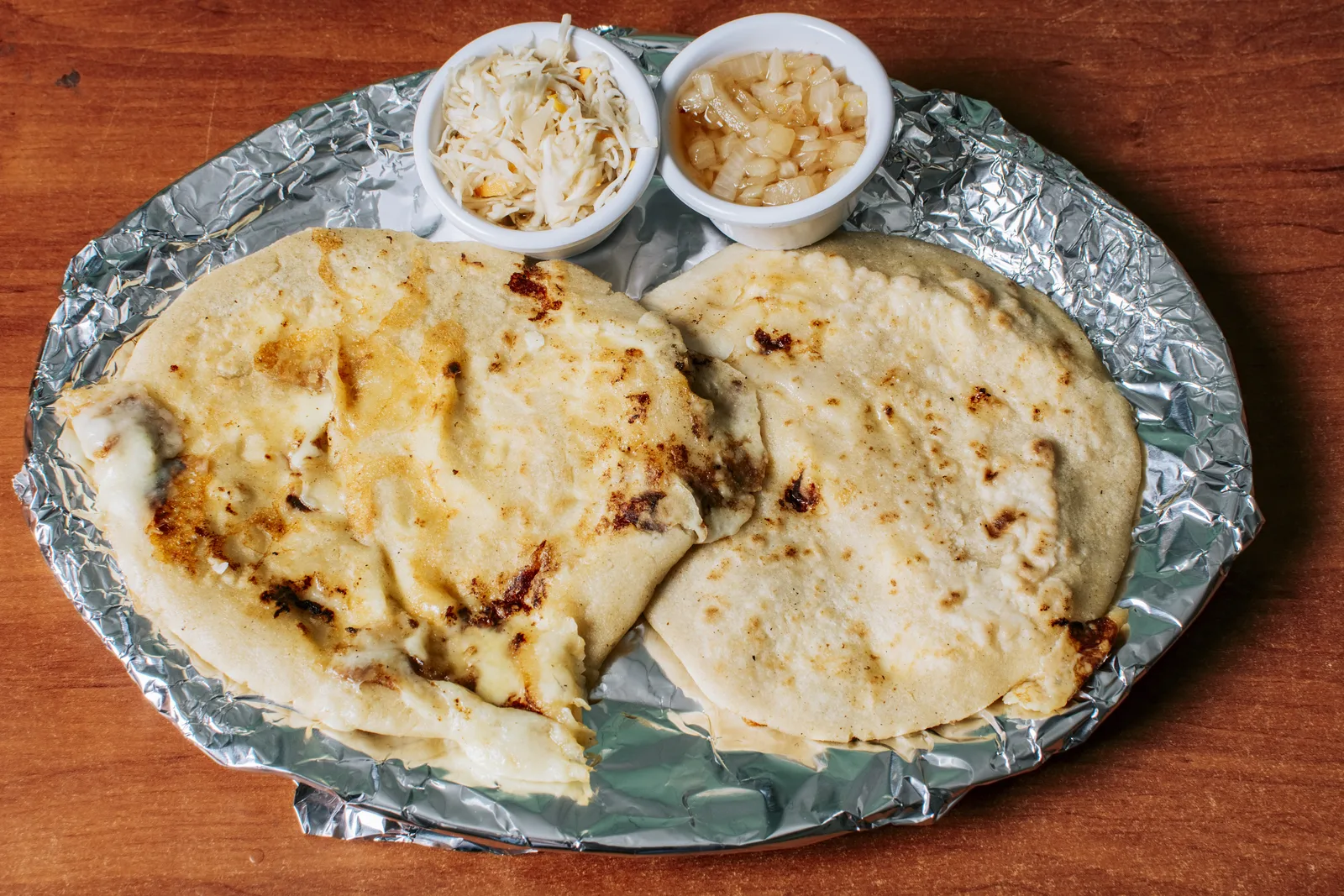

A pupusa (poo-POO-sah) is a thick corn tortilla with the filling sealed inside before it hits the griddle, El Salvador’s national dish and the reason the country has a National Pupusa Day, on the second Sunday of November. At home they come down to one thing: a dough wet enough to close around cheese without splitting. This recipe gives you that dough with a simple test, the classic fillings in grams and ounces, the vinegary cabbage slaw called curtido, the thin tomato salsa that goes with it, and what to buy in a US or UK supermarket.
What pupusas are, and how they differ from arepas and gorditas
How do you make pupusas? Knead 3 cups (340 g) masa harina with 2¼ to 2¾ cups (540 to 650 ml) hot water and ¾ tsp salt until a flattened ball of dough no longer cracks at the edge. Shape 12 balls, stuff each with about 1⅓ oz (38 g) cheese and loroco, seal and pat them ⅜ in (1 cm) thick. Cook on a griddle over medium heat for 4 to 5 minutes per side. 70 minutes for 4 servings.
A good pupusa is about 4 in (10 cm) across, soft and steamy in the middle, and freckled with brown spots outside. You eat it with your hands, with a pile of curtido on top. Three of them make a meal.
Pupusas get confused with two other corn cakes:
- Arepas are made with pre-cooked corn flour (masarepa), not masa harina, and are thicker. A Venezuelan arepa is cooked plain, then split open and stuffed. Its dough tastes of plain corn; pupusa dough tastes of tortilla.
- Gorditas use the same masa, but a Mexican gordita is usually cooked hollow and slit open afterwards. A pupusa is sealed all the way round before cooking.
Time and skill. 70 minutes: 40 to mix, fill and shape, 30 at the griddle in three batches. Curtido needs at least 2 hours in the fridge, so start it first or the day before. Rated medium, because sealing them takes a few tries. By the fourth one you’ll have it.
Shopping list for US and UK kitchens
Everything for 12 pupusas is in the recipe card. Three items need explaining.
Masa harina, not cornmeal
You need masa harina: corn that has been cooked with lime (nixtamalized), dried and ground, the same flour used for homemade corn tortillas. Maseca is the brand you’ll see most in US supermarkets, in the Latin aisle; in the UK it’s sold mostly online and in Latin American shops.
- Fresh masa from a tortilleria works even better. It’s already hydrated: knead it, do the crack test and add water only if it splits. Use it the same day.
- Masarepa or P.A.N. (arepa flour) will do in a pinch, but the dough cracks more when you seal it and the pupusas taste like arepas.
- Cornmeal, polenta and UK cornflour (which is cornstarch) won’t form a dough at all.
The cheese, quesillo and what replaces it
Salvadoran pupusas use quesillo, a soft, mild, stretchy white cheese that melts into strings, not the crumbly kind of queso fresco. Latin grocers in the US often stock a Salvadoran or Central American quesillo; look in the dairy case. If you can’t find it:
| Where you are | Best swap | What changes |
|---|---|---|
| US | 10½ oz (300 g) whole-milk low-moisture mozzarella + 3½ oz (100 g) queso fresco | Very close; the queso fresco adds the salty, tangy note |
| US | Oaxaca cheese, shredded | Melts and stretches like quesillo |
| US | Monterey Jack | Melts well, tastes more like a deli cheese |
| UK | Block mozzarella for pizza + a little crumbled feta | Good melt; go easy on the feta, it’s saltier |
Avoid fresh mozzarella balls in brine. They release water as they heat and burst the pupusa open.
Loroco, frozen or jarred
Loroco is the edible flower bud of a Central American vine, green and vegetal, somewhere between chard and asparagus. Fresh loroco is rare outside the region. Latin and Central American grocers sell it frozen or in jars, in brine or vinegar, and both are also sold online.
- Frozen is the better buy. Thaw, pat dry and chop finely.
- Jarred is softer and milder. Rinse it well under the tap and drain, or the filling will taste of vinegar, and use a little more.
- Use only the buds. The stems are bitter.
No loroco? Make plain cheese or bean-and-cheese pupusas. They’re just as traditional.
Pupusa dough, the crack test and how much water
Pupusa dough is wetter than tortilla dough: 2¼ to 2¾ cups (540 to 650 ml) water for 3 cups (340 g) masa harina, depending on the brand and how dry it is. Hot water helps the flour absorb it faster and gives a softer dough.
- Mix. Masa harina and salt, then 2¼ cups (540 ml) hot water. Stir with a spoon, then knead by hand 2 to 3 minutes once it’s cool enough to touch.
- Crack test. Flatten a walnut-size ball to ⅜ in (1 cm). Cracks wider than ¼ in (5 mm) around the edge mean it’s too dry: add 2 tsp water, knead and test again. Stop when the edge stays almost smooth.
- Rest 10 minutes under a damp towel. Test once more before shaping, since masa keeps drinking water.
What right feels like. Soft as play dough, slightly tacky on a dry hand, not sticky at all on a damp one. If it sticks even to wet hands, you’ve overshot; work in masa harina 1 tbsp at a time.
Fillings, with amounts for 12 pupusas
Each pupusa takes 1⅓ to 1½ oz (38 to 45 g) of filling, about the size of a large walnut. Overfill and the dough gets too thin to survive patting out.
| Filling | Amount for 12 |
|---|---|
| Cheese and loroco (the recipe card) | 14 oz (400 g) cheese + 2 oz (60 g) loroco |
| Cheese only | 1 lb (450 g) cheese |
| Bean and cheese | 8½ oz (240 g) thick refried beans + 8½ oz (240 g) cheese |
| Bean only | 1 lb (450 g) thick refried beans |
| Revueltas | 6⅓ oz (180 g) each of chicharrón paste, beans and cheese |
Beans must be thick enough to hold on a spoon. Wet beans soak the dough from the inside and it splits. Small red beans are the usual choice; drained canned kidney beans, mashed and cooked down in a skillet with a spoonful of oil, work well. Or start from Mexican refried beans and dry them in the pan until a spoon dragged through leaves a clear trail.
Chicharrón here isn’t crunchy pork rind. It’s pork cooked in its own fat and ground with tomato into a paste. For about 12 revueltas:
- Cut 1 lb (450 g) pork belly or boneless shoulder into 1 in (2.5 cm) cubes. Put in a pot with 2 cups (480 ml) water, 2 garlic cloves and ½ tsp salt.
- Bring to a boil, then let it bubble uncovered over medium heat until every drop of water is gone, half an hour to 45 minutes. Fish out the garlic.
- Keep cooking over medium-low about 15 minutes, until the pork browns in the rendered fat.
- Add 1 oz (30 g) onion, 1 chopped tomato (3½ oz / 100 g) and 1 oz (30 g) green bell pepper (UK green pepper). Cover and cook 15 minutes over low heat.
- Pulse in a food processor to an almost smooth paste. Use at room temperature; cold filling doesn’t spread evenly.
Revueltas (“mixed”) combine chicharrón, beans and cheese. Mix all three in a bowl before rolling the filling balls, so every pupusa gets some of each.
How to shape pupusas so they don’t burst
Keep the dough and the finished pupusas covered. Masa exposed to air dries at the edges within minutes, and that’s where cracks start.
- Damp hands. A cup of water with 1 tsp oil stirred in, right by the board. Dip before every pupusa.
- Make a cup. Pat an 80 g (2¾ oz) ball into a 3 in (8 cm) disc and press your thumb into it to form a cup with even walls, just under ⅜ in (1 cm).
- Fill and seal. Drop in the filling ball, draw the edges up and over, pinch shut and pull off the knob of extra dough on top.
- Pat out. Seam side up, slap it gently from palm to palm, rotating a little each time, until it’s 4 to 4½ in (10 to 11 cm) wide and ⅜ in (1 cm) thick. If filling peeks through, press a pinch of dough over it and smooth with a wet finger.
Struggling by hand? Cut the sides off a zip-top bag, put the sealed ball inside and press it with the bottom of a glass pie dish or a tortilla press, without closing the press all the way.
Cooking on a griddle or cast-iron skillet
Medium heat, 4 to 5 minutes per side. Too hot and the outside scorches before the cheese in the middle melts; too low and they dry out and turn tough.
- Preheat a comal, flat griddle or cast-iron skillet for 3 to 5 minutes. A large nonstick skillet works too.
- Wipe it with a few drops of oil on a paper towel. They’re toasted, not fried.
- Cook 3 or 4 at a time. Don’t move them until they release on their own, and never press them with the spatula.
- They’re done when both sides have golden-brown spots and they’ve puffed a little. A bit of cheese escaping and crisping on the pan is part of the fun.
Curtido, the slaw that goes on top
Curtido is a lightly pickled cabbage slaw with oregano: crunchy, sour, a bit like a quick sauerkraut without the fermentation. It cuts through the cheese. It needs at least 2 hours in the fridge and is best the next day.
Makes about 4 cups, enough for 12 pupusas:
- ½ head green cabbage (about 1 lb / 450 g), very thinly sliced
- 1 large carrot, grated
- ½ onion, thinly sliced
- ½ cup (120 ml) white or cider vinegar
- ¼ cup (60 ml) water
- ½ tsp salt and ½ tsp sugar
- 1 tsp dried oregano (Mexican if you have it)
- Red pepper flakes or 1 sliced jalapeño, optional
Put the cabbage in a colander and slowly pour boiling water over it, then drain and press out as much water as you can. This softens it slightly so it takes the vinegar. Toss with the carrot and onion, add the vinegar, water, salt, sugar, oregano and chile, and cover. Chill 2 hours minimum, ideally overnight. It keeps 1 week in a closed jar.
Salvadoran tomato salsa
A thin, mild red sauce, closer to a pourable tomato sauce than a chunky salsa or ketchup. Enough for 12 pupusas:
- 4 ripe plum tomatoes (about 1 lb / 450 g), or a 15 oz (425 g) can of whole tomatoes
- ½ onion, 1 garlic clove and ½ green bell pepper
- ½ tsp dried oregano and ½ tsp salt
- 1 tbsp oil
- ½ jalapeño or serrano, if you want heat
Blend everything except the oil until smooth. Heat the oil in a saucepan, pour in the sauce, bring to a boil and simmer gently about 30 minutes, stirring now and then, until it darkens slightly and loses its raw taste. Short on time? A quarter of an hour is enough, though the sauce tastes fresher and less rounded. Serve warm or at room temperature. Keeps 5 days in the fridge.
Make-ahead plan and cooking for a crowd
Plan on 2 or 3 pupusas per adult. A 2.2 lb (1 kg) bag of masa harina makes about 35 pupusas this size.
- The day before. Curtido, salsa, chicharrón paste and thick beans. Refrigerate everything.
- On the day. Take the fillings out 30 minutes ahead, make the dough, shape all the pupusas under a damp towel, then cook. Each batch takes 9 to 10 minutes.
- For 20 people, about 48 pupusas, multiply the recipe by 4 (3 lb / 1.36 kg masa harina) and run two skillets or a large griddle. With two cooks, one shapes and one cooks, so raw pupusas don’t sit and dry out.
Cost. Cheese is the expensive part, plus imported loroco. Bean-and-cheese and revueltas, heavier on the beans, cost noticeably less. For a bigger Central American spread, Honduran baleadas use the same refried beans, folded into a wheat flour tortilla.
Troubleshooting
| Problem | Why | Fix |
|---|---|---|
| Cracks when you seal it | Dough too dry | Back to the crack test; add water 2 tsp at a time |
| Sticks to your hands | Dry hands or too much water | Dampen hands first; if it still sticks, add 1 tbsp masa harina |
| Filling bursts out everywhere | Too much filling or uneven walls | Max 1½ oz (45 g); keep the cup the same thickness all round |
| Burnt outside, cold cheese inside | Heat too high | Medium heat, the full 4 to 5 minutes per side |
| Hard and dry | Heat too low, too long, or dough left uncovered | Cover dough and pupusas with a damp towel |
| Soggy inside | Runny beans or fresh mozzarella | Cook the beans down; use block cheese |
Allergens and heat. Contains milk (cheese). Corn pupusas are naturally gluten-free, but check the masa harina label if you’re cooking for someone with celiac disease. They’re not spicy at all; any heat goes in the curtido or salsa, which makes cheese and bean-and-cheese pupusas an easy sell with kids.
Freezing and reheating pupusas
- Freeze raw. Lay shaped pupusas on a parchment-lined tray and freeze until solid. Wrap each one in plastic and bag them: up to 1 month. Cook from frozen over medium heat, adding 1 minute per side.
- Cooked, in the fridge. Well covered, 3 to 4 days.
- Reheat in a skillet over medium-low, covered for the first few minutes and turning once or twice, until the center is piping hot, 165°F (74°C). The microwave makes them soft and rubbery; if you must use it, finish them in a dry skillet for a minute.
- Curtido keeps 1 week and salsa 5 days, both in closed jars in the fridge.
Pupusa questions people ask
Are pupusas gluten-free? Corn pupusas contain no wheat. The only thing to check is the masa harina bag, for cross-contact if someone has celiac disease.
Can I make pupusas with rice flour? Yes, rice-flour pupusas are a Salvadoran variation. The dough is less pliable and needs wetter hands; learn with corn first.
Why are my pupusas raw in the middle? They’re too thick or the heat is too high. At ⅜ in (1 cm) and medium heat, 4 to 5 minutes per side is enough. If you make them thicker, turn the heat down slightly and add 1 to 2 minutes per side.
Can I make the dough the day before? Yes, wrapped tightly in the fridge. It will be drier the next day: knead in 1 or 2 tbsp hot water and repeat the crack test before shaping.
Nutrition per serving
These figures are for one serving (three cheese-and-loroco pupusas made with the mozzarella and queso fresco blend), without curtido or salsa:
- Calories: 627 kcal
- Protein: 28 g
- Carbohydrates: 68 g
- Fat: 28 g (14 g saturated)
- Fiber: 5 g
- Sugars: 2 g
- Sodium: 990 mg
That’s about 209 kcal per pupusa. Cheese supplies close to half the energy; bean fillings lower the fat and add fiber.
I’m Venezuelan, so I grew up shaping corn dough into arepas, and I still tore my first pupusas open. It wasn’t my hands, it was a dry dough. Since I started doing the little crack test before shaping, they close every time. At home the bean-and-cheese ones disappear first, and my son Dylan always claims the one that split on the pan, for the crust of toasted cheese. A pupusa is only as good as its dough. Josnaisis.