
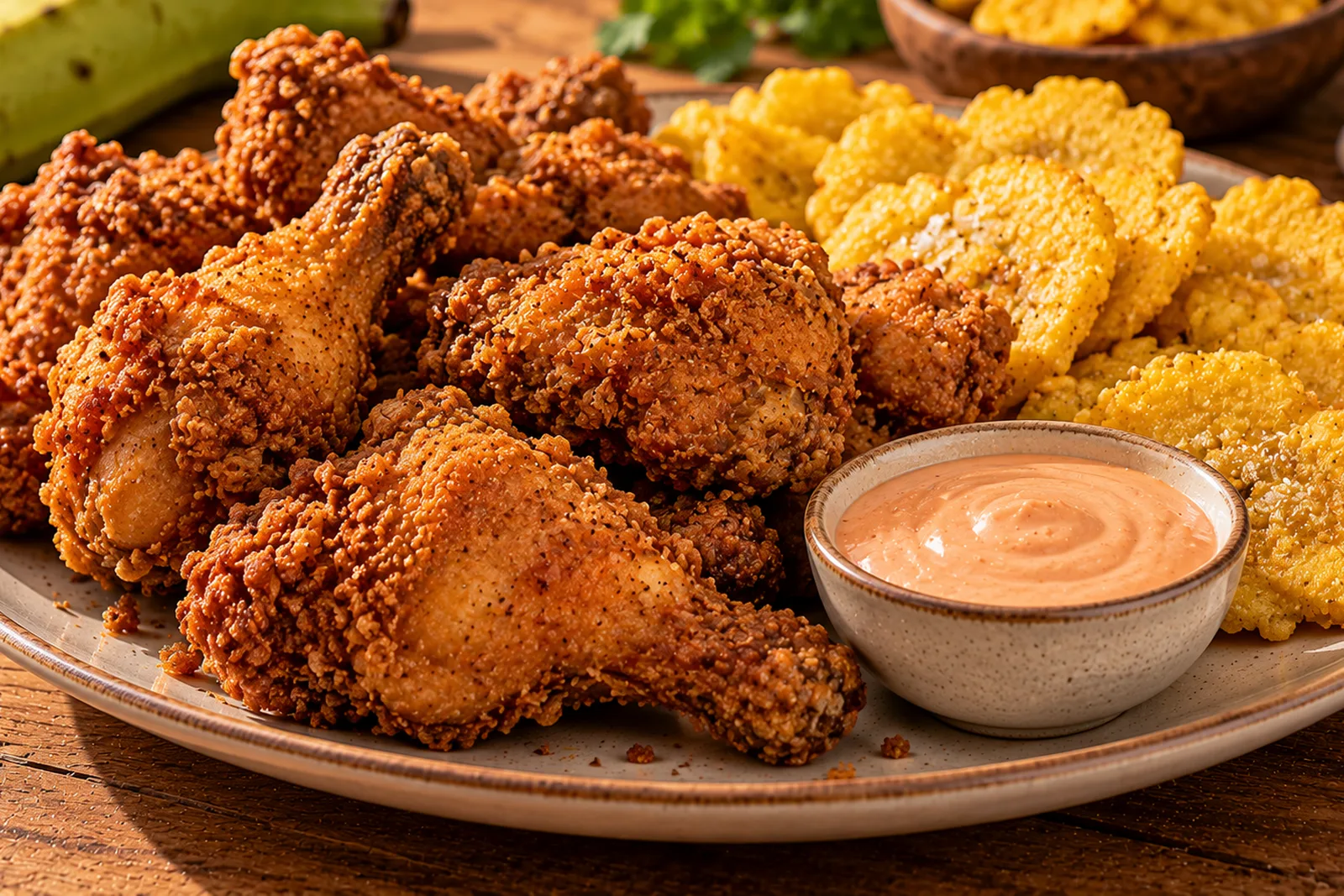

Pica pollo (PEE-kah POH-yoh) is the fried chicken of the Dominican Republic: bone-in pieces marinated in lime, garlic and oregano, dredged in seasoned flour and fried until the crust is craggy and deep gold. It’s eaten with your hands, with twice-fried green plantains and ketchup on the side, and it’s also the name of the fast-food counters that sell it all over the country, a business spread by the island’s Chinese community, and many of them serve it with fried rice too. What sets the home version apart from Southern fried chicken is one step: the chicken is simmered in its own marinade before it’s floured, so it reaches the oil already cooked and seasoned to the bone.
What pica pollo is, and how long it takes
How do you make Dominican pica pollo? Marinate 3½ lb (1.6 kg) of bone-in chicken pieces in lime juice, garlic, oregano and salt for at least 30 minutes. Simmer them in the marinade, covered with water, for 15 to 20 minutes until they reach 165°F (74°C), drain, dredge in seasoned flour and fry in batches at 350°F (175°C) for 5 to 7 minutes until golden. 110 minutes for 4 servings.
Total time 110 minutes, though 30 of that is the chicken sitting in the marinade and 20 is a pot simmering on its own. Medium difficulty: the only part that needs your attention is the oil temperature.
Pica pollo vs chicharrón de pollo vs pollo frito
Dominicans don’t always draw hard lines between these, and plenty of people call pica pollo chicharrón de pollo. Roughly:
- Pica pollo: larger bone-in pieces, floured and fried, often simmered first.
- Chicharrón de pollo: bite-size chunks, often boneless thigh or breast, marinated, floured and fried raw, no simmering.
- Pollo frito: bone-in pieces cooked in their marinade and fried with no flour at all, so there’s no crust.
If you’re after a thin, crumbed cutlet instead, that’s Colombian breaded chicken, a different dish.
Ingredients and US or UK supermarket swaps
Plan on 3 pieces per person; with tostones and rice, one 3½ lb (1.6 kg) chicken feeds 4.
| If the recipe calls for | Use | What changes |
|---|---|---|
| Sour orange (naranja agria) | Bottled sour orange from the Latin aisle; or Seville oranges in the UK in January and February; or 2 parts orange juice to 1 part lime | Lime alone is sharper; sour orange is more bitter and floral |
| Dominican oregano | Any dried oregano, Mexican or Mediterranean | Dominican oregano is stronger; sniff the flour and add up to 1 tsp more if it smells flat |
| Sazón packet | Leave it out, or use a pinch of paprika for color | Sazón adds orange color and salt; taste the marinade before adding all the salt |
| Cut-up whole chicken | A family pack of thighs and drumsticks, same weight | All pieces cook evenly and stay juicier |
Cutting a whole chicken for pica pollo
Ask the butcher to cut it “for frying” into 10 to 12 pieces, or do it yourself with a heavy knife or poultry shears:
- Wings: cut through the shoulder joint. 2 pieces.
- Legs: pull away from the body, cut through the hip joint, then split each at the knee into thigh and drumstick. 4 pieces.
- Breast: split down the breastbone and cut each half in two, through the bone. 4 pieces.
- Back: fry it in 2 pieces or freeze it for stock.
Equipment. A pot for simmering, a heavy 8 to 9½ in (20 to 24 cm) pot or Dutch oven for frying, a wire rack and an instant-read thermometer. The thermometer does double duty, checking the oil and the chicken.
How to make pica pollo, step by step
The marinade
Mashing the garlic with the salt turns it into a paste that clings to the skin. 30 minutes is enough for salt and lime to get in; overnight in the fridge gives deeper flavor. I don’t go past a day, because that much acid leaves the surface of the meat soft.
Why Dominican cooks simmer the chicken first
In a home pot the oil temperature drops as soon as the chicken goes in, and thick bone-in pieces take a long time to cook through: the crust can go dark while the inside is still raw. Simmering first, in the marinade, solves that. Cover the pieces with water and give them 15 to 20 minutes from the boil; pieces of 2 to 4 in (5 to 10 cm) are usually done by then. The broth left behind is good for rice or soup.
Then let them drain on a rack for 10 minutes. They should be warm and dry to the touch before they go into the flour.
Oil temperature and frying time
- Oil at 350°F (175°C), about 1¼ in (3 cm) deep, enough to come halfway up the pieces; turn them halfway through.
- 3 or 4 pieces per batch. More than that and the oil falls below 320°F (160°C), and the flour soaks up fat instead of browning.
- Simmered chicken takes 5 to 7 minutes per batch, until the crust is deep golden all over.
- Let the oil recover to 350°F (175°C) between batches, and skim out the loose flour bits that sink and burn.
No thermometer? Drop in a pinch of the flour: it should sizzle at once and turn golden in a few seconds. If it darkens immediately, the oil is too hot.
How to tell it’s done
Chicken is safe when the thickest part reaches 165°F (74°C). Check the biggest thigh or breast piece, pushing the probe into the center without touching the bone, which gives a false reading. With the simmering method, check as the chicken comes out of the water.
Clear juices or the color of the meat don’t tell you the chicken is safe: dark meat can stay slightly pink near the bone even when it’s cooked, and the reverse happens too. Check every large piece with the thermometer, and if one falls short, give it a few more minutes in the water or oil and measure again.
Troubleshooting
- The crust falls off. The chicken was wet or still hot when you floured it. Let it drain until the surface is dry.
- Pale and greasy. The oil was too cool or the pot too crowded. Fry 3 or 4 pieces at a time and wait for the oil to come back up.
- Dark outside, raw inside. That happens when raw chicken hits very hot oil. Simmer it first, or fry raw at the lower temperature below.
- Too salty. Sazón and store-bought adobo already contain salt. Taste the marinade before adding the full teaspoon.
- Soggy by the time it’s served. It was piled on paper towels or covered. A rack lets the steam escape.
Allergens and heat. Contains wheat (gluten). Not spicy, and kids usually love it as is, with ketchup.
No-boil, air fryer and party versions
- No-boil, straight into the oil. Marinate and flour the raw pieces and fry at 325°F (160 to 165°C), lower than in the recipe, so the inside cooks before the crust darkens. Allow 10 to 12 minutes for wings and 12 to 18 minutes for thighs, drumsticks and breast pieces, turning every 3 or 4 minutes, and pull each piece when it reads 165°F (74°C). Here the thermometer isn’t optional. The crust comes out thicker and crunchier, the meat a little less seasoned inside.
- Chicharrón de pollo. Bone 2¼ lb (1 kg) of skin-on thighs, cut into bite-size chunks, marinate the same way and fry raw at 350°F (175°C) for 6 to 8 minutes per batch.
- Air fryer. Works best with boneless chicharrón-size pieces: floured, misted with oil, in a greased basket with space between them, 15 to 20 minutes at 365°F (185°C). For raw bone-in pieces, 25 to 30 minutes at 380°F (190°C), flipping halfway, until 165°F (74°C). It comes out paler and a bit drier than deep-fried; spray any patches of white flour with a little more oil.
- Gluten-free. Dredge in cornstarch or rice flour alone. The crust is thinner and more brittle.
- For 12 or 20. Count one 3½ lb (1.6 kg) chicken per 4 people: 3 chickens for 12, 5 for 20. Simmer everything the day before, cool the pieces quickly and refrigerate them covered. Next day, flour and fry in two pots at once; since the chicken comes straight from the fridge, make sure it reaches 165°F (74°C) before serving.
What to serve with pica pollo
The classic plate is pica pollo with crispy Caribbean tostones, lime wedges and ketchup, or ketchup stirred into mayonnaise, which is the same idea as Latin pink sauce, 2 parts mayo to 1 part ketchup. Fried yuca works in place of the plantains. For a full Dominican lunch, add moro de guandules, rice with pigeon peas or white rice with Dominican habichuelas guisadas.
Storing and reheating so it stays crisp
Fridge. Refrigerate within 2 hours of frying, covered. It keeps 3 to 4 days.
Freezer. Up to 4 months in freezer bags with the air pressed out. Thaw overnight in the fridge.
Reheating. Oven at 400°F (200°C), on a wire rack set over a sheet pan, single layer and uncovered, for 15 to 20 minutes, until the skin crackles and the center reaches 165°F (74°C). In an air fryer, 375°F (190°C), 4 to 5 minutes per side. The microwave heats it through, but the crust turns soft.
Pica pollo FAQ
Do you have to boil the chicken before frying it? No, but at home it’s the easier route: the inside is already cooked, so the oil only has to brown the crust. What confirms it’s done is a 165°F (74°C) reading as it comes out of the water. If you skip it, fry lower, at 325°F (160 to 165°C), and check each piece for 165°F (74°C).
Can I use only chicken breast? Yes, though it dries out sooner. Cut it into similar bone-in pieces, start checking before the 15-minute mark, since breast cooks faster than thigh, pull it at 165°F (74°C) and fry just long enough to brown.
What’s the best oil for pica pollo? A neutral oil that handles 350°F (175°C): vegetable, canola, peanut or corn. Extra virgin olive oil starts to smoke around that temperature and changes the flavor.
Nutrition
Per serving (about 166 g / 6 oz of fried chicken off the bone, a quarter of the recipe, without sides), estimated from the composition of flour-dredged fried chicken:
- Calories: 446 kcal
- Protein: 47 g
- Carbohydrates: 5 g
- Fat: 25 g, of which 7 g saturated
- Fiber: 0 g
- Sugar: 0 g
- Sodium: 720 mg
It’s an estimate: how much oil the crust absorbs depends on the frying temperature and on how much flour sticks. A serving of the tostones on this site adds about 465 calories, almost as much as the chicken.
At home I make this with thighs and drumsticks only, because everyone fights over them and every batch comes out equally juicy. I mix the marinade at night, simmer in the morning and fry right before we eat, with the tostones already flattened and waiting. Dylan gets his ketchup in a little bowl on the side; pour it over and the crust goes soft, and he lets me know about it. Josnaisis.