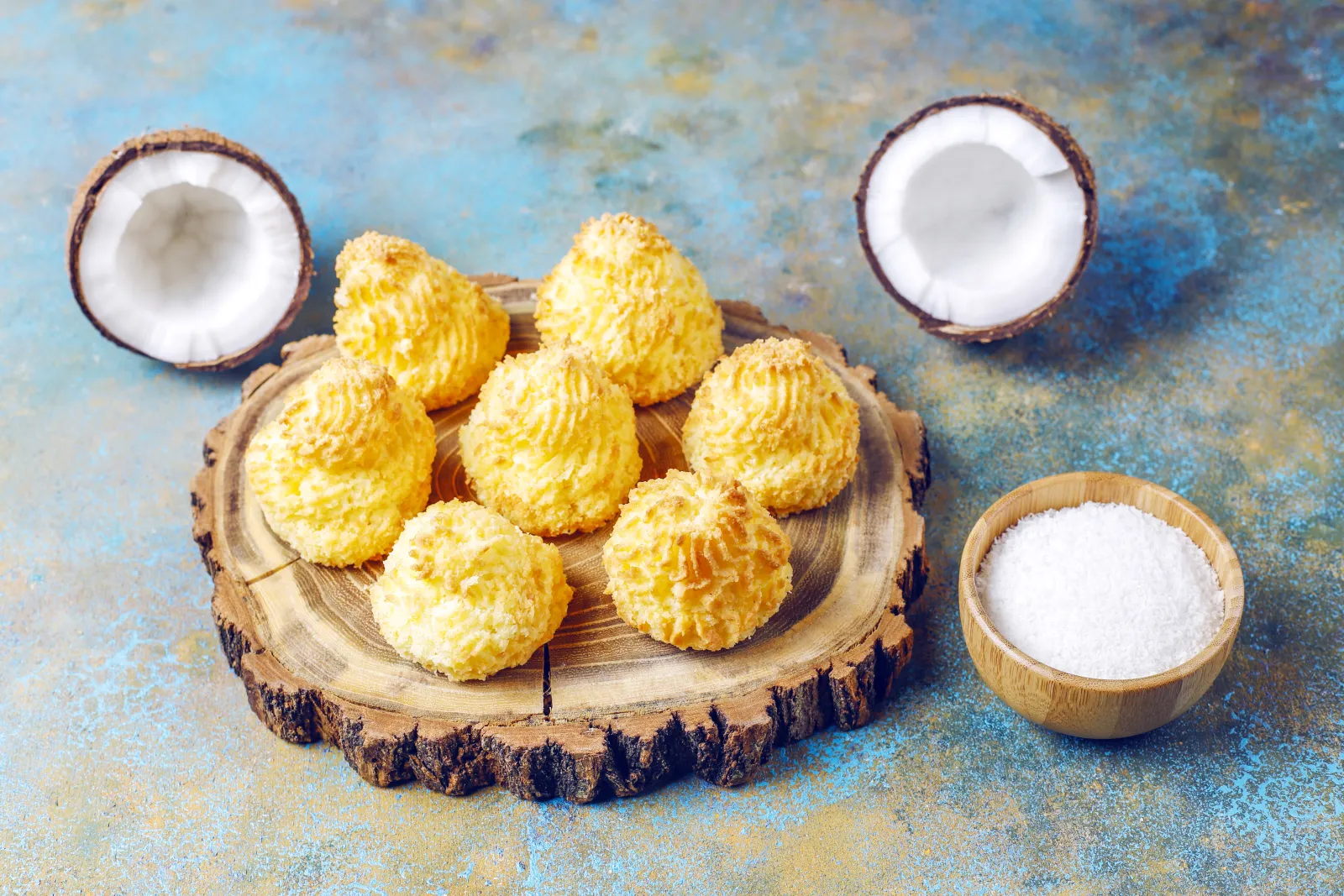

If coconut kisses make you think of snowy white macaroons, the Venezuelan kind will surprise you. Besitos de coco (beh-SEE-tohs deh KOH-koh) are small brown drop cookies from Venezuela, built on a syrup of papelón, the dark unrefined cane sugar sold in blocks, simmered with cinnamon and clove. Grated fresh coconut and a good amount of flour go in, they bake for 18-20 minutes, and they come out crisp on the outside with a soft, cakey center studded with chewy coconut. This batch makes 30.
What are Venezuelan coconut kisses?
How do you make Venezuelan coconut kisses? Simmer 17.6 oz (500 g) of papelón or piloncillo with 1 cup (250 ml) of water, a cinnamon stick and 6 cloves, then let the syrup cool completely. Stir in 10.6 oz (300 g) of coarsely grated fresh coconut, 14.8 oz (420 g) of flour with baking powder and soda, an egg and 2 tbsp of melted butter, scoop into mounds and bake 18-20 minutes at 350°F (180°C). 130 minutes for 30 servings.
They are a Venezuelan sweet sold in dulcerías, the little sweet shops and stalls, and baked at home especially around Holy Week. Think of them as a spiced coconut drop cookie: the flavor sits between gingerbread and a brown-sugar coconut cookie, with no frosting and no filling.
- Worth making if you have a coconut on hand, like molasses-y sweets, or want a cookie that travels well in a tin.
- Not for gluten-free or egg-free eaters as written, or anyone after a moist, pure-coconut bite; that is what a macaroon is for.
- Time: 130 minutes on the clock, about 55 hands-on. Make the syrup the night before and use desiccated coconut, and baking day is about 75 minutes.
- Difficulty: easy. No candy thermometer, no rolling, no chilling. You mix with a spoon.
Coconut kisses vs coconut macaroons
The honest difference is flour. An American coconut macaroon is mostly coconut held together by egg whites and sugar, or by sweetened condensed milk, with little or no flour, baked at 325°F (165°C) until the tops just turn golden. Many are naturally gluten-free. A Venezuelan besito has more flour than coconut by weight, 14.8 oz (420 g) to 10.6 oz (300 g), so it bakes up dark, domed and cakey.
Puerto Rican besitos de coco sit in between: brown sugar, egg yolks, butter and only a little flour, baked at 350°F for about 25 minutes, crisp outside and moist inside. If you searched “coconut kisses” and landed on a Puerto Rican recipe, that is why it looks so different from this one.
Ingredients, and what to buy in the US and UK
Every amount is in the recipe card. The ratio to remember is the syrup: 2 parts cane sugar to 1 part water by weight, 17.6 oz (500 g) to 1 cup (250 ml).
Papelón and its supermarket stand-ins
| What you find | Where | Amount | What changes |
|---|---|---|---|
| Papelón or panela | Latin grocers, online | 17.6 oz (500 g) | nothing, same product |
| Piloncillo | Mexican aisle, US | a little over two 8-oz (225 g) cones | nothing; chop it first |
| Dark muscovado | most UK supermarkets | 17.6 oz (500 g) | very close, dissolves faster |
| Dark brown sugar | anywhere | 17.6 oz (500 g), about 2¼ packed cups | lighter color, less cane flavor |
Fresh, desiccated or frozen coconut
Fresh coconut, coarsely grated, gives the chewy pieces that make these cookies. A medium coconut holds about 14 oz (400 g) of meat; peeled, you are left with the 10.6 oz (300 g) you need. I peel off the brown skin with a vegetable peeler. Some Venezuelan cooks leave it on, which makes darker, speckled cookies with a few tougher strands. The squeezed pulp left over from making coconut milk works too, with a less juicy result.
Unsweetened desiccated coconut (UK) or unsweetened shredded coconut (US) works if you put the water back. Fresh coconut is close to half water, so 5.6 oz (160 g) soaked 15 minutes in 9½ tbsp (140 ml) of hot water replaces 10.6 oz (300 g) of fresh. The crumb comes out a little finer and drier.
Sweetened flaked coconut is 43% sugar. It browns before the dough is baked through and makes the cookies cloying. Skip it here.
Flour, egg, butter and leaveners
Use all-purpose (plain) flour, not self-rising, since the dough already has ½ tsp each of baking powder and baking soda. The soda reacts with the slight acidity of the cane sugar, which is what makes the mounds puff and crack a little on top. One egg binds and browns them; 2 tbsp of butter keeps the crumb tender.
Equipment
A saucepan and a sieve for the syrup, a large bowl, a wooden spoon, two baking sheets about 12 x 16 inches (30 x 40 cm), parchment and a box grater. No parchment: grease and flour the sheets. No grater: pulse the coconut in a food processor, stopping well before it turns to paste. A hammer or the spine of a heavy knife opens the coconut.
Make-ahead plan and method
The night before: make and strain the syrup and leave it covered on the counter. Grated fresh coconut keeps 3-4 days in a covered container in the fridge, so you can grate it ahead too.
Do not make the dough ahead. Once the baking soda meets the syrup it starts working, and a dough left to sit for hours bakes flatter.
On the day: start the oven 10 minutes before you finish mixing. Stir the cold syrup with half the coconut, add the flour in three goes, then the egg and butter, then the remaining coconut. Stop as soon as no dry flour shows. The dough should drop off the spoon in one lump: if it spreads on the sheet like batter, add 2-3 tbsp of flour; if you could knead it by hand, it already has too much.
How to tell coconut kisses are done
Bake one sheet at a time on the middle rack, 18-20 minutes at 350°F (180°C).
- Bottoms deep golden. Lift one with a spatula and look.
- Edges set, center just yielding when you press it with a fingertip.
- Coconut tips toasted where they poke out.
- Firm in the center while still in the oven means overbaked; they will be dry once cool.
Brush them with the 3 tbsp of syrup you set aside as they come out. It adds shine and a slightly tacky top, and it is optional.
Scaling for a crowd
- 15 cookies, for 4-6 people: halve everything. For the egg, beat it and use half, about 1 oz (25 g). One sheet.
- 30 cookies, for 12-20 people: the recipe as written.
- 60 cookies, for a party: double it in a bigger pan, make the syrup the night before because a double batch takes much longer to cool, and bake four sheets in a row, one at a time.
Mistakes that ruin coconut kisses
- Warm syrup. The single most common cause of flat, greasy cookies. It melts the butter, starts cooking the egg and spends the baking soda in the bowl.
- Too much flour. A dough firm enough to roll in your hands bakes into dry, hard cookies.
- Syrup boiled to the thread stage. Less water means a drier dough and harder cookies; 3 minutes at the boil is enough.
- Baking past 20 minutes at 350°F (180°C) with 1.6 oz (45 g) mounds. Trust the center, not the timer.
- Low rack or thin sheet. The bottoms scorch before the middle bakes. Use the middle rack, or double-stack two sheets.
- Tasting raw dough. It has raw egg and raw flour; wait for the oven.
Allergens: wheat (gluten), egg, milk (butter) and coconut. No heat; clove gives warmth, not spice. Kids generally love them; for toddlers, grate the coconut finer.
Other ways to make them
- Short on time: syrup the night before plus soaked desiccated coconut, about 75 minutes on the day.
- Egg-free and dairy-free: some Venezuelan versions use only syrup, coconut, flour, baking soda and baking powder. They come out denser and paler, and they are vegan.
- Condensed-milk version: one 14-oz (405 g) can of sweetened condensed milk, 10.6 oz (300 g) of desiccated coconut, ½ cup (65 g) of flour, 1 tbsp of rum and 1 tsp of salt, baked 15-20 minutes at 350°F (180°C), makes about 36 pale, moist cookies, much closer to a macaroon. No cane-sugar flavor.
- Bite-size for a party: 1-tablespoon mounds, 12-15 minutes, about 60 cookies.
- Extra spice: a pinch of ground ginger or a few anise seeds in the syrup.
What a batch costs in the US
One fresh brown coconut at $2.44 and a little over two 8-oz piloncillo cones at $1.28 each ($2.82) are most of the bill; flour, butter and one egg add 97 cents. That makes $6.23 a batch, about 21 cents a cookie, before the spices and leaveners. In Bogotá’s wholesale market the coconut is half the cost; in the US the cane sugar costs more than the coconut. I do not have a reliable UK price to quote.
Serving and storing
Serve them with coffee or a glass of cold milk. A glass of papelón con limón, Venezuelan cane-sugar lemonade is a lot of sugar alongside, but on a tray of Venezuelan sweets they sit well next to green papaya in spiced syrup, which shares the papelón and clove. If coconut sweets are your thing, conservas de coco are the stovetop cousin with no flour, cooked to 234-237°F (112-114°C) and cut into squares, and Venezuelan catalinas are the rolled, coconut-free papelón cookie. Leftover coconut meat goes into Colombian coconut rice. And if someone asks for a “cocada” in Venezuela, they will get a blended coconut drink, not a cookie.
Room temperature: cooled completely, in a tin or airtight box. With fresh coconut I count on 5 days; with desiccated, a little longer, because fresh coconut is what turns rancid first.
Freezer: I keep them no longer than 3 months, in a well-sealed freezer bag. They thaw in 30 minutes on the counter.
Reviving: if humidity softens them, 5 minutes in a 300°F (150°C) oven brings back the crust for me. Anything that smells rancid or shows mold goes in the bin.
Coconut kisses FAQ
What is the difference between coconut kisses and coconut macaroons? Venezuelan coconut kisses have more flour than coconut and a spiced cane-sugar syrup, so they are dark and cakey. Macaroons are mostly coconut bound with egg whites or condensed milk, pale and chewy.
Are coconut kisses gluten-free? Not this recipe: it has 14.8 oz (420 g) of wheat flour. Many egg-white macaroons are.
Can I use desiccated or shredded coconut instead of fresh? Yes, unsweetened: 5.6 oz (160 g) soaked 15 minutes in 9½ tbsp (140 ml) of hot water replaces 10.6 oz (300 g) of fresh.
What can I use instead of papelón? Piloncillo or panela at the same weight, dark muscovado in the UK, or dark brown sugar.
Why did my coconut kisses come out flat? Usually the syrup was still warm when it went in, or the dough was too loose. Let the syrup cool completely, and stiffen a runny dough with a little more flour.
How long do coconut kisses last? Up to 3 months frozen; at room temperature in a tin, I count on 5 days with fresh coconut.
Can I make them without eggs? Yes. Leave out the egg and butter; they bake denser and paler, and the recipe becomes vegan.
Nutrition per cookie
Calculated per cookie from the weights in this recipe, made with fresh coconut and with papelón counted as brown sugar (one serving is a thirtieth of the batch):
- Calories: 159 kcal
- Protein: 2 g
- Carbohydrates: 29 g
- Sugars: 17 g
- Fat: 4 g, of which 4 g saturated
- Fiber: 1 g
- Sodium: 51 mg
Most of the sugar comes from the papelón and most of the fat from the coconut and butter. Two cookies with coffee make a full snack.
The first batch I baked in Colombia spread into thin brown puddles, and it took me a while to admit the syrup had gone in warm. Now I make it after dinner, leave it covered overnight, and in the morning the dough comes together in ten minutes. Dylan does the glazing and always claims the one with the most toasted coconut. Cold syrup, sticky dough, and pull them while the middle still gives. Josnaisis.