
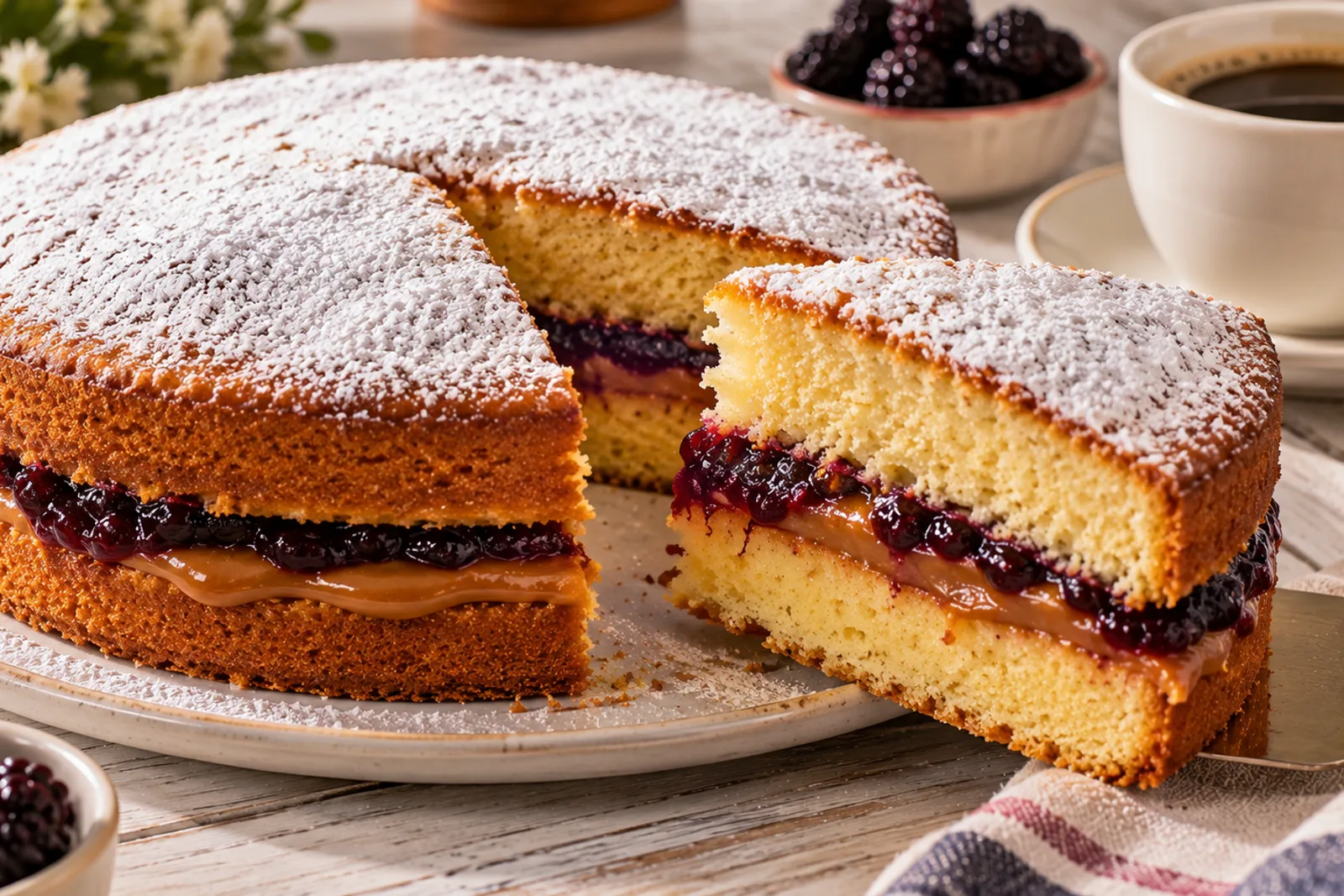

Torta María Luisa (TOR-tah mah-REE-ah loo-EE-sah) is a Colombian layer cake: two thin, golden butter layers with a little orange zest, held together with blackberry jam or arequipe, Colombia’s thick dulce de leche, and finished with nothing but a snowfall of powdered sugar. If you know a Victoria sponge, you’re most of the way there. The difference is the filling and the orange, and in Colombia it’s eaten with afternoon coffee as often as at birthdays. Here’s the recipe for two 8 in pans, how to tell the layers are done, a 25-minute blackberry jam, and which store-bought swaps work in the US and UK.
Colombian Maria Luisa cake at a glance
How do you make a Maria Luisa cake? Cream 1 cup (225 g) of butter with 1¼ cups (250 g) of sugar and orange zest for 5 minutes, beat in 4 eggs one at a time, then gently mix in 2 cups (250 g) of flour with ¼ cup of milk and 2 tbsp of orange juice. Bake in two 8 in (20 cm) pans at 350°F (175°C) for 30 to 35 minutes, cool completely, sandwich with ¾ cup (250 g) of blackberry jam or dulce de leche and dust with powdered sugar. 70 minutes of work and baking for 10 slices.
- Taste and texture: buttery, fine-crumbed and moist, with tart fruit in the middle. Not very sweet with jam; noticeably sweeter with dulce de leche.
- Time: 40 minutes hands-on and 30 in the oven. Add an hour for the butter to soften and 70 minutes of resting and cooling, so plan on 3 hours 10 minutes from fridge to table.
- Skill level: easy. No frosting, no piping, no layer-splitting. The only real test is patience: the layers must be cold before you fill them.
In Venezuela a cake with the same name usually has pastry cream and guava inside, and is a much bigger project. This is the Colombian one.
What to buy in a US or UK supermarket
Everything for the cake itself is standard: unsalted butter, all-purpose (UK plain) flour, baking powder, eggs, whole milk and one orange. The filling is where you have choices.
- Blackberry jam. In Colombia it’s made with mora de Castilla, an Andean blackberry that’s more sour than the ones in US and UK stores. Regular blackberries work; keep the lemon juice in the homemade jam so it doesn’t taste flat. For store-bought, pick seedless blackberry jam (US) or a thick blackberry or bramble jam (UK). Runny jam squeezes out of the sides when you slice.
- Frozen blackberry pulp. Latin grocers and the frozen aisle of many US supermarkets sell 14 oz (400 g) packs of seedless blackberry pulp, often labeled mora. It’s already strained, so you can skip the sieve.
- Dulce de leche or arequipe. Use the thick kind that holds its shape on a spoon. Cans and jars sit in the Latin or baking aisle in the US and in larger UK supermarkets. If you’d rather make it, our Colombian dulce de leche (arequipe) thickens to spreading consistency as it cools.
- No orange? Use 1 tsp vanilla extract and replace the juice with 2 more tbsp of milk.
Equipment. Two 8 in (20 cm) round cake pans at least 1½ in (4 cm) deep, a hand or stand mixer, a cooling rack and a fine sieve for the sugar. A 9 in pan works too, with thinner layers that bake a few minutes faster. A probe thermometer is optional but handy.
How to make it
Creaming, then a light hand
Beat the butter, sugar and zest for a full 5 minutes on medium. It should turn from yellow to almost white and look fluffy; that trapped air is part of what lifts the cake. Add the eggs one by one, waiting until each disappears. If the mixture looks grainy, like cottage cheese, a couple of spoonfuls of the flour mixture brings it back together.
Once the flour goes in, switch to the lowest speed or a spatula and stop as soon as you can’t see dry flour. Alternating flour and liquid (three additions of flour, two of liquid) keeps the batter smooth without extra mixing. Overmixing here is what makes a Maria Luisa tough and full of tunnels.
Baking and the doneness test
Weigh the batter if you can, about 515 g (18 oz) per pan, so both layers rise to the same height. Tap each pan on the counter once to release large air bubbles. Bake at 350°F (175°C) for 30 to 35 minutes, and keep the door shut for the first 20.
The layers are done when:
- A toothpick in the center comes out clean or with a few dry crumbs.
- The edges have pulled away from the sides of the pan.
- The center springs back when you press it lightly.
- An instant-read thermometer in the center reads 205 to 210°F (96 to 99°C) at sea level. At around 190°F (88°C) it still needs more time. At high altitude, see below.
If the edges are very brown at 28 minutes and the middle is still wet, your oven runs hot; drop it to 325°F (165°C) for the last few minutes.
Blackberry jam in 25 minutes
You can make it while the layers bake.
- Put 400 g (14 oz) blackberries, 150 g (¾ cup) sugar and 1 tbsp lemon juice in a saucepan. Cook over medium heat for 10 minutes, mashing the berries, until they collapse.
- Push everything through a sieve with the back of a spoon to remove the seeds (skip this with seedless pulp).
- Return the purée to the pan and simmer 8 to 10 minutes, stirring, until thick.
- Cold plate test. Put a saucer in the freezer before you start. Drop a little jam on it, wait 30 seconds and push it with your finger. If the surface wrinkles and the gap stays open, it’s ready. If it runs back, cook 2 minutes more and test again.
It sets further as it cools, so don’t push it too far or it turns gummy. Weigh out 250 g (¾ cup) for the cake; any extra is breakfast toast.
Cooling, leveling and filling
Leave the layers 10 minutes in the pans, then turn them out onto a rack and let them cool about an hour, until the bottoms feel cool too. Fill them warm and the jam melts into the bottom layer, while dulce de leche slides out of the sides.
Trim any dome with a serrated knife. Set the first layer on the plate, spread the filling to within ½ in (1 cm) of the edge, then put the second layer on flat side up so the top is smooth and level. Dust the powdered sugar through a fine sieve right before serving: sugar draws moisture from the cake and the air, and in an hour, especially on a humid day or a chilled cake, it turns see-through and blotchy. A paper doily laid on top before dusting leaves a lace pattern.
Troubleshooting
| What happened | Why | Next time |
|---|---|---|
| Sunk in the middle | Door opened before 20 minutes, underbaked center, too much baking powder, or high altitude | Wait for a clean toothpick and a center that springs back |
| Tough, with tunnels | Batter overmixed after the flour went in | Lowest speed or a spatula, stop at the last streak of flour |
| Dense and flat | Cold butter or eggs, short creaming, or melted butter | Soft butter, room-temperature eggs, a full 5 minutes of creaming |
| Dry | Overbaked, or too much flour from packed cups | Weigh the flour or spoon it into the cup and level |
| Stuck to the pan | No parchment circle, or turned out completely cold | Line the bottoms and unmold after 10 minutes |
| Filling oozing out | Layers still warm, or runny jam or dulce de leche | Chill the assembled cake 20 minutes before slicing |
Baking at altitude. Above about 7,000 ft (2,100 m), as in Bogotá, a good starting point is to cut the baking powder to 1 tsp, raise the oven to 365°F (185°C) and start testing at 25 minutes. Around 5,000 ft (1,500 m) the recipe may work as written; if it sinks, use 1¼ tsp. Every oven differs, so note what works for you. And skip the thermometer up there: water boils at about 196°F (91°C) in Bogotá, so the center never reaches 205°F even when the cake is done. Go by the toothpick and the spring-back.
Allergens. Contains wheat (gluten), egg and milk. No heat at all, and kids nearly always like it, especially with dulce de leche.
Cost. Butter is by far the priciest item on the list. Margarine makes a cheaper, slightly fluffier cake that tastes less of butter.
Variations, cupcakes and other pans
- Maria Luisa cupcakes. Fill paper-lined muffin cups two-thirds full for about 20. Bake at 350°F (175°C) for 18 to 22 minutes, testing at 18. Once cool, cut a small cone from the top of each, spoon in 1 tsp jam or dulce de leche, replace the cone and dust with sugar.
- One deep pan. All the batter in one 8 in (20 cm) pan at least 2 in (5 cm) deep, at 325°F (165°C): start checking with a toothpick at 40 minutes; it usually takes 45 to 55. Cool, split horizontally with a serrated knife and fill.
- Sheet-pan version. A 9 x 13 in (23 x 33 cm) pan gives a thin sheet that usually takes 25 to 30 minutes; start checking with a toothpick at 20. Cut it in half crosswise, fill one half and set the other on top for a rectangular cake that slices into squares.
- With guava. Swap the blackberry for guava jam, or guava paste melted with 2 or 3 tbsp water. If you like guava baked into dough, the Colombian guava roscón is the sweet bread version.
- Oil instead of butter. Use 180 ml (¾ cup) neutral oil for the 225 g butter and beat the eggs and sugar for 3 to 4 minutes before adding it. Moister and softer from the fridge, but less buttery and a coarser crumb.
- For a crowd of 20. Make two separate batches rather than one double batch, which is hard to mix evenly in a home bowl.
If you’d like a plain butter cake without the filling, our Colombian pound cake is the loaf-pan cousin, baked lower and slower. For a citrus cake made with oil and soaked in syrup, try the orange cake.
Make ahead and storage
- The day before: bake the layers, cool them completely, wrap in plastic and keep at room temperature. Homemade jam keeps in a clean jar in the fridge; I use it within 2 weeks. Fill on the day and dust at the last minute.
- Assembled with jam: covered, at cool room temperature, 2 to 3 days.
- With dulce de leche, or in hot weather: covered in the fridge for up to 5 days. Take slices out 20 minutes before eating so the butter in the crumb softens, and re-dust the top.
- Freezer: freeze the plain layers, not the filled cake, wrapped individually and then bagged. At 0°F (-18°C) they stay safe indefinitely; I use them within 2 to 3 months for best flavor. Thaw wrapped in the fridge overnight, then fill.
Maria Luisa cake FAQs
Is Maria Luisa cake Colombian or Venezuelan? Both countries make a cake by that name, and so does El Salvador, but they aren’t the same cake. This is the Colombian one: two butter layers with blackberry jam or dulce de leche and powdered sugar on top. The Venezuelan version usually has pastry cream and guava, and in El Salvador it’s often filled with a thick milk custard.
Is it the same as a Victoria sponge? Close. Both are two butter layers with jam in the middle and powdered sugar on top. The Colombian cake adds orange zest and juice, uses blackberry instead of raspberry, and often swaps the jam for dulce de leche. It has no buttercream or whipped cream layer.
Can I fill it with whipped cream? You can, but then it has to live in the fridge and shouldn’t sit out more than 2 hours. For a cream-and-fruit Colombian dessert, the merengón uses blackberries too, or go for a soaked tres leches cake.
Why does my powdered sugar disappear? Sugar absorbs moisture. Dust only once the cake is completely cool and just before it goes to the table, and don’t dust a cake straight from the fridge.
Nutrition
Per slice (1 of 10), with blackberry jam, calculated ingredient by ingredient from the recipe amounts:
- Calories: 459 kcal
- Protein: 6 g
- Carbohydrates: 64 g
- Fat: 21 g, of which 12 g saturated
- Fiber: 1 g
- Sugars: 39 g
- Sodium: 148 mg
With dulce de leche instead of jam, a slice comes to about 468 kcal and 22 g fat.
I grew up in Venezuela with birthday cakes buried under cream, so this one won me over by doing less: two layers, one of fruit and a little sugar on top. The one rule I don’t bend is cooling the layers fully, even with guests at the door. If your day is tight, bake them the night before; they slice cleaner and the cake is better for it. Josnaisis.