
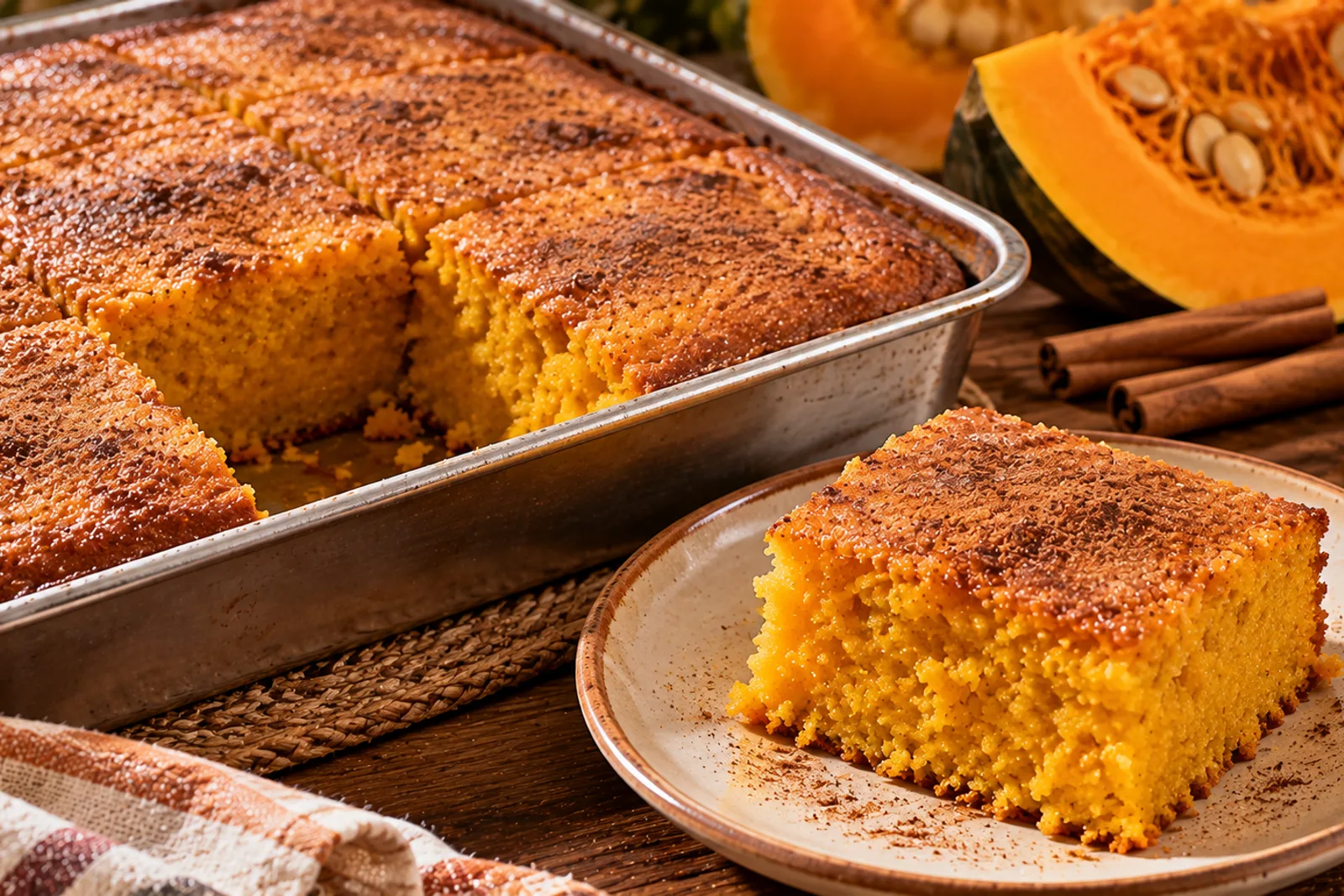

Torta de auyama (TOR-tah deh ow-YAH-mah) is Venezuela’s everyday pumpkin cake, made with auyama, the big orange-fleshed squash sold in wedges across the Caribbean and in Latin markets in the US as calabaza or West Indian pumpkin. Think of a spiced pumpkin bread baked in a round pan: dense, moist, deep orange, sweetened partly with papelón, an unrefined cane sugar with a dark caramel taste. The make-or-break detail is water. Fresh squash purée has to be drained until it’s as thick as canned pumpkin, or the middle bakes up gummy while the edges look done.
What it is and how long it takes
How do you make Venezuelan pumpkin cake? Steam peeled squash, mash it and drain the purée for 30 minutes. Mix 15 oz (425 g) of it with 1 stick (113 g) of melted butter, ¾ cup (150 g) sugar, ½ cup (100 g) packed papelón or dark brown sugar and 3 eggs, fold in 2 cups (250 g) flour with baking powder, baking soda and warm spices, and bake in a 9 in (23 cm) round pan at 350°F (180°C) for 45 to 55 minutes. 185 minutes in total for 12 slices, including the purée and cooling.
It isn’t light like a layer cake. The crumb is close and tender, the kind that slices neatly and stays moist for days, with cinnamon up front and cloves and nutmeg in the background. In Venezuela the same name also covers a pudding-style dessert baked over caramel in a water bath; this is the baked, sliceable one.
Time. About 25 minutes of hands-on work. The rest is steaming, draining, baking and cooling, and the purée can be made the day before. Easy: the only things to watch are how wet the purée is and whether the center is done.
Two other Venezuelan bakes on this site work the same way, turning something humble into dessert: Venezuelan bread pudding, made from stale bread, and sweet plantain cake with cheese, which walks the line between sweet and savory.
Ingredients and US and UK swaps
| Ingredient | Metric | US | Swap and what changes |
|---|---|---|---|
| Squash purée | 425 g | 1¾ cups (one 15-oz can) | Canned 100% pumpkin: denser, darker, milder |
| All-purpose flour | 250 g | 2 cups | UK plain flour |
| Granulated sugar | 150 g | ¾ cup | UK caster sugar |
| Papelón or piloncillo | 100 g | ½ cup packed | Dark brown sugar or dark muscovado |
| Unsalted butter | 113 g | 1 stick | 100 ml (scant ½ cup) neutral oil |
| Large eggs | 3 | 3 | No swap tested |
Which squash to buy
Auyama is Cucurbita moschata, the same species as butternut. Look for deep orange, firm flesh; pale squash gives a yellow, bland cake.
- US. Latin and Caribbean markets sell calabaza in plastic-wrapped wedges. Any supermarket has butternut year-round and kabocha in the fall.
- UK. Butternut squash is the easy choice; Caribbean grocers often carry West Indian pumpkin in pieces.
- Skip carving pumpkins. They’re watery and taste of very little.
A 1 kg (2¼ lb) piece leaves more than enough flesh once it’s peeled and seeded. Freeze what’s left over.
Canned pumpkin or fresh squash
A standard 15-oz can holds exactly the 425 g this recipe needs, and it’s the shortcut I’d take outside Latin America. Make sure the label says 100% pure pumpkin, not pumpkin pie filling, which is already sweetened and spiced. Canned pumpkin goes straight into the bowl; the cake comes out a shade darker and tastes less of fresh squash. In the UK canned pumpkin turns up in some large supermarkets and online, mostly in the fall.
If you go fresh, steaming is the method in the recipe. Boiled squash takes about as long but soaks up water, so it needs longer in the sieve. Roasted wedges, 30 minutes at 350°F (175°C) turned halfway, give a sweeter, drier purée and a slightly drier cake.
Papelón and its stand-ins
Papelón is unrefined cane sugar sold in hard cones or blocks; Colombians call it panela and Mexicans piloncillo, and Latin grocers sell all three. Grate it on a box grater. Dark brown sugar (or dark muscovado in the UK) is the closest supermarket swap, slightly less deep. With white sugar only, the cake is just as moist but paler and flatter. You can cut the papelón to 50 g (¼ cup packed) for a less sweet cake that browns less.
Pan and equipment
A 9 in (23 cm) round pan at least 2 in (5 cm) deep, a fine-mesh sieve, a steamer basket (or a metal colander set over a pot with a lid), two bowls, a whisk and a spatula. No mixer needed. An instant-read thermometer helps with the center but isn’t essential.
Other pans take the same batter; only the time changes. A 10 in (24 cm) tube or Bundt pan needs 50 to 60 minutes, a 9 x 5 in (23 x 13 cm) loaf pan 60 to 70, and muffins about 20 to 25.
Step by step
Steam and drain the squash
Steam the cubes covered for 15 to 20 minutes, until a fork meets no resistance. Steaming keeps them drier than boiling. Mash, then drain in a sieve for 30 minutes: lots of drips at first, then almost none. When a spoonful mounds and leaves no puddle, it’s ready. Weigh it after draining.
The purée keeps 3 to 4 days covered in the fridge and 3 months frozen. Thawed purée weeps, so drain it again.
Mix by hand, and stop early
The butter should be warm, not hot, or it starts to cook the eggs. Whisk it with both sugars for 1 minute, then the eggs one at a time, the vanilla and the purée. Fold in the flour mix in two batches just until it disappears. A few specks of papelón are fine. Keep stirring and the crumb turns tight and rubbery. The batter should be thick, falling from the spatula in heavy ribbons.
Bake to the right center
350°F (180°C), middle rack, 45 to 55 minutes for the 9 in pan; start checking at 40. It’s done when:
- the top springs back under a light press;
- the edges pull away from the pan;
- a skewer in the center comes out with no wet batter, a moist crumb or two at most. Test halfway between edge and center as well, since the outside sets first.
With a thermometer, the center reads 200 to 205°F (93 to 96°C). Tent with foil if the top darkens too fast.
Cool before you cut
15 minutes in the pan, then on a rack for at least 45 minutes. A hot crumb is still setting and squashes under the knife. Wrapped overnight, it gets moister and the spices come forward, so it’s a good make-ahead cake.
If it comes out gummy, sunken or dry
- Gummy middle, clean skewer at the edge. Wet purée or too little time. Drain until it mounds and test the center. If you’ve already cut it, a further 10 minutes at 350°F (180°C) under foil will set the middle, though the cut face dries a little.
- Sank after baking. Underbaked, or the baking powder was old. Check the date and keep the oven door shut for the first 35 minutes.
- Rubbery, springy crumb. Overmixed after the flour went in.
- Dry and crumbly. Overbaked, or roasted purée that was very dry. Pull it as soon as the skewer shows no wet batter.
- Dark outside, raw inside. Oven running hot or a small, deep pan. Drop to 340°F (170°C) and tent with foil halfway.
Allergens. Contains wheat (gluten), egg and milk (butter). Not spicy; most kids like it, especially without the cloves.
Variations
- With raisins. The optional ½ cup (75 g), tossed in flour so they don’t sink. Drain them well if you soak them in rum or warm water first.
- Oil instead of butter. 100 ml (scant ½ cup) neutral oil keeps the crumb softer straight from the fridge, with less butter flavor.
- Muffins. Fill lined muffin cups two-thirds full and bake at 350°F (180°C); start testing with a skewer at 20 minutes.
- Double batch. Double everything and use a 9 x 13 in (23 x 33 cm) pan, greased and lined. The batter sits deeper than in the round pan, so start checking at 45 minutes and go by the skewer and the 200°F (93°C) center.
- Pudding style. The custardy Venezuelan version uses far less flour, bakes over caramel in a water bath and chills for hours. If that’s the texture you want, the caramel and water bath work exactly as in Venezuelan quesillo.
For other squash recipes, Mexican calabaza en tacha simmers wedges in piloncillo syrup, and Colombian squash soup is the savory everyday use. If you like vegetable cakes, the Brazilian carrot cake blends raw carrots into the batter.
Serving and storing
Serve at room temperature with black coffee or a glass of milk, plain or dusted with powdered sugar or cinnamon. The 9 in round cuts into 12 slices.
Room temperature. Covered, 2 days. In hot, humid weather, refrigerate from day one.
Fridge. Well wrapped, up to 5 days. The cold firms the crumb, so take it out 30 minutes before serving or give a slice 10 to 15 seconds in the microwave.
Freezer. Whole or in wrapped slices inside a freezer bag, 3 months. Thaw at room temperature still wrapped, so condensation stays on the wrapping and not on the cake.
Venezuelan pumpkin cake FAQ
Is torta de auyama the same as American pumpkin bread? Close relatives: both are spiced quick breads leavened with baking powder and soda and built on pumpkin purée. This version is sweetened partly with papelón, made with butter and baked in a round pan, so it’s served in wedges like a cake rather than sliced from a loaf.
Can I use raw grated squash? Not in this recipe. Raw squash releases its water in the oven and leaves strands in the crumb; cakes built on grated squash use different ratios.
Can I use frozen butternut cubes? Yes. Steam them from frozen for a few minutes longer than fresh, then drain the purée longer, as frozen squash gives off more water.
Why does mine taste bland? Pale squash, boiled purée or skipped salt. Choose deep orange flesh, steam it, and keep the ½ tsp (3 g) of salt, which is what makes the cinnamon and papelón come through.
Nutrition per slice
One of 12 slices, worked out ingredient by ingredient from the recipe quantities, without raisins:
- Calories: 251 kcal
- Protein: 4 g
- Carbohydrates: 39 g
- Fat: 9 g (5 g saturated)
- Fiber: 1 g
- Sugars: 22 g
- Sodium: 224 mg
Flour brings about 76 kcal per slice, the two sugars about 80 and the butter about 68; the squash only 7. Raisins add roughly 19 kcal a slice.
Most of the time I don’t buy squash for this cake. I buy it for soup, and the cake comes from the piece that’s left over, which is why I split it over two days: purée one evening, bake the next. It also stops me from skipping the draining, which is the step that matters. If the first slice seems quiet, wrap the rest and try it again tomorrow. Josnaisis.