
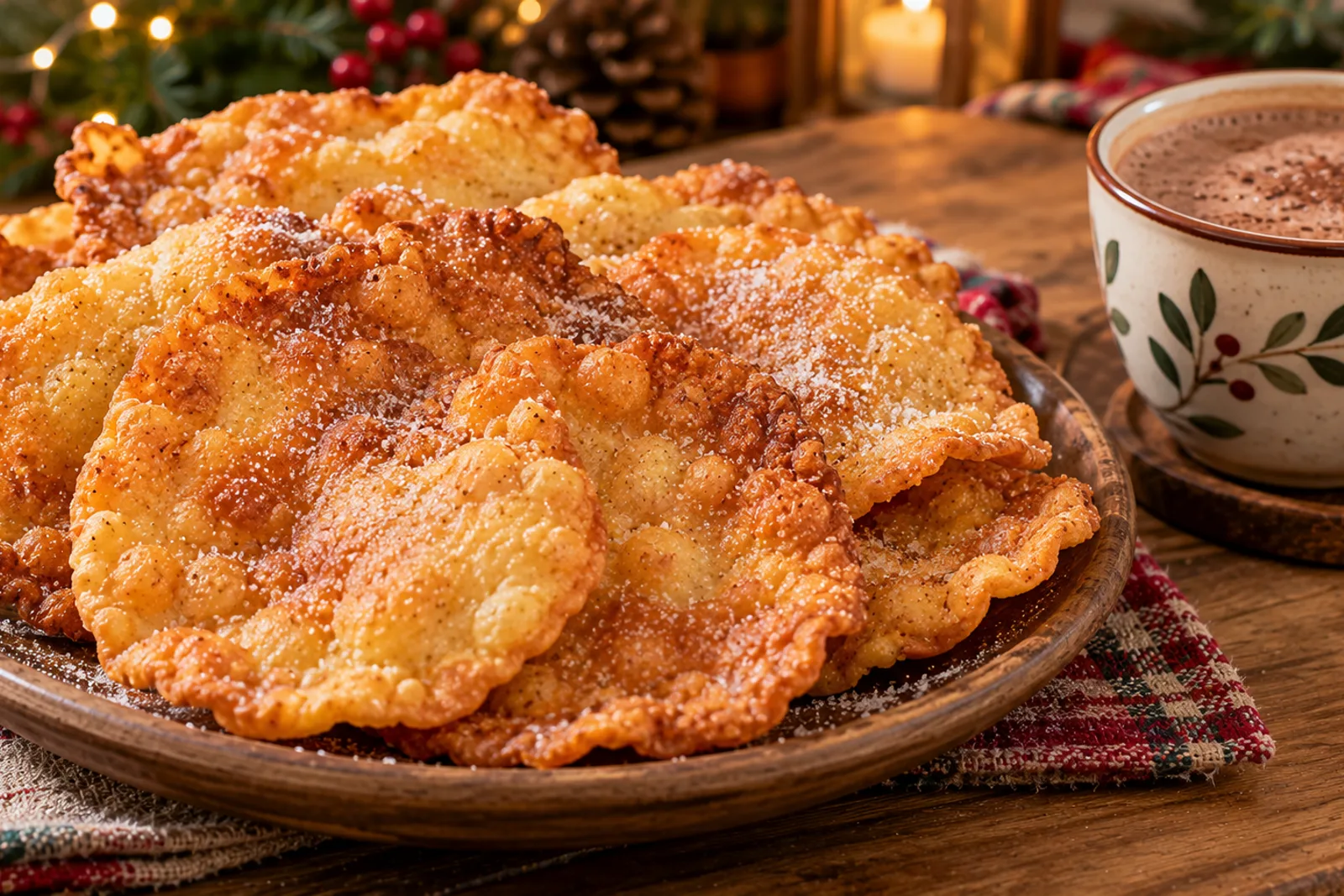

Hojaldras (oh-HAHL-drahs), from Colombia, are thin sheets of wheat-and-egg dough, deep-fried until they puff and blister, then tossed in sugar while hot. In Colombia they’re a Christmas sweet, set out with custards and cheese fritters during the nine nights of prayer before Christmas Eve. This version uses baking powder and two eggs, so the pastries come out puffier and more tender than the thinner, shattering style. One batch makes about 60, enough for 12 people. Here’s the dough, how thin to roll it, the oil temperature with and without a thermometer, how many to make for a crowd and how to keep them crisp for days.
What hojaldras are, and how they differ from hojuelas
How do you make Colombian hojaldras? Rub 3 tbsp (40 g) of cold butter into 4 cups (500 g) of flour with 2 tsp baking powder, sugar and salt, add 2 eggs beaten with ⅔ cup (150 ml) orange juice, knead and rest 30 minutes. Roll to 1/16 in (2 mm), cut into 4 x 1½ in (10 x 4 cm) strips, fry at 350°F (175°C) for 1 to 2 minutes per side and toss in sugar while hot. 85 minutes for 12 servings.
Hojaldra is the name used mainly in Colombia’s Valle del Cauca, around Cali, for the fried wheat pastry that people in Medellín call hojuela. It belongs to December: the Novena, nine evenings of prayer from December 16 to 24, ends with a table of sweets, and hojaldras sit beside Colombian natilla, cheese buñuelos and, in the Valle, Colombian manjar blanco.
Two doughs travel under both names. One uses a single egg, orange juice and no leavening, and fries into glass-thin sheets that shatter; that’s our Colombian hojuelas with panela syrup. The other, this one, adds baking powder and a second egg. The result puffs more evenly, with a tender middle that crunches without splintering.
The other two in the chart get mixed up by name or by pan. Colombian buñuelos aren’t wheat at all: they’re savory cheese balls bound with cornstarch and tapioca starch, fried in cooler oil. Dominican yaniqueques are thin wheat discs with baking powder too, but with no egg or orange, and usually eaten salted.
One more name clash. In Panama, an hojaldra (or hojalda) is something else: a soft fried breakfast bread eaten with fresh cheese, eggs or beans. It isn’t this pastry.
Time and difficulty. 85 minutes, 30 of them a hands-off rest. Medium difficulty: the dough is easy; rolling evenly to 1/16 in and holding the oil at temperature through 8 batches take a little practice.
Ingredients for 60 hojaldras, and US and UK swaps
| Ingredient | Metric | US | Notes |
|---|---|---|---|
| All-purpose flour | 500 g | 4 cups | UK plain flour; not bread flour |
| Baking powder | 8 g | 2 tsp | Check it’s fresh |
| Sugar (dough) | 25 g | 2 tbsp | |
| Salt | 3 g | ½ tsp | |
| Cold butter | 40 g | 3 tbsp | Margarine works the same |
| Eggs | 2 large | 2 large | UK large or medium-large |
| Orange juice | 150 ml | ⅔ cup | Carton juice is fine |
| Frying oil | 1 liter | about 1 quart | Neutral, high smoke point |
| Sugar (coating) | 60 g | 5 tbsp | Granulated or powdered |
- Flour. Ordinary all-purpose (UK plain). Bread flour makes a springy dough that shrinks back every time you roll it.
- Baking powder is the difference between this pastry and an hojuela: it releases gas in the hot oil, so the sheet puffs more and stays tender. Leave it out and you get the thinner, brittle hojuela.
- Two eggs give the stretch to roll thin without tearing, plus color and a tender center.
- Cold butter, rubbed into the flour, makes the pastry snap rather than bend.
- Orange juice is both the liquid and the aroma. Carton juice without added sugar works; add the zest of one orange for more fragrance.
- Oil. Soybean, sunflower, canola or UK rapeseed. Extra-virgin olive oil leaves its own taste.
The panela version. Some families wet the dough with Colombian aguapanela, a drink of unrefined cane sugar dissolved in water, instead of orange juice: the same ⅔ cup (150 ml), cold. The pastries turn darker and taste of brown sugar, and because the dough holds more sugar, they color faster, so watch the first batch. Panela is sold as piloncillo in the Mexican section of US supermarkets and in Latin shops in the UK.
Equipment. A rolling pin (or a smooth wine bottle), a knife or pizza wheel, a deep 8 to 9½ in (20 to 24 cm) pot, a slotted spoon, a rack or paper towels and, ideally, a deep-fry thermometer.
How to make hojaldras step by step
Start to finish takes 85 minutes. The rest gives you a free half hour, and the oil heats while you finish cutting, so the frying is the only stretch you can’t walk away from.
The dough, smooth and firm
Whisk the dry ingredients, rub in the cold butter until it looks like coarse sand, then add the eggs beaten with the juice. Knead 5 to 8 minutes. It’s ready when it’s smooth and firm, doesn’t stick to your fingers, and a finger dent springs back slowly. Soft, sticky dough soaks up more oil; too much flour makes it tough. Adjust a tablespoon at a time.
A 30-minute rest
Wrapped, at room temperature. Resting relaxes the dough; skip it and it shrinks every time you roll, so the pastries end up thick.
Roll to 1/16 inch and cut
Work with a quarter of the dough at a time and keep the rest covered. Roll to 2 mm (1/16 in), until you can see the shadow of your hand through it. Cut into 4 x 1½ in (10 x 4 cm) strips or diamonds. Flour the counter sparingly: loose flour burns in the oil.
Fry at 350°F
About 1½ in (4 cm) of oil in the pot, never more than a third of its height. Batches of 8: more pieces drop the temperature.
What you should see. The pastry floats straight up with lively bubbles around it, blisters and puffs within 10 to 15 seconds, and is pale gold after 1 to 2 minutes per side. It keeps coloring a little out of the oil, so pull it one shade early.
Sugar while hot
Toss each batch in sugar within 30 seconds of lifting it out, while the surface is still slick. Granulated sugar gives a crunchy sparkle; powdered sugar a soft white coat. Once they cool, sugar won’t stick.
Why hojaldras turn out tough, greasy or flat
- Tough → rolled thicker than ⅛ in (3 mm), dough not rested, or too much flour on the counter. Roll to 1/16 in and give it the full 30 minutes.
- Pale and greasy → oil below 330°F (165°C), or too many in the pot. Wait for 350°F (175°C) between batches.
- Dark outside, raw inside → oil at 375°F (190°C) or more, or dough too thick. Lower the heat and test with a scrap.
- Flat, no puff → old baking powder or dough too dry. Drop a pinch of the powder into hot water; if it doesn’t fizz, replace it.
- Browning in seconds → panela dough, or oil running too hot. Pull them sooner and turn the heat down.
- Re-rolled scraps come out tough → pressing them together works the dough again. Rest them 10 minutes, covered, before rolling.
With kids around. Let them cut with the pizza wheel and do the sugaring at another table, away from the stove. Pot on a back burner, handle turned in, and never any water near hot oil.
Heat level, 0 out of 5. Most kids love them. Allergens: wheat (gluten), egg and milk (butter). Dairy-free with vegetable margarine.
How many to make for a party, and what to do ahead
I count about 4 per person when they share the table with other desserts, and 6 if they’re the only sweet. The recipe scales straight up: multiply everything by the same amount.
The day before. The dough keeps, wrapped, in the fridge for up to 24 hours; give it 30 minutes out before rolling or it cracks. Fried and fully cooled, the pastries keep 3 to 4 days in a tin, so you don’t have to fry on the day.
Half batch. 250 g (2 cups) flour and 1 egg make about 30, for 6 people, in a little over an hour.
The expensive part is the quart of frying oil, even though the pastries only take up some of it. Strained and cooled, it can fry another batch the next day; if it smokes before reaching temperature or smells stale, throw it out.
Serving hojaldras and keeping them crisp for 3 to 4 days
How to serve them. Piled on a big plate with custard or manjar blanco beside them, and something hot to drink, like Colombian hot chocolate or aguapanela. A spoonful of dulce de leche on top, right before eating, is another December favorite.
Variations. Cinnamon sugar: 1 tsp ground cinnamon per 60 g (5 tbsp) sugar. Powdered sugar gives a whiter, softer bite. What doesn’t work is soaking them in syrup to store: they go soft within a couple of hours.
Storing. Completely cool, in an airtight tin or jar lined with a paper towel, at room temperature and away from the stove. They stay crisp 3 to 4 days; with baking powder and two eggs the center is more tender than an hojuela’s, so they soften sooner. Don’t refrigerate them: the moisture softens them.
Re-crisping. Oven at 300°F (150°C) for 3 to 4 minutes on a sheet pan, then cool on a rack before they go back in the tin. There’s no need to freeze fried hojaldras.
5 common questions about hojaldras
Are hojaldras and hojuelas the same thing? They’re very close, and the name changes by region: hojaldra mainly in Valle del Cauca, hojuela in Medellín. What really changes is the dough. With baking powder and two eggs, like this one, they’re puffier and more tender; without leavening, thinner and more brittle.
Are hojaldras the same as puff pastry? No. Hojaldre means puff pastry in Spanish, which causes the mix-up, but hojaldras are a quick kneaded dough that’s fried, not a laminated dough that’s baked.
Do hojaldras have anise? Colombian hojaldra dough is scented with orange, not anise. If you love anise you can add it, but that makes it your own variation rather than the December classic.
Can I make them without baking powder? Yes, and you’ll get the classic hojuela: thinner, more brittle, with more irregular blisters. Roll it even thinner.
Can I make them without eggs? I haven’t tested it. Without the two eggs the dough loses the stretch and the tender center that define this version; for an egg-free fried pastry, start from the hojuela instead.
Hojaldras nutrition
Per serving of 5 pastries, sugar-coated, allowing for about 150 g (5¼ oz) of oil absorbed across the whole batch:
- Calories: 331 kcal
- Protein: 6 g
- Carbohydrates: 40 g
- Fat: 16 g, of which 4 g saturated
- Fiber: 1 g
- Sugars: 8 g
- Sodium: 181 mg
Nearly half the fat is frying oil, and it depends on temperature: in cooler oil the pastry soaks up much more.
In my kitchen hojaldras and hojuelas share December without competing. The hojuelas go in the tin that lasts the week; the hojaldras are for eating the same day or the next, still a little warm, with their soft middle. If you only get one thing right, make it the thickness: at 1/16 inch almost everything else forgives you. Josnaisis.