
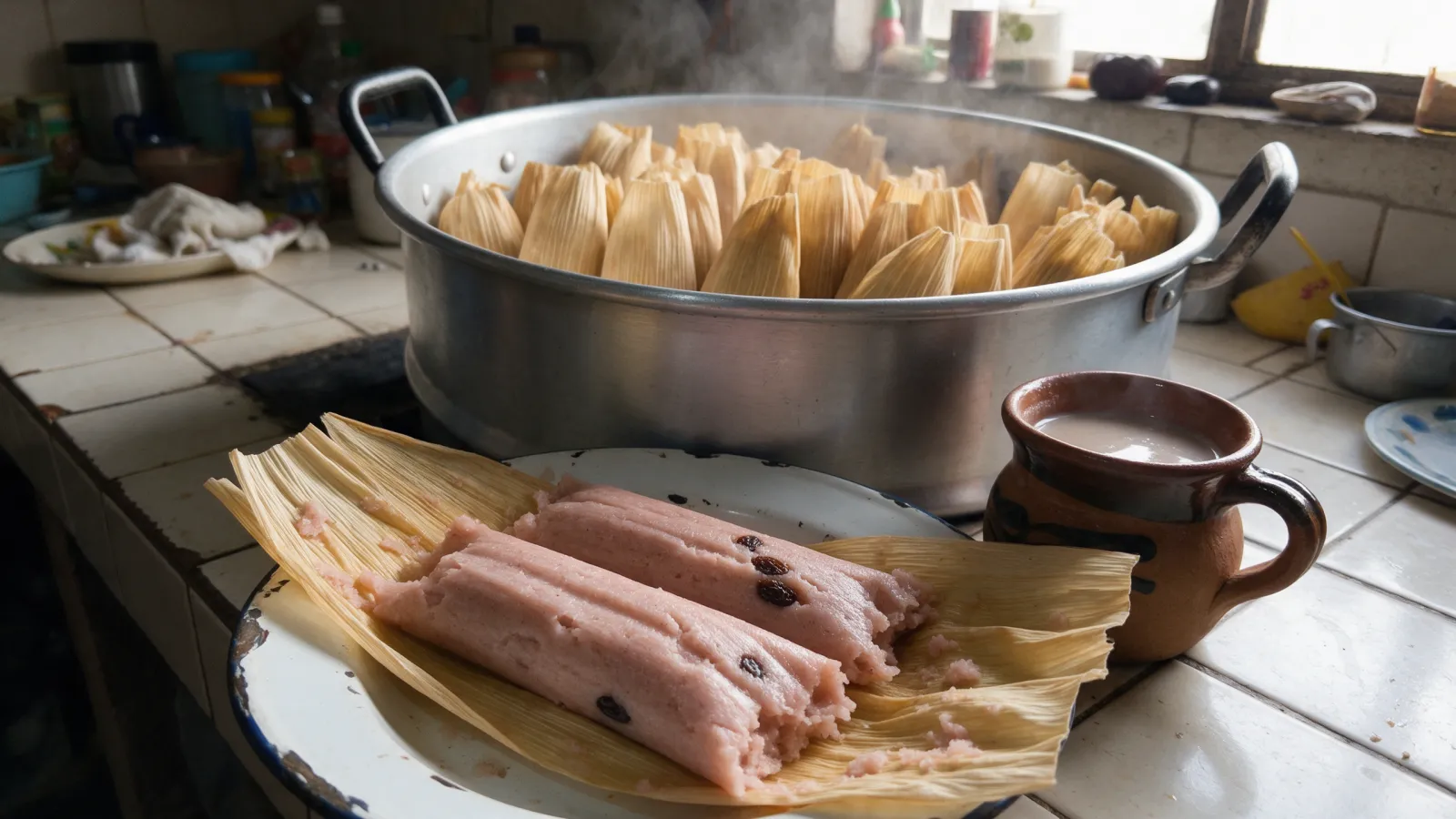

Tamales de dulce (tah-MAH-lehs deh DOOL-seh) are Mexico’s dessert tamales: no filling, just corn masa whipped with lard, butter and sugar, tinted pink, studded with raisins, wrapped in a corn husk and steamed until it turns into something between a sponge cake and cornbread. They show up with a mug of atole on February 2, Candlemas, and at Christmas posadas. The batter has to be whipped until a dab floats in ice water, and here’s the catch nobody warns you about: test it before the raisins go in, or it sinks no matter how well you beat it.
Are sweet tamales worth making at home?
How do you make Mexican sweet tamales? Cream lard, butter and sugar until pale, then beat in corn masa with warm milk, cinnamon and pink coloring until ½ teaspoon floats in ice water. Fold in raisins, spread the batter on soaked corn husks with no filling, fold, and steam about 75 minutes, then rest 15. Ready in 160 minutes for 24 servings (24 tamales).
Yes, if you have a free afternoon or you’re already making savory tamales. There’s no filling to cook, so the hands-on part is short: about 55 minutes out of 160, all of it in the first hour. The rest is steam and a 15-minute rest.
When they shine. Candlemas, when whoever found the figurine in the Mexican three kings bread on January 6 is supposed to host the tamales. Also Christmas, when they can share dessert duty with a creamy Mexican apple salad, a breakfast with hot drinks, or the sweet end of a tamale party.
Who might skip them. Anyone after a light dessert: each tamale is about 223 kcal, half of it from fat. Dairy-free tables, unless you use the coconut version below. And anyone without a pot tall enough to stand 24 tamales upright.
Difficulty, honestly medium. Two things decide the result: batter that floats, and patience before you unwrap the first one. Nothing else is hard.
The pink is decoration, not a flavor. It used to come from cochineal and now comes from food coloring, and lard, cane sugar and raisins arrived with the Spanish to a corn dough that already existed.
What you need, and what to buy in a US or UK supermarket
Exact amounts are in the recipe card: 1 kg (2.2 lb) masa, 150 g (5.3 oz) lard, 150 g (5.3 oz) butter, 250 g (8.8 oz) sugar, 250 ml (1 cup) milk, 110 g (¾ cup) raisins and 36 husks for 24 tamales.
The sugar question
250 g per kilo of fresh masa, 1¼ cups per 2.2 lb. Converted to fresh-masa weight, the usual versions range from 88 to 294 g per kilo. The sweetest, filled with guava and cream cheese, sit around 294 g; the lightest sit between 88 and 132 g and taste like barely sweet cornbread. 250 g, the amount in the traditional version, tastes like dessert without being cloying, and the raisins add the rest. Taste the raw batter: steam mutes sweetness a little.
Lard, butter or shortening
I use half lard, half butter, 300 g (10.6 oz) of fat per kilo, the same ratio as my green chicken tamales. Lard whips up and holds more air; butter is 81 % fat and mostly water otherwise, so on its own it gives a denser tamale, but it tastes like butter, which you want here.
- No pork → vegetable shortening (Crisco in the US, Trex in the UK) in place of lard, same weight. Hardly any difference.
- All butter → 300 g (10.6 oz, 2⅔ sticks). Richer, denser, slower to float.
- Oil → it can’t be whipped, so the tamales come out heavy. I don’t use it for sweet ones.
- UK note → lard is sold in blocks in most supermarkets, next to the butter.
Fresh masa or masa harina
Fresh unprepared masa comes from a tortillería. Without one, masa harina for tamales (Maseca Tamal is the common bag in the US): 400 g (14 oz, 3½ cups) plus 600 ml (2½ cups) hot water replaces 1 kg (2.2 lb) of fresh masa. In the UK, buy it from Mexican grocers online. Prepared masa already contains fat and salt, so leave out the lard and butter and just beat in sugar, milk and color. Cornmeal, polenta and precooked arepa flour won’t work: the corn isn’t nixtamalized (cooked with lime), and the texture and flavor are wrong.
Food coloring, natural or not
For the classic shade, pink gel paste, a toothpick tip per batch, or 8 to 10 drops of red liquid coloring per 2.2 lb of masa. Some cooks use 6 drops for a batch of about 10, others 8 to 10 for 29. Supermarket red drops in the US are often Allura Red, listed as Red 40, and in the UK and EU that dye must carry a warning that it may affect activity and attention in children. If that bothers you, skip it: color doesn’t change the taste.
Natural colors struggle here. Beet fades with long heating and turns yellow-brown above pH 7.5, and masa is made with lime, which is alkaline, then steamed for 75 minutes. Hibiscus goes purple. Carmine (cochineal) gives a stable pink, but it has had to be named on US labels since 2011 because of severe allergic reactions, and it isn’t vegan.
Where to find the rest
- Corn husks → Latin aisle of large US supermarkets, Mexican grocers, or online in the UK. One 8 oz (227 g) bag covers a batch with spares.
- Raisins → any brand; golden raisins work the same.
- Equipment → an 8 to 10 quart (8-10 L) stockpot with a steamer basket, a stand or hand mixer, and a deep bowl. No tamale steamer? A metal colander or a heatproof plate on three balls of foil inside a tall pot does the job, as I show in the green tamales. No mixer? A wooden spoon and about 20 minutes of beating in two half batches, in my experience.
How to plan your tamale day
Make ahead. Beat the batter the day before, without the raisins, and refrigerate it covered. Next day, give it 30 minutes on the counter, beat 2 to 3 minutes with a splash of warm milk and redo the float test. Batter and finished tamales both keep several days in the fridge.
Order of work. Husks and raisins into hot water, cream the fat and sugar, add masa, milk and color, float test, fold in raisins, then fill and fold in an assembly line while the steamer heats.
How to tell each stage is right.
- Husks → fold without cracking after 30 minutes.
- Creamed fat → pale and fluffy after 8 minutes.
- Batter → thick cake batter, evenly pink, no streaks.
- Float test → ½ teaspoon floats in ice water, before the raisins.
- Steam → constant steam at the lid’s edge and a rattling coin.
Why the float test fails with raisins
A whipped batter floats because the fat traps air, and that air expands in the steam and lightens the tamale. Drop ½ teaspoon in cold water, and run the test before the raisins go in. With a raisin in the dollop, it’s heavier and sinks even when the batter is fine. Use ice water so the fat in the dollop doesn’t melt and fool you.
Steaming time and the doneness test
Test one at 60 minutes and plan on 75 minutes from the boil for a full 8 to 10 quart pot of 24. Times run from 45-60 minutes for small batches to about 2 hours for a pot of 25-35; most batches land near 75. Pull one out, wait 5 minutes, unwrap. If the husk peels away clean, they’re done. In my kitchen, sweet masa straight from the pot looks even rawer than savory, soft and glossy, and opening it then is what makes people over-steam.
Party math
- 4 to 6 people → half batch: 500 g (1.1 lb) masa, 75 g each of lard and butter, 125 g (⅔ cup) sugar, 125 ml (½ cup) milk, 55 g raisins. 12 tamales; check one at 45 minutes.
- 12 to 20 → the full recipe, 24 tamales. Next to savory tamales, I count one sweet and two savory per person.
- 40 → 2 kg (4.4 lb) masa and 48 tamales, beaten in two 1 kg batches, since a home mixer can’t handle more. Two pots or two rounds of steaming.
Before you start, mistakes, kids and allergens
- Heavy, dense tamales → under-whipped or too little fat. The dollop must float.
- Never floats → batter too dry or fat too cold. Add 50 ml (3 tbsp) warm milk, beat 2 minutes, test again.
- Pale pink after steaming → steam lightens color. Mix the raw batter one shade deeper.
- Brownish or gray pink → beet or hibiscus in limed masa. Use gel or liquid coloring.
- Wet patches around fruit → the raisins or pineapple went in wet. Drain and pat dry.
- Batter stuck to the husk → not enough steam, or opened too hot. Rest 5 minutes; if still sticky, 15 minutes more.
Heat level, 0 out of 5. Kids? Usually a hit; each tamale has about 14 g of sugar, so half is plenty for small ones, and tell them the husk isn’t eaten. Allergens: dairy (butter, milk). No gluten or egg, since masa is corn, but check the baking powder and masa harina labels for anyone with celiac disease. Carmine is a known allergen; nuts, if you add pecans.
Which version should you make?
- Short on time → prepared masa: beat in sugar, milk and color for 5 minutes, test and fill. Saves about 15 minutes.
- Pineapple → 200 g (1 cup) drained canned pineapple instead of raisins, and half the milk swapped for the syrup. Pineapple tamales can need up to 90 minutes of steam.
- Coconut → 100 g (1 cup) shredded coconut, and coconut milk instead of milk. With lard or shortening in place of the butter, it’s dairy-free.
- Strawberry → 2 tablespoons strawberry drink powder in the batter, or a splash of grenadine.
- Lighter → 200 g fat and 200 g sugar per kilo: about 40 kcal less per tamale, slightly firmer.
- Filled → tuck cubes of guava paste and cream cheese into each one.
They’re nothing like Colombian tamales, such as Colombian chicken tamales in banana leaf, which are savory, kneaded rather than whipped, and packed with meat and vegetables. Mexico’s other sweet corn dessert, pan de elote, a sweet corn cake with condensed milk, skips the masa and uses fresh kernels.
How much do sweet tamales cost?
About $13.80 for 24, or 58 cents a tamale, using US average prices for August 2026 (sugar $1.024/lb, butter $4.021/lb, whole milk $4.229/gal) and store listings for the rest: an 8 oz bag of husks at $8.99 (Safeway), a 4 lb tub of Armour lard at $11.12 (Walmart), a 4.4 lb bag of masa harina at $3.31 (H-E-B) and a 12 oz box of Sun-Maid raisins at $3.28 (Walmart). The butter price is for salted butter. Baking powder, cinnamon and coloring aren’t counted.
What drives the price is the husks, about two thirds of the total. The batter alone is $4.81, 20 cents a tamale, and the leftover husks go toward the next batch. Swap the butter for more lard and you save about 40 cents. I couldn’t find verifiable UK or Mexican prices for these ingredients, so I don’t give them.
What to expect, serving and storing
Taste and texture. Soft, moist and cakey, softer than savory masa, with cinnamon, toasted corn from the nixtamalized masa and juicy raisins. Pink inside, no dye taste.
How they’re served. Hot, in the husk, which each person peels on their plate. In Mexico they go with a hot corn drink: Mexican atole or a thick champurrado, chocolate atole. Adults may prefer café de olla, spiced Mexican coffee.
Fridge. No more than 2 hours at room temperature, then 3 to 4 days at 40°F (4°C) or below, in their husks in a closed container.
Freezer. Cooked, cooled, in their husks, in airtight bags: 3 to 4 months for best quality. The best way to get ahead for Candlemas.
Reheating. Steam them: 15 to 20 minutes from the fridge, about 30 minutes from frozen without thawing, to 165°F (74°C) in the center. Or thaw them overnight in the fridge and re-steam 15 minutes. In the microwave, wrap in a damp towel and heat in 1-minute bursts. On a dry skillet in the husk, turned now and then, the sugar at the edges toasts into a crust I like even better than day one.
Sweet tamale questions
How much sugar goes into sweet tamale masa? Here, 250 g (1¼ cups) per kilo (2.2 lb) of fresh masa. Under 150 g per kilo they barely taste sweet; the usual range is 88 to 294 g.
What makes sweet tamales pink? Food coloring: pink gel or a few drops of red liquid, added at the end of beating. Traditionally it was cochineal. The color has no flavor.
Can I color them naturally? Beet fades toward brown and hibiscus turns purple in limed masa over 75 minutes of steam. Carmine stays pink but is an allergen. Or leave them ivory.
How do I know the masa is ready? ½ teaspoon floats in a glass of ice water. Test before adding raisins.
How long do sweet tamales steam? Steam about 75 minutes from the boil, then rest them covered for 15; that’s for a full pot of 24. Done when the husk peels away clean after a 5-minute rest.
Why are my sweet tamales hard? The batter wasn’t whipped enough or had too little fat. It should float before you fill the husks, with 300 g (10.6 oz) of fat per kilo of masa.
Can I freeze sweet tamales? Yes, cooked and cooled in their husks, for 3 to 4 months. Steam about 30 minutes from frozen to 165°F (74°C).
Can I make them in an Instant Pot? Some cooks do pineapple tamales at low pressure for 35 minutes with a 10-minute natural release. I haven’t tested it with this batter, so I’d stick to the steamer.
Nutrition per tamale
Per tamale (1 of 24, about 80 g of batter), calculated ingredient by ingredient using this recipe’s amounts, with the fresh masa counted as 400 g of masa harina:
- Calories: 223 kcal
- Protein: 2 g
- Carbohydrates: 28 g
- Sugars: 14 g, from sugar and raisins
- Fat: 12 g, 6 g saturated
- Fiber: 1 g
- Sodium: 85 mg
Half the calories come from fat. The lighter version, 200 g each of fat and sugar per kilo, comes to about 181 kcal.
Where I live in Colombia, the closest thing I knew to a sweet tamal was an envuelto de mazorca, made from fresh sweet corn in its own husk. My first pink batch came out heavy because I kept beating, convinced the batter was failing the float test, when it was only the raisin in the dollop. Now I scoop the test before the fruit goes in. Josnaisis.