

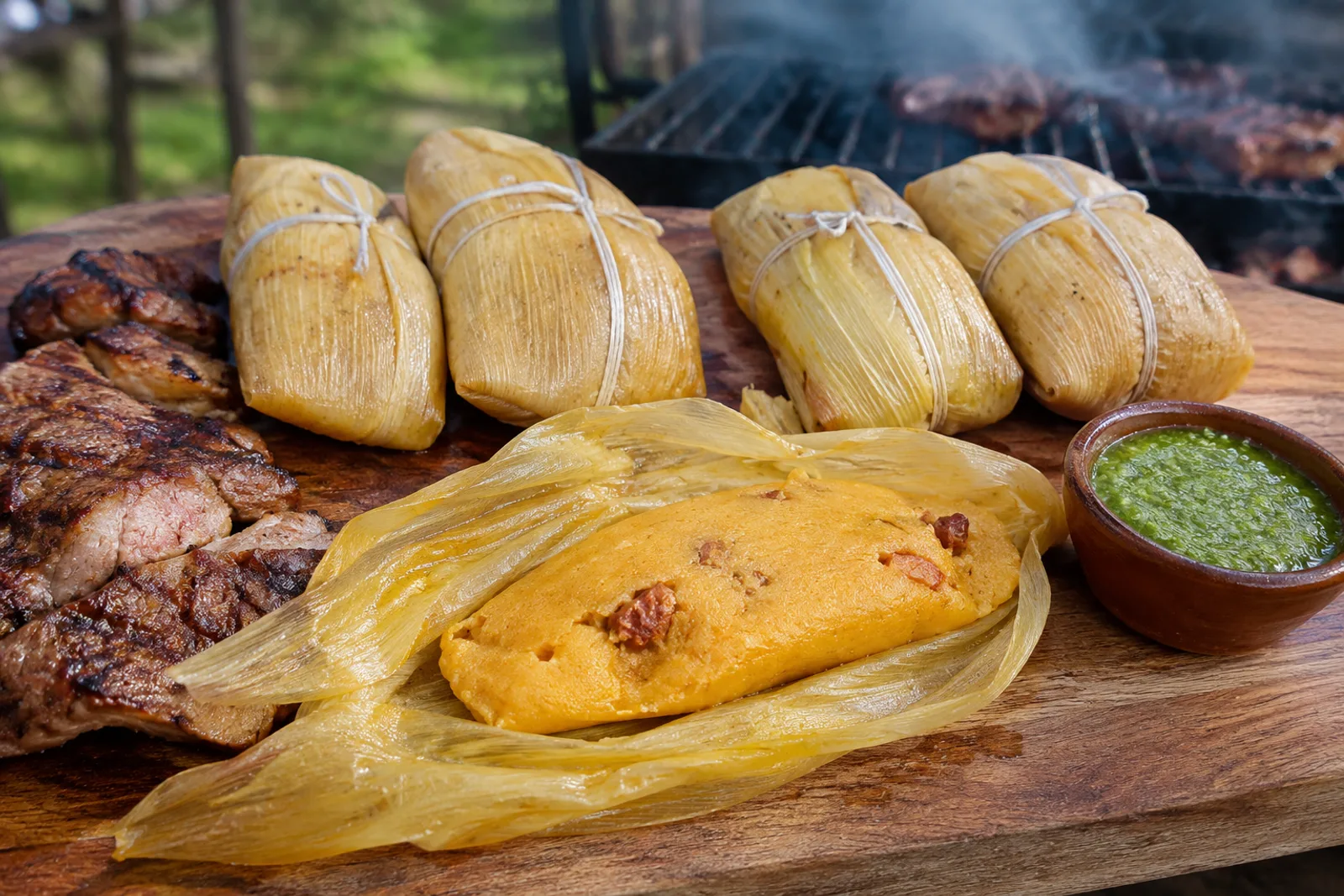

A Venezuelan hallaquita (ah-yah-KEE-tah) is a tamale with no filling, made with arepa flour instead of masa, rolled in a corn husk like a wrapped candy and boiled rather than steamed. The whole recipe fits in one line: 3 cups of precooked cornmeal to 3 cups of warm water, 4 tablespoons of lard, twelve logs of 105 g (3¾ oz) and 40 minutes in salted water. In Venezuela it sits next to the grilled beef at a cookout, the way bread or potato salad would at an American barbecue. Below are the dough test, how to tie them without kitchen string, how to tell they’re cooked, what to use in the US and UK, and how many to make for 20 people.
What hallaquitas are, and how they differ from hallacas
How do you make Venezuelan hallaquitas? Mix 480 g (3 cups) of precooked cornmeal with 720 ml (3 cups) of warm water, 50 g (4 tablespoons) of lard and 9 g (1½ teaspoons) of salt, shape 12 logs of 105 g (3¾ oz), roll each in two soaked corn husks, tie the ends and boil covered for 40 minutes in salted water. Rest them 10 minutes before unwrapping. 95 minutes for 6 servings.
They are plain on purpose. You unwrap one on your plate and eat it in bites between forkfuls of steak, sausage and a spoonful of guasacaca, the tangy Venezuelan avocado sauce or Venezuelan garlic sauce. The other classic version has crushed pork rinds kneaded into the dough, which makes them salty and rich enough to eat on their own.
The names get mixed up, even among Venezuelans:
- Hallaca. The Christmas dish: dough spread on a banana leaf, filled with a three-meat stew, olives and raisins, and boiled for 90 minutes. The full recipe is in Venezuelan hallacas.
- Bollo navideño. Leftover hallaca dough and stew mixed together and wrapped in banana leaf. Some families call these hallaquitas too; they’re in Venezuelan Christmas bollos.
- Bollito pelón. A dough ball stuffed with beef and simmered in tomato sauce, no leaf at all: Venezuelan bollitos pelones.
- Hallaquita, this recipe. Unfilled dough in a corn husk, made all year. Its closest cousins are on the Colombian coast: Colombian bollo de yuca uses the same husk with cassava dough, and Colombian corn envueltos are made with fresh sweet corn.
Time and difficulty. 95 minutes, of which about 30 are hands-on: mixing and wrapping. The rest is soaking, boiling and resting. Easy. The only skill is tying them snugly, and you’ll have it by the third one.
Ingredients for 12 hallaquitas, with US and UK swaps
The recipe makes 12 rolls of about 105 g (3¾ oz), two each as a side for 6. Scaling for a bigger cookout is further down.
The flour, the fat and the salt
- Precooked cornmeal, sold as masarepa or arepa flour: P.A.N., Goya or Juana, white or yellow. Yellow gives golden hallaquitas. In the US it’s in the Latin aisle of most large supermarkets; in the UK, online and in Latin American grocers.
- Regular cornmeal, polenta and grits won’t work. They’re raw and won’t form a dough with warm water. Mexican masa harina does make a dough, but the result tastes like a tamale, not a hallaquita.
- Lard gives the tender crumb and the savory flavor. In the US it’s sold in tubs in the Latin aisle and in blocks near the shortening; in the UK, in blocks in the baking aisle. Butter works and tastes richer; vegetable oil or shortening work and taste more neutral. Use the same weight.
- Salt. The 9 g is fine table salt. If you only have kosher salt, weigh it: by volume, Diamond Crystal takes about twice as many spoonfuls.
- Water or stock. Water keeps them clean-tasting next to well-seasoned meat. Unsalted chicken stock makes them tastier for eating on their own; if your stock is salted, skip the salt in the dough and taste.
Corn husks, dried or fresh, and what to use instead
Dried husks are the ones sold in bags for tamales. They come stiff and crack if you fold them dry, so soak them 20 to 30 minutes in very hot water under a plate. If one splits along the grain when you fold it, it needs more soaking. Fresh husks from an ear of corn need no soaking: the inner ones are softer and bigger, and the tougher outer ones make good ties.
Where to find them:
- US. Bags of dried tamale husks in the Hispanic aisle of large supermarkets and in Mexican grocers.
- UK. Online and in Mexican or Latin American shops. Fresh corn with its husks shows up in summer.
- No husks at all. Frozen banana leaves from Latin or Asian grocers, cut into 25 × 20 cm (10 × 8 in) rectangles and passed over a flame; they smell different and the roll ends up closer to a Christmas bollo. As a last resort, parchment paper inside and foil outside, sealed tightly: same shape and cooking time, but none of the husk aroma.
Equipment. A pot of about 7 liters (7½ quarts) with a lid for 12, a large bowl, long tongs and a colander. If you don’t have cotton kitchen string, strips of husk tie just as well. Never plastic string.
How to make hallaquitas, step by step
Start with the husks, because they take longest: mix the dough while they soak, and wrap while the water comes to a boil.
The dough and how it should feel
Dissolve the salt in the warm water first, then add the flour gradually, working it with your hand so no dry pockets form. Rest it 5 minutes, covered: precooked cornmeal keeps absorbing water and the dough firms up.
The test. Press a ball of dough flat between your palms. It should spread without cracking at the edge and come off your hand almost clean. Think of arepa dough, slightly softer. If it cracks, the roll will split in the pot, so fix it now with water, 2 tablespoons at a time.
Wrapping and tying without kitchen string
- Ties. Tear 4 to 6 husks lengthwise into strips about 5 mm (¼ in) wide. If a strip snaps when you knot it, twist two together.
- Two husks. Lay them one over the other at their wide ends, overlapping about 5 cm (2 in), so you have a sheet longer than the log.
- The log. A 105 g (3¾ oz) portion shaped into a 12 cm (4¾ in) log, down the middle of the husks.
- Roll. Fold one side of the husk over the dough and roll tightly until the husk goes around one and a half times.
- Tie. Tie both ends right where the dough stops, like a wrapped candy, with a husk strip or cotton string and a double knot. Any gap between the dough and the knot is where water gets in.
Wrapping the whole batch takes about a quarter of an hour.
Boiling and how to tell they’re done
Salted water at a full boil, enough to cover, lid on, and 40 minutes over medium heat from when the water returns to a boil. If they float, rest a plate on top.
At 35 minutes, lift one out and open it. It’s ready when the husk peels away clean without taking dough with it, and the dough is firm, matte and doesn’t stick to a knife. If it sticks, or the center is glossy like raw dough, put it back and give them all 5 to 10 more minutes. Drain them standing up and wait 10 minutes before unwrapping; straight from the pot they’re still soft.
Common problems and how to fix them
- Soggy ends. The tie was loose or too far from the dough. Tie right where the log ends, with the husk wrapped one and a half times.
- They split or crack in the water. The dough was too dry. Fix it before shaping: the flattened ball shouldn’t crack.
- Sticky inside. Not boiled long enough, or the water stopped boiling when they went in. Count the 40 minutes from the return to a boil.
- Husks tear when you fold them. Not soaked enough. Ten more minutes in hot water.
- Bland. A plain hallaquita is meant to be mild, but without salt in the dough it tastes of flour. Taste a pinch of dough before shaping.
Heat, kids and allergens. Not spicy, and most kids like them, especially with grated cheese. Precooked cornmeal is naturally gluten-free; if you’re cooking for someone with celiac disease, check the flour and stock labels. No egg or dairy unless you use butter. The pork rind version contains pork.
Hallaquitas with pork rinds, and other versions
With pork rinds (hallaquitas de chicharrón)
Crush the pork rinds almost to a powder, in a food processor or in a zip-top bag with a rolling pin, and knead them into the dough after it rests. I use 150 g (5 oz) for 480 g (3 cups) of flour; with more, the dough loses its hold and breaks when you shape the logs. The rinds are already salty, so the dough salt drops to 6 g (1 teaspoon). The dough is heavier, so each of the 12 portions comes to about 117 g (4 oz).
In the US, bagged chicharrones or pork rinds from the snack aisle work, as do the ones from a Latin butcher. In the UK, pork scratchings are harder and carry more fat: chop them with a knife, because in a processor they turn to paste.
Other versions
- With stock. Chicken stock instead of water, for eating them on their own at breakfast.
- Red, with bell pepper. Blend 1 seeded red bell pepper with some of the warm water, measure the purée and top it up with water to 720 ml (3 cups) before mixing the dough; then adjust with the flattened-ball test. They come out reddish and taste of pepper.
- With annatto. Warm the lard over low heat with 1 tablespoon of annatto (achiote) seeds for 5 minutes and strain it: the rolls turn orange, like hallaca dough.
- Filled. Once there’s a stew inside, it’s a bollo: the Christmas bollos above are the recipe for that.
How many to make for a cookout
As a side I count two per person; if there are lots of kids or lots of meat, one and a half. Every 12 rolls take 480 g (3 cups) of flour and 720 ml (3 cups) of water. For 40, that’s about 1.6 kg (3½ lb) of flour, so two 1 kg (2.2 lb) bags. One batch of 12 fills a 7-liter (7½-quart) pot; for more, use two pots or boil in batches. The time stays the same, because it depends on the size of each roll, not how many are in the pot.
The flour and husks are cheap; the pork rinds are what push the cost up. For a big cookout I make half plain and half with pork rinds.
Serving, storing and reheating
Serving. Hot, unwrapped on the plate; the husk isn’t eaten. They go next to grilled steak, sausages and blood sausage, or a slow-roasted Venezuelan carne en vara, with guasacaca spooned on top. At breakfast, with butter and a salty white cheese grated over.
Fridge. Cooled, still in their husks, in a closed container: 3 to 4 days. Get them into the fridge within 2 hours of coming out of the pot.
Freezer. Cooked, cooled and in their husks, in freezer bags: about 3 months. It’s the easiest way to have them ready for the next cookout.
Reheating. Leave the husks on and drop them into boiling water: 10 minutes from the fridge, 20 minutes from frozen. Or put them straight on the grill, in their husks, turning them until the husk toasts and the center is hot. In the microwave, wrapped in a damp paper towel, 1½ to 2 minutes. Whatever the method, check the center: 165°F (74°C) means it’s hot all the way through.
Frequently asked questions
Do you eat the husk? No. It’s only the wrapper and gives aroma; peel it off and set it aside.
Can I steam them instead of boiling? Yes, standing up in a covered steamer, above the water. They take longer than boiling, around 1 hour: open one to test, with the same signs, husk peeling away clean and firm dough.
Is it better to freeze them raw or cooked? Cooked, because they come out of the freezer ready in 20 minutes. You can freeze them raw and tied, but then they need a good deal longer than 40 minutes in the pot from frozen, and you should test one before serving.
Why did mine come out hard? The dough was too dry, or they were reheated without their husks. The dough should be slightly softer than arepa dough, and reheating always happens with the husk on.
Nutrition
Per serving of 2 plain hallaquitas (about 210 g, 7½ oz), worked out from the recipe quantities:
- Calories: 370 kcal
- Protein: 6 g
- Carbohydrates: 64 g
- Fat: 10 g, of which 3 g saturated
- Fiber: 3 g
- Sugars: 1 g
- Sodium: 585 mg
Nearly all of it is the flour; the lard adds about 75 kcal a serving. With 150 g (5 oz) of pork rinds a serving rises to about 505 kcal and 21 g of protein, and sodium to about 850 mg.
On its own a plain hallaquita seems bland, and that’s the point: its job is to be soft and mild next to salty grilled meat and a sharp sauce. That’s why mine are made with water, not stock, when they’re for the grill, and the pork rind ones get set aside for whoever asks for them. When I make a batch, half go straight into the freezer with the date written on the bag. Josnaisis.