

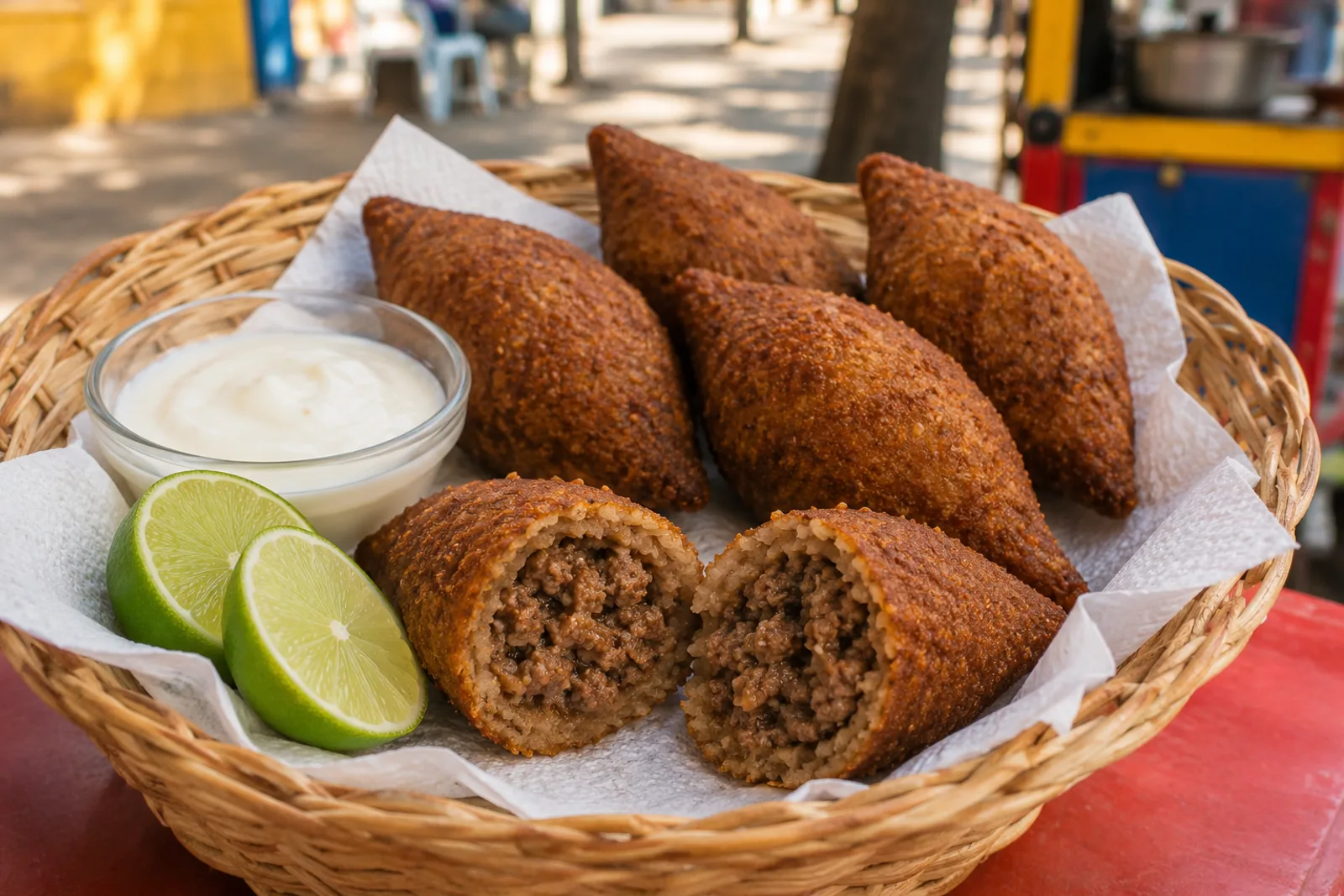

Colombian kibbeh, called quibbe on the Caribbean coast, is a torpedo of raw ground beef kneaded with fine bulgur, onion and spearmint, stuffed with cooked beef and deep-fried until almost mahogany. Because the shell is raw meat, the frying matters more than with an empanada: oil at 350°F (175°C), a shell that reaches 160°F (71°C), and a short rest in the fridge first so it doesn’t split. This batch makes 16 pieces, enough for 8 as a snack, and covers which bulgur to buy, how to shape the points so they hold, freezing them raw, and the lime and tangy dip they’re eaten with.
What Colombian kibbeh is, and what to expect
How do you make Colombian kibbeh? Soak 280 g (2 cups) fine bulgur for 30 minutes, wring it dry and process it with 450 g (1 lb) lean ground beef, onion and spearmint into a smooth paste. Shape 16 hollow torpedoes, fill them with cold cooked beef, chill 20 minutes and deep-fry at 350°F (175°C) for 4 to 5 minutes. 120 minutes for 8 servings.
Each one is about 4 in (10 cm) long with two sharp points. The outside is a deep brown, crunchy crust with a nubbly texture from the wheat; inside there’s loose, savory beef and onion. There’s mint in the shell, and on the coast fresh lime is squeezed over every bite. The dish came with Syrian and Lebanese immigrants who settled in Barranquilla and other Caribbean towns in the late 19th and early 20th centuries, and it’s now a fixture of any coastal spread of fried snacks.
How it differs from Lebanese kibbeh. In Lebanon kibbeh is eaten raw, baked in a tray or fried, and the shell is usually spiced with cinnamon and pepper blends; the Barranquilla version is the fried one, made with beef and mint and served with lime and a soured-cream dip.
It isn’t a carimañola, whose dough is boiled cassava, or a Colombian empanada, which is corn dough. Kibbeh is the only one of those coastal fritters with meat in the dough itself, and that’s what changes the frying.
Time and difficulty. 2 hours start to finish, nearly an hour and a half of it hands-on. Medium difficulty: shaping the torpedo takes a few tries.
Ingredients, and the bulgur you need
For 16 pieces the shell uses 280 g (10 oz) bulgur to 450 g (1 lb) lean beef, a little over 1 part wheat to 1½ parts meat by weight. More wheat gives a crunchier crust that cracks when you shape it; more meat gives a juicier, softer shell that struggles to keep its points.
Fine bulgur, and where to find it
Bulgur is wheat that has been cooked, dried and cracked. It’s sold in several grinds and only the fine one works here, labeled #1 in Middle Eastern shops. Medium and coarse grinds won’t bind with the meat and leave gaps in the shell where oil gets in.
- US. Middle Eastern grocers and online, as fine bulgur or #1 bulgur. The bulgur in the grains aisle of most supermarkets is medium or coarse.
- UK. Turkish and Middle Eastern grocers stock fine bulgur. Supermarket bulgur, usually in the world foods or rice aisle, tends to be coarse, meant for salads and pilafs.
- Only coarse available? Grind it dry in a spice or coffee grinder for 20 to 30 seconds, until it looks like semolina, before soaking. Not identical, but it binds.
Cracked wheat is not the same thing: it isn’t precooked, so it won’t soften in a 30-minute soak and the crust comes out hard.
Beef, mint and allspice
- Lean beef for the shell. 90% lean, ideally ground twice; ask the butcher. Fatty beef makes a soft shell that sags in the oil. The filling can be fattier, since it’s cooked first.
- Spearmint, the common garden mint in the UK, not peppermint, which tastes like candy. Dried mint won’t work here: it turns into dark specks and tastes like tea.
- Allspice is the warm spice Colombians call pimienta de olor. A Lebanese seven-spice blend can replace it if you have one; the result is more perfumed, closer to Lebanese kibbeh.
Equipment. A food processor or meat grinder, a pot about 8 in (20 cm) wide with 2 in (5 cm) of oil, and an instant-read or frying thermometer. Without a processor you can knead by hand for 10 minutes with a bowl of ice water nearby, but the shell will be less smooth and crack more.
How to make Colombian kibbeh, step by step
The filling cooks while the bulgur soaks, so it’s cold by the time you shape: warm filling softens the shell from the inside and the kibbeh splits in the oil. The fridge rest at the end is the step people skip and the one that saves the most kibbeh.
Soaking and squeezing the bulgur
Thirty minutes in cold water is enough for fine bulgur. A grain is ready when you can squash it between your fingers with no hard core, while the grains still look separate, not mushy. Then the step that decides whether the shell holds: wring it in a towel until it stops dripping. Any water left in the wheat turns to steam in the oil and opens cracks.
A smooth, sticky shell mixture
Blitz the onion on its own first, so no chunks break the wall later, then process it with the beef, bulgur and spices in two batches. It’s ready when it’s one even pink color, with no loose grains visible, and a pinch squeezed between your fingers sticks to your skin. If it crumbles, it needs more ice water, a tablespoon at a time.
Check the seasoning before shaping: fry a hazelnut-sized piece for a minute in the filling skillet and taste it.
Shaping a torpedo that won’t burst
- Hands dipped in ice water, every time. Cold, damp mixture doesn’t stick, and cracks close when you run a wet finger over them.
- A 75 g (2½ oz) ball, about the size of a small egg. Push your index finger in and turn the ball around it, pressing against your palm, until the wall is about ¼ in (0.5 cm) thick. Thicker stays raw inside; thinner tears.
- 1 heaped tablespoon of filling, about 20 g (¾ oz), without filling it to the opening.
- Pinch it closed and roll both ends between your palms into points, as if rolling clay. The points are where they split, so they should be solid shell with no filling.
- Set it on a tray and smooth it with a wet finger.
At least 20 minutes in the fridge before frying. The shell firms up, the fat sets and the kibbeh goes into the oil without losing its shape.
Oil temperature, and when the meat is done
Heat the oil to 350°F (175°C). Without a thermometer, dip the tip of one kibbeh in: it should bubble fast and hard straight away, with no smoke. Fry 4 at a time for 4 to 5 minutes, turning halfway. Crowding the pot drops the temperature and the crust soaks up oil before it seals.
They’re done when evenly dark brown, deeper than an empanada, and they sound hollow when tapped with tongs. The shell went in raw, so check the first of each batch: push the thermometer into the middle of the wall and it should read 160°F (71°C). The filling is already cooked, but it has to come out piping hot: for kibbeh fried from frozen, also probe the center of the filling, which should reach 165°F (74°C).
Drain on a rack, not paper towels: resting on paper, the underside steams and goes soft.
Why kibbeh split, and other problems
- They split in the oil. Wet bulgur, warm filling, or frying them straight after shaping. Wring the wheat in a towel, cool the filling and give them the 20 minutes in the fridge.
- They crack while shaping. The mixture or your hands are dry. Another tablespoon of ice water in the mix and keep your hands wet.
- Greasy. Oil below 330°F (165°C), almost always from frying too many at once. Batches of 4, and wait for the thermometer to return to 350°F (175°C).
- Black outside, raw inside. Oil too hot or a wall too thick. Hold it at 350°F (175°C) and keep the wall at ¼ in (0.5 cm).
- The points break. Filling went all the way to the edge. Keep the spoonful in the middle; the points are shell only.
- Bland shell. Salt and mint disappear into the wheat. Fry a test piece before shaping all 16.
Heat and allergens. Not spicy; the heat comes from the ají at the table, which is why kids usually like them. Contains gluten (the wheat), so it isn’t suitable for celiacs; with suero or yogurt it has dairy, and with pine nuts, tree nuts.
Freezing, other versions and party quantities
- Frozen raw, the best way to get ahead. After shaping, freeze them spaced out on a tray for 2 hours, then bag them. They keep 3 months. Fry from frozen at 350°F (175°C) for 6 to 7 minutes, 3 at a time, until the shell reaches 160°F (71°C) and the center of the filling 165°F (74°C).
- Baked. Brushed with oil, at 375°F (190°C) for 15 to 20 minutes, turning halfway, until browned and at 160°F (71°C). Drier, with a less crunchy crust.
- Air fryer. Brushed with oil, at 390°F (200°C) for about 18 minutes, turning halfway, until the shell reaches 160°F (71°C) and the center of the filling 165°F (74°C). Browner than baked, a little drier than fried.
- Coastal fillings. Instead of pine nuts, mix chopped scallions, raisins or chopped hard-boiled egg into the cooked beef.
- Mini kibbeh for a party. 35 g (1¼ oz) balls with half a tablespoon of filling: you get about 32, fried for 3 minutes, to the same dark brown and the same 160°F (71°C).
- For a crowd. The recipe doubles without changes; process the shell mixture in batches that don’t fill more than half the processor bowl. For 32 pieces, 560 g (1¼ lb) bulgur and 1.4 kg (3 lb) beef in all.
What drives the cost. The beef, which is most of the weight. Bulgur is cheap and goes a long way, so don’t cut the beef by adding more wheat than the ratio allows.
Serving, storing and reheating
Serving. On the Colombian coast they’re eaten hot, with lime squeezed over each bite, the same way as Colombian butifarras. Alongside goes suero costeño, a thick, salty soured cream, or a sharp Colombian ají of onion, tomato and lime. A quick dip for 16 kibbeh: ½ cup (120 ml) suero costeño, 2 tbsp chopped spearmint, 1 tbsp chopped scallion, a splash of water to loosen it, a few drops of lime, salt and pepper. In the US, suero costeño is in the refrigerated section of Latin grocers; otherwise plain whole-milk yogurt with a pinch of salt and lime makes a similar dip, less salty and less sour. Two per person as a starter, three or four as a meal, and with a Colombian egg arepa you have a full coastal spread.
Fridge. Once fried, into a sealed container within 2 hours; they keep 3 to 4 days.
Reheating. In the oven or air fryer at 350°F (180°C) for 8 to 10 minutes, until the center reaches 165°F (74°C). The microwave heats them but leaves the crust soft.
Freezing after frying. It works, but the crust loses its crunch when reheated. If you’re freezing, freeze them raw.
Frequently asked questions
Can I use lamb, pork or chicken? Ground lamb works in the shell and gives something closer to Lebanese kibbeh. Ground chicken is softer and the shell struggles to hold its shape; if you use it, choose skinless thigh and fry until the shell reaches 165°F (74°C). Pork on its own, without beef, comes out greasy.
Why is the beef in the shell raw? Raw meat is what glues the wheat together. Cooked beef crumbles and can’t be shaped into a torpedo. That’s why the shell has to reach 160°F (71°C) in the oil.
Can I make the shell mixture the day before? Yes, covered in the fridge, for up to 24 hours. It will be firmer the next day: work it for a minute with wet hands before shaping. The filling can also be made ahead.
How many kibbeh per pound of beef? In this recipe, the 1 lb (450 g) of beef in the shell plus 280 g (10 oz) bulgur makes 16 kibbeh with 75 g (2½ oz) of shell each, with another 9 oz (250 g) of beef for the filling.
Nutrition
Per serving of 2 kibbeh, calculated ingredient by ingredient from the recipe quantities, with an estimate of about 4 g of oil absorbed per piece:
- Calories: 390 kcal
- Protein: 22 g
- Carbohydrates: 30 g
- Fat: 21 g, of which 6 g saturated
- Fiber: 5 g
- Sugar: 2 g
- Sodium: 650 mg
I shape the whole batch on the same day and fry only what we’ll eat; the rest goes straight into the freezer on a tray, so there are always kibbeh for visitors without dirtying the processor again. And I fry the first batch with the thermometer in the pot even though I know the sound of the oil by now: it tells me whether the wall I shaped is right. Josnaisis.