

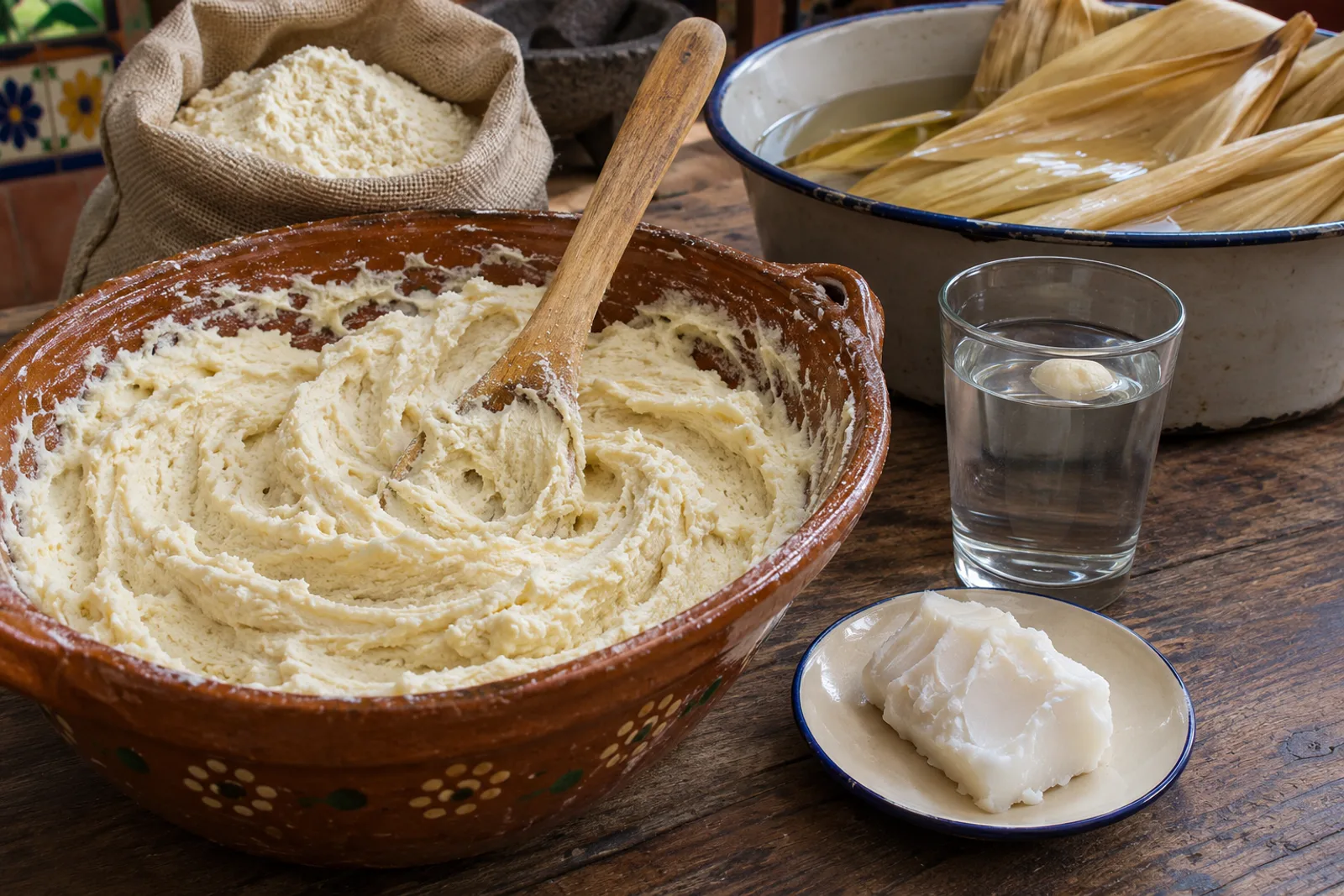

Most tamale trouble starts in the mixing bowl, in the 15 minutes it takes to beat 1½ cups of lard into the masa, long before the steamer. Masa is the dough of Mexican tamales: corn treated with lime (nixtamalized) and ground, then beaten with lard and broth until it turns into a soft, pale batter that spreads on a corn husk and steams up tender. This page covers that dough on its own, from a bag of masa harina or from fresh masa, with lard, shortening, butter or oil, how much of each per pound, how many tamales a batch makes, and how far to trust the famous float test.
How much lard and broth per pound of masa
How do you make masa for tamales? Beat 1½ cups (300 g) of lard by itself for 5 minutes until white and fluffy. Add salt and baking powder, then 2.2 lb (1 kg) of fresh masa, or masa harina mixed with hot water, in pieces, alternating with about 1⅔ cups (400 ml) of warm broth, and beat 10 more minutes until it spreads smoothly without cracking; if a small dab also floats in cold water, it has plenty of air. 35 minutes for 24 servings, enough masa for 24 tamales.
| For this much masa | 1 lb (454 g) fresh | 2.2 lb (1 kg) fresh |
|---|---|---|
| Or masa harina + hot water | 1½ cups + 1 cup + 2 tbsp | 3½ cups + 2½ cups |
| Lard or shortening | ⅔ cup (136 g / 4¾ oz) | 1½ cups (300 g / 10½ oz) |
| Warm broth | ¾ cup (180 ml), up to 1 cup | 1⅔ cups (400 ml), up to 2 cups |
| Fine salt | 1 tsp | 2 tsp |
| Baking powder | 1 tsp | 2 tsp |
| Tamales (75 g / 2⅔ oz of masa each) | 10 to 11 | 23 to 24 |
Many Mexican home cooks go a little leaner, about 250 g of fat per kilo (1¼ cups), which gives a firmer masa. I use 300 g: the tamales come out softer and moister. Much past that they turn greasy and slump, and need to cool before they hold their shape.
Time. 35 minutes with masa harina, about 20 with fresh masa, which doesn’t need soaking. Easy: it takes patience with the mixer, not skill.
Fresh masa, prepared masa or masa harina
All three make good tamales. What matters is that the corn is nixtamalized: cooked with calcium hydroxide (cal, or pickling lime) before grinding. That’s what gives masa its toasty corn flavor and lets it hold together.
- Fresh unprepared masa (masa sin preparar). Sold by the pound at tortillerías and Mexican markets in the US. Ask for masa for tamales, which is a little coarser than tortilla masa. Best corn flavor.
- Prepared masa (masa preparada). The tub in the refrigerated case already has lard and salt in it. Skip this recipe’s lard, salt and broth. Check the texture first: if it already spreads smoothly, use it as is; if it’s stiff, beat in warm broth 2 tablespoons at a time, and check the salt on a small cooked piece.
- Masa harina. Dried, ground masa in a bag. Masa harina for tamales (such as Maseca Tamal, in the Hispanic aisle of most large US supermarkets) is coarser than the tortilla kind; the tortilla kind works too, a bit denser. 3½ cups (400 g) with 2½ cups (600 ml) hot water equals 2.2 lb (1 kg) of fresh masa. You can hydrate it with broth instead of water.
- What doesn’t work. Cornmeal, polenta and grits are not nixtamalized and won’t hold together. Masarepa (P.A.N.) is precooked corn for arepas, also not nixtamalized: the tamal tastes like an arepa. And in the UK, cornflour is cornstarch, a different thing entirely. Look for masa harina online or in Mexican and Latin grocers; it’s the same flour used for homemade corn tortillas.
Lard, shortening, butter or oil
Lard is solid at room temperature, so whipping it traps tiny air bubbles. That air is what makes the test dab float and what makes a tamal light. The fat that matters is the one you can whip.
- Pork lard. The classic flavor. In the US there are two kinds: the shelf-stable tubs and blocks, which are hydrogenated and firm, and fresh rendered lard (manteca) from a Mexican carnicería, softer and porkier. Both whip. In the UK, the blocks of lard in the baking aisle are what you want.
- Vegetable shortening (Crisco in the US, Trex in the UK). Whips and floats just like lard, with a neutral taste. With vegetable broth, it makes the masa vegetarian.
- Butter. About 81% fat and the rest mostly water. It whips but softens fast in a warm kitchen and gives a denser masa. For butter flavor, use half butter and half lard; it’s lovely in sweet tamales.
Tamale masa with oil
It works, but it’s a different tamal. Oil is liquid and can’t be whipped. Use 1 cup (220 g) of neutral oil per 2.2 lb (1 kg) of masa, beat it into the masa with the baking powder and salt, and add broth more cautiously: start with about 1¼ cups (300 ml) and add more 2 tablespoons at a time until it spreads smoothly. The tamales come out tender but less airy and a little more compact than with whipped lard, about 30 calories lighter each. Skip the float test here: oil masa rarely floats even when it’s fine. Spread it a little thinner so the tamales don’t turn heavy.
How to whip tamale masa
The lard alone, 5 minutes. This is the step people skip and the one that counts most. Lard should be soft when you start: straight from the fridge it goes lumpy, and melted it holds no air. Beat until it goes from cream to bright white, like frosting.
Masa and broth, in turns. Add the masa in 4 or 5 pieces with splashes of broth between them. Pouring all the liquid at once leaves you with lumps the masa never absorbs. Then 10 minutes on medium. A stand mixer with the paddle is easiest; a hand mixer works in a big bowl. By hand with a wooden spoon, expect 20 to 30 minutes of beating for 2.2 lb (1 kg).
How it should look.
- Like thick cake batter or soft hummus: it holds on a spoon and drops off slowly in one piece.
- It spreads smooth on a husk, with no cracked edges. Cracks mean it needs broth, 2 tbsp at a time.
- It doesn’t glue itself to your fingers. If it does, work in masa harina 1 tbsp at a time.
Does the masa float test work?
Drop ½ teaspoon of masa into a glass of cold water. If it floats, there’s enough air in it; if it sinks, beat 2 to 3 minutes more and test again. I always do it, but it only measures one thing, the air in the whipped fat. It tells you nothing about whether there’s enough broth or salt.
- Oil-based or low-fat masa won’t float even when it’s well made. Judge it by texture instead.
- Some masa harina doughs never quite float and still make tender tamales. If yours sinks slowly after 15 minutes of beating but spreads smoothly, use it and spread a thinner layer.
- Floating doesn’t rescue a dry masa. If it floats but cracks when spread, the tamales will be crumbly: it needs broth, not air.
- Test before adding anything. Raisins or pieces of chile will sink a perfectly good dab.
How many tamales per pound of masa
A standard husk tamal takes about 75 g (2⅔ oz, a scant ⅓ cup) of prepared masa, spread in a 4 × 3 in (10 × 8 cm) rectangle. On that basis 2.2 lb (1 kg) of fresh masa makes 23 to 24 tamales, or 10 to 11 per pound. Size changes everything:
Small, thin tamales are the northern Mexican style: red chile beef tamales take about 50 g (1¾ oz) of masa per husk, so 4.4 lb (2 kg) of masa makes 60, and you count three per person rather than two.
A 4 lb (1.8 kg) bag of masa harina hydrates to about 10 lb (4.5 kg) of masa: with its lard and broth, that’s around 9 dozen standard tamales. Plan on 2 or 3 tamales per person for a meal.
| Fresh masa | Or masa harina + hot water | Lard | Warm broth | Tamales (75 g each) |
|---|---|---|---|---|
| 2.2 lb (1 kg) | 3½ cups + 2½ cups | 1½ cups (300 g) | 1⅔-2 cups | 23-24 |
| 4.4 lb (2 kg) | 7 cups + 5 cups | 3 cups (600 g) | 3⅓-4 cups | 46-48 |
| 6.6 lb (3 kg) | 10½ cups + 7½ cups | 4½ cups (900 g) | 5-6⅓ cups | 69-72 |
| 11 lb (5 kg) | 17½ cups + 12½ cups | 7½ cups (1.5 kg) | 8½-10½ cups | 115-120 |
Above 4.4 lb (2 kg), whip in batches that fill no more than half the bowl, or the lard at the bottom never gets beaten.
Using the same masa for other tamales
- Savory husk tamales. As is, with the broth from whatever meat you’re filling them with: green chicken tamales, red pork tamales or rajas con queso tamales, with vegetable broth for a meatless batch.
- Sweet tamales. Swap the broth for warm milk and beat sugar in with the fat: the pink sweet tamales use 250 g (1¼ cups) sugar and 300 g fat, half lard and half butter, per kilo.
- Banana-leaf tamales. Oaxacan mole tamales use a softer, wetter masa with 250 g of lard and more broth, since it doesn’t have to stand up in the pot. Colombian tamales, like the tamal tolimense, are a separate family: a kneaded corn dough moistened with meat broth, never whipped.
Making masa ahead and storing it
- Fridge. Covered with plastic wrap pressed on the surface, up to 2 days. It firms up as the lard sets; leave it out 30 minutes and rebeat 1 to 2 minutes with a splash of warm broth until it spreads smoothly again.
- Freezer. Up to 3 months in a bag with the air pressed out. Thaw overnight in the fridge; it comes out wet and crumbly and comes back together when rebeaten with a little broth.
- Leftover masa on the day. Steam a few extra tamales plain or with a strip of cheese. Cooked tamales freeze better than raw masa.
Tamale masa questions
Do I need baking powder? It isn’t essential, since the whipped fat provides the air. The 2 teaspoons help the tamales rise a little more in the steam and come out less compact, especially if the masa never quite floated. Without it they still work, just a bit denser.
How much masa do I need for 50 or 100 tamales? For 50, about 4¾ lb (2.2 kg) of fresh masa or 2 lb (900 g) of masa harina; for 100, about 9½ lb (4.3 kg) of masa or 3¾ lb (1.7 kg) of masa harina, with 1½ cups (300 g) of lard for every 2.2 lb (1 kg) of masa. Buy a little extra: some husks always tear.
Why are my tamales dry and crumbly? Nearly always a dry masa: too little broth, or masa harina that wasn’t fully hydrated. It should spread smoothly on the husk; if the edges crack, add broth before you fill. Lean masa, under 250 g of fat per kilo, also steams up harder.
Why do my tamales stick to the husk? First, let one rest 5 minutes out of the pot before judging: straight from the steamer they always look raw. If they’re still pasty after that, the masa had too much broth or they needed more steaming. The tamales guide has steaming times for each kind.
Nutrition facts for tamale masa
Per portion of masa for one tamal (75 g / 2⅔ oz of prepared masa, no filling or husk), worked out from the recipe quantities with low-sodium broth:
- Calories: 175 kcal
- Protein: 2 g
- Carbohydrates: 13 g
- Fat: 13 g, of which 5 g saturated
- Fiber: 1 g
- Sugars: 0 g
- Sodium: 273 mg
The lard supplies about 113 of those 175 calories. With 250 g per kilo it drops to about 155, and with 1 cup of oil to about 145. The filling comes on top.
I beat the lard until it looks as white as meringue and then I watch the broth like a hawk, because a masa that sinks is easier to fix than one that cracks. When I use masa harina I hydrate it with hot broth instead of water and let it sit while the lard whips, and the float test always goes in the same glass of cold water, before anyone adds raisins. Josnaisis.