

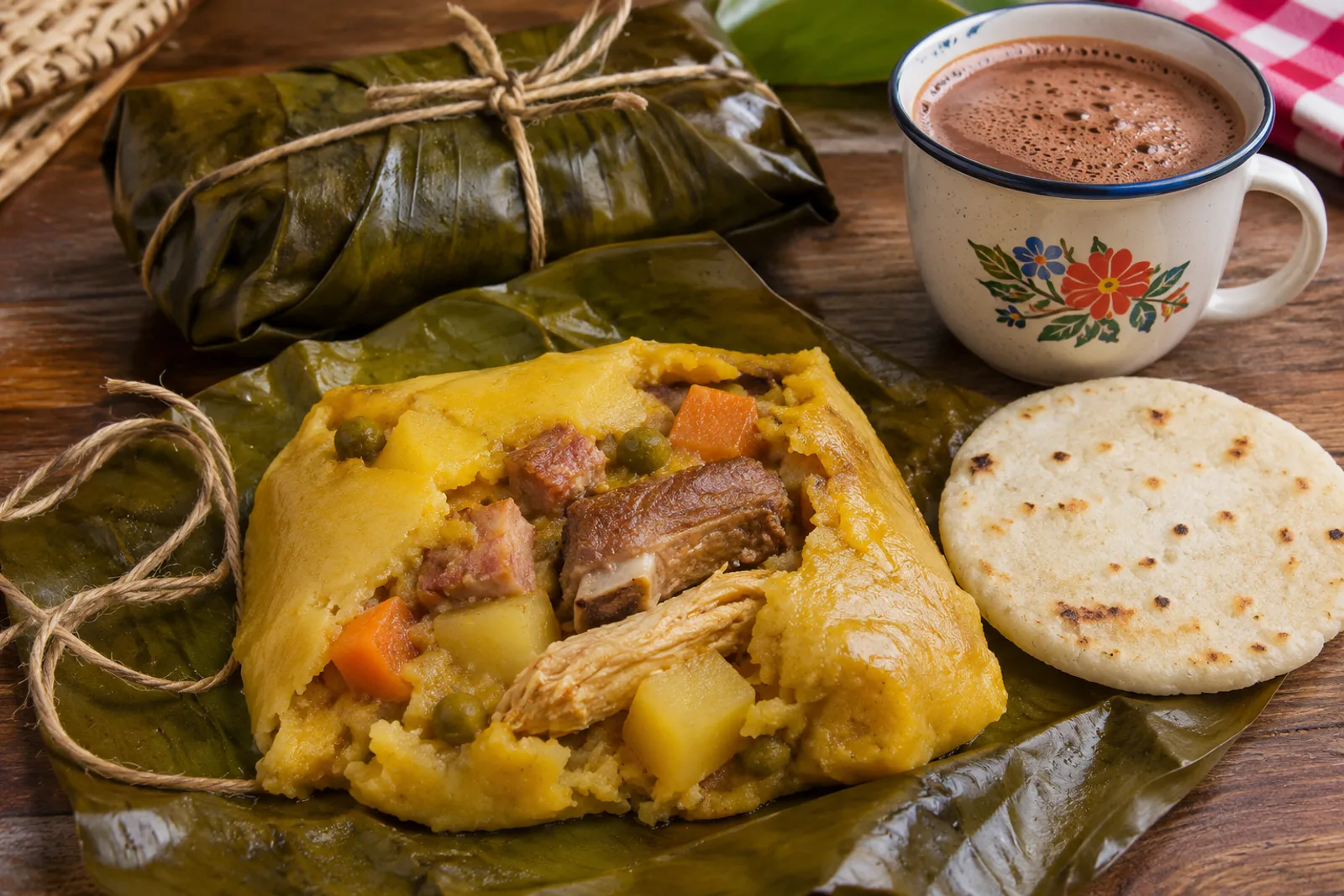

Antioquia-style tamales, the tamales antioqueños or paisa tamales of northwest Colombia, are made with the same corn dough as the region’s arepas: dried white hulled corn, boiled and ground, tinted yellow with annatto and seasoned with ½ cup (120 ml) of the blended onion, garlic and cumin paste, set aside before the pork goes into the rest. The filling is all pork and goes in raw, one piece each of spareribs, shoulder and pork belly, with potato, carrot, peas and a spoonful of hogao, a Colombian tomato and scallion sauce. Each one is wrapped in two crossed banana leaves and simmered for 2½ hours. Below is the recipe for 12, a shortcut with precooked cornmeal, how to tell the corn and the tamal are done, and how this one differs from other Colombian tamales.
What an Antioquia tamal is, and how long it takes
How do you make Antioquia-style tamales? The night before, blend the seasoning paste, marinate pork ribs, shoulder and belly in it, and soak 800 g (1.75 lb) of dried white hulled corn. Next day, boil and grind the corn and knead it with the paste, lard and annatto; spread it on two crossed banana leaves, add the three raw pork cuts, potato, carrot, peas and hogao, tie the parcel and simmer it 2½ hours. 355 minutes for 12 servings.
If you know Mexican tamales, set that picture aside. This is a large parcel opened on the plate and eaten with a knife and fork. The masa is dense and yellow, tasting of corn and cumin; the rib meat slides off the bone and the pork belly, which bastes the masa from the inside as it simmers, turns soft and juicy. It is not spicy.
Time. 355 minutes on cooking day: an hour and a half of simmering the corn (45 minutes of leaves, hogao and vegetables fit inside it), 30 minutes of cooling, 30 of grinding and kneading, 45 of assembling twelve, 2½ hours of a covered pot you leave alone and a 10-minute rest. About two hours of that is hands-on. The night before takes 15 minutes. With precooked cornmeal instead of hulled corn you skip the boiling, cooling and grinding, but the leaves and hogao no longer overlap with anything: 45 minutes of prep, about 15 of kneading, 45 of assembling, the simmer and the rest bring the day to about 265 minutes. Difficulty, medium. The only tricky part is judging the corn.
Who it is for. A December tamal-making day with family, or a freezer stash. If you have no grinder or food processor, make the cornmeal version.
How it compares with other Colombian tamales
The Bogotá-style tamal adds chicken and chickpeas to a masa of precooked cornmeal; the Tolima-style tamal soaks its corn for three days, mixes rice into the masa and adds egg; the Valle del Cauca tamal cooks its masa like a thick porridge before wrapping. The Colombian pork tamales on this site are the everyday version, with pre-cooked meat, cornmeal hydrated with the broth and two hours of steam. The Antioquia tamal keeps to its own: arepa dough, seasoning paste in the masa, and three raw pork cuts that cook in the pot.
Ingredients for 12 Antioquia-style tamales
The full shopping list, with the paste, masa and hogao by weight, is in the recipe card. Each tamal takes about 160 g (5½ oz) of masa and one piece of each meat. Here is how a single one breaks down:
Hulled corn, and the precooked cornmeal shortcut
Dried white hulled corn (maíz blanco trillado) is whole dried corn with the hull and germ removed, the same grain used for Colombian arepa paisa. Outside Colombia, look for it in Colombian or Latin grocery stores and online. Do not swap in hominy or Mexican pozole corn: both are treated with lime (nixtamalized), and the masa ends up tasting like a corn tortilla.
With precooked cornmeal. Many families in Antioquia make it this way today. Replace the corn and its cooking water with 500 g (1 lb 2 oz) precooked yellow cornmeal, sold as masarepa, and 1.3 liters (5½ cups) warm water, then knead in the reserved paste, lard, annatto and salt. It should be softer than arepa dough, spreadable and crack-free, because it keeps soaking up meat juices in the pot. It comes out smoother and less corn-forward. Masa harina for tortillas will not work: it is nixtamalized and changes the flavor.
The three pork cuts, by their US and UK names
- Spareribs, cut by the butcher into bite-sized pieces on the bone. In the UK, ask for pork spare ribs cut through the bone.
- Shoulder or fresh ham. Pork shoulder or Boston butt in the US; pork shoulder in the UK. Skip lean loin, which dries out in 2½ hours.
- Fresh pork belly, uncured. Smoked bacon changes the flavor of the whole masa.
Banana leaves and equipment
You need 24 rectangles of 40 to 50 cm (16 to 20 in), two per tamal, plus scraps to line the pot. In the US and UK they are sold frozen in Latin and Asian grocery stores, usually in 1 lb (454 g) packs: buy 3, since some always tear. Thaw them in the fridge overnight, then wipe and warm them like fresh ones. Foil will hold a tamal together if you cannot find leaves, but the masa comes out paler and without the leaf’s aroma.
You also need a big lidded pot that fits all 12 lying flat, a hand corn mill or food processor, a blender for the paste and kitchen twine.
How to make Antioquia-style tamales step by step
What happens the night before and on the day
The night before is 15 minutes of work: paste, marinade and corn soak, both left 8 to 12 hours. On cooking day the order runs like this:
The leaves, the hogao and the vegetables fit into the hour and a half the corn spends on the stove. To split the job over two days, the ground hulled-corn masa keeps 2 days in the fridge with plastic wrap pressed onto the surface so it does not form a crust.
Cooking and grinding the corn
Hulled corn takes 1 to 2 hours depending on the batch, and the only way to know is to taste it, starting at 50 minutes. It is ready when a kernel breaks cleanly between your teeth, tender outside with a little give left in the center, and not split open. Undercook it and the masa is gritty; overcook it and the masa turns sticky and the tamal gummy.
Save a cup (240 ml) of the cooking water before draining and let the corn cool for 30 minutes. In a hand mill, two passes with the plates set tight. In a food processor, work in batches, adding 2 or 3 tablespoons of the cooking water if it stalls, until no pieces of kernel remain.
Seasoning paste in the masa
This is the paisa signature: the 120 ml (½ cup) of paste you set aside before marinating goes into the masa, with the lard, annatto and salt. Knead for 4 to 5 minutes, until the color is even and a small ball pressed flat does not crack. If it does, add cooking water 60 ml (¼ cup) at a time.
Before you assemble, fry a teaspoon of masa for 2 minutes in a skillet and taste it. Bland masa cannot be fixed once the tamal is tied, and the pork belly will not salt it enough.
Assembling and tying
- Cross two leaf rectangles, one on top of the other.
- Spread about 160 g (5½ oz) of masa into a square about 12 cm (5 in) across.
- Pile 1 piece each of rib, shoulder and pork belly in the middle; around them, 2 potato slices, 2 or 3 carrot slices and 1 tbsp peas, with 1 heaped tbsp hogao on top, so the unreserved half stretches exactly to 12.
- Fold the sides of the bottom leaf over the filling, then the sides of the top leaf, into a square parcel with no gaps.
- Tie it crosswise, two turns lengthwise and two across.
If anything shifts when you lift it by the string, add a third leaf and tie again. A loose tamal lets water in and the masa washes out.
Simmering, and how to tell it is done
Count 2½ hours from the moment the water returns to a boil with the tamales in: gentle simmer, lid on, water almost covering them. Every 30 minutes check the level and top up with water that is already boiling. The meat goes in raw and on the bone, which is why this tamal needs a little longer than ones built with cooked meat.
Lift one out and let it rest 10 minutes before opening; straight from the pot the masa always looks soft. It is done when:
- The masa is firm and peels cleanly off the leaf.
- The rib meat pulls off the bone with a fork.
- The pork belly is soft and translucent, not rubbery.
- With a thermometer, the center of the meat reads above 145°F (63°C).
If any check fails, put it back and test another after 20 minutes.
When the masa or the tamal goes wrong
Nearly every problem with this tamal starts with the corn or the tie, and you can spot it before it is too late:
- Not tasting the corn. Cooking time changes from one bag to the next; the clock only tells you when to start tasting.
- Loin instead of shoulder. It comes out dry and stringy after 2½ hours.
- Letting the pot run low. Over 2½ hours the water drops a lot; if it boils dry, the bottom scorches and the lower tamales stick to the pot. Check every 30 minutes.
- Opening it straight away. Two minutes out of the pot the masa looks raw; wait the full 10.
Allergens and heat. Gluten-free as long as the corn or cornmeal and the annatto carry no wheat (check the labels); no egg or nuts; dairy only if you use butter instead of lard. Not spicy, so children usually like it; for them, leave out the pork belly.
Scaling up to 24 or 36
The recipe multiplies straight across: for 24, 1.6 kg (3.5 lb) hulled corn, 1.8 kg (4 lb) ribs, 1.2 kg (2.6 lb) shoulder and 900 g (2 lb) pork belly; for 36, triple everything. Simmering time stays at 2½ hours, because it depends on the size of each tamal, not on how many are in the pot. What changes is the pot: use two at once, or cook in two batches, each with its own doneness test.
For 24 or more, the corn is the bulk of the work: grind it and make the masa the day before (it keeps 2 days in the fridge) and save the cooking day for assembling and simmering. With an assembly line, one person on leaves, one on masa and filling, one on twine, the masa never sits drying in the bowl.
Cost. The pork is what makes this expensive, especially the ribs and belly; the corn, potatoes and leaves are cheap. To bring it down, use more shoulder and fewer ribs, which are mostly bone.
Variations
- With precooked cornmeal. 500 g (1 lb 2 oz) masarepa and 1.3 liters (5½ cups) warm water instead of the hulled corn, as above. About 90 minutes less on the clock, nearly all of it pot and cooling time rather than work.
- With chicken. Some households add a small bone-in chicken thigh along with the pork. It then comes very close to the Bogotá tamal; if you add it, the center of the chicken must reach 165°F (74°C).
- Leaner. Without the pork belly it drops to about 650 kcal per tamal, but the masa is drier: knead in 60 ml (¼ cup) extra cooking water.
- Steamed. In a tamale steamer, standing upright with the water below the rack, they also cook through; allow at least the same time and test one at 2½ hours as you would in the pot.
Serving and storing
Serving. It is eaten with Colombian hot chocolate and an arepa, with the other half of the hogao on the side; the hogao method is in the Colombian patacones recipe. One tamal is a full meal.
Fridge and freezer. In their leaves, in sealed containers, not stacked while hot, refrigerate them within 2 hours of leaving the pot. They keep 3 to 4 days in the fridge and 3 to 4 months in the freezer, cooked, still wrapped and tied.
Reheating. In boiling water with the leaf on, about 15 minutes from the fridge and about 30 from frozen, until the center reaches 165°F (74°C). More methods and times, for this and other tamales, are in the guide to tamales from Mexico, Colombia and Venezuela.
Frequently asked questions
Does the meat go in raw or cooked? Raw, marinated overnight in the seasoning paste. It cooks inside during the 2½ hours and releases its fat into the masa, which is why the pork belly is not fried first.
Is it the same as a Mexican tamale? No. Mexican tamales are usually smaller, steamed in corn husks, with a nixtamalized masa beaten with lard. This one is boiled in banana leaves, uses unlimed hulled corn and carries bone-in pork and vegetables inside.
Can I use white cornmeal instead of yellow? Yes. The yellow comes from the annatto; with white masarepa it turns out just as yellow if you keep the full amount of annatto.
Can I freeze them uncooked? Better not. Raw potato does not freeze well and raw masa weeps as it thaws. Cook them first, then freeze them once cool.
Nutrition per tamal
Per tamal (1 of 12), worked out ingredient by ingredient from the quantities above, counting the half of the hogao that goes inside:
- Calories: 840 kcal
- Protein: 30 g
- Carbohydrates: 67 g
- Fat: 51 g, including 17 g saturated
- Fiber: 8 g
- Sugars: 4 g
- Sodium: 1018 mg
The corn brings about 243 kcal per tamal and the pork belly about 194, nearly the same; the ribs, about 150. The hot chocolate and arepa are extra.
I taste the corn every ten minutes from the fifty-minute mark, even if it seems fussy, because it is the one part of this recipe you cannot fix later. And I always pour the paste for the masa into its own jar before the meat goes in. Coming from the Venezuelan hallaca, I like how plain this tamal is: corn, pork and cumin, no raisins or capers, and a masa that tastes like an arepa. Josnaisis.