

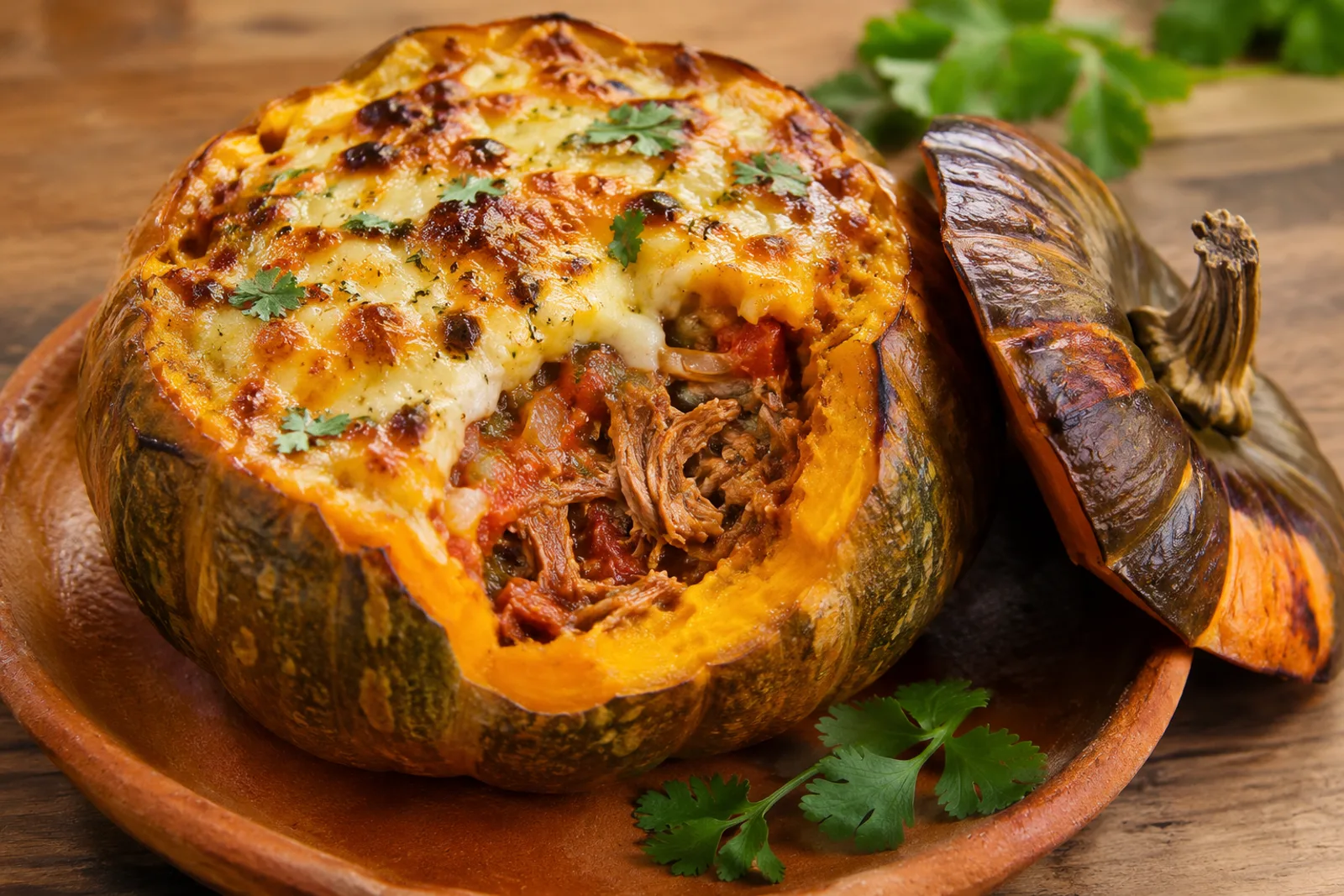

Capón de ahuyama (kah-POHN deh ah-YOO-mah) is what cowhands on the plains of eastern Colombia make with a squash, a piece of dried salted beef and a wedge of salty white cheese: the squash is hollowed out, baked, packed with the shredded beef and a tomato and pepper sofrito, and baked again until the cheese browns. The shell becomes the serving dish. Its home is Arauca, on the Venezuelan border, and the dried beef it uses is the same kind llaneros carried on long cattle drives. This recipe bakes it twice, empty first and then filled, because a raw squash never softens in the time the filling needs.
What capón de ahuyama is, and how long it takes
How do you make capón de ahuyama? Hollow out 2 small squashes and bake them empty at 350°F (180°C) for 45 to 60 minutes. Fill them with 14 oz (400 g) of desalted, simmered and shredded dried beef mixed with an onion, pepper and tomato sofrito and cubes of salty white cheese, then bake 25 minutes more, uncovered for the last 10. 155 minutes for 4 servings, plus an overnight soak.
At the table it’s a savory dish, not a sweet one: the only sweetness is the squash itself, which you scrape from the shell and eat with forkfuls of beef and softened cheese. Think of it as a cousin of stuffed acorn squash, with a filling built on salt-cured beef instead of sausage or grains.
Time. 155 minutes on the day, about an hour of it hands-on, plus 8 to 12 hours of soaking the night before. Medium difficulty: nothing is hard, but the beef and the first bake have to run in parallel.
Which squash to buy in a US or UK store
In Colombia it’s made with ahuyama, a round, hard-skinned squash with deep orange flesh, from the same species as butternut. Outside Colombia, choose a squash of 1 to 1.3 kg (2¼ to 3 lb) that sits flat and has a firm, unblemished skin.
- Kabocha is the best match: round, dense and sweet, and it holds its shape whole. In the UK, Crown Prince behaves the same way.
- Butternut tastes closest but is long, not round. Halve it lengthwise, hollow each half to a 2 cm (¾ in) wall and fill them like boats; being thinner, they soften sooner, so start testing early.
- Acorn squash works as a single serving, one per person.
- Carving pumpkins are watery and bland. Skip them.
If you can only find one big squash of 2.5 to 3 kg (5½ to 6½ lb), it serves 4 to 6, but the first bake runs much longer; go by the knife, not the clock.
The beef, and what to use if you can’t find carne seca
The traditional filling uses carne seca, beef that has been salted and dried until hard. In the US and the UK the closest thing is Brazilian carne seca (charque), sold in vacuum packs at Brazilian and Latin grocers; it needs the same overnight soak. Don’t swap in beef jerky: it’s sweetened, seasoned and already cooked, and it won’t shred. Spanish cecina is cured to be eaten raw in slices, and it would change the flavor of the dish.
Drying meat in the sun at home isn’t something I’d recommend, since there’s no control over temperature or humidity. If you can’t get carne seca, there are two honest stand-ins.
- Fridge-cured beef. My Colombian carne oreada cures for 12 to 24 hours on a rack in the fridge and gives a similar cured edge, slightly sweet from the panela. Grill it, dice it into 1 cm (½ in) pieces and fold it into the sofrito. Start with 500 g (1 lb 2 oz) raw.
- Fresh flank, shredded. 600 g (1⅓ lb) of flank simmered in salted water until it falls apart, as in Colombian shredded beef, gives about 400 g (14 oz) of shreds. It’s milder and less salty, so here you do season the filling.
The dried-beef filling is a close relative of Venezuelan pisillo, but pisillo is fried dry and loose to serve as a side, while this one stays moist with extra sofrito and liquid so it can survive 25 minutes in the oven.
Cheese and pantry swaps
| You need | In the US | In the UK |
|---|---|---|
| Queso costeño or llanero (salty, firm, softens without stringing) | Queso fresco or queso blanco, with a little cotija on top for salt | Feta, drained |
| Ground annatto (achiote) | Latin aisle, sold as achiote or bijol | Sweet paprika, for color |
| Carne seca | Brazilian grocers, vacuum-packed | Brazilian grocers, or fresh flank |
| Ahuyama | Kabocha, or acorn for single servings | Crown Prince or kabocha |
Mozzarella will melt into strings: tasty, but it’s another dish.
Equipment. A large sturdy knife, a metal spoon, a 3-quart (3 l) pot with a lid, a skillet, a rimmed baking sheet and, ideally, an instant-read thermometer.
The make-ahead plan, in 155 minutes
The day before, the beef goes into its soak. If you want a lighter serving day, simmer and shred it then too and make the whole filling; it keeps covered in the fridge overnight. You can also hollow out the squashes a day ahead and keep them wrapped in the fridge. That leaves only the oven work on the day.
How to make it, step by step
Desalting the beef
Cut the beef into 4 to 5 cm (1½ to 2 in) pieces, which lose salt far faster than a whole slab. Soak them 8 to 12 hours in the fridge, changing the water every 3 to 4 hours. Next day, boil 10 minutes and throw that water out, then simmer in fresh water for 60 to 90 minutes, depending on how dry the beef was. Once it’s done, taste a shred and the liquid separately. If the beef is still very salty, put it back in fresh water for about another half hour before shredding; if the liquid is the salty one, use plain water in the filling instead. Either way, the sofrito gets no salt until you’ve tasted the mix.
Hollowing the squash
Push the knife in about 4 to 5 cm (1½ to 2 in) from the stem, angled outward, and cut all the way round. The beveled edge lets the lid rest on the rim instead of falling in. Scrape the cavity down to a ¾ in (2 cm) wall: thinner and it splits when you cut it at the table, thicker and it takes too long to soften. Usually removing the seeds and fibers is enough; if you have to scrape out some flesh to get there, save it for soup.
The first bake, and how to tell it’s ready
Empty, lids on, 350°F (180°C) for 45 to 60 minutes for 2¼ to 3 lb (1 to 1.3 kg) squashes. Pull them when:
- a knife tip goes into the flesh on the inside with a little resistance, like an almost-cooked potato;
- the skin is still firm and the squash keeps its shape when you move the tray;
- the flesh inside has turned a brighter orange.
If the knife meets no resistance at all, take them out right away; they still have 25 minutes to go.
No big oven? Boil the hollowed squashes in salted water, fully submerged, until a knife goes in with a little resistance; start testing at 15 minutes. Drain them upside down before filling. They come out wetter and a little less sweet than roasted.
The filling
The sofrito takes about 15 minutes: onion until translucent, then pepper and garlic, then tomato with cumin and annatto until it collapses. Add the shredded beef and ½ cup (120 ml) of the cooking liquid for 5 minutes more. It should look glossy and moist with no loose liquid in the pan; the oven will take some moisture away. The cheese goes in off the heat so it softens in the oven rather than melting in the skillet.
The final bake
Fill the squashes with the hot filling, then 15 minutes covered and 10 uncovered with the grated cheese on top. It’s done when the cheese is golden at the edges, the filling bubbles when you push it with a spoon and a knife slides through the squash wall from the outside.
Because the beef goes in already cooked, what matters is reheating the filling to 165°F (74°C) in the center. With hot filling that happens easily in 25 minutes; if you filled it cold from the fridge, add 10 to 15 minutes covered and check with the thermometer.
With rice or without
Both versions go by the same name. This recipe is the no-rice one: dried beef, sofrito and cheese, saltier and more intense, with rice or boiled yuca on the side. The rice version is milder and feeds more people.
To make it, stir 2 cups (300 g) of cooked Colombian white rice and 1 cup (150 g) of corn kernels, fresh or frozen, into the finished filling, plus another ¼ cup (60 ml) of cooking liquid. You can cut the beef to 300 g (10½ oz). The filling grows a lot, so you’ll need 3 small squashes or one of 5½ to 6½ lb (2.5 to 3 kg), and it serves 6. Anything that doesn’t fit goes on the side. If the beef is good and the squash is the main event, I go without rice; for a crowd or a single big squash, with.
Mistakes that ruin it
- Filling a raw squash. The filling dries out long before the flesh softens. Always precook it empty first, in the oven or in a pot of boiling water.
- Overdoing the first bake. A squash that’s already completely soft splits open at the table.
- Skipping the soak. Unsoaked carne seca makes the dish inedibly salty.
- Salting before tasting. Dried beef plus salty cheese often means the sofrito needs none.
- A dry filling. Not enough sofrito or liquid. A few spoonfuls of hot cooking liquid at the table will rescue it.
- Walls under ¾ in (2 cm). They tear when you cut the squash in half.
Heat, kids and allergens. It isn’t spicy; hot sauce goes on the table. Kids tend to like it for the sweet squash, so give them more squash and less of the salty beef. Contains milk (cheese). Gluten-free as long as your annatto blend is.
Serving, storing and reheating
Serve each squash halved at the table. I like it with boiled yuca or white rice and a spoonful of tomato hogao, the same one that goes on Colombian patacones. For the rest of the menu from the plains, see llanero food; for a big gathering, it sits well next to Colombian llanero beef, the stake-roasted veal of the region’s parties.
Fridge. Within 2 hours, scoop the filling and squash out of the shell into a covered container: 3 to 4 days. Left in the whole shell it cools too slowly.
Freezer. The filling alone freezes well for 2 to 3 months. Baked squash turns watery when thawed, so blend any leftover into a Colombian squash soup instead.
Reheat filling and squash in a covered dish at 350°F (180°C) for 15 to 20 minutes, or in the microwave in 1 to 2 minute bursts, stirring, until it steams in the middle, 165°F (74°C).
FAQ
Can I use beef jerky instead of carne seca? No. Jerky is cooked, seasoned and often sweet, and it won’t soften into shreds. Use Brazilian carne seca, or fresh flank.
Do you eat the skin? Usually not. The shell is the bowl: scrape the flesh with a spoon down to the skin, which on ahuyama stays tough even after 70 to 80 minutes in the oven. Kabocha is different: its skin softens in the oven and you can eat it if it’s tender.
Can I make it with ground beef? You can brown 500 g (1 lb 2 oz) of ground beef in the same sofrito until it reaches 160°F (71°C) on a thermometer (color isn’t a reliable sign, since it can brown before it’s done), then fill and bake as usual to 165°F (74°C) in the center. But you lose the shredded texture that makes the dish. It ends up closer to a meat pie filling.
How is it different from American stuffed acorn squash? It’s a main course built on salt-cured beef and salty cheese, with no sweet spices, brown sugar or grains in the classic version.
Nutrition per serving
Per serving (half a squash, about 350 g / 12 oz of flesh, plus a quarter of the no-rice filling), worked out ingredient by ingredient from the recipe amounts:
- Calories: 543 kcal
- Protein: 46 g
- Carbohydrates: 48 g
- Fat: 22 g, of which 9 g saturated
- Fiber: 9 g
- Sugars: 19 g
The dried beef brings about 150 kcal and 31 g of protein per serving, and the cheese about 150 kcal. I don’t give a sodium figure, because it depends on how much salt the beef loses during the soak and on the cheese; with carne seca and queso costeño this is a salty dish. Each cup of cooked rice you add puts about 205 kcal into the filling.
With a squash I don’t trust the timer. Before filling it, I push a knife into the flesh from the inside; if it still resists a little, it’s ready, because the last 25 minutes finish it. Josnaisis.