

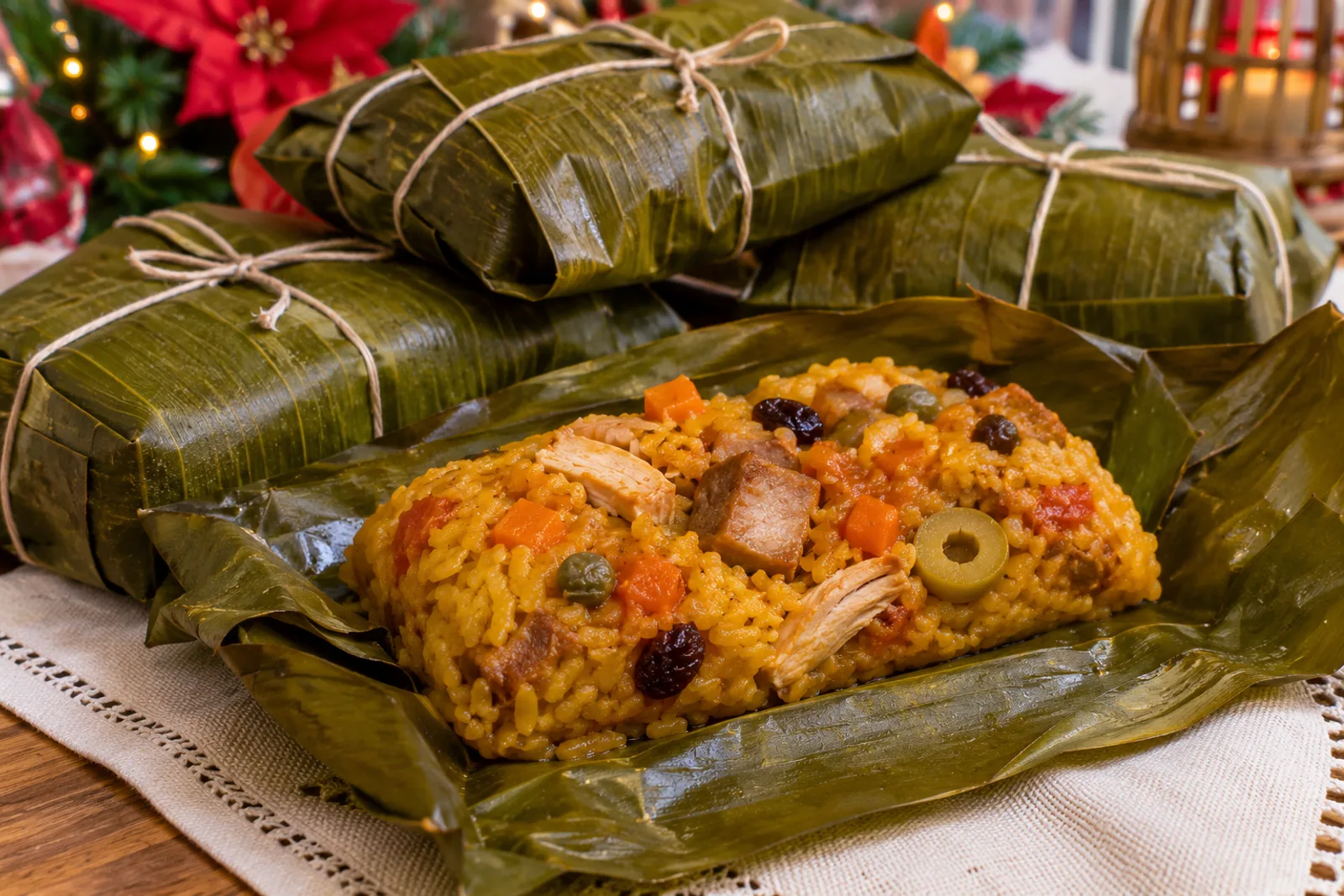

Colombian rice pasteles are tamales with no corn at all: 3 cups of raw long-grain rice get tossed with red annatto oil, cumin and a good splash of vinegar, then wrapped in leaves around a pork rib, a chicken thigh and a piece of pork belly, all raw, and boiled for 2 hours. The rice drinks up the meat juices and turns into a firm, savory orange block you slice with a fork. On Colombia’s Caribbean coast, around Barranquilla and Cartagena, they’re simply called pasteles and they’re made by the dozen for Christmas and New Year’s Eve. This recipe makes 12, with a night-before plan, how to tell the rice is cooked without opening the whole batch, quantities up to 48 and how to freeze them.
What Colombian rice pasteles are
How do you make Colombian rice pasteles? Marinate pork ribs, chicken thighs and pork belly overnight in a blended onion, bell pepper, garlic, cumin and vinegar marinade. The next day toss 3 cups (600 g) of raw rice with annatto oil, vinegar, cumin and some of the marinade, layer rice, meat and vegetables on banana or bijao leaves, tie each parcel and boil them covered for 2 hours with water over the top. 245 minutes for 12 servings.
A pastel (pahs-TEL; plural pasteles, pahs-TEL-ehs) opens into a compact slab of rice, denser than any pot of rice you’ve made, with a mild tang from the vinegar and plenty of cumin. In the middle sit the meat, a couple of potato slices and some vegetables. It isn’t spicy: ají dulce is a sweet pepper. A cabbage leaf wrapped right around the rice, inside the outer leaf, is the coastal touch you won’t find in Colombia’s inland tamales.
If you know other leaf-wrapped dishes, here is how it compares:
The Colombian tamal tolimense also contains rice, but folded into a corn dough that needs a 3-day soak. Puerto Rico has its own rice pasteles, made with half-cooked rice and a stew that’s already cooked, and the better-known Puerto Rican pasteles use a green banana and yautía masa. From the same coast, the Colombian bollo de yuca is a plain cassava roll in corn husk, with no filling. If you’ve made tungos, the rice and cheese parcels of the Colombian plains, the rice there is soaked and ground; here it stays whole.
Time. 245 minutes in all. On the day, the pot does 120 of the 220 minutes on its own, and the night before takes 25. Difficulty, medium. Nothing is hard; it’s about organization and a tight tie.
Who it’s for. A holiday cooking day with family, or a freezer stash for January. One pastel is a full meal for one person. For a weeknight dinner, this isn’t the dish.
Ingredients and US or UK swaps
Each pastel takes just ¼ cup (50 g) of raw rice plus one piece of each meat:
| Ingredient | What it is | In the US | In the UK |
|---|---|---|---|
| Annatto seeds (achiote) | Brick-red seeds that color the oil and add an earthy note | Latin aisle or Latin grocers, sold as annatto or achiote | Latin, Caribbean or spice shops, or online |
| Ají dulce | Small sweet pepper, no heat | Frozen at Caribbean grocers | Rare; use ½ extra red bell pepper |
| Bijao leaf | The coast’s leaf for pasteles | Hard to find; use frozen banana leaves from Latin or Asian grocers | Frozen banana leaves from Asian or Caribbean shops |
| Pork belly | Fresh, not smoked | Butcher counter; not bacon | Supermarket pork belly slices |
| Long-grain rice | Unrinsed, so the surface starch binds it | Any long-grain white rice | Long-grain; avoid pudding rice |
Annatto, if you can’t find it. 1 tsp sweet paprika gives the color but not the flavor.
Vinegar. It’s what gives pasteles their faint sour edge against the pork. If you’d like it softer, cut the rice vinegar to 6 tbsp (90 ml).
Equipment. A stockpot of about 4 to 5 gallons (15 to 20 liters) with a lid, wide enough for 12 parcels lying flat under water; a blender; a big bowl; and a meat thermometer if you have one. If your pot is smaller, boil in two batches.
Make-ahead plan
The night before you only blend the marinade, set aside ½ cup (120 ml) for the rice and toss the rest with the meat, then refrigerate overnight (3 hours minimum). Wipe the leaves too, and keep them rolled in a bag. The day itself looks like this:
How to make Colombian rice pasteles
Annatto oil and seasoned rice
Put the seeds in cold oil over low heat for three or four minutes, swirling, until the oil is deep red. Pull it off if it starts to smoke or the seeds go very dark, because it turns bitter. Strain it straight onto the rice.
Mix the rice with the oil, vinegar, cumin, salt and reserved marinade until not a single white grain is left, and let it sit 30 minutes. Then split it into 12 equal piles on a tray, so every parcel gets the same amount.
Filling and tying
Lay two pieces of leaf in a cross, shiny side up, with a cabbage leaf on top. Spread half a pile of rice loosely, add the meat, a tablespoon of peas, carrot, green beans, about 50 g (1¾ oz) of sliced potato, onion and capers, then the rest of the rice, and fold the cabbage over. Close the bottom leaf like an envelope, wrap the second one the other way and tie in a cross, twice around each way.
The rice triples as it cooks. Packed tight, it has nowhere to go and the parcel splits or the center stays raw. Some water always seeps through the leaves, and that is what finishes cooking the rice; the problem is a loose tie or a torn leaf, which lets the parcel open and water pour in, so the rice comes out washed-out. Aim for a snug parcel with loose rice inside.
Boiling and the doneness test
Put the pot on the heat when you start filling: 4 to 5 gallons (15 to 20 liters) of water takes over half an hour to boil. Line it with leaf scraps so no parcel touches the metal, and stir 2 tbsp vinegar and a tablespoon of salt into the water. Lay the pasteles in flat, with water covering them, because the rice cooks in the water that seeps through the leaf. Once it’s back to a boil, cover and cook 2 hours at a steady simmer-boil. Every 30 minutes, top up with boiling water, never cold.
Once the two hours are up, lift one from the middle of the pot, give it a 10-minute rest and open it:
- The rice is tender end to end, with no chalky center, and holds together as one block.
- The color is an even orange, and the leaf has gone from bright green to olive.
- The chicken pulls off the bone and reads 165°F (74°C) in the thickest part, without touching the bone. Color is no guide: meat by the bone can stay pink even when it is done. If it is under 165°F, keep boiling even if the rice is ready.
Still firm in the middle? Give the batch 20 more minutes and test again. Pot size, burner and parcel size all shift the timing, so the test pastel is what counts.
Troubleshooting
- Too salty. The meat marinade, the rice and the pot water all carry salt. If your ají dulce or any stock you use is salted, drop the salt in the rice to 1 tsp.
- Allergens. No gluten, dairy or egg. Not spicy; most kids like them with the capers left out. Warn guests about the bones.
Batch sizes for a holiday cooking day
Everything scales straight up; the only fixed thing is the boil. Each potful still needs its 2 hours from when the water returns to a boil.
| 12 pasteles | 24 | 36 | 48 | |
|---|---|---|---|---|
| Raw rice | 600 g (3 cups) | 1.2 kg (6 cups) | 1.8 kg (9 cups) | 2.4 kg (12 cups) |
| Pork ribs | 900 g (2 lb) | 1.8 kg (4 lb) | 2.7 kg (6 lb) | 3.6 kg (8 lb) |
| Chicken thighs | 12 | 24 | 36 | 48 |
| Pork belly | 300 g (10½ oz) | 600 g (1⅓ lb) | 900 g (2 lb) | 1.2 kg (2⅔ lb) |
| Annatto seeds | 1 tbsp | 2 tbsp | 3 tbsp | 4 tbsp |
| Leaf pieces | 24 | 48 | 72 | 96 |
Season the rice in 3-cup (600 g) batches so each rests the same time, and work as a pair: one person fills, the other wraps and ties. While the first pot boils, keep the next batch of wrapped parcels in the fridge; raw parcels shouldn’t spend more than 2 hours out of the fridge, counting the time it takes to wrap them. The meat is what drives the cost; chicken only, or smaller rib pieces, brings it down a lot.
Variations
- All pork or all chicken. Double up one meat. Pork and hen (stewing chicken) are the coast’s favorites.
- With a stewing hen. It’s tougher than a supermarket chicken, so cook the pieces in their marinade until tender first, and use that broth in the pot water. Some cooks then soak the rice for 1 hour, drain it well before seasoning and boil for less time, but that only works when all the meat is precooked. If the ribs and pork belly go in raw, keep the full 2 hours and check the chicken and rice as in the main recipe.
- Party style. 4 capers, 3 raisins and 2 olives per pastel, tucked in with the meat. Raisins against the vinegar aren’t for everyone, so try a few first.
- Short on leaves. Foil alone doesn’t give the same rice or the leaf aroma. Use one banana leaf and add an outer layer of foil or parchment, then tie as usual.
Serving, storing and reheating
Serving. Open it on the plate on its own leaf and eat it hot with a fork; one per person is a meal. On a coastal holiday table, Colombian butifarras, the little poached sausages from Soledad, are another local favorite, and for the rest of the menu see Latin Christmas recipes. For more parcels from Mexico, Colombia and Venezuela, start with the tamales guide.
Fridge. Spread them out on trays or in shallow containers rather than piling them up hot, so they cool fast, then cover them, still in the leaf, and refrigerate within 2 hours of coming out of the pot (1 hour on a very hot day). They keep 3 to 4 days.
Freezer. I freeze them already cooked, cooled, still wrapped and tied, in dated freezer bags. Good for 3 months.
Reheating. Unopened, in boiling water: about 20 minutes from the fridge and about 40 straight from frozen. In the microwave, open on a plate and covered, at medium power in 2-minute bursts; the rice dries out a little more. The center should reach 165°F (74°C).
Frequently asked questions
Is the rice raw or cooked when you wrap the pasteles? Raw, seasoned but uncooked. It cooks inside the leaf for the full 2 hours in the water that seeps in and the juices of the meat, which is why it sets firm and flavorful. Puerto Rican rice pasteles use half-cooked rice and boil for less time.
Can I freeze them uncooked? I don’t, since both the meat and the rice are raw. Raw ones would need more than 2 hours of boiling straight from frozen, while cooked pasteles freeze well and reheat in about 40 minutes.
Can I make them without banana leaves? Not really with foil or parchment alone: the rice cooks unevenly and you lose the leaf flavor. One banana leaf with foil or parchment over it works.
How many pasteles per person? One. With the rice, two meats and potato inside, it’s a complete plate.
Nutrition
Per pastel, of 12, worked out ingredient by ingredient from the quantities above, meat weighed without the bone:
- Calories: 677 kcal
- Protein: 33 g
- Carbohydrates: 59 g
- Fat: 33 g, of which 10 g saturated
- Fiber: 5 g
- Sugars: 5 g
- Sodium: 988 mg
The rice brings about 180 kcal per pastel and the pork, ribs and belly together, about 280. Sodium counts the salt in the marinade and the rice; the salted pot water adds some more. Chicken only and no pork belly cuts the fat noticeably.
I grew up with Venezuelan hallacas, which are all about kneading corn dough, so these made me think the other way round: there’s nothing to knead, and the whole thing depends on the rice having water around it and room to grow. When I make them I weigh out the rice piles, settle the leaf scraps on the bottom of the pot before anything goes in, and never pull the batch until I’ve opened one from the middle. Josnaisis.