

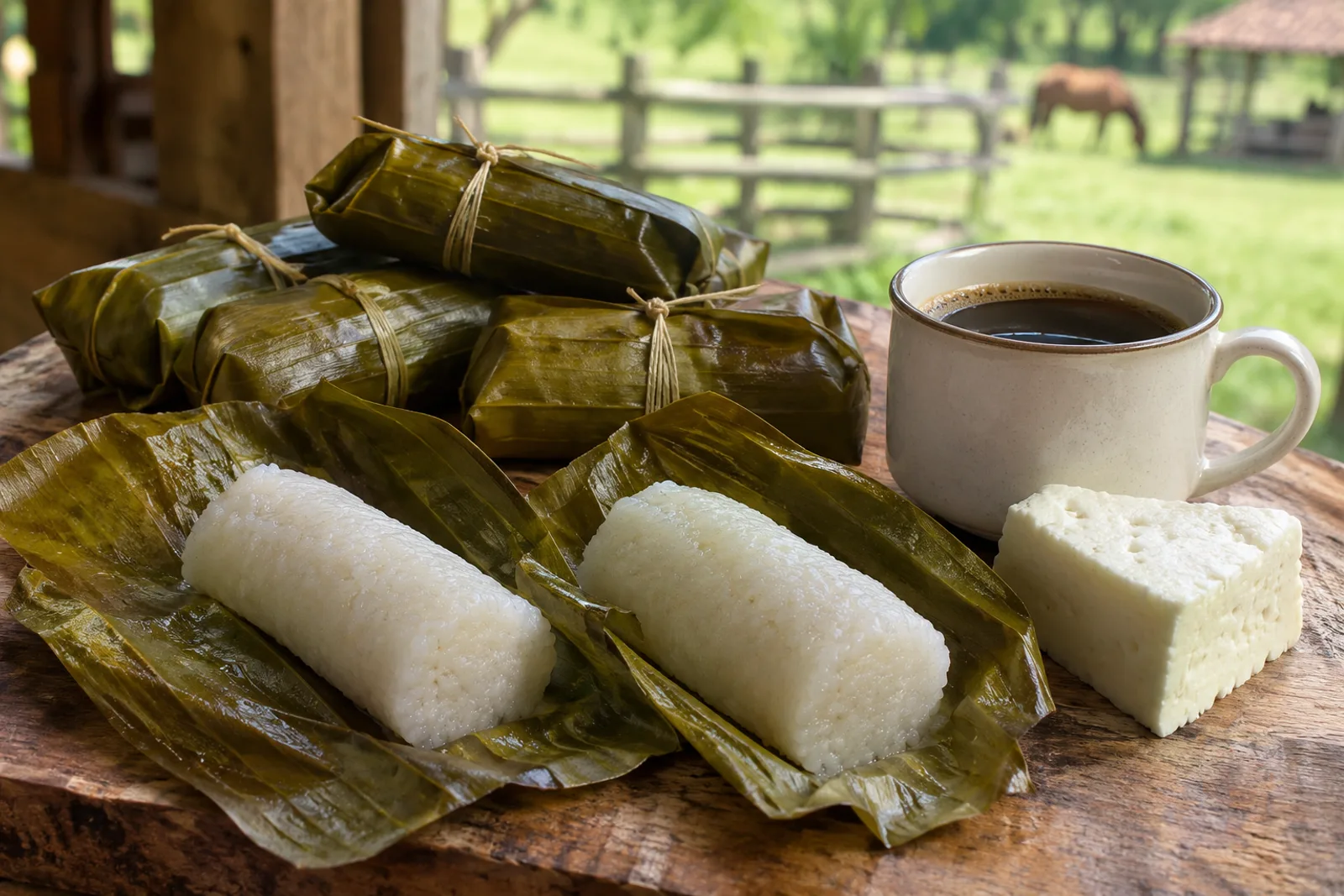

Tungos (TOON-gohs) are what the cattle country of eastern Colombia eats instead of bread. Raw rice soaked overnight is ground with an equal weight of fresh cheese, spooned into cones of leaf and steamed. The ratio is the whole recipe: 500 g (1 lb 2 oz) of rice, 500 g of cheese, twelve parcels of 95 g (3⅓ oz) and 45 minutes over boiling water. If you know tamales, think of a tamale with no filling where rice and cheese replace the corn masa. Below: how to grind it without a grain mill, US and UK swaps, how to tell they’re cooked and how many to make for a crowd.
What tungos are and where they come from
How do you make Colombian tungos? Soak 500 g (1 lb 2 oz) of rice for 8 to 12 hours, drain it and grind it with 500 g of fresh cheese and a pinch of salt into a fine dough that holds on a spoon. Fill 12 banana leaf cones with 95 g (3⅓ oz) each, close them and steam for 45 minutes. Rest 10 minutes before unwrapping. 95 minutes on the day, plus the overnight soak, for 6 servings.
They come from the Llanos, the tropical grasslands that Colombia shares with Venezuela, mostly from the departments of Meta and Casanare. Out there they sit beside the slow-roasted veal, mamona or Colombian llanero beef, with boiled cassava and hot sauce, and they turn up again at breakfast with coffee. A sweet version adds sugar, or a piece of guava paste in the middle.
How they compare with other wrapped doughs you may have seen (the whole family is in our guide to tamales from Mexico, Colombia and Venezuela):
- Tungo. Ground raw rice and fresh cheese, unfilled, in a banana or bijao leaf cone, steamed.
- Colombian envuelto. Fresh sweet corn, butter and cheese steamed in the corn’s own husk; sweet and studded with kernels. See Colombian corn envueltos.
- Venezuelan hallaquita. Unfilled arepa-flour dough boiled in a corn husk, eaten with grilled meat across the border: Venezuelan hallaquitas.
- Bollo de yuca. Grated cassava boiled in corn husks, from the Caribbean coast: Colombian bollo de yuca.
- Hayaca llanera. The Christmas tamale of the same region, with a three-meat filling: Colombian llanero hayacas.
The same rice-and-cheese dough also goes into the oven as small rings, called pan de arroz, the rice and cheese bread of Meta.
Time and difficulty. 95 minutes on the day, about 40 of them hands-on, plus an 8-hour overnight soak that takes 5 minutes to start. Medium, only because of the grinding: coarse rice gives a gritty tungo.
Ingredients for 12 tungos, with US and UK swaps
The recipe makes 12 parcels of about 95 g (3⅓ oz), two each for 6 people as a side. Rice and cheese are equal weights, which makes scaling simple.
Rice, or rice flour
- Long-grain white rice, raw. Ordinary supermarket rice. Skip parboiled or converted rice: the grain stays hard after soaking and won’t grind fine.
- Soak. At least 4 hours; I leave it 8 to 12, overnight, in the fridge if the kitchen is warm.
- The rice flour shortcut. Regular white rice flour (in the US baking or gluten-free aisle; in the UK, the free-from or world food aisle) gives a good tungo with no grinding at all. Don’t use sweet or glutinous rice flour, such as mochiko: it turns the dough chewy and gummy. For 500 g (1 lb 2 oz) of flour, start with 250 ml (1 cup) of warm water, mix it into the crumbled cheese and add more a tablespoon at a time until it holds in a mound on a spoon. Let it rest covered in the fridge at least 1 hour, overnight if you can.
The cheese
Cuajada is Colombia’s fresh curd cheese: white, moist, mild and lightly salted, a little squeaky. One that’s a day or two old, slightly drier, makes a firmer dough than a very fresh one. If yours weeps whey, drain it in a sieve for 30 minutes.
- US. Colombian grocers sometimes carry cuajada. Otherwise use Mexican queso fresco, which is saltier: leave the salt out of the dough and taste.
- UK. Queso fresco turns up in Latin shops and online. Paneer, crumbled very fine, is the easiest stand-in: it’s milder and firmer, so the dough may need an extra tablespoon or two of water.
- Don’t use ricotta or cottage cheese alone. They’re too wet and have no elasticity, so the tungo comes out soft and falls apart.
The leaves
In Colombia the traditional wrapper is bijao, a stiff, fragrant leaf whose central rib locks the cone shut without string. Outside Colombia, use frozen banana leaves from Latin American or Asian grocers in the US and UK. They’re thinner and tear unless softened over a flame or in boiling water, and they have no stiff rib, so each cone is folded like an envelope and tied. As a last resort, parchment lined with foil holds the shape, but you lose the leaf aroma that makes them taste like tungos.
Equipment. A large lidded pot with a steamer rack, a steamer basket, or a bed of leaf trimmings above the water. A hand grain mill or a strong blender. Cotton kitchen string for banana leaves.
Make-ahead plan
The night before: rinse and soak the rice, 5 minutes. On the day, grind and mix first; prepare the leaves and heat the water while the dough sits, and start filling once the water is hot.
How to make tungos
Grinding rice and cheese
With a hand grain mill, feed the drained rice and crumbled cheese through together, then once more with the mill set tighter. That’s how it’s done on the plains and it gives the smoothest dough.
With a blender, do the rice alone in 1-cup batches, each with 2 to 3 tablespoons of the soaking water, until you can’t see grains. Then work in the cheese by hand, crumbled very fine. Use as little water as you can get away with; a wet dough gives a pasty tungo.
The grind test. Rub a little dough between your thumb and finger. It should feel like very fine sand. If you feel bits, grind again.
The dough
Add the salt and knead 2 to 3 minutes. Don’t taste the raw dough: judge the salt by tasting the cheese first, since cheeses vary a lot. The dough is right when it holds in a mound on a spoon without slumping and doesn’t crack when pressed. If it cracks, add soaking water 2 tablespoons at a time. If it slumps, add a spoonful of rice flour or chill it 20 minutes to firm up.
Shaping the cones
- Soften the leaf. Wash, dry and pass it over a flame or through boiling water for a few seconds until it turns glossy and bends without splitting. Cut pieces of 30 × 25 cm (12 × 10 in).
- Roll a cone. Roll it into a cone, rib on the outside, and pinch the point so there’s no hole.
- Fill. Divide all the dough into 12 equal portions, about 95 g (3⅓ oz) each, two heaped serving spoons. Leave 6 cm (2½ in) of leaf free at the top.
- Close. Fold the top down over the opening. Banana leaf: fold it like an envelope and tie it with a strip of leaf or string. Bijao: tuck the rib tip into a fold.
Twelve take about 10 minutes once you have the knack.
Steaming
Put 3 to 4 cm (1¼ to 1½ in) of water in a large pot with a rack or a bed of leaf trimmings above it; the parcels must not sit in water. When it boils, lay the tungos on top, upright or seam side down, cover with more leaves and the lid, and steam 45 minutes over medium heat, with steam escaping around the lid. Check the water every 15 minutes and top up with boiling water, never cold.
How to tell tungos are done
Open one at 40 minutes.
If any sign says it needs more time, give the batch 10 minutes more and open another. On the plains some people cook them far longer in a pot, up to 2 hours; with parcels of about 95 g (3⅓ oz), start testing at 40 to 45 minutes, and if you make them bigger, test one and add time in 10-minute steps. Rest them 10 minutes off the heat: straight from the pot the dough is softer, and resting sets it.
Troubleshooting
- Gritty inside. The rice was under-soaked or coarsely ground. Soak 8 to 12 hours and do the fine-sand test before filling.
- Pasty or wet. Too much water in the blender or a very moist cheese. Use 2 to 3 tablespoons of water per cup of rice and drain the cheese 30 minutes.
- Raw in the middle. The water stopped boiling, or the timer started before there was steam. Keep a steady boil and time from when the lid steams.
- Cones open and leak. Dough too soft or a loose point. Firm up the dough, pinch the point tight and tie banana leaf parcels.
- Bland. Cuajada is lightly salted. Taste the cheese before you salt the dough.
Heat, kids and allergens. No chili at all, and children tend to like them, especially the sweet ones. They contain dairy. Rice is gluten free; if you’re cooking for someone with celiac disease and using rice flour, check that the bag is labelled gluten free.
Sweet tungos and other versions
Sweet
For breakfast I add 2 to 3 tablespoons of sugar to a batch made with 500 g (1 lb 2 oz) of rice and keep the salt to a pinch. Or bury a piece of guava paste of about 15 g (½ oz) in the middle of each cone, between two layers of dough.
The party version is close to a steamed fruitcake: for every 500 g (1 lb 2 oz) of rice, about 250 g (9 oz) of sugar and 125 g (4½ oz) of butter, a teaspoon of baking powder, chopped prunes, cherries and figs, and a splash of rum. It goes into smaller cones, two spoonfuls each, and steams the same 45 minutes.
With cooked rice
In Casanare they’re also made with very soft cooked rice, mashed with farmer’s cheese, butter and pichero, a traditional fermented milk, sweet or savory. Because the rice is already cooked, they need only about 30 minutes in a water bath or steamer, and they come out softer. Cooked rice shouldn’t sit out more than 2 hours before you wrap and cook it.
Corn and plantain
Some households use the name for corn-dough parcels in banana leaf, and in Casanare there’s a baked ripe plantain tungo made with corn flour and lard. Different doughs: this recipe is the rice one.
How many for a crowd
I count 2 per person next to grilled meat, cassava and plantain. Every 12 tungos take 500 g (1 lb 2 oz) of rice and 500 g of cheese. A large steamer pot holds about 12 laid in two layers; for more, use two pots or steam in batches, with the same timing, because it depends on the size of each parcel, not on how many there are.
The cheese is half the dough and most of the cost; rice and leaves are cheap. For a big batch, buy the cheese a day ahead so it dries a little, which is how you want it.
Serving, storing and reheating
Serving. Hot, unwrapped at the table; the leaf isn’t eaten. Beside grilled beef, boiled cassava and hot sauce, in place of bread. At breakfast with coffee, and the sweet ones on their own. For the rest of the plains table, see llanero food from the Colombian and Venezuelan plains.
Fridge. Cooled, in their leaves, in a closed container: 3 to 4 days. Refrigerate within 2 hours of cooking, since they’re made with fresh cheese.
Freezer. Cooked, cooled and still wrapped, in freezer bags: about 3 months.
Reheating. In their leaves, steamed: 10 minutes from the fridge, 20 minutes from frozen. Or on the grill next to the meat, turning until the leaf chars and the center is hot. In the microwave, wrapped in a damp paper towel, 1½ to 2 minutes; they dry out a little. Whatever the method, the center should reach 165°F (74°C).
FAQ
Do you eat the leaf? No. The leaf is only a wrapper that adds aroma; peel it off on your plate.
Can I boil them instead of steaming? Not in open-topped cones: under water, it gets in through the fold and the tungo turns soggy. To boil them, wrap each one fully closed like a tamale, tie it well and use the same doneness signs.
Can I use sushi rice or jasmine rice? I’d avoid sticky short-grain sushi rice, which makes a gummier dough. Jasmine works if it’s raw and not parboiled, though it adds its own floral aroma. Ordinary long-grain white rice is the neutral choice.
Should I freeze them raw or cooked? Cooked. They go from freezer to table in 20 minutes of steaming. Raw dough weeps water as it thaws and the parcels lose their shape.
Nutrition per serving
Per serving of 2 savory tungos (about 190 g / 6¾ oz), calculated from the recipe amounts:
- Calories: 553 kcal
- Protein: 21 g
- Carbohydrates: 69 g
- Fat: 20 g, of which 11 g saturated
- Fiber: 1 g
- Sugars: 2 g
- Sodium: 824 mg
Rice provides a little over half the calories; the cheese supplies nearly all the fat and protein. One tungo is about 277 kcal. The figures are calculated with Mexican queso fresco; Colombian cuajada, moister and less salty, brings the fat and sodium down a little.
To me, as a Venezuelan, tungos feel like cousins of our hallaquitas: plain dough in a leaf, made to sit beside the meat, but built on rice and cheese instead of corn. The work happens the night before and at the grinder, and the steam does the rest. Start the soak before bed, grind in the morning without rushing, and any leftovers go into the freezer in their leaves for the next cookout. Josnaisis.