

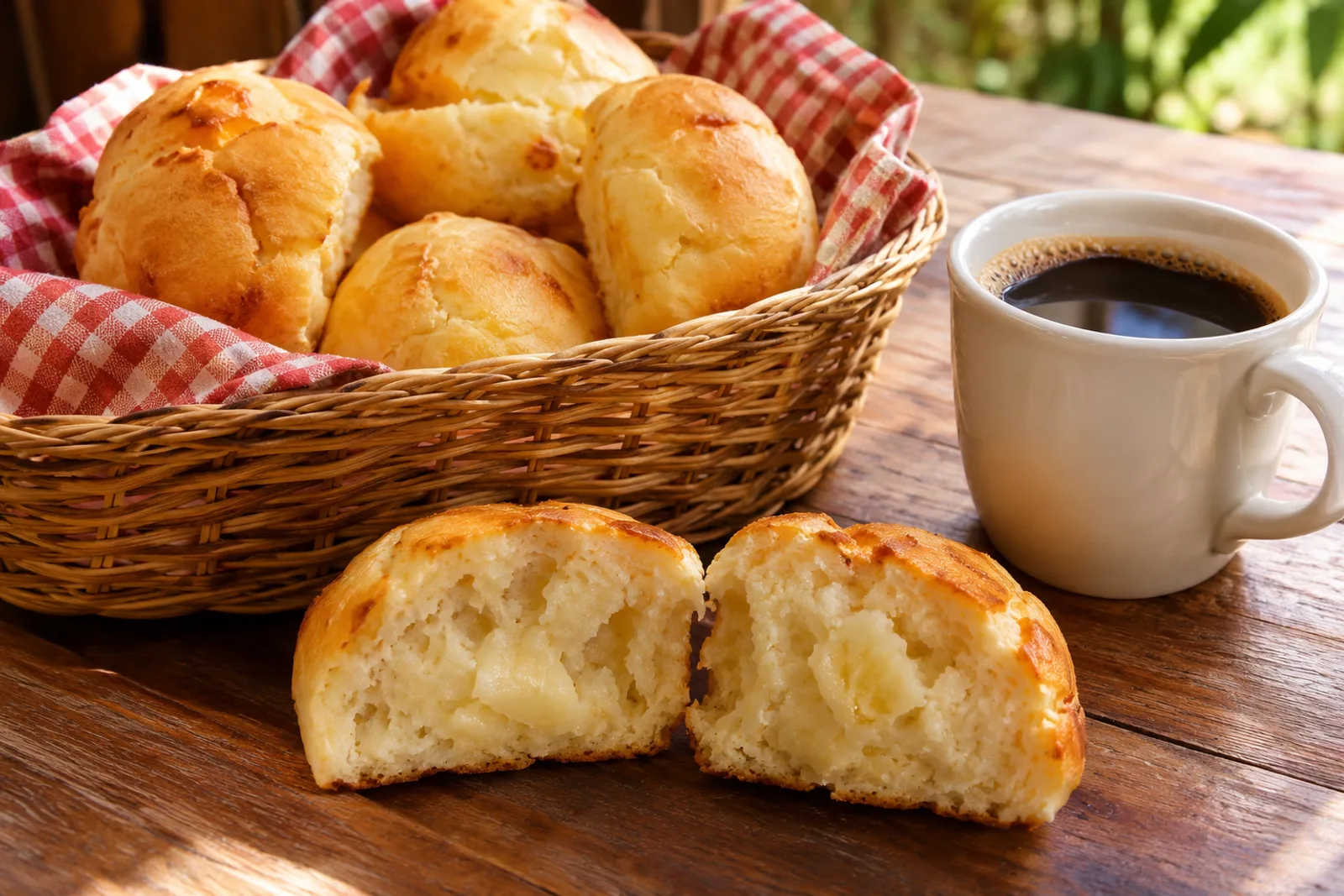

Two ingredients in equal weights, raw rice and fresh cheese, make this bread from the plains of eastern Colombia. You soak the rice overnight, grind it wet with the cheese into a dough, roll it into rings the size of a cookie and give them a few minutes in a very hot oven. Pulled out straight away they are soft; left in the cooling oven they turn crisp. There is no wheat, egg or yeast, so it is gluten-free without trying. This recipe makes about 56 rings and covers the two things that trip people up outside Colombia: what cheese to buy and how to grind the rice.
What is pan de arroz?
How do you make Colombian pan de arroz? Soak 500 g (1.1 lb) of raw white rice for 12 hours, drain and dry it, then grind it with 500 g (1.1 lb) of dry fresh cheese until no grit remains. Knead, shape 0.7 oz (20 g) rings and bake at 480°F (250°C) for 7 to 10 minutes, until the bases are barely golden. For crisp rings, leave them in the switched-off oven overnight. 110 minutes for 12 servings, plus the overnight soak and, for crisp rings, the drying time in the switched-off oven.
Pan de arroz (“rice bread”) comes from the department of Meta, in the Llanos, the cattle plains that run east of the Andes toward Venezuela. The town of San Martín is where it began, and Restrepo, where most of the bakeries are now, holds a festival for it every year. In 2016 Meta declared the traditional way of making it part of the department’s cultural heritage. It is sold in small bags at bakeries and shops all over the region.
What you get. Small white rings that taste of mild fresh cheese. Soft ones have a dense, moist, slightly springy crumb. Crisp ones are light and dry all the way through and break like a biscuit; they keep for days and are meant to be dunked in coffee.
Time and effort. The soak takes 12 hours and no work. Baking day is about 110 minutes: 30 to drain, 15 to grind, 10 to knead, 25 to shape and 30 in the oven across three sheets. I rate it medium, not for the method but because grinding finely and shaping rings that don’t split takes a little practice.
Ingredients and where to find them
| Ingredient | What it is | US | UK |
|---|---|---|---|
| Long-grain white rice | Ordinary raw rice, ground at home after soaking | Any regular long-grain; not parboiled or “converted” | Any long-grain white; not “easy cook” |
| Cuajada | Colombian fresh cheese curd, unsalted, used a few days old so it is dry | Farmer’s cheese (closest); queso fresco, with no added salt | Ricotta drained 2 hours under a weight in the fridge |
| Salt | Only if your cheese is unsalted | Fine table salt | Fine table salt |
| Milk or whey | Only to fix cracking dough | Whole milk | Whole milk |
The rice
Use plain long-grain white rice. Parboiled (“converted” in the US, “easy cook” in the UK) has already been heated and does not soften or grind the same way. Bakers in Meta actually prefer rice that is not freshly harvested, so an older bag from the pantry is fine.
The soak is what lets you grind raw rice. After 12 hours a grain snaps under a fingernail and grinds to something like damp flour. Under 4 hours it stays hard in the middle and the dough turns gritty and cracks.
Using rice flour instead. This is an adaptation, not the Llanos recipe, and it needs one adjustment. Store-bought rice flour is dry, while soaked rice carries the water it absorbed, so the dough needs liquid: as a rough starting point, use about 120 ml (½ cup) of milk or water per 500 g (1.1 lb) of flour, then add more a tablespoon at a time until a rope rolls without cracking. Expect a slightly sandier dough that splits more easily as you close the rings, and a denser ring. Use regular white rice flour, not glutinous or sweet rice flour (mochiko), which makes a sticky, gummy dough.
The cheese
Colombian cuajada is a mild, unsalted fresh curd. For this bread it should be dry, not fresh off the press; bakeries use it a few days old, once it has shed its whey and gone slightly rubbery. A wet cheese makes a sticky dough that slumps in the oven.
- Farmer’s cheese (US) is the best match: dry, mild, ready to use as it is.
- Queso fresco (US, Latin aisle) works but is saltier: leave out the salt.
- Ricotta (UK and US) works only if drained: wrap it in a clean towel, set it in a sieve with a plate on top and leave it in the fridge for 2 hours.
- Skip melting cheeses like mozzarella and aged cheeses like cheddar: they change both the dough and the flavor.
Whatever you use, dry it in the fridge. Never leave fresh cheese out on the counter to “age”.
Equipment
The tool that matters is the grinder. A hand-cranked grain mill (the kind sold for corn) does the best job. A food processor works in small batches, stopping to scrape down. A blender can manage small handfuls on pulse, but it grinds the coarsest. You also need a kitchen scale for the rings and two or three baking sheets.
Make-ahead plan
- Two days before. Wrap the cheese and let it drain in the fridge.
- The night before. Put the rice to soak.
- Baking day. Follow the order below; turn the oven on when you start shaping.
How to make pan de arroz
Drain and dry the rice
Fifteen minutes in a sieve gets rid of the water, but the grains are still wet on the outside. Spread them on a towel for another 15. Surface water is what makes the dough sticky.
Grind it with the cheese
Grind the rice and cheese together, alternating handfuls: the cheese helps the rice through the mill or past the blades without clogging. In about 15 minutes you have a crumbly mass that holds when squeezed. Rub a pinch between your fingers. If you feel hard bits, grind it again; those bits are what make the rings split at the curve.
Knead and shape
Knead with the heels of your hands for about 10 minutes. It starts crumbly and comes together smooth. It is ready when you can roll a rope and bend it without cracks on the outside.
If it cracks, it needs moisture: one tablespoon of milk, knead, test again. If it sticks, it is warm or the cheese was wet: 10 minutes in the fridge. Warm hands crack it too, which is why bakers in Meta knead for a while before shaping, until the dough stops picking up the heat of their palms.
For each ring, weigh a 0.7 oz (20 g) ball, roll a 6 in (15 cm) rope about as thick as your little finger and pinch the ends together. Leave ⅝ in (1.5 cm) between rings on an ungreased sheet.
Bake soft or crisp
The oven has to be at 480°F (250°C) before the first sheet goes in, rack in the middle. Bake one sheet at a time; each takes 7 to 10 minutes at 480°F.
Pan de arroz stays pale, so don’t wait for a golden top. Take the rings out when the surface has lost its sheen and looks dry and matte, the bases are just golden, and a ring pressed with a fingertip gives slightly without denting. Pull them too early and the inside is still wet; leave them past the 10-minute mark and the bases darken while the rings harden without ever going crisp.
In the wood-fired ovens of Colombian bakeries, which run far hotter than a home oven, soft rings can be done in about 3 minutes. At home, go by the three signs above.
For crisp pan de arroz, switch the oven off after the last sheet, put all the rings back in and close the door until the oven is cold, or overnight. The leftover heat dries them slowly without browning them, the home version of what bakeries do when they leave the trays in the dying oven from night until morning. They are done when they feel light, snap cleanly and are dry at the center.
Troubleshooting
- Rings split when you close them or in the oven. Grit in the dough, or dough that is warm and dry. Grind again, add a spoon of milk, chill 10 minutes.
- They spread and feel sticky. The cheese or the rice was too wet. Drain better next time; 15 minutes of chilling helps a little.
- Hard and pale but not crisp. The oven was not fully hot when the sheet went in. Preheat for 20 minutes.
- Burned bottoms. Dark sheet or low rack. Use the middle rack and line dark sheets with parchment.
- Gritty to eat. Short soak or coarse grinding. With rice flour, expect a little of this anyway.
- Crisp ones went soft. They picked up moisture. Spread them out and give them 5 minutes at 320°F (160°C); they crisp again as they cool.
Allergens. Contains milk. No wheat, egg or nuts, so it is naturally gluten-free; if you bake for someone with celiac disease and use rice flour, pick one certified gluten-free. Kids usually like it: it is mild and cheesy, with no spice.
How it compares with other cheese breads
If you have had Brazilian pão de queijo, you might expect the same chew. Pan de arroz is different: no added starch, no egg, and a denser, plainer crumb. Within Colombia, pandebono uses sour cassava starch and salty cheese and puffs up; almojábanas are made with precooked cornmeal and curd and have a cake-soft crumb; pandeyuca is a crisp-shelled cassava ring; and achiras are dry, crunchy sticks of achira starch. The closest in shape is Paraguayan chipa, also a ring, but made with cassava starch and anise.
Variations and scaling
- With butter and a little sweetness. Some bakeries work a little butter and sugar syrup into the dough along with the salt. Each has its own amounts, so start small if you try it: too much makes the dough hard.
- Soft only. Start checking at 7 minutes, take them out as soon as they show the three signs above and eat them the same day.
- Rice flour shortcut. See the ingredients section: start with 120 ml (½ cup) of liquid per 500 g (1.1 lb) of flour.
- For a crowd. Scale both ingredients equally; nothing else changes except the number of sheets.
In Meta the same rice-and-cheese dough also goes into tungos, wrapped in leaves and steamed instead of baked. For the rest of the region’s cooking, from stake-roasted beef to river fish, see llanero food.
Serving and storage
Serve soft rings warm with black coffee or café con leche, and crisp ones for dunking in coffee or a mug of Colombian hot chocolate. They are breakfast, afternoon and road-trip food.
Soft rings are best the day they are baked. They contain fresh cheese, so don’t leave them out of the fridge more than 2 hours, or more than 1 hour if the room is above 90°F (32°C). Covered in the fridge they keep 3 to 4 days; refresh them for 3 minutes at 400°F (200°C).
Crisp rings, if they are dry to the center, keep in an airtight jar or tin at room temperature; I keep mine up to a week. A ring that is soft inside is not a crisp ring: refrigerate it like the soft ones.
Freezing. Freeze soft rings once baked and cooled, in a sealed bag, for up to 2 months. Reheat from frozen, 5 minutes at 400°F (200°C).
FAQ
Can I use leftover cooked rice? It won’t make the same bread. Cooked rice has already swollen its starch, so the dough turns sticky and does not dry out the same way in the oven. Pan de arroz needs raw rice, soaked.
Is this the same as Bolivian pan de arroz? No. The Bolivian bread shares the name but is made with rice flour and cooked cassava, with a different shape and crumb.
Does it rise? No. There is no yeast, baking powder or egg; the cheese is what holds the ground rice together, so the crumb is dense rather than airy.
How short can the soak be? 4 hours is the practical minimum for grinding. 3 hours can work if you grind longer, but the dough tends to be gritty. 12 hours, or a full day, gives the smoothest dough.
Nutrition per serving
Worked out ingredient by ingredient, for one serving (a twelfth of the batch):
- Calories: 277
- Protein: 11 g
- Carbohydrates: 35 g
- Fat: 10 g, of which saturated 5 g
- Fiber: 1 g
- Sugar: 1 g
With about 5 rings to a serving, each ring is about 60 calories. I don’t give a sodium figure because it depends entirely on your cheese and on whether you add salt.
With only two ingredients, all the skill is in the dough. If rings split, I grind the dough a second time before I add any milk, because grit is nearly always the reason. And I bake the whole batch every time: a few soft ones to eat straight from the oven, and the rest left overnight in the switched-off oven, because a crisp ring dipped in coffee is the version I like best. Josnaisis.