

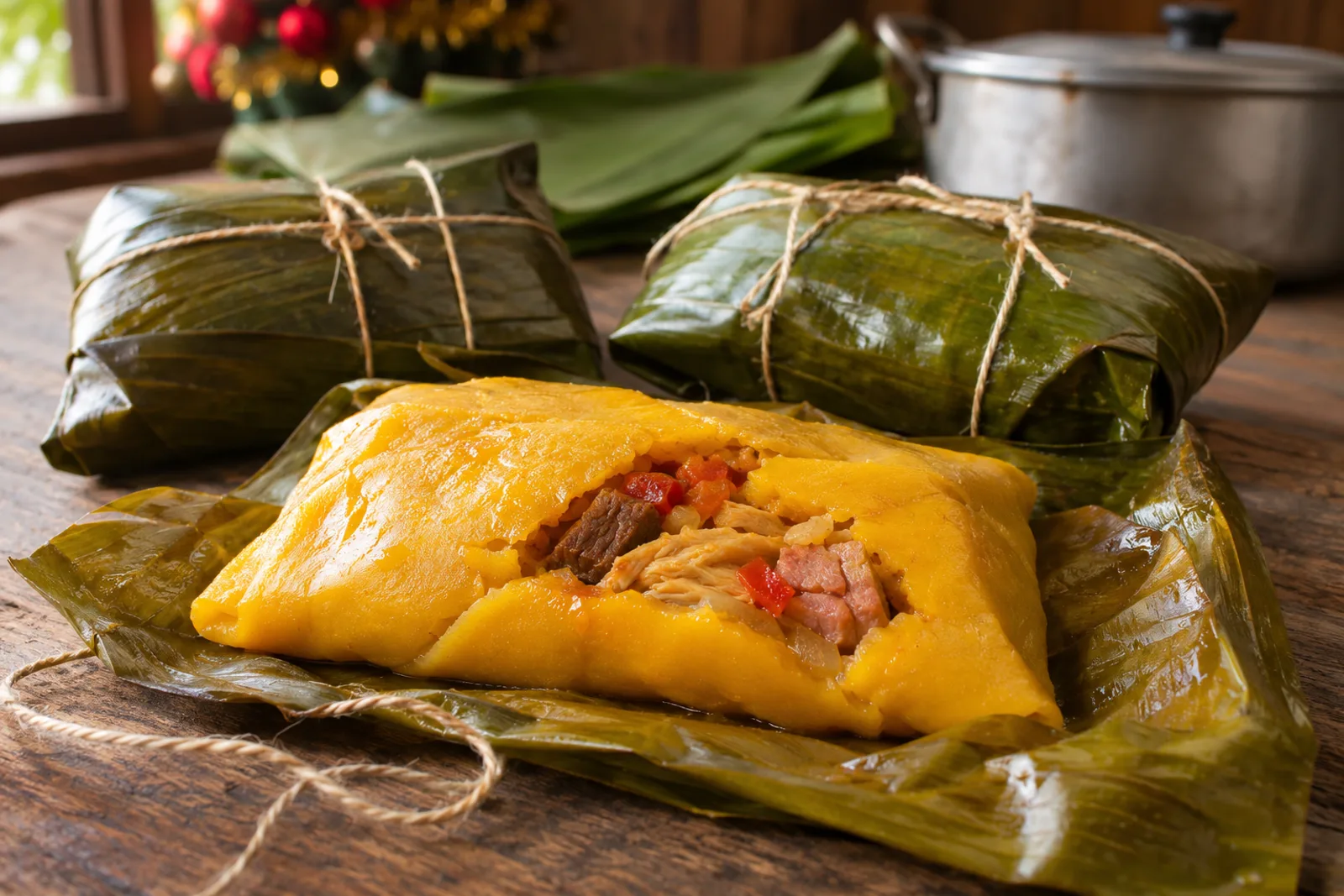

On Colombia’s eastern plains, the Llanos, every family has its own hayaca, and this three-meat version breaks the usual tamal rule of cooking the meat inside the leaf: the meat goes into the pot first: beef, pork and chicken simmer together, and the broth they leave behind is what the corn dough is kneaded with. The result is a dough that tastes of the filling and a parcel that only needs 90 minutes in boiling water. This recipe makes 20, enough for a family Christmas batch, and covers what to buy in a US or UK supermarket, how to split the work over two days and how to freeze and reheat them.
What hayacas llaneras are
How do you make Colombian hayacas llaneras? The day before, simmer beef, pork and chicken together with onion, garlic, salt and cumin, chop the meat, mix it with an achiote sofrito and save the broth. Next day, knead 1.2 kg (2 lb 10 oz) of precooked corn flour with that broth and lard, wrap each portion in bijao or banana leaf with the meat, potato, carrot, peas and half an egg, tie it and boil for 90 minutes. 310 minutes for 20 servings.
Hayacas are the December tamal of Colombia’s Llanos, the tropical cattle plains of Casanare and Meta that run east of the Andes toward Venezuela. Each one is a flat, rectangular parcel of yellow corn dough around three meats, which is why locals call them trifásicas, plus potato, carrot, peas and a boiled egg. The word sounds exactly like the Venezuelan hallaca; on the Colombian plains it is often spelled with a y, though you will also see hallaca llanera, and people also call it tamal llanero. It is not spicy unless you add chile.
If you have eaten Mexican tamales, forget the corn husk and the steamer: these are boiled in leaves, eaten with a fork and closer in size to a small meal.
How it differs from other leaf-wrapped tamales
| Hayaca llanera | Venezuelan hallaca | Tamal tolimense | Bogotá-style tamal | |
|---|---|---|---|---|
| Meat | Beef, pork and chicken cooked first, then chopped | Three meats marinated 24 hours in wine and stewed separately | Raw marinated chicken, ribs and pork belly | Raw marinated chicken, ribs and pork belly |
| Dough | Precooked corn flour mixed with the meat broth | Precooked corn flour with hen broth and annatto lard | Hominy soaked 3 days and ground, with rice and peas | Precooked corn flour with water, hogao and peas |
| Extras | Potato, carrot, peas, half an egg | Olives, capers, raisins, onion, bell pepper | Potato, carrot, half an egg | Potato, carrot, chickpeas |
| Boil | 90 minutes | 90 minutes | 150 minutes | 2 hours |
The order of work is the real difference. In the Tolima and Bogotá tamales the meat goes in raw and cooks inside the leaf; the hallaca uses a cooked stew but a dough made with a separate hen broth. In this version, the meats simmer together first and the dough is kneaded with that same broth, so dough and filling taste of one another. It isn’t the only way on the plains: some families marinate the meat raw or stew it separately. The Valle del Cauca tamal goes another way again and cooks its dough like porridge before wrapping. The tamales of all three countries, with the masa and leaf each one uses, are in our guide to tamales.
Time and effort. 310 minutes over two days: about 115 the day before, 90 of them unattended simmering, and about 195 on wrapping day, including the 90-minute boil. Difficulty, medium. Nothing is hard; it takes planning and a tight tie.
Ingredients and US and UK swaps
The Spanish names in the list are the ones you will see on Latin store labels. Here is what to buy and what changes if you swap:
| Recipe ingredient | US | UK | What changes |
|---|---|---|---|
| Precooked corn flour (harina precocida) | Masarepa, in the Latin aisle | Masarepa from Latin grocers or online | Nothing; white works too, paler |
| Masa harina (Mexican, for tortillas) | Don’t use it | Don’t use it | Tastes of tortilla, dense dough |
| Cornmeal or polenta | Don’t use it | Don’t use it | Not precooked, gritty |
| Beef flank or brisket | Flank or brisket | Skirt or brisket | Fine either way |
| Pork shoulder | Pork shoulder (butt) | Pork shoulder | Leaner leg also works, a little drier |
| Lard | Lard or vegetable oil | Lard or vegetable oil | Oil gives an equally soft, less savory dough |
| Ground achiote (annatto) | Latin aisle, sold as achiote or color | Latin or Caribbean grocers | 1 tsp sweet paprika colors it, different flavor |
| Scallions | Green onions | Spring onions | None |
| Bijao leaves | Rarely sold | Rarely sold | Use banana leaves, below |
Bijao leaves and banana leaves
Bijao is a broad, smooth leaf from the Llanos that gives the dough a softer, greener aroma than banana leaf. Outside Colombia you will almost never find it, so use frozen banana leaves: 1 lb (454 g) packs in the freezer of Latin and Asian grocery stores in the US, and from Asian and Latin grocers or online shops in the UK. Count 4 packs for 20 hayacas, because some leaves always tear. Thaw them in the fridge overnight. Foil keeps the water out if you have no leaves at all, though the dough loses the leaf aroma. Tie with thick cotton twine, never plastic string.
Equipment. One large pot for the meat and the biggest pot you own for boiling, deep enough to cover the parcels lying flat (for 20 you will likely need two), a large mixing bowl and an instant-read thermometer for the final check.
The make-ahead plan
Day 1. The beef goes in first because it is the toughest, the pork after 30 minutes and the chicken after 60. While it simmers, clean the leaves, boil the eggs and chop the vegetables. Cut the cooked meat into 2 cm (¾ in) pieces rather than shredding it fine, which dries it out inside the dough. Strain and keep the broth. Everything goes in the fridge within 2 hours.
Day 2. The dough, the assembly line and the pot.
Wrapping and boiling
Getting the dough right
The dough should be softer than arepa dough, like thick mashed potatoes: spreadable with a spoon and not cracking when you squeeze it. If it cracks, it needs broth, 100 ml (scant ½ cup) at a time. Taste it for salt before you wrap, because there is no fixing it later: fry a teaspoon of dough in a skillet for 2 minutes and eat it.
Folding and tying
- Cross two pieces of leaf brushed with a little lard.
- Spread about 170 g (6 oz) of dough into a 1 cm (⅜ in) rectangle, leaving 5 cm (2 in) of leaf free all round.
- Add the meat and sofrito, 2 potato slices, carrot, peas and half an egg.
- Fold the bottom leaf’s sides over, then its ends; wrap the top leaf the opposite way. The parcel should be flat, not round.
- Tie in a cross, two turns each way, with a firm knot.
If the parcel shifts when you lift it by the string, add a third leaf and tie again. Some cooks on the plains only fold their hayacas and pack them tight in the pot; at home, tied is safer.
How to tell they are done
Start the 90 minutes once the water is back at a boil. Keep it gentle, keep the lid on and top up with boiling water every 30 minutes. At high altitude water boils below 212°F (100°C) and you may need longer, so trust the signs over the clock.
Let a test hayaca rest 15 minutes before you open it, since every fresh tamal looks raw at first. It is ready when the leaf has gone olive green, the dough is firm and peels cleanly away and the center reads 165°F (74°C).
What goes wrong
- Dry, crumbly dough. It was mixed as stiff as arepa dough. It should be soft; it keeps absorbing moisture in the pot.
- Bland dough. It wasn’t tasted before wrapping. Fry a spoonful first.
- Water inside. Torn leaves or a loose tie. Soften the leaves and use two turns each way.
- Scorched bottom layer. The pot ran low. Check every 30 minutes.
- Leftover meat left out overnight. Everything cooked on day 1 goes in the fridge within 2 hours.
Allergens and heat. Contains egg. Gluten-free if your corn flour and achiote are (check labels); no dairy or nuts. Mild enough for children; serve the Colombian ají picante on the side for anyone who wants heat.
Scaling for a tamalada
Multiply straight up; only the pots and the simmering water change, since that water becomes the dough broth. Boiling time stays at 90 minutes.
| Hayacas | Beef + pork | Bone-in chicken | Simmering water | Corn flour | Lard | Eggs | Leaf pieces |
|---|---|---|---|---|---|---|---|
| 10 | 400 g + 400 g (14 oz each) | 600 g (1⅓ lb) | 1.5 L (6⅓ cups) | 600 g (1 lb 5 oz) | 75 g (⅓ cup) | 5 | 20 |
| 20 | 800 g + 800 g (1¾ lb each) | 1.2 kg (2⅔ lb) | 3 L (3 quarts) | 1.2 kg (2 lb 10 oz) | 150 g (⅔ cup) | 10 | 40 |
| 40 | 1.6 kg + 1.6 kg (3½ lb each) | 2.4 kg (5⅓ lb) | 6 L (6⅓ quarts) | 2.4 kg (5¼ lb) | 300 g (1⅓ cups) | 20 | 80 |
With three people, set up a line: one spreads dough, one adds filling, one ties. Keep the dough under a damp towel. The beef and pork are the costly part of the batch; swapping half the beef for more chicken brings it down.
Variations. Raw marinated meat, as in the Bogotá-style tamal in the table above, needs 2 hours of boiling and a 165°F (74°C) center, and you lose the broth-flavored dough. Some families in Meta add cooked rice to the filling or rice flour to the dough, which makes a denser parcel. A few raisins and an olive on top of the meat take it closer to the Venezuelan hallaca.
Serving, storing and reheating
Open it on the plate on its own leaf and eat it hot with a fork; one is a meal. On the plains it shares the December table with Colombian llanero beef roasted on stakes. More from the region in the llanero food guide and more holiday cooking in the Latin Christmas recipes.
- Fridge. In their leaves, spread out in shallow covered containers rather than left stacked in the pot, within 2 hours of coming out of the pot, or 1 hour if the room is above 90°F (32°C). Don’t wait for the whole batch to cool in the pot. They keep 3 to 4 days.
- Freezer. Cooked and cooled, leaves and twine on, in freezer bags: 3 months.
- Reheat. Still wrapped, in boiling water: about 15 minutes from the fridge, about 30 from frozen without thawing. Or unwrapped on a plate, covered, in the microwave at medium power in 2-minute bursts. Either way the center must reach 165°F (74°C).
Hayaca FAQ, spelling, freezing and steaming
Is a hayaca the same as a hallaca? Same pronunciation, different dish. On the Colombian plains it is usually spelled hayaca (hallaca llanera also turns up), and this version is made with cooked meats and broth dough; the Venezuelan hallaca has a wine-marinated stew and olives, capers and raisins.
Can I freeze them uncooked? Better not. Raw potato freezes badly and raw dough weeps as it thaws. Boil them the full 90 minutes, cool, then freeze.
Can I steam them instead of boiling? Yes, though the timing depends on your steamer and how tightly the parcels are packed, and I haven’t timed it with this size. Open a test parcel and check the signs above before taking out the rest.
Nutrition per hayaca
Per hayaca (1 of 20, no chile), worked out ingredient by ingredient from the recipe quantities:
- Calories: 582 kcal
- Protein: 33 g
- Carbohydrates: 60 g
- Fat: 23 g, of which 8 g saturated
- Fiber: 5 g
- Sugars: 4 g
- Sodium: 858 mg
The corn flour accounts for about 222 kcal per parcel, the three meats about 183 and the lard and oil about 86. Most of the sodium comes from the salt in the broth and dough, so if your broth tastes salty, hold back the 2 teaspoons in the dough until you have tasted it.
I chop the meat rather than shredding it because I like finding real bites inside the dough, and I always fry a spoonful of dough before I wrap the first one. I grew up with the Caracas hallaca, full of olives and raisins, and what I like about the llanero version is how direct it is: three meats, their broth and a leaf. Josnaisis.