

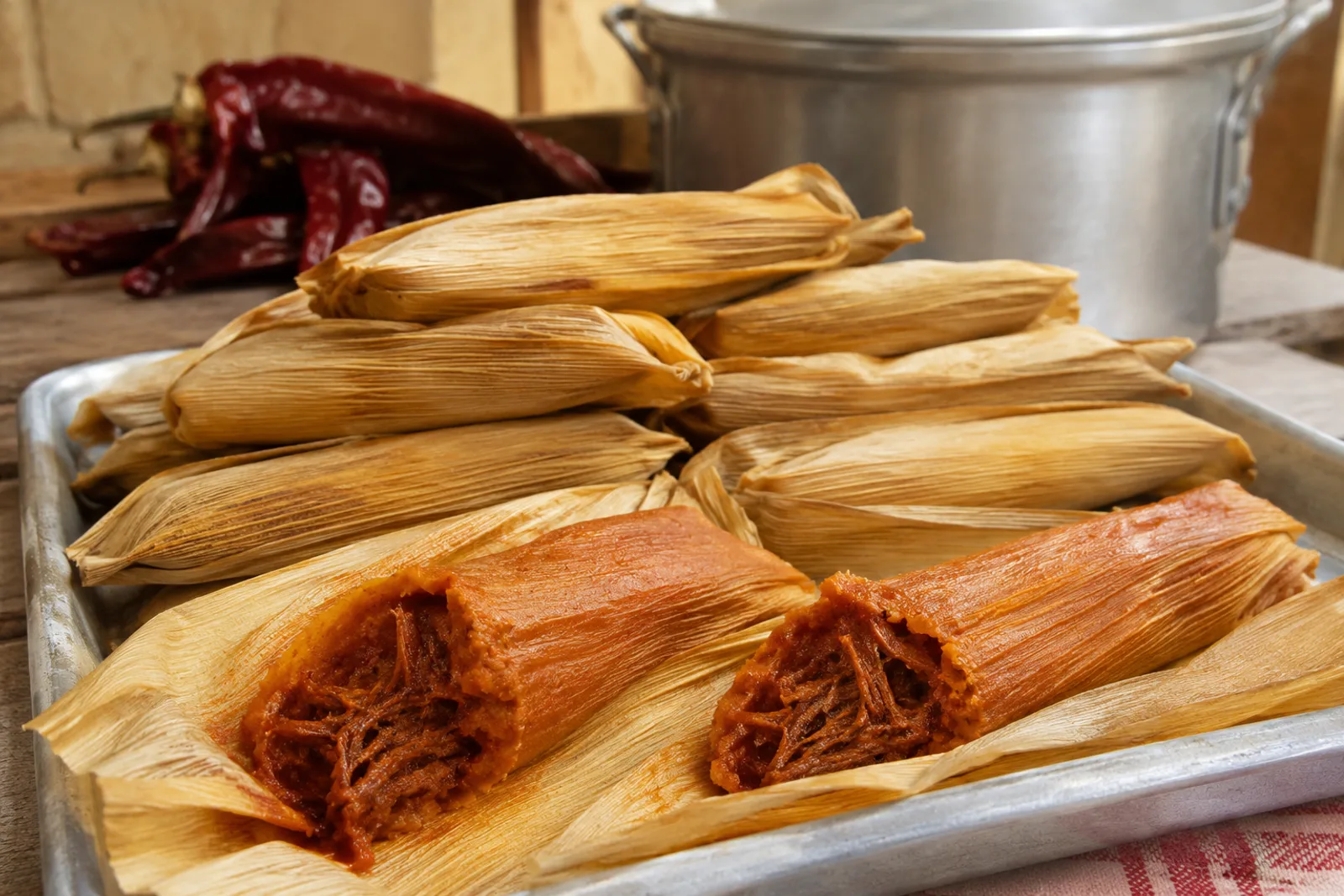

Beef tamales from northern Mexico are small and thin: 2 kg (4.4 lb) of masa makes 60 of them, each with about 50 g (1¾ oz) of orange masa, a spoonful of shredded beef in dried red chile sauce and, the way they do it in Sonora, a green olive in the middle. The work splits over two days, beef and sauce first, then a day of beating, filling and 90 minutes of steam. Below is the full recipe for 60, which dried chiles to buy in a US or UK shop, how to keep the filling dry enough for such a thin masa, and how to tell when they are cooked.
What makes these beef tamales northern
How do you make red chile beef tamales? Simmer 1.5 kg (3.3 lb) of beef chuck for 2 to 2½ hours, shred it and cook it down in a sauce of 12 dried red chiles thickened with lard and flour until no liquid is left. Beat 2 kg (4.4 lb) of masa with 400 g (14 oz) of lard, broth and a little of the sauce, spread 50 g (1¾ oz) on each husk, add filling and an olive, and steam 90 minutes. 390 minutes for 20 servings of 3 tamales.
A tamale is corn dough (masa) spread on a corn husk around a filling and steamed until it sets. In Sonora, Chihuahua and across the border in Arizona, the classic one is filled with beef simmered until it shreds and cooked in a smooth sauce of dried red chiles, the same sauce that turns the masa orange. Compared with central Mexican tamales, norteños tend to be slimmer, with less masa per husk, and this version uses less lard. They are mild: the red chile brings color and an earthy taste, not heat.
If you want pork in guajillo and ancho, with a fluffier masa, that is red pork tamales, and green chicken tamales use the same masa with tomatillo salsa. For every style from Mexico to Venezuela, see how to make tamales.
Shopping list for a US or UK kitchen
The recipe makes 60 tamales, enough for twenty people at three apiece, since these small ones are eaten a few at a time.
Dried red chiles, and what to buy instead
The northern red chile is long, smooth and brick red when dried. In US supermarkets it is sold in bags in the Hispanic aisle as California chili pods or New Mexico chili pods; dried Anaheims are the same pepper. California and Anaheim pods are among the mildest dried chiles, earthy with a hint of raisin. New Mexico pods come in mild, medium and hot, so check the bag and buy mild if you are cooking for kids.
- Guajillo. The closest swap, 12 for 12, and easier to find online in the UK. The sauce turns a brighter red and a little tangier.
- 9 guajillos plus 3 anchos. Darker and sweeter, closer to the sauce in chile colorado beef, which also works as a filling.
- Not paprika or chili powder. Paprika gives color but none of the dried-chile flavor, and US chili powder is a blend with cumin and garlic that turns the filling into something else.
- For heat, simmer 2 or 3 dried chiles de árbol with the red chiles. Without them, most kids eat these happily.
Pick pods that bend without cracking. Brittle ones are old and taste dusty.
Beef, masa, lard and husks
- Beef. Chuck roast in the US; braising steak or chuck and blade in the UK. Lean cuts such as bottom round go dry and stringy inside a masa this thin.
- Masa. Fresh unprepared masa from a tortillería or Mexican market is best. With masa harina, use 800 g (7 cups) of masa harina for tamales with 1.2 liters (5 cups) of warm water in place of the 2 kg (4.4 lb). Use water rather than broth here: the pot only gives about 2 liters (8 cups) of broth, and the sauce, filling and beating need it. “Prepared masa” already has lard and salt in it; if that is what you have, leave out the lard here and taste before salting. Cornmeal and Venezuelan arepa flour will not work, because the corn has not been treated with lime. The tamale masa recipe goes through every flour and fat in detail.
- Lard. UK supermarkets sell blocks of it in the chiller; in the US it is in the Hispanic aisle or by the butter. Vegetable shortening gives the same texture without the pork flavor. Oil makes a denser masa, because it cannot hold air.
- Corn husks. Sold dried in bags in US supermarkets and Mexican shops; in the UK, from Mexican grocers online. One medium husk per tamale.
- Olives. Spanish-style green olives (manzanilla), pitted or not. Optional, but if you leave the pits in, warn your guests.
Equipment. A large stockpot for the beef, a blender, a fine sieve, a wide pan, a stand or hand mixer, and a tamale steamer or any tall pot with a rack that holds 60 tamales standing up.
Scaling for a smaller or bigger party
Everything scales in proportion except the steaming, which does not double.
Two-day plan
Making the filling a day ahead is what keeps a batch of 60 manageable: cold filling is easier to spoon and the beef picks up more chile flavor overnight. The first day takes about 200 minutes, most of it unattended simmering; tamale day takes 190 minutes.
- Day before. Beef, sauce and filling. Store the filling, the ½ cup of sauce for the masa and the strained broth separately, covered, in the fridge.
- Tamale day. The husks soak while the masa is beaten. With two people, one spreading and one filling and folding, all 60 are done in half an hour.
- To get further ahead, beaten masa also keeps overnight in the fridge. Let it warm up and beat it for 2 or 3 minutes with a splash of warm broth before spreading, because cold masa tears.
The red chile beef filling
Tender in 2 to 2½ hours. Simmer the chuck in big pieces rather than cubes, so it shreds into longer strands and stays moist. It is ready when a piece falls apart under a fork; if you have to push, it needs more time. Keep all the broth: it goes into the sauce, the filling and the masa.
Blend with broth, not chile water. After their 15-minute simmer, blend the chiles with beef broth and throw away the water they cooked in, which is murky and can taste bitter. The strained sauce then goes into a little lard and flour toasted for 1 to 2 minutes, which thickens it and rounds out the flavor. For gluten-free tamales, skip the flour and reduce the filling 5 to 10 minutes longer.
Cook it dry. This step decides more than any other. With 3 mm (⅛ in) of masa around it, any loose broth soaks in and the tamale turns soggy or splits when you unwrap it. Keep cooking the beef in its sauce until a spoon dragged across the pan leaves a track that closes slowly and no puddle forms. It tightens further as it cools.
A thin masa at 5 to 1
This northern version uses 5 parts masa to 1 part lard by weight, 400 g (14 oz) for 2 kg (4.4 lb). That is less lard than usual, and on purpose. Once you drop below 250 g per kilo, the masa comes out firmer and a little less fluffy than the basic tamale masa, which is what you want here: it spreads thin without tearing and holds together around such a small filling. If you prefer it more tender, go up to 250 g per kilo (4 oz per lb).
- Beating. Lard alone first, 5 minutes, until it turns white. Then the masa in chunks, alternating with the sauce and broth. It is ready when the color is even, it spreads like thick mashed potatoes and it does not cling to your fingers. Expect to use 500 to 750 ml (2 to 3 cups) of broth, depending on how moist your masa is.
- The one-tamale test. Before filling all 60, spread masa on one husk with no filling, steam it for 10 to 15 minutes and let it rest 5 minutes out of the pot. If it peels cleanly off the husk, the masa is right; if it sticks, give it a few more minutes of steam and rest first, because it is usually just undercooked. Only if it still sticks once cooked, beat in 2 more tablespoons of lard and test again. The float test, a pinch of masa dropped in water, works too.
- Salt. Fry a small ball in a dry skillet and taste it, since raw masa is misleading. It should taste slightly salty, because steaming mutes it.
Filling and folding small tamales
- Husk. Drain it, pat it dry and lay it smooth side up, pointed end toward you.
- Masa. 2 heaped tablespoons, about 50 g (1¾ oz), spread with the back of the spoon over the wide half. Keep it thin and even, about 3 mm (⅛ in), with 2 cm (¾ in) clear on the sides and nothing on the tip.
- Filling. 1 heaped tablespoon of beef down the center and one olive. More than that squeezes out when you fold.
- Fold. Bring one side of the husk over the filling so the masa wraps around it, lay the other side over the top and fold the pointed end up. The top stays open.
If your husks are small, overlap two along the wide edge. Assembled tamales can wait in the fridge, covered, while you finish the rest.
How long to steam beef tamales
A full pot of 60 needs 90 minutes over medium-low heat, counted from when steam escapes the lid. A very crowded pot can need up to 105 minutes; half a batch, 30 tamales, is usually done in 75 to 90.
- Water. Up to 5 cm (2 in) below the rack. Top up with hot water down the side every 30 minutes; if you hear the pot sizzling dry, add some right away.
- The test. At 75 minutes, take one from the center, let it sit a minute and unwrap it. If the husk peels away cleanly and the masa is set, they are done. If the masa sticks or looks wet and raw, give them 15 minutes and test again.
- Rest. Straight out of the steamer they are soft and a little tacky. Turn off the heat, uncover and leave them 10 minutes in the pot to firm up.
No tamale steamer? A tall stockpot with a metal steamer basket, or a rack set on an upturned heatproof plate, does the same job; the tamales guide shows how to set one up.
Mistakes that ruin beef tamales
- Wet filling. Soggy tamales whose masa falls apart when unwrapped. Reduce until the spoon leaves a track.
- Masa too thick. More than 50 g (1¾ oz) per husk and it stops being a norteño: it takes longer to cook and the beef gets lost.
- Masa sticking to the husk. Either it needs more steaming or more lard. Test one plain tamale before filling them all.
- Bitter sauce. Scorched chiles, or chiles blended in their cooking water. Simmer them without toasting and blend with broth.
- Pot boiled dry. The bottom scorches and the lowest tamales go hard. Hot water every 30 minutes.
- Cold masa. It will not spread and it cracks. Take it out of the fridge 1 hour ahead and beat it briefly.
Allergens and heat. Contains gluten in the flour that thickens the sauce, which you can leave out, and lard, which you can swap for vegetable shortening. With red chiles alone, the heat is mild.
Variations from the north
- With potato and carrot. Sonoran cooks add sticks of potato and carrot about 6 mm (¼ in) thick and 5 cm (2 in) long, boiled in salted water until just tender, alongside the beef. For 60 tamales, about 500 g (1 lb) of each. More filling, milder flavor.
- With raisins. 2 or 3 per tamale next to the olive, sweet against salty, as in the Nogales version.
- Half beef, half pork. 750 g (1.65 lb) of each, simmered together for the same time. Juicier and richer.
- Hotter. 2 or 3 chiles de árbol simmered and blended with the red chiles.
- With leftover chile colorado. Shred the beef into its sauce and cook it down until it no longer drips. Allow 1 heaped tablespoon per tamale.
Serving and storing
Plan on three tamales per person as part of a meal, four if they are the whole meal. Eat them freshly unwrapped, with frijoles charros on the side, and at a December breakfast or late supper with thick Mexican champurrado or coffee.
- Fridge. Cooled and covered within 2 hours, they keep 3 to 4 days.
- Freezer. In a well-sealed bag, 2 to 3 months for best quality.
- Reheating. Steam them in their husks, 15 minutes from the fridge or 20 to 25 minutes from frozen, until the center reaches 165°F (74°C). Being small, they heat through faster than a large tamale.
FAQ
Are beef tamales norteños spicy? Not much. California and mild New Mexico chile pods are among the mildest dried chiles and give color and flavor rather than burn; New Mexico pods also come in hot, so check the bag. For real heat, simmer two or three chiles de árbol with the sauce.
Why is there an olive inside? It is the custom in Sonora and southern Arizona: one green olive in the middle of each tamale, sometimes with raisins or potato. Its salty, sour bite cuts the richness of the lard. Leave it out and nothing else in the recipe changes.
How many tamales does a pound of masa make? About 14 of these small ones, which is 30 per kilo, using 50 g (1¾ oz) of prepared masa each. The same masa makes 24 green chicken tamales per kilo, because those are bigger.
Can I make the masa without lard? Yes, with the same weight of vegetable shortening: just as soft, with no pork flavor. Oil works, but the masa holds no air and the tamales come out more compact.
Nutrition
Per serving of 3 tamales, with olives, calculated ingredient by ingredient from the recipe card:
- Calories: 560 kcal
- Protein: 19 g
- Carbohydrates: 36 g
- Fat: 38 g, of which 14 g saturated
- Fiber: 4 g
- Sugars: 3 g
- Sodium: 730 mg
Each tamale is about 187 kcal. Almost half the fat comes from the lard in the masa, about 21 g (¾ oz) per serving at 200 g per kilo. Without olives, sodium drops by about 125 mg per serving.
I always make these over two days, and the part I watch most is the filling: I let it cook down until I think it is about to catch, and that is when it is right. With masa this thin there is no room for a wet filling. I use pitted olives, because nobody at my table expects one and I would rather not surprise anyone. Josnaisis.