

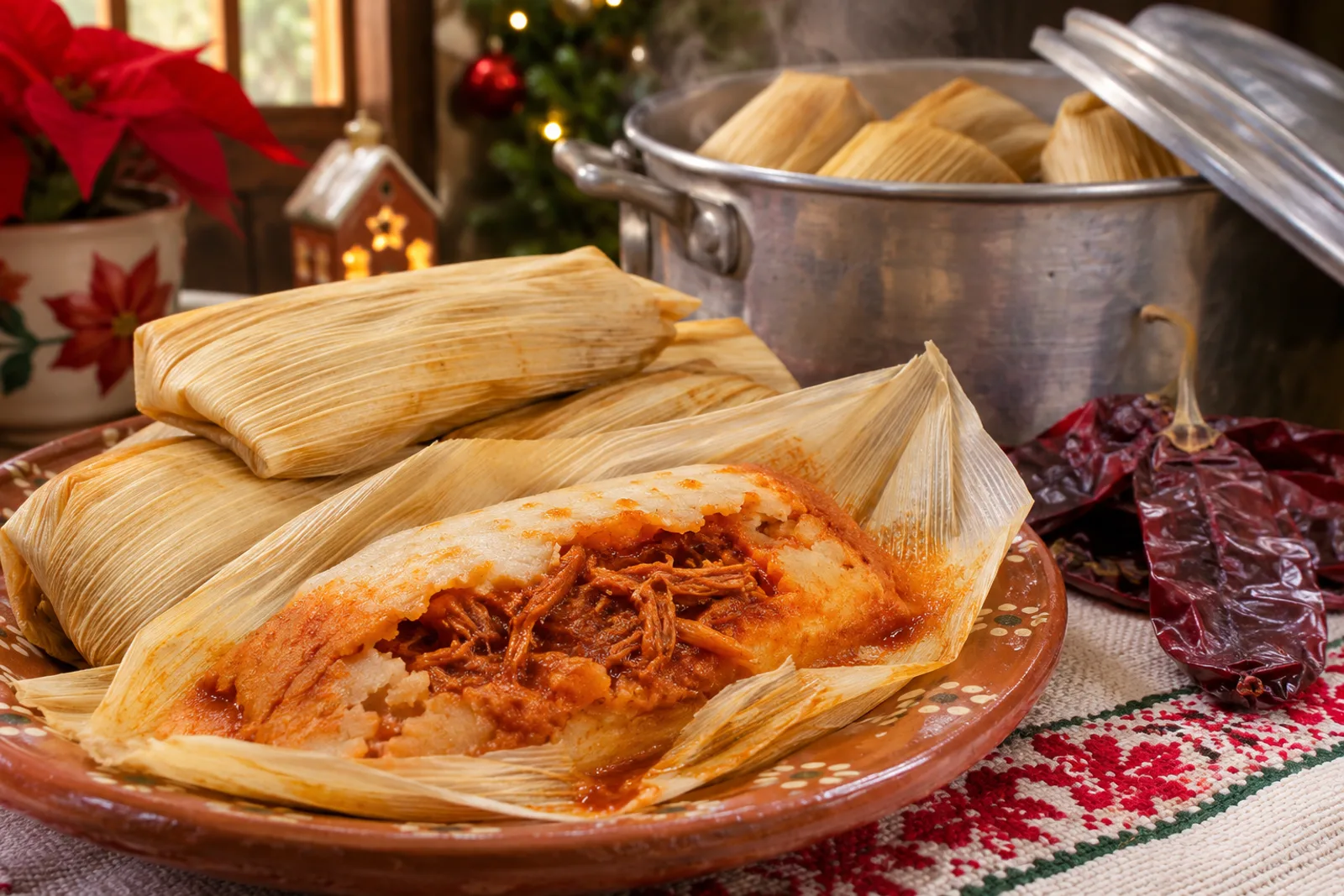

Tamales rojos (tah-MAH-lehs ROH-hohs) are Mexico’s red tamales: a corn husk spread with whipped masa, filled with pork shoulder shredded into a dark sauce of guajillo and ancho chiles, and steamed until the masa sets. What makes them red all the way through is that the masa is beaten with the pork’s own broth and half a cup of that same chile sauce, so it comes out pale orange and seasoned. This recipe makes 24, split over two days, with what to buy in a US or UK supermarket and how to steam them in an ordinary stockpot.
What red pork tamales are, and how long they take
How do you make red pork tamales? Simmer 2¼ lb (1 kg) of pork shoulder with onion and garlic until it shreds, blend 8 toasted guajillos and 3 anchos with that broth, and fry the sauce. Cook the shredded pork in the sauce until it’s thick. Beat 1 kg (2¼ lb) of masa with 300 g (1½ cups) of lard, pork broth and ½ cup of the sauce until a dab floats in water, spread it on soaked corn husks, fill, fold and steam 75 to 90 minutes. 330 minutes for 12 servings (24 tamales).
Total time 330 minutes, about 125 of them hands-on, because the sauce and the masa get made while the pork simmers. Spread over two days it’s far easier: about 2½ hours for the pork and filling the day before, then about 3 hours on tamale day, half of it hands-off steaming. Medium difficulty: nothing is hard, but three things decide the result, and they’re covered below.
A good one has soft, moist masa that peels cleanly off the husk and a juicy center of pork in a thick brick-red sauce that tastes of dried chile, with a sweet undertone from the ancho. Without any chile de árbol, the heat is mild. You don’t eat the husk; you unwrap the tamal on your plate.
How they compare with other tamales
Green chicken tamales use the same whipped masa with a tangy tomatillo and serrano filling. Red chile beef tamales from northern Mexico are smaller and thinner, with beef in chile colorado. Colombian pork tamales are a different family altogether: kneaded cornmeal dough with no whipped lard, pork on the bone with potato and vegetables, wrapped in banana leaves.
Shopping list for 24 tamales
Each tamal gets about 70 g (a scant ⅓ cup) of masa and 35 g (2 tbsp) of filling; a serving is 2 tamales. The recipe makes about 1.7 kg (3¾ lb) of beaten masa, so just divide all of it among the 24 husks rather than weighing every portion.
| Ingredient | Metric | US | Where to find it |
|---|---|---|---|
| Pork shoulder, boneless | 1 kg | 2¼ lb | Labeled pork butt or Boston butt in the US; pork shoulder in the UK |
| Guajillo chiles | 8 (45 g) | 8 (1½ oz) | Bags in the Hispanic aisle or produce section |
| Ancho chiles | 3 (45 g) | 3 (1½ oz) | Same shelf as the guajillos |
| Masa harina for tamales | 400 g | 3½ cups | Bag marked “for tamales”; or 1 kg (2¼ lb) fresh unprepared masa |
| Lard | 325 g | about 1⅔ cups in all | Tubs in the Hispanic aisle; UK blocks in the baking aisle |
| Dried corn husks | 40 | 40 | Hispanic aisle, usually an 8 oz bag |
Pork shoulder, not loin
Shoulder (sold as pork butt or Boston butt in the US) has fat and connective tissue running through it. After 1½ to 2 hours at a simmer it shreds into juicy strands that survive the steamer. Pork loin comes out dry and stringy, so skip it here. If you can only find bone-in shoulder, buy about 1.3 kg (3 lb); the bone also gives the broth more body.
Pressure cooker or electric multicooker. Cover the 5 cm (2 in) chunks with water, along with the onion and garlic, without going over the two-thirds line, and cook 40 minutes at high pressure with about 15 minutes of natural release. The broth is just as good for the masa.
Guajillo and ancho chiles, and how hot to make it
Guajillos are long, smooth and brick red; they bring bright color and a fruity, slightly tart flavor. Anchos are dried poblanos, wrinkled and almost black; they add depth, body and a raisin-like sweetness. Together they’re mild. Dried chile de árbol is the one that brings the heat:
| Heat level | Chiles | Good for |
|---|---|---|
| Mild | 8 guajillos + 3 anchos, seeds and veins removed | Kids and anyone who avoids heat |
| Medium | The same plus 1 or 2 chiles de árbol | Most tables |
| Hot | The same plus 3 or 4 chiles de árbol | People who want to feel it |
Toast the árbol with the others, but only for a few seconds, since thin chiles burn fast. If guajillos are all you can find, use 12: the sauce is tangier and less rounded, but it works. Don’t swap in chili powder blends; they contain cumin, garlic and oregano and won’t give the same sauce. The same chile mix and toasting method go into chile colorado beef, if you want the full detail on avoiding bitterness.
Masa harina, fresh masa, and why not “prepared masa”
Masa harina is flour made from nixtamalized corn (corn cooked with lime), and it’s what most people outside Mexico use. Buy the bag labeled for tamales, which is coarser than the one for tortillas; the tortilla kind makes denser tamales. Cornmeal, polenta and Colombian or Venezuelan arepa flour won’t work: they aren’t nixtamalized and the dough won’t hold together the same way.
Fresh masa from a Mexican market or tortillería is better still, but ask for unprepared masa (“masa sin preparar”). The “prepared masa for tamales” sold in tubs and bags around the holidays already has fat and salt mixed in, so if you use it, check the label, skip the lard, baking powder and salt here, and beat in the chile sauce and broth a little at a time, only until it spreads like thick frosting; it may need much less liquid than the recipe lists. Since the kilo you buy already includes fat and liquid, expect fewer than 24 tamales.
What makes this masa red is the liquid: 275 ml (1 cup plus 2 tbsp) of pork broth and 125 ml (½ cup) of the chile sauce per kilo of masa. More sauce than that makes the masa too soft to spread. For the base method, ratios with oil or shortening and how many tamales a bag makes, see tamale masa.
Corn husks and lard outside the Hispanic aisle
- US. Dried husks, chiles and masa harina sit together in the Hispanic or international aisle of most large supermarkets, and every Mexican grocery has them. Shelf-stable lard comes in tubs on the same aisle; fresh rendered lard from a Mexican butcher tastes more of pork.
- UK. Lard is sold in blocks in most supermarkets and works well. Dried chiles, masa harina and husks are easiest from Mexican food shops online. If you can’t get husks, rectangles of baking parchment about 20 × 25 cm (8 × 10 in), folded the same way and tied with string, will hold the masa. You lose the light corn aroma of the husk, but they steam the same way.
- No lard. Vegetable shortening, same weight, whips just as well and tastes neutral. Oil doesn’t whip, so the masa won’t float and the tamales come out denser.
Do you need a tamale steamer?
No. A tamale steamer (tamalera) is just a tall pot with a raised rack. Any 8 to 10 quart stockpot with a lid works if you raise the tamales above the water: a collapsible steamer basket, a metal colander that fits inside, or a heatproof plate turned upside down on three balls of foil. Keep 1½ in (4 cm) of water below the rack, never less than 1 in (2.5 cm), and drop a coin in: while it rattles, there’s water. A 10 quart pot holds 24 tamales standing up.
Make-ahead plan
The day before. Cook the pork, make the sauce, put ½ cup in a jar for the masa and cook the filling down. Refrigerate the filling, the reserved sauce and the broth separately, covered, within 2 hours. Chilled overnight, the filling firms up and is easier to spoon than when it’s fresh.
Tamale day. Soak the husks, warm the broth, beat the masa, assemble and steam: about 3 hours. Raw assembled tamales can also wait, covered in the fridge, for up to 24 hours before steaming.
For 48, double everything and use two pots or steam in two batches. If your mixer bowl is small, beat the masa in two batches too.
How to make red pork tamales, step by step
The chile sauce. Chiles go 10 to 20 seconds per side in a dry skillet, pressed flat: they barely change color and smell toasty. If they smoke or blacken, throw them out. Soak 20 minutes in very hot water and pour that water away, since it carries the bitterness. Blend with clean broth from the pork pot and strain out the skins. Frying the sauce 5 minutes in lard cooks off the raw chile taste; it darkens a shade and thickens slightly. Use a deep pan, because it spatters hard when it goes in.
The filling, thick and cool. This is the step people rush and the one that ruins the most tamales. Cook the shredded pork 15 to 20 minutes in the sauce until a spoonful holds a mound on a plate with no puddle around it. Any loose liquid ends up in the masa during steaming. Fill the tamales with it cool or warm, not hot, or it melts the lard in the masa as you spread it.
The masa. Beat the lard alone for 5 minutes until it turns white, then add masa and liquids in turns. After 10 minutes it should spread like thick frosting without tearing. The float test tells you it holds enough air: if it floats, the tamales will be light. If it still sinks after 15 minutes of beating but spreads well, use it anyway; they’ll just be a little denser. Raw masa should taste slightly salty, because steaming mutes it.
Rolling. About 70 g (a scant ⅓ cup) of masa on the wide half of the husk, 35 g (2 tbsp) of filling in the middle, sides folded until they meet over the filling, narrow end folded back. Overlap two narrow husks if needed.
Steaming. Upright and close together, but not packed: if they’re jammed in, the ones in the middle take much longer. 75 to 90 minutes from the boil with the coin rattling the whole time. Straight out of the pot, a tamal always looks raw; give it 5 minutes before you judge.
Troubleshooting red pork tamales
- Bitter sauce. Burnt chiles, or chiles blended with their soaking water. There’s no real fix; 1 tsp sugar and a little more broth mask it. Next time, fewer seconds on the skillet.
- Mushy tamales that split open. The filling was too wet. Reduce it 5 to 10 minutes more, uncovered, and let it cool before rolling.
- Masa won’t float. Not beaten long enough, or the lard was cold and hard. Beat 2 or 3 minutes more and test again; in a cold kitchen, leave the lard out an hour before you start.
- Tough or dry pork. Not enough time in the pot, or it was loin. If shoulder doesn’t shred with a fork, give it 15 to 20 minutes more.
- Still sticking to the husk after 2 hours. The pot is too full, the heat too low, or the water ran out. Take a few out, check the water is boiling and the coin rattles, and keep going 15 minutes at a time.
- Pale, bland masa. Too little salt, or water used instead of broth. It shows more in red tamales because the filling is so bold, so taste the masa before you start rolling.
Allergens. No gluten, dairy or egg, as long as your baking powder is gluten-free (some contain wheat starch, so check the label).
Variations
- With cheese. A 10 g strip of Oaxaca cheese, Monterey Jack or mild cheddar laid on the filling before folding. Milder and creamier.
- With chicken. 1 kg (2¼ lb) bone-in chicken thighs instead of pork, cooked until they reach 165°F (74°C) and shred easily. A lighter filling; the masa tastes a little less rich because chicken broth is milder.
- Meatless. Strips of roasted poblano and cheese in the same red sauce. For the green version with cheese, rajas con queso tamales have their own sauce.
For a map of the whole family, from Mexico to Venezuela, with steaming times and how to reheat each kind, see the tamales guide.
Serving and storing
Serve them hot in their husks with Mexican champurrado, the thick chocolate corn drink that goes with tamales for breakfast or supper in Mexico. Two per person make a meal; one is enough at breakfast.
Fridge 3 to 4 days in their husks, in a sealed container, put away within 2 hours. Freezer 3 to 4 months, cooked and cooled first (raw masa changes texture when frozen). Reheat by steaming 15 to 20 minutes from the fridge or about 30 minutes from frozen, until 165°F (74°C) in the center. Leftover filling keeps as long in the fridge and makes good tacos.
Frequently asked questions
Do you put red chile sauce in the masa? Some of it. Half a cup per 2¼ lb (1 kg) of masa, along with the broth, turns it orange and seasons it without making it too soft to spread.
Pork butt or pork shoulder for tamales? Both are shoulder. Pork butt (Boston butt) is the upper part and a little more marbled; picnic shoulder is the lower part. Either works as long as it keeps its fat; lean pork loin dries out.
Are red pork tamales spicy? Usually only mildly. Guajillo and ancho taste of chile more than heat, but guajillos do carry some heat and it varies from bag to bag, so taste the sauce before serving them to kids. Real heat comes from chile de árbol, which you add or leave out.
Why are my tamales dry? Masa with too little liquid, steaming far too long, or reheating them uncovered. The masa should spread like frosting; if it cracks as you spread it, it needs more broth.
Nutrition
Per serving of 2 tamales, worked out ingredient by ingredient from the quantities above, using masa harina:
- Calories: 593 kcal
- Protein: 18 g
- Carbohydrates: 32 g
- Fat: 44 g, of which 16 g saturated
- Fiber: 4 g
- Sugars: 3 g
- Sodium: 980 mg
That’s about 296 kcal per tamal. The lard accounts for roughly four in every ten calories and the pork for about a third. Some of the pork fat stays in the broth; chill it and lift off the fat that sets on top if you want them a little lighter.
The thing I watch most with red tamales is the filling. I’d rather it look almost dry in the pan, because any sauce left loose ends up in the masa. That’s why I make it the day before and roll the tamales with it cold, a full spoonful and no puddle. At home Dylan’s go without árbol and mine get two: I blend the árbol separately with a little sauce and stir it into my half of the filling only. Josnaisis.