

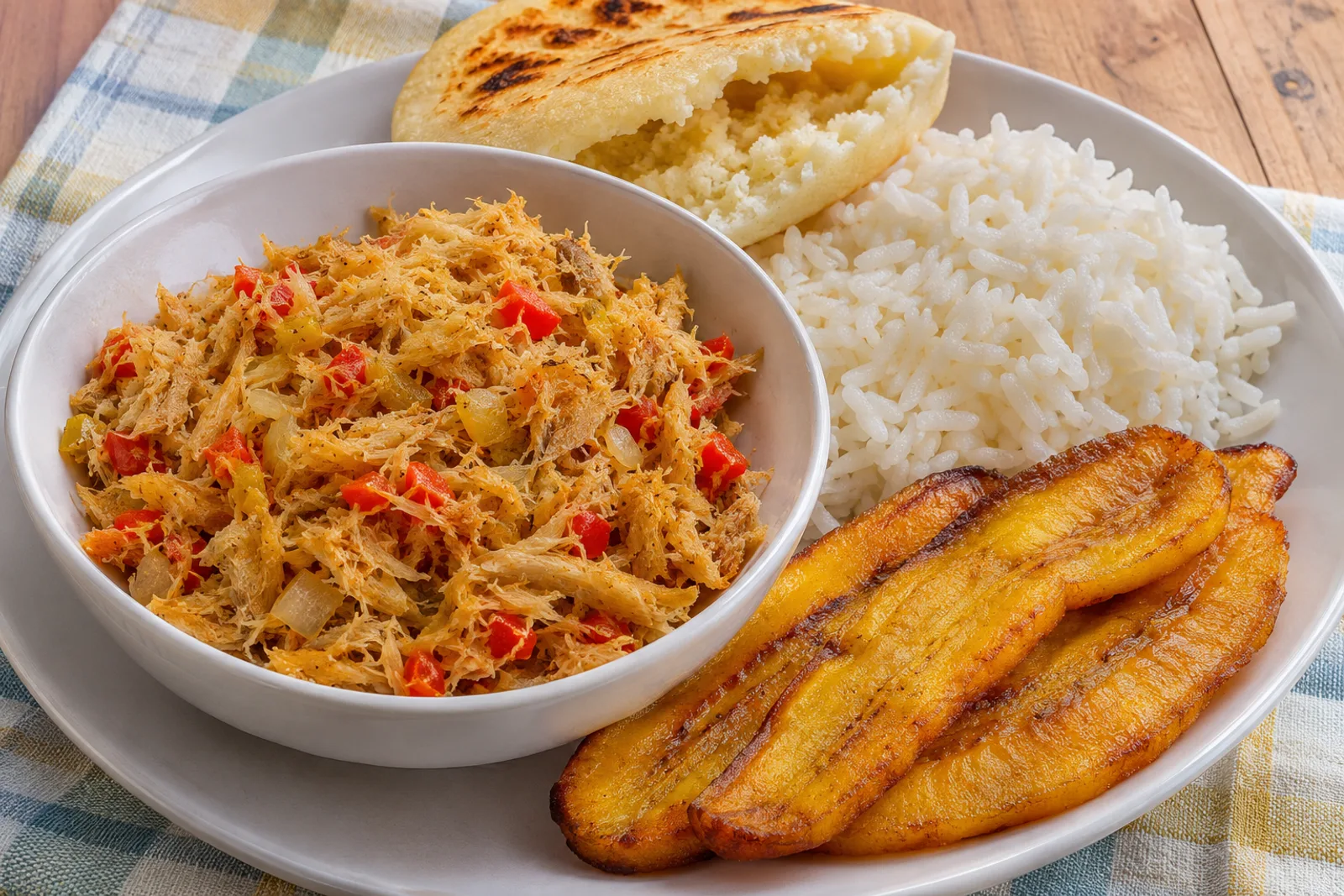

Pisillo (pee-SEE-yo) is what Venezuelans do with salt fish in Lent: soak it, boil it, shred it into threads and cook it in a skillet with onion, sweet peppers and annatto until it’s completely dry and loose. No sauce, no broth. It’s eaten over rice with black beans on meatless Fridays and spooned into corn-flour empanadas, and if you can buy salt cod at your supermarket, you can make it. The hard part isn’t the cooking. It’s knowing how long to soak the fish and how to tell when the salt is gone, so that’s where most of this page goes.
What is fish pisillo?
How do you make Venezuelan fish pisillo? Soak salt fish in the fridge for 12-24 hours (48-72 for thick salt cod loins), changing the water, then boil it 10 minutes in fresh water and discard that water. Shred it with no skin or bones and wring it dry in a towel. Fry onion, red bell pepper, ají dulce, garlic and scallions in annatto oil, add the fish and cook over medium-low heat for 15-20 minutes until dry and loose. Ready in 75 minutes for 6 servings, plus the overnight soak.
Pisillo comes from the Llanos, the cattle plains Venezuela shares with Colombia, where the everyday version is made with beef. The fish version is the one for Lent and Holy Week: in many Venezuelan homes, from Ciudad Bolívar on the Orinoco to the coast, it’s made with fish bought salted and dried. On the coast it’s also made with fresh fish.
If you’ve seen the beef version, the Venezuelan beef pisillo simmers flank steak for 2 hours and dries it 30-35 minutes with a cup of broth. This fish version needs neither: it dries in 15-20 minutes and goes into the pan with no liquid at all. It’s also drier than cazón guisado, the shark filling for empanadas, which uses fresh fish and a cup of its poaching water.
Time. 75 minutes on the day, about 60 hands-on, plus 12 to 24 hours of soaking that only asks you to change the water. Difficulty, medium: nothing is technical, but you plan a day ahead and pick out bones patiently.
Which fish to buy in the US and UK
The recipe calls for 700 g (1½ lb) of dried salt fish for 6 servings, about 4 oz (115 g) each; the full ingredient list is in the recipe card at the bottom. In Venezuela that’s salted cazón (a small shark), salted catfish from the Orinoco, or salted curvina, a drum. Outside Venezuela:
- Salt cod (bacalao). The easiest to find. In the US it’s in the Latin or international aisle, usually in a small wooden box or vacuum pack; in the UK, in Portuguese, Spanish and Caribbean shops, often sold as saltfish. Its flakes are big, so shred them finer.
- Check the label. Some boxes of “bacalao” in US Latin aisles are salted Alaska pollock. It’s cheaper, with thinner flakes and less flavor. It works, but it shreds into smaller bits.
- Frozen desalted salt cod. Common in Spanish supermarkets and some US stores. Skip the soak, thaw it in the fridge and start at the 10-minute boil. Use 770 g (1.7 lb), because it already carries its soaking water.
- Fresh fish, no soak. 1 kg (2.2 lb) of fillets: cod, haddock, pollock, catfish or tilapia. Tilapia is the cheapest and the wettest. The pisillo comes out milder and softer.
Skip shark if you’re cooking for anyone pregnant, breastfeeding or small children: it’s high in mercury. Capybara, which Venezuelans also salt and turn into pisillo for Lent in the Llanos, is the other traditional version, but you won’t find it outside the region, and in Colombia its commercial sale is banned.
The Venezuelan sofrito, and what to swap
- Ají dulce is a small Caribbean pepper that smells like a habanero and has almost no heat. Look in Caribbean and Latin markets, fresh or frozen, sometimes labeled ajicitos or cachucha. Without it, use another 80 g (3 oz) of red bell pepper: same color, less perfume.
- Annatto (achiote) is a red seed sold ground or whole in the Latin aisle. It colors the oil orange and adds a faint earthy note. Without it, ½ teaspoon of sweet paprika gives the color. Avoid seasoning packets with achiote; they’re mostly salt.
- Scallions stand in for Venezuelan cebollín. Use the whites and most of the greens.
There’s no salt in the sofrito. The fish brings its own.
Some cooks, especially in Apure, add 1 seeded, chopped tomato (150 g / 5 oz) to the sofrito and cook it 5 minutes more before the fish goes in. The pisillo comes out redder and a little less dry.
How to soak salt fish, and how to know it’s ready
Soak it in the fridge, at 40°F (4°C) or below, every time. These are hours of fish sitting in water, and 2 hours is the limit for perishable food at room temperature.
- Rinse and cut into 2-inch (5-6 cm) pieces. Small pieces give up salt faster than a whole slab.
- 3 liters (3 quarts) of cold water for 1½ lb (700 g), covered. Change it every 4 hours while you’re awake; aim for at least 3 changes.
- Thickness decides the time. Thin Venezuelan-style fillets under ⅜ inch (1 cm): 12 hours, overnight. Pieces ⅜ to ¾ inch (1-2 cm): 24 hours. Thick salt cod loins: one day per centimeter, so 48 hours for a ¾-inch (2 cm) loin.
The taste test. Never taste raw salt fish. Cut a thin slice, ⅛ inch (2-3 mm), from the center of the thickest piece and boil it in unsalted water for about 2 minutes, until it is white and opaque all the way through; if in doubt, 145°F (63°C). Then taste it. It should taste like fish you’ve already salted properly. If it stings your tongue, give it 4 more hours in fresh water and test again.
Then boil and discard. The 10-minute boil in fresh water, which you pour away, pulls out the salt left deep inside. It doesn’t replace the soak: a very salty fish boiled without soaking stays salty in the middle and turns tough.
When to throw it out. Soaked fish looks whiter, thicker and springy. If it smells sour or feels slimy, it spoiled during the soak. If you notice an ammonia smell when it heats, even briefly, throw out the fish and the water; more soaking won’t rescue it. It happens most with shark.
Make-ahead plan, from soak to skillet
- The night before. Rinse, cut and start the soak. Change the water at bedtime and first thing in the morning.
- The next day, minute 0. Taste test, then fish into fresh water and onto the heat. Chop the sofrito while it boils.
- Minute 20. Drain, discard the water, let the fish cool 10 minutes.
- Minute 30. Skin, bone, shred, wring dry. About 15 minutes.
- Minute 45. Sofrito, 10 minutes. Then the fish, 15-20 minutes.
Shred and wring. Shred with your fingers, not forks: fingers find the fine pin bones in catfish and drum, and the cartilage in shark. Then twist the shredded fish in a clean towel over the sink until it stops dripping. Skip this and the skillet fills with water and you get a stew.
What dry looks like. Over medium-low heat, stirring every 2 minutes:
- 5 minutes: it’s still steaming and looks wet.
- 10 minutes: no liquid in the pan, but the shreds stick together in clumps.
- 15-20 minutes: a spoon dragged across leaves a dry line, the threads fall apart on their own and look glossy from the orange oil. Done.
- Past 25-30 minutes: it turns into hard splinters and the bottom scorches.
If it’s still wet at 15 minutes, nudge the heat up, but not past medium; the onion and annatto burn before the fish dries.
With fresh fish
Replace the soak and boil with this: put 1 kg (2.2 lb) of fillets in a pot with water to cover and 1 teaspoon of salt, bring to a gentle simmer and cook 6-8 minutes, until the flesh is opaque and flakes with a fork, 145°F (63°C) in the center. Drain, shred and wring it out the same way. Add 1 teaspoon (6 g) of salt to the sofrito with the cumin and taste at the end. The drying time doesn’t change.
For 4, 12 or 20 people
Allow about 4 oz (115 g) of salt fish per person, or 6 oz (170 g) of fresh fillet. For 4, use 1 lb (470 g) of salt fish and two thirds of the sofrito; for 12, 3 lb (1.4 kg); for 20, 5 lb (2.3 kg). Soak with about 4 quarts (4 liters) of water per 2.2 lb (1 kg). The skillet is the bottleneck: don’t dry more than 2.2 lb (1 kg) of shredded fish at a time in a 12-inch (30 cm) pan.
When it goes wrong
- Too salty. Short soak, too few water changes, or salt in the sofrito. You can’t pull salt out of finished pisillo. Make a second batch of sofrito with no salt and mix it in, or add plain cooked fresh fish, and serve it with unsalted rice.
- Wet and stew-like. The fish wasn’t wrung out, or the pan was crowded. Spread it ¾-1 inch (2-3 cm) deep and keep going 5 more minutes.
- Dry and sawdusty. Too long or too hot. A tablespoon of oil and 2-3 of water at the end help a little.
- Bones. Shredded in a hurry or with forks. Go back over it with your fingers.
Heat. None; ají dulce is sweet. Put hot sauce on the table. Allergens. Fish. No gluten, dairy, egg or nuts.
How to serve it, and how to store it
In Venezuela it goes over white rice with Venezuelan black beans, fried ripe plantain and a simple salad, or into an arepa or a corn-flour empanada. For empanadas, dry it all the way and let it cool first; plan on about 1½ oz (40 g) of filling per medium Venezuelan empanada. The same dry filling, layered with sweet plantain and cheese and baked, is the heart of pastel de chucho, and if you already have a box of salt cod open, Mexican Christmas bacalao uses the same soak in a tomato and olive stew. More meatless Friday dishes are on the Latin Lent recipes page, and the rest of the plains’ cooking is in Llanero food.
Fridge. Within 2 hours of cooking, in a sealed container: 3-4 days at 40°F (4°C) or below.
Freezer. With almost no water in it, pisillo freezes well. Flat in 10-14 oz (300-400 g) bags, it keeps its quality 4-6 months. Thaw overnight in the fridge.
Reheating. In a skillet over medium heat with 2-3 tablespoons of water per 2 cups, stirring 4-5 minutes until it steams and reaches 165°F (74°C). The microwave dries it out; cover it and add the water.
Fish pisillo FAQ
Can I desalt salt cod faster by boiling it? Not on its own. The boil after soaking removes what’s left, but boiling unsoaked salt fish leaves the center salty and the outside tough. If you’re short on time, use frozen desalted cod or fresh fillets.
Is Caribbean saltfish the same thing? It’s the same product, usually salt cod or salted pollock, and it works here. In ackee and saltfish the flakes stay bigger and moister; pisillo shreds them fine and cooks them dry.
Why is my pisillo wet? The fish wasn’t wrung out, or too much went into the pan. Wring it until it stops dripping and dry no more than 2.2 lb (1 kg) at a time in a 12-inch skillet.
How much does it make for empanadas? Weigh the finished pisillo and divide by 1½ oz (40 g) per medium empanada. Salt fish varies too much in how much water it takes up to give one number.
Nutrition per serving
Per serving, one of 6, without rice or sides, calculated from the recipe amounts and 770 g (1.7 lb) of soaked, cleaned fish:
- Calories: 225 kcal
- Protein: 24 g
- Carbohydrates: 9 g
- Fat: 10 g, 1 g saturated
- Fiber: 2 g
- Sugars: 4 g
- Sodium: 1,910 mg
Sodium is the number that matters and the least exact one. I base it on well-soaked salt cod, about 1,480 mg per 100 g (3½ oz), and almost all of it comes from the fish, since the sofrito has no salt. The discarded boil lowers it a little more, by an amount no one can measure at home. Made with 2.2 lb (1 kg) of fresh fillets and the salt in the recipe, a serving is about 255 kcal and 500 mg of sodium.
For me, fish pisillo is Holy Week food, and I treat it as a two-day dish: the fish goes into the fridge before I go to bed, and I tape a note to the door with the times for changing the water. I do the taste test every single time, even with fish from the same shop, because no two pieces let go of their salt the same way. And I don’t salt anything until the pisillo is finished; it almost never needs it. Josnaisis.