

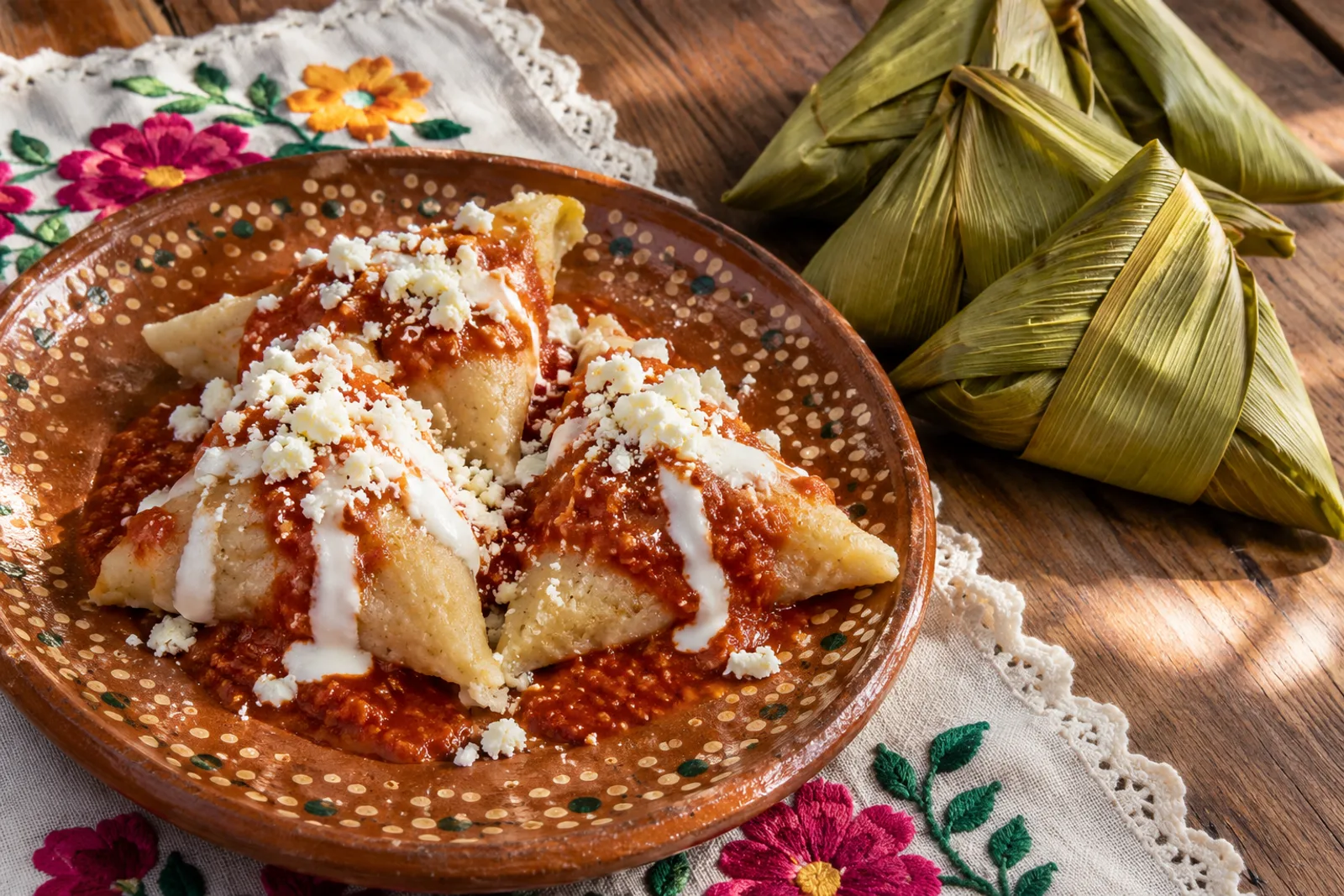

Most Mexican tamales get spread on a dried husk and folded into a packet. A corunda is built the other way around: 60 g (2 oz) of masa goes into a cone twisted from a long, ribbon-like corn leaf, and the rest of that leaf is folded over and over, like a flag, until it locks into a neat triangle that needs no tie. There’s no filling. Corundas come from the Mexican state of Michoacán, and the flavor goes on top, as a thin tomato and serrano salsa, a pour of crema and crumbled cheese. Below is the recipe for 24, a step-by-step folding diagram, and what to wrap them in when you can’t get corn leaves, which is most places outside Mexico.
What corundas are and how long they take
How do you make corundas? Beat 250 g (1¼ cups) of lard until white, beat in 1 kg (2.2 lb) of masa with baking powder, salt and broth, and pack 60 g (2 oz) portions into a cone made from a long corn leaf. Fold the leaf around the masa until it closes into a triangle, then steam the 24 corundas for 70 minutes. Unwrap and serve with tomato salsa, crema and cheese. 130 minutes for 8 servings.
Corundas are small, unfilled tamales of nixtamalized corn dough beaten with lard. They come out cream-colored, compact and tender, with a clean corn flavor, closer to a dumpling than to the fluffy filled tamales most people in the US know. In Michoacán, especially around the lakes and in the Purépecha highlands, they’re eaten for breakfast or supper, and they’re also served instead of tortillas with churipo, a beef and chile broth.
Michoacán has a second famous tamal, and the two get mixed up. Uchepos are made from fresh sweet corn ground raw and wrapped in the green husks of the ear; corundas use nixtamal masa and the leaf of the plant itself. If you want a tamal with something inside, the rajas con queso tamales are the filled cousin.
Time: 130 minutes, 70 of them hands-off steaming. Difficulty: medium. The dough is easy; folding takes practice, and your first four or five will look lopsided.
Ingredients for 24 corundas
Full quantities are in the recipe card: 1 kg (2.2 lb) of masa, 250 g (1¼ cups) of lard and about 40 leaves make 24 corundas of 60 g (2 oz), 3 per person.
Fresh masa or masa harina
Fresh masa from a tortillería or a Latin market tastes best. Ask for plain masa for tortillas, not “prepared masa for tamales,” which already contains fat and salt and throws off the recipe. With masa harina, 400 g (3½ cups) mixed with 600 ml (2½ cups) of hot water makes the kilo; cover it and let it sit 15 minutes before beating. Masa harina is in the Latin aisle of most large US supermarkets; in the UK, buy it online or from Mexican specialty shops. Cornmeal, polenta and arepa flour won’t work, because that corn hasn’t been cooked with lime and the dough won’t hold together the same way. The full tamale dough method, with ratios for larger batches, is in the tamale masa recipe.
Lard, baking powder and a pinch of soda
Lard gives corundas their flavor and tenderness. They take 250 g (1¼ cups) per kilo of masa and only 180 ml (¾ cup) of broth, less of both than a whipped filled-tamale masa, which is why they stay compact and hold the triangle. Vegetable shortening, beaten the same way, works and tastes more neutral. With 1 cup (220 g) of neutral oil, the dough is mixed rather than beaten and comes out denser.
Some cooks in Michoacán lighten the dough with wood-ash water or tequesquite, a natural alkaline mineral salt you won’t find outside Mexico. I use 1 teaspoon of baking powder and a pinch of baking soda for a slight alkaline note. More than a pinch and the masa turns bitter.
Corn leaves, and what to use instead
The wrapper is the leaf of the corn plant, long and narrow like a ribbon. It isn’t the husk around the ear. That length is what lets you fold the triangle. In Michoacán markets they’re sold by the bundle; outside Mexico you’ll only have them if you grow corn or can get whole green stalks. Here’s how the realistic options compare:
- Banana leaves, sold frozen in Latin and Asian grocery stores in the US and the UK. Thaw, cut into strips about 2½ inches wide and 18 to 20 inches long (6-7 × 45-50 cm), and soften each one for 1 minute in hot water or over a gas flame. They fold into the same triangle; the corunda comes out a little moister and smells faintly of banana leaf.
- Dried corn husks, the standard tamale wrapper, soaked 30 minutes in hot water. They’re too short for the flag fold, so spread the masa and fold them into a small rectangular tamal. Same taste, different shape.
Salsa, crema and cheese
The salsa is ripe tomatoes boiled with serrano chile, blended with onion and garlic and simmered briefly. One serrano keeps it mild, and a second one takes it to medium heat. Half a fresh jalapeño can replace the serrano.
Mexican crema is in the dairy case of most US supermarkets with Latin products. Crème fraîche is the closest swap, and sour cream thinned with a spoonful of milk also works. Cotija is dry and salty; feta is the nearest substitute, and queso fresco gives a milder version.
Equipment: an 8 to 10 quart (8-10 L) stockpot with a lid and a steamer rack or basket, or a tamale steamer; a stand or hand mixer, or a wooden spoon and some arm work.
How to make corundas, step by step
Prepare the leaves
Wipe both sides of each leaf with a damp cloth and let them drain. Fresh leaves bend easily; if one is stiff or splitting, 1 minute in hot water softens it. Set torn or short leaves aside for lining the pot.
Beat the masa
Beat the lard alone for 5 minutes, until it goes from off-white to white and fluffy. That air is what makes corundas tender. Then add the masa, mixed with the baking powder, soda and salt, in four additions, alternating with the warm broth, and beat 5 minutes more.
You’re looking for a thick, spreadable paste that comes off your palm without smearing. If it cracks when you squeeze it, add broth 1 tablespoon at a time, up to 60 ml (¼ cup). Before you start folding, cook a small flattened ball in a skillet for a minute or two per side and taste that; don’t taste the masa raw. It should taste slightly salty, because steaming mutes it.
How to fold a corunda
This fold is what makes a corunda a corunda. Once you have the rhythm, each one takes about a minute.
- Cone. Lay the leaf smooth side up with the wide end toward you. Fold that end diagonally and twist it into a cone, smooth side inside.
- Masa. Pack in 60 g (2 oz, about ¼ cup) of masa and press it down into the tip so there are no air pockets.
- Flag fold. Fold the rest of the leaf over the opening to cover the masa: that’s your triangle. Keep folding the leaf around it, flat and over a different side each time, until it runs out.
- Tuck. Slip the last end of the leaf under the final fold. If the leaf is short or the end pops out, tie it with a thin strip of leaf.
If one comes out loose, unwrap it and start again with a fresh leaf; the masa doesn’t mind. Banana leaf strips fold the same way but are stiffer, so press each fold firmly. Some cooks keep folding until the corunda has extra points, more like a star. It tastes the same.
Steaming without a tamale pot
Pour in water to 1 inch (2-3 cm) below the rack, line the rack with leaves and stand the corundas up or lean them against each other, loosely. Cover them with more leaves, a clean kitchen towel and the lid. Once it boils, turn the heat to medium-low for a steady simmer and check the water every 20 minutes, topping it up with hot water poured down the side of the pot.
Put the steamer water on while you fold the last few corundas so it’s boiling when you finish: the 70 minutes count from the boil. With masa harina, mix it with the hot water as soon as you start and let it rest its 15 minutes while you wash the leaves; that adds roughly five minutes. A sticky test corunda at the end means extra steaming time on top.
How to tell they’re done
Test one after 70 minutes of steaming: lift it out, let it cool for a minute, then unwrap. It’s ready when the masa peels cleanly away from the leaf and the center is spongy and set, not glossy or wet. A sticky middle means the whole pot needs another 15 to 20 minutes; rewrap the test one and put it back. Straight out of the steamer they’re soft; 10 minutes resting covered off the heat firms them up so they unwrap neatly.
The tomato salsa
While the corundas steam, boil the tomatoes and serranos for 10 minutes, until the skins split. Blend them with the onion, garlic, salt and 120 ml (½ cup) of the cooking water. Fry the purée in the hot oil for 10 minutes over medium heat, stirring, until it darkens slightly. Keep it brothy: the corundas soak it up on the plate.
Why corundas open, stay sticky or turn hard
- They open in the pot. The last flap wasn’t tucked in, or the leaf was too short. Hide the end under the last fold and tie any doubtful ones.
- Sticky center. Not enough steam. Rewrap and give them 15 to 20 minutes more.
- Hard and dry. Too little lard or broth in the masa, or the pot boiled dry and they cooked in dry heat. The masa should be spreadable, and the water needs checking every 20 minutes.
- Heavy and dense. The lard wasn’t beaten long enough, or the masa went in cold from the fridge. Let both sit out first and beat the lard until it turns white.
- Bland. The masa was under-salted. Taste a small cooked piece before folding; you can’t fix it afterwards.
Allergens and heat. The corundas themselves contain no gluten or dairy; the dairy is in the crema and cheese on top. If you need gluten-free, check the baking powder and broth labels. All the heat is in the salsa, so kids can have theirs with just crema and cheese.
Variations and bigger batches
- With pork in the salsa. A very Michoacán way to serve them. I simmer about 500 g (1.1 lb) of pork shoulder in ¾ inch (2 cm) cubes in salted water until tender, 40 to 50 minutes, and add it to the salsa for its last 10 minutes.
- With rajas. A spoonful of rajas con crema, poblano strips in cream, instead of the tomato salsa makes a meatless plate. For a fully vegetarian corunda, make the masa with vegetable shortening and vegetable broth too.
- With cheese inside. Before closing the cone, press a 10 g (⅓ oz) cube of queso fresco or Oaxaca cheese into the masa. Not the classic corunda, but the fold is the same.
- Without lard. Use 250 g (1¼ cups) of vegetable shortening, beaten the same way.
- For 12 or 16 people. Multiply the card by 1.5 or 2: 1.5 kg (3.3 lb) of masa and 375 g (scant 2 cups) of lard make 36 corundas; 2 kg (4.4 lb) and 500 g (2½ cups) make 48. Steam more than 24 in two pots or two batches so they aren’t packed tight.
Serving, storing and reheating
Eat them hot and unwrapped, 3 per person, in a shallow bowl: salsa first, then crema and cheese. The leaf isn’t eaten. A side of frijoles de la olla makes it a full meal; at breakfast they go with café de olla or a warm cup of atole.
Make ahead. The beaten masa keeps 2 days covered in the fridge; let it sit out 30 minutes and beat it for 1 minute before folding. The salsa keeps 3 to 4 days.
Fridge and freezer. Don’t wait for the whole batch to cool in the pot: spread them in shallow containers and refrigerate within 2 hours. Still in their leaves, they keep 3 to 4 days in an airtight container and 2 to 3 months in a freezer bag. Reheat them in their leaves by steaming, 10 to 15 minutes from the fridge and about 30 minutes from frozen, until the center reaches 165°F (74°C). Other ways to reheat tamales are in the guide to how to make tamales.
Corundas FAQ
How many corundas does 1 kg (2.2 lb) of masa make? With the lard and broth, 1 kg of masa turns into almost 1.5 kg (3.3 lb) of dough: 24 corundas of 60 g (2 oz). Fist-sized ones, about twice as big, give you 12 to 14.
Are corundas gluten-free? The masa is corn, so yes, as long as your baking powder and broth are gluten-free. Check both labels.
Why are they triangular? Because of the fold. The long leaf turns over on itself at an angle, and each turn closes one side of the triangle, just like folding a flag. That’s also why they hold without string.
What are ash corundas? Yes, they’re a different preparation. Wood ash comes in, often when the corn is cooked before grinding, and the method and wrapper change from town to town; the pieces tend to be larger and flattened, about the size of a fist. Swapping this recipe’s broth for ash water won’t give you one. This recipe is the more common lard corunda.
Corundas nutrition facts
Per serving (3 corundas with salsa, 30 ml / 2 tablespoons of crema and 20 g / ¾ oz of cotija), calculated ingredient by ingredient from the recipe card:
- Calories: 630 kcal
- Protein: 10 g
- Carbohydrates: 44 g
- Fat: 47 g, including 19 g saturated
- Fiber: 4 g
- Sugars: 4 g
- Sodium: 1,040 mg
The lard accounts for about 280 kcal per serving and the masa about 180; the crema and cotija add another 130. More than half the sodium comes from the cheese and the salt in the masa, so queso fresco instead of cotija brings it down noticeably.
The fold clicks when you stop thinking about wrapping and start thinking about turning: the leaf never crumples, it just changes sides. If the first few come out crooked, eat them anyway, they taste exactly the same, and by the fifth you’ll be making triangles. I can’t get corn leaves in Colombia, but banana leaves are sold everywhere here, so mine are made with strips of those. Josnaisis.