

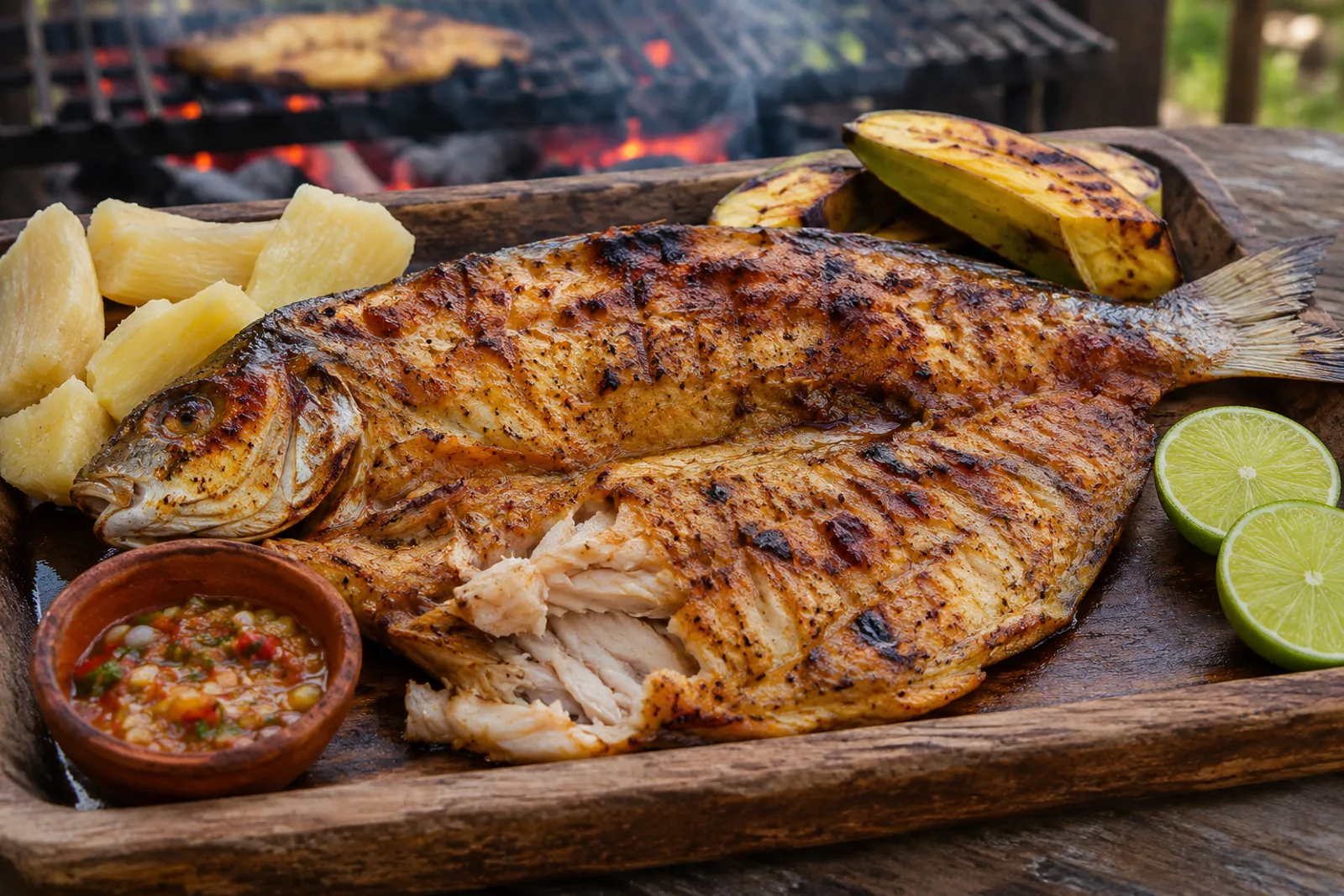

Cachama (kah-CHAH-mah) is a big, deep-bodied freshwater fish from the Orinoco and Amazon river basins, a vegetarian cousin of the piranha that’s sold in the US as pacu or tambaqui. On the tropical grasslands that Colombia and Venezuela share, the Llanos, it’s split open like a book, rubbed with garlic, lime and green onion, and grilled skin side down over charcoal. Because its belly is rich with fat, it stays moist where a lean white fish would dry out. This is that recipe for four, with an oven and grill-pan route, the swaps that actually work in a US or UK kitchen, and how to eat around its bones.
What grilled cachama is, and what it tastes like
How do you grill a whole cachama Llanero-style? Butterfly two 2 lb (1 kg) fish, rub the flesh with mashed garlic, salt, lime juice and green onion and chill 20 to 30 minutes. Grill skin side down over medium coals for 12 to 15 minutes without moving, flip, and cook 5 to 8 minutes more until it reads 145°F (63°C) next to the backbone. 65 minutes for 4 servings.
Expect firm, white, sweet-tasting flesh that breaks into big flakes, a smoky, crackly skin and a belly that’s almost buttery. The marinade is plain on purpose: garlic, lime and salt to season, nothing that hides the charcoal. Nearly all cachama sold today is farmed in ponds in the Colombian and Venezuelan plains, and in the town of Puerto Gaitán, in Colombia’s Meta department, the fish has a festival of its own.
Time and effort. 65 minutes: 10 to marinate, 30 of resting while the coals burn down, and 20 to 25 over the fire. It’s rated medium because flipping an open fish without tearing it takes a steady hand, and so does reading the doneness by the bone.
Ingredients and where to find cachama
Two fish of 2 to 2¼ lb (900 g to 1 kg) feed four. Once the head, backbone and bones are gone, a little under half the weight is meat, roughly 8 oz (225 g) raw per person. If you can only get smaller 1 lb (450 to 500 g) fish, plan on one per person.
Cachama, pacu or tambaqui in the US and UK
This is the hard part outside South America, so here’s the honest picture:
- US. The same fish and its close relatives turn up frozen, whole or as “ribs”, under the names pacu, tambaqui or cachama, in some Latin American, Brazilian and Asian markets and through seafood distributors that ship. Supply comes and goes. Check that it’s sold for eating, not for aquariums.
- UK. I haven’t found a reliable retail source. Use one of the swaps below.
- Swaps that work. A whole tilapia, a sea bream or a branzino (European sea bass, just “sea bass” in the UK) of 1 to 1¾ lb (400 to 800 g), which any good fish counter can butterfly. Pompano is a good US choice too. They take the same marinade and technique, but they’re leaner and milder, have far fewer bones and cook faster: 5 to 8 minutes per side.
Butterflying the fish, or asking for it
Ask the fishmonger to butterfly it through the back, from head to tail, keeping the belly in one piece, so it opens flat like a book. To do it yourself on a scaled, gutted fish:
- Lay it on its side and cut along the back, right beside the dorsal fin, down to the backbone.
- Keep cutting over the ribs, with the knife grazing the bone, until that side opens, without cutting through the belly skin.
- Repeat on the other side of the backbone and open the fish out.
- Snip the backbone at the head and tail with kitchen shears and lift it out. Or leave it in: it lifts out in one piece at the table.
Cachama scales are small and very hard. Buy it scaled if you possibly can.
The marinade
Garlic, salt, lime and green onion are the whole Llanero seasoning. In Colombia this is cebolla larga, a long green onion very close to a thick US scallion or UK spring onion. Cumin is optional, and some cooks add a pinch of annatto (achiote) for a reddish color. Keep the marinade on the flesh side; on the skin it just burns.
Equipment. A charcoal grill with a clean grate, two wide fish spatulas or a hinged fish basket, and an instant-read thermometer if you have one.
How to grill cachama, step by step
The coals and the marinade run at the same time, so by the end of the 30-minute rest the fire is ready.
Medium coals, no flames
Charcoal needs 25 to 30 minutes to ash over. Wait for it: over live flames the skin scorches while the middle stays raw. To check the heat, hold your open palm 4 to 5 in (10 to 12 cm) above the grate. If you can keep it there 5 to 7 seconds, that’s medium. If you pull away after 2 or 3, raise the grate or spread the coals.
Skin side down, then one flip
A butterflied fish does most of its cooking through the skin, which acts as a shield while the fat from the belly melts into the flesh. Leave it 12 to 15 minutes without touching it. It’s ready to flip when:
- The flesh has turned white almost to the top, with just a glossy strip left in the middle of the loin.
- The skin slides off the grate when you push it with a spatula. If it resists, give it another minute.
Slide one spatula under the head and one under the tail and turn it in one movement; with a basket, just flip the basket. The flesh side needs only 5 to 8 minutes to brown and finish the center.
How to tell it’s done
The last part to cook is the thickest section of the loin, right against the backbone. Probe there without touching bone: you want 145°F (63°C). Without a thermometer, pull the flesh apart with a fork at that spot. It should be opaque white all the way to the bone and come apart in flakes, with no glassy or pink patches.
Rest it 3 minutes on the board before serving so the flakes stay whole.
No charcoal? Grill pan, oven, foil packet or fried
The marinated fish cooks well indoors too. You lose the smoke, and with some methods the crisp skin, but the target is always 145°F (63°C) by the backbone.
- Grill pan or gas grill. Best with 1 lb (450 to 500 g) fish that fit the pan. Medium-high heat, oiled pan and skin, skin side down 8 to 10 minutes under a lid or an upturned baking sheet so the top cooks too, then 4 to 5 minutes flesh side down.
- Oven. Heat to 400°F (200°C). Lay the butterflied fish skin side down on an oiled rack over a tray, or on oiled parchment, and roast 18 to 22 minutes for a 2 lb (1 kg) fish, then 3 minutes under the broiler (UK grill) to brown. A whole, unopened fish with 3 cuts per side needs 25 to 30 minutes.
- Foil packet. Very moist, no crisp skin. Lay the fish on sliced onion and tomato on a sheet of parchment, wrap that in foil and seal; the parchment keeps the lime off the aluminum. Bake at 400°F (200°C) for 25 minutes, open the packet and give it 5 more. Over coals, turn the packet halfway; the timing depends heavily on the fire, so open a corner from 20 minutes on and cook to 145°F (63°C) by the backbone.
- Fried. Use whole 1 to 1¼ lb (500 to 600 g) fish with 3 diagonal cuts per side. Same marinade, dried well and dusted with flour, then fried at 350°F (180°C) in about ¾ in (2 cm) of oil for 6 to 8 minutes per side, to 145°F by the backbone. The method, including drying the fish twice so it doesn’t spit, is the one in my whole fried mojarra.
How to eat around the Y-shaped bones
Cachama has plenty of intramuscular pin bones, many of them Y-shaped, buried in the loin; in farmed tambaqui about 27 have been counted on each side. You can’t pull them out before cooking without wrecking the flesh, but once it’s grilled they’re easy to deal with:
- The loin, the thick top section, holds the Y bones. Pull the flesh into flakes following the lines of the muscle, working outward from the backbone, and the bones show up between the flakes.
- The belly, the fattiest and juiciest part, has long ribs that come out whole when you pull them.
- The backbone, if you left it in, lifts out from the tail end in one piece.
For kids, give them belly meat already lifted off the ribs and check each flake with your fingers. The fish isn’t spicy; the ají goes on the side. The only major allergen here is fish.
What goes wrong, and how to fix it
- It stuck and tore. Dirty or cold grate, or it was moved too early. Clean the grate, oil it once it’s hot, and don’t touch the fish until the skin lets go.
- Charred outside, raw by the bone. Flames or coals too close. Spread the coals, raise the grate, or tent the fish with foil for 5 more minutes.
- Chalky surface. The lime sat on the flesh much longer than 30 minutes. To prep ahead, marinate overnight with only garlic, salt and onion, and add the lime 30 minutes before grilling.
- Dry flesh. It went past 145°F, usually in the thin tail end. Probe the loin and take it off as soon as it gets there.
- Muddy taste. Some pond-farmed fish carry an earthy flavor that collects in the fat. Smell the fish when you buy it, and if it’s there, trim away the fat inside the belly cavity before marinating.
Make ahead, serving a crowd, and leftovers
- The day before. Mash the garlic, salt and cumin and chop the onion; keep them covered in the fridge. Raw fish keeps 1 to 2 days in the fridge, so buy it no more than a day ahead.
- For 12. Six 2 lb (1 kg) fish, or twelve 1 lb ones. A home grill fits two butterflied fish at a time, and at 17 to 23 minutes a batch, the first fish would wait over half an hour. The easy answer is to serve them as they come off; to feed everyone at once, use two grills (4 fish per batch) and hold the first batch under foil in a 200°F (90°C) oven for no more than 20 minutes, after which it dries out. Add charcoal between batches.
- Fridge. Refrigerate within 2 hours, or within 1 hour if it’s above 90°F (32°C), as it often is at an outdoor cookout, with the big bones removed, in a covered container: 3 to 4 days.
- Freezer. Cooked and flaked, well wrapped, up to 3 months. Thaw in the fridge.
- Reheating. In a covered skillet over low heat with 2 tbsp water, or covered with foil in a 325°F (160°C) oven, until the center reaches 165°F (74°C), about 8 to 10 minutes. The microwave dries it and makes it smell fishier.
What to serve with grilled cachama
On the plains it comes with boiled cassava (yuca) and plantain roasted on the same coals, plus a fresh chile sauce and lime. Allow about 7 oz (200 g) of cassava per person; frozen peeled cassava from Latin and Asian grocers works fine. For something crisp, try fried yuca or Colombian patacones, and for the sauce, a bright Colombian ají picante. If you’re cooking a whole Llanero spread, it sits next to slow-roasted Llanero beef; the rest of the plains table is in my guide to Llanero food. For a saucy fish dish instead of a grilled one, Colombian pescado sudado poaches the fish in tomato and onion.
Frequently asked questions
Can I grill frozen pacu straight from the freezer? No. Thaw it in the fridge, in a container, for 12 to 24 hours, then dry it very well. Frozen fish releases water, sticks to the grate, and the middle lags far behind the skin.
Is cachama the same as pacu? Close. Cachama is the Colombian and Venezuelan name for two farmed species: the black cachama, sold in Brazil and the US as tambaqui, and the white cachama, one of the fish called pacu. They cook the same way.
Is it really related to the piranha? Same family, different diet. Cachama eats mostly fruit and seeds and has flat, crushing teeth. The flesh tastes like a rich freshwater fish, nothing like the piranha’s reputation.
Do I grill it with the head on? On the plains, yes, and the cheeks are worth eating. If it won’t fit your grill, cut it off before marinating; the timing doesn’t change.
Nutrition per serving
Per serving (about 8 oz / 225 g raw cachama with its share of marinade and oil, without cassava or plantain), worked out ingredient by ingredient from the recipe amounts:
- Calories: 360 kcal
- Protein: 41 g
- Carbohydrates: 5 g
- Fat: 19 g, including 3 g saturated
- Fiber: 1 g
- Sugar: 1 g
- Sodium: 985 mg
Cachama’s fat level varies with farm and size, so treat these as estimates. Most of the sodium is from the marinade salt, some of which drips off on the grill.
I buy cachama more than almost any other fish in Colombia because it forgives what tilapia won’t: a minute too long on the grill and it’s still juicy. At home I make it on a grill pan with one-pound fish, and the belly is always the first thing to disappear from the platter. Josnaisis.