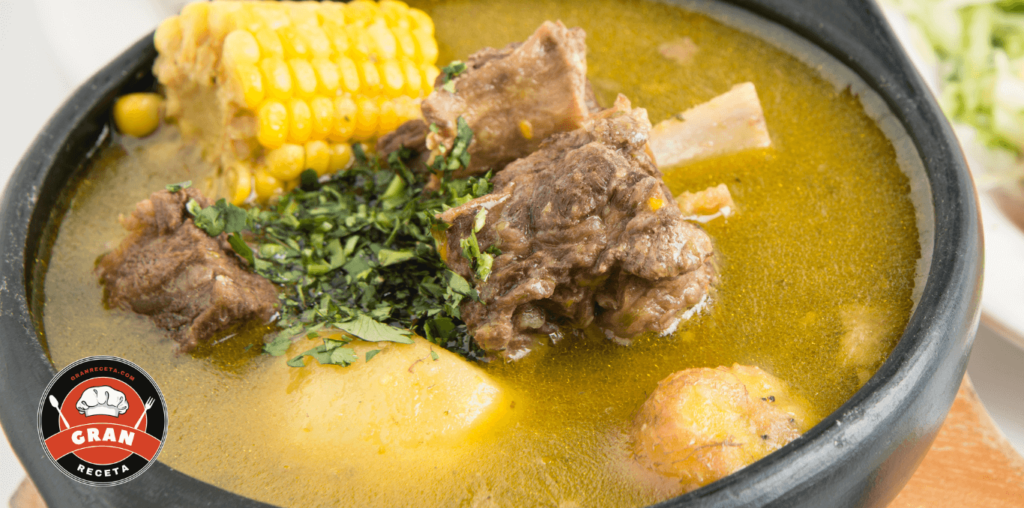
In Bogotá this one is eaten twice at the same meal. A cup of clear broth arrives first, you drink it while the table fills, and only then does the platter come out with beef, pork, chicken and longaniza on it. That two-course service is the whole point of puchero santafereño, Bogotá’s Sunday pot, and it is also what separates it from sancocho. Eight servings, 510 calories each, two and a half hours.
How do you make puchero santafereño? Simmer beef in cold water for two hours at 194°F, skimming. Add pork after half an hour, chicken and cassava at the 75-minute mark, and the corn, potato, whole longaniza, plantain and cabbage across the final twenty-five minutes. Serve the strained broth in cups first, then the platter. 150 minutes for 8 servings.
Puchero, sancocho or cocido, in one table
If you have eaten Colombian food before, the pot will look familiar. The three dishes share a shape — meat, a starchy root, corn, a spoonful of hogao on top — and they are told apart at the table rather than at the stove.
Only the puchero splits into two courses, and that single difference sets everything else. The broth has to be clear because you look at it in the cup. The meats have to stay whole because they are laid out on a platter rather than ladled into a bowl. And the hogao is made separately and passed around, never stirred into the pot.
What to buy, and what to buy instead
None of the four meats is exotic once you know what to ask for. Short ribs or shank give the broth its body, pork neck bones give it fat and depth, bone-in thighs give tender meat without clouding anything, and the longaniza gives the salt and the spice.
Longaniza is a fresh, coarsely ground pork sausage seasoned with cumin and annatto, sold in Latin markets and often in the frozen case. Spanish chorizo works, so does Portuguese linguiça; both are firmer and saltier, so hold back a little on the salt in the pot. Whichever you use, leave the link whole and resist pricking it, or its fat and colour bleed out and the clear broth turns orange.
For the vegetables, frozen cassava and frozen green plantain are genuinely fine here and save you the peeling. Cassava is sold as yuca in Latin markets and as manioc elsewhere; green plantains are the firm, starchy ones, never the yellow spotted ones.
Why the pot must not boil
At a trembling simmer, the fat the meats release floats to the top in a layer you can lift off with a ladle. At a rolling boil, the same fat is beaten into the liquid and stays there. There is no way back from that emulsion — straining does nothing, because the fat is no longer sitting on the surface to be strained.
The cold-water start works on the same principle. Warming slowly, the proteins that cloud a broth rise as grey scum in the first twenty minutes, where a skimmer takes them off. Drop the meat into water that is already hot and they set inside the cut instead.
Where the time goes
Two hours at the stove and half an hour of service, which here is real work: solids out with a slotted spoon, broth through a strainer, platter assembled, hogao passed.
Make it ahead
This is a good dish to split across two days, and the reason is practical. Cook the broth with the four meats one day, chill it overnight, and the fat sets into a solid disc you lift off in one piece — the easiest fat removal there is, and worth about forty calories a serving. The next day, reheat and put the vegetables in for their final stretch.
Who this recipe is for
- Cooking for a crowd — one pot, eight servings, and most of it is unattended
- You have eaten sancocho and want the other one — same family, different table manners
- You like a clear broth — this is the Colombian dish built around one
- You want leftovers that become something else — shredded meat plus broth is the next day’s soup
- You are shopping in a US or UK supermarket — every cut here has a substitute
Five things that go wrong
Boiling instead of simmering. Above 205°F (96°C) the fat emulsifies and the broth will not clear again.
Meat into hot water. The scum sets inside the cut and never comes out.
Pricking the longaniza. Its fat and colour bleed into the broth.
All the vegetables at once. The cabbage dissolves while the cassava is still hard.
One bowl instead of two courses. Perfectly good dinner, but you have made a sancocho.
Four variations worth trying
With chickpeas. ½ cup (100 g) soaked overnight and cooked with the beef, closer to the Spanish puchero, which is also built on chickpeas.
With arracacha. 10 oz (300 g) alongside the cassava, for an earthy sweetness very typical of the Bogotá savanna.
Without pork. Beef and chicken only, a cleaner broth and roughly 80 calories less per serving.
With fava beans. ½ cup (100 g) in the last 15 minutes, common in the towns around the capital.
What to serve with it, and how much per person
A cup of broth, then the platter: white rice on the side, sliced avocado and a small bowl of ají, plus the hogao. A serving is about 6 oz (180 g) of meat with the vegetables, and the broth counts as the first course rather than a side.
If you want the rest of Bogotá’s Sunday table, colombian ajiaco is the other cold-highland soup, built on three potatoes and guascas. The cocido boyacense swaps the four meats for three native Andean tubers, and colombian sancocho is the one-bowl version of this same idea. For the leftovers, shredded meat and rice make a colombian calentado the next morning.
Frequently asked questions
What is the difference between puchero and sancocho? The service. Puchero comes in two courses, broth in a cup and then a platter; sancocho arrives in a single bowl.
Why is my broth cloudy? Either it boiled hard or the meat went into hot water. Hold it at 194°F and skim during the first twenty minutes.
Can I make it the day before? Yes, and it is better: chill the broth with the meats, lift off the solid fat, then add the vegetables when you reheat.
What beef cut should I use? Short ribs or shank, bone in. Lean cuts give no broth and dry out over two hours.
Can I use a slow cooker? For the broth stage yes, on low for six hours, but add the vegetables at the end on the stove so they keep their shape.
Nutrition
Per serving, one eighth of the pot with broth, meats and vegetables, calculated from each ingredient according to the USDA SR Legacy database:
- Calories: 510 kcal
- Protein: 33 g
- Carbohydrates: 36 g
- Fat: 23 g, 8 g of it saturated
- Fibre: 4 g
- Sodium: 680 mg
The protein is high for a soup because four different animals contribute to it. Most of the fat comes from the pork and the sausage, so the beef-and-chicken version lands closer to 430 calories, and the overnight fat removal takes off a little more.
The first time I was served puchero in Bogotá I got a cup of broth and assumed that was dinner, so I sipped it slowly to make it last. Then the platter came out with four kinds of meat on it and I had no room left. Now, when I cook it at home, I warn people before I hand them the cup. Josnaisis.