

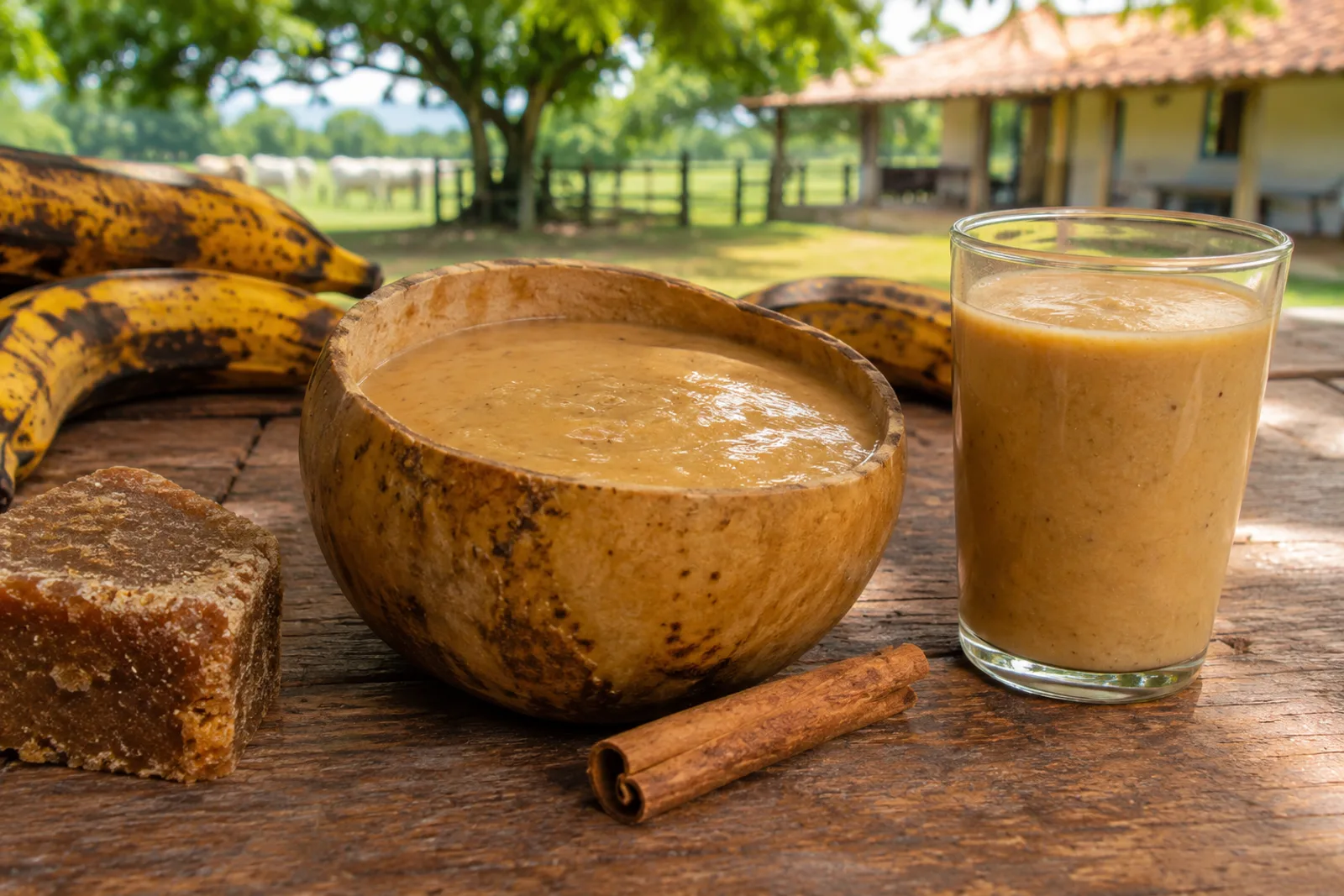

On the cattle plains of eastern Colombia, the Llanos, a plantain whose skin has gone completely black isn’t past saving: it’s ready for majule (mah-HOO-leh). The soft fruit is boiled until it collapses, beaten into hot milk, and thickened with crumbled fresh cheese that melts into the pot. You get a hot, spoonable drink that tastes like plantain custard, with soft melted cheese through it, and not a gram of added sugar.
What is majule, and is it worth making?
How do you make majule? Boil 1 kg (2.2 lb) of peeled, very ripe plantain for 25 minutes until it falls apart, drain, beat it into a rough mash and simmer for 10 minutes in 720 ml (3 cups) of whole milk. Stir in 250 g (9 oz) of crumbled fresh cheese for 3-5 minutes, until it melts and is evenly spread. Ready in about 65 minutes for 6 servings.
Majule sits halfway between a hot milk drink and a loose pudding. In the Colombian departments of Meta, Casanare and Arauca it is served steaming in a mug or a shallow bowl, sipped or eaten with a spoon, and some families call it the cowboy’s soup. Nothing about it is hard. It needs the right plantains, a heavy pot and about 20 minutes of stirring at the end.
Worth it if you have plantains that have gone black, you like rice pudding or hot malted milk, or you want a warm drink that children will finish.
Skip it if dairy is a problem, since milk and cheese are half the recipe, or if you only have yellow plantains and can’t wait a few days for them to darken.
Two drinks with the same name
On the plains, majule also means a fermented drink, sometimes called plantain chicha: very ripe plantain is cooked, broken up by hand in water, strained and left to ferment, and the longer it sits the more alcohol it builds. That one has no fixed point a home cook can control, so it is not the recipe here. If you want a fermented thick drink with clear timings, try Colombian rice masato; for a cold, unfermented rice-and-milk drink, Venezuela’s rice chicha.
Ingredients and what to buy outside Colombia
The ratio is 1 large plantain to 180 ml (¾ cup) of milk and about 40 g (1½ oz) of cheese per serving. The batch makes 6 servings of about 300 ml (1¼ cups).
Plantains, and why black is the point
A plantain is the large, starchy cooking banana sold next to the bananas. In the US most supermarkets carry them; in the UK, look in Caribbean, African and Latin grocers or the world-food section of large supermarkets. They are usually green or yellow when you buy them. Leave them on the counter, out of the fridge, until the skin is black and gives when you press it, the same stage you’d want for Venezuelan fried sweet plantains or a little beyond. One large plantain gives about 270 g (9½ oz) of flesh.
| What you have | Will it work? | What changes |
|---|---|---|
| Black or nearly black plantain | Yes, ideal | Sweet and collapses easily |
| Yellow with black spots | Yes, with sugar | Starchier and less sweet; add panela or dark brown sugar, which turns it into the sweetened version below |
| Firm yellow or green plantain | No | Won’t break down; tastes of raw starch |
| Bananas | No | Turn watery within minutes and taste of banana, not plantain |
The core. Split the plantain lengthwise and you’ll see a dark line of tiny seeds down the middle. Cut it out: it greys the drink and leaves hard specks.
The cheese
Colombian cuajada is a fresh, white, mild, barely salted curd cheese. It is what thickens the pot and gives the strings.
- US. Colombian cuajada in Latin grocers, or Mexican queso fresco, sold in the dairy aisle of many supermarkets. Queso fresco softens but never melts or strings, so it stays as soft crumbs spread through the drink; it is also saltier, so taste before you add any extra.
- UK. Fresh Latin cheese from Latin grocers or online. Failing that, fresh mozzarella torn into small pieces melts into strings, though it is milder and less salty.
- Cheeses that won’t work. Halloumi and paneer hold their shape in heat and stay as cubes; aged, hard cheeses only add salt.
Milk. Whole milk. Skimmed makes a thin, watery majule. There is no sugar in this version.
Equipment. A heavy-based 3-4 litre (3-4 quart) pot, a wooden spoon and something to beat the plantain: the traditional wooden molinillo (a whisk you spin between your palms), a potato masher, or a balloon whisk. A blender makes it silky but loses the strings; if you use one, let the plantain cool and blend it with the cold milk before heating.
How to make majule
Boil the plantain until it collapses
Cut it into 2 cm (¾ in) pieces and cover with water. From the boil, give it 25 minutes uncovered at medium. It’s done when a piece squashes against the side of the pot under the back of a spoon without pressure and shows no pale centre. If a few pieces are still firm, add 5 minutes and test again. Save 1 cup (240 ml) of the cooking water before draining: it thins the majule later without diluting the plantain flavour.
Beat it rough, not smooth
Back in the pot, beat or mash the plantain for 2-3 minutes. You want a coarse, stringy mash. Smooth baby-food purée gives a gluey drink.
Simmer with the milk, low and stirring
Once the milk comes to a simmer the mixture starts to catch on the bottom. Keep it at medium-low for 10 minutes, scraping the base with the wooden spoon every minute or so. It’s ready for the cheese when it coats the back of the spoon and a line drawn through it with your finger holds for a moment.
Melt the cheese in small crumbles
Break the cheese into pea-sized crumbles. A whole block stays lumpy. Stir constantly for 3-5 minutes: cuajada melts into strings, the majule thickens a little more and sometimes turns faintly pink. Turn off the heat when no whole pieces of cheese are left and it’s as thick as you like. With queso fresco you won’t get strings, just soft crumbs spread through it, and that’s fine.
Troubleshooting
- Starchy and bland. The plantains weren’t ripe enough. Stir in 2 tablespoons of grated panela or dark brown sugar, taste, and add more if needed.
- Scorched on the bottom. Don’t scrape it up. Pour the top into a clean pot and carry on.
- Unmelted cheese. Crumbles were too big or the pot had cooled. Whisk hard for 1 minute over low heat. With queso fresco, small soft crumbs are normal: no amount of whisking melts them further.
- Too thick. It thickens as it cools. Loosen with the reserved cooking water or hot milk, ¼ cup (60 ml) at a time.
- Too thin. Give it 3-4 minutes more simmering before the cheese goes in.
Allergens and kids. Contains milk. No gluten, egg or nuts, and no heat. Kids tend to love the sweetness and the cheese strings; serve theirs warm rather than hot, because a mug of majule holds heat for a long time.
Variations and bigger batches
- Panela and cinnamon. Casanare has a sweeter, thicker version, with a piece of panela and a cinnamon stick cooked with the milk and the cheese grated on top instead of melted in. I start with about 50 g (¼ cup packed) of grated panela or dark muscovado for this batch and adjust.
- Lighter. Semi-skimmed milk and half the cheese, 125 g (4½ oz). Looser and less salty.
- Sweeter with no sugar. Add a fifth very black plantain.
- Without milk. On the plains this becomes machuque: the drained plantain mashed with fresh cheese and no milk at all, eaten with a spoon as food rather than drunk. There’s no faithful dairy-free majule, since milk and cheese are half of it.
- Bigger batches. The recipe multiplies straight up. For 12 servings use a wide 6-litre (6-quart) pot; in a tall one the base scorches before the milk on top boils.
Serving, storing and reheating
Serving. Hot or warm, in mugs or shallow bowls, as an afternoon drink or dessert. I like something salty alongside, such as tungos, the rice and cheese parcels of the plains, or a plain arepa. After a big plains-style meal like Colombian llanero beef, a small 150 ml (⅔ cup) cup is enough. For the wider picture, see our guide to llanero food from the Colombian and Venezuelan plains.
Fridge. Cover and refrigerate within 2 hours; it keeps 3-4 days and sets almost like pudding.
Freezer. I don’t freeze it: the cheese separates and the texture turns grainy.
Reheating. In a pot over low heat with ¼ cup (60 ml) of milk per 2 cups, stirring and whisking until it’s steaming in the centre, 165°F (74°C). In the microwave, use medium power in 1-minute bursts, stirring between them.
Majule FAQs
Does majule contain alcohol? Not this one, which is made and drunk the same day. The fermented plains drink with the same name does.
Can I drink it cold? Yes, but it sets in the fridge. Thin each glass with cold milk and whisk. If you want a properly cold, thirst-quenching drink instead, Venezuelan papelón con limón is raw cane sugar and lime over ice.
Can I use leftover boiled plantains? Yes. Skip the boiling, beat the cooked plantain into the milk, simmer 10 minutes and finish with the cheese.
Can I make it with Venezuelan queso de mano? Yes, if it’s fresh and mild. Queso de mano is a stretched-curd cheese, so it gives longer, stretchier strings than cuajada.
Nutrition per serving
Per serving (about 300 ml / 1¼ cups, without cinnamon or panela), worked out ingredient by ingredient from the recipe card:
- Calories: 403 kcal
- Protein: 14 g
- Carbohydrates: 60 g
- Fat: 15 g, of which 8 g saturated
- Fiber: 3 g
- Sugars: 36 g, all from the plantain and milk
- Sodium: 373 mg
Plantain accounts for half the calories and the cheese for nearly a third. A milder, less salty cheese brings the sodium down. The panela version adds about 32 kcal per serving.
I buy plantains by the bunch, and they never all ripen when I need them for frying. The ones that turn black too early go into majule, and since I started doing that I haven’t thrown one away. I keep mine unsweetened, with just a little cinnamon, in a big mug so it gets drunk slowly. Josnaisis.