

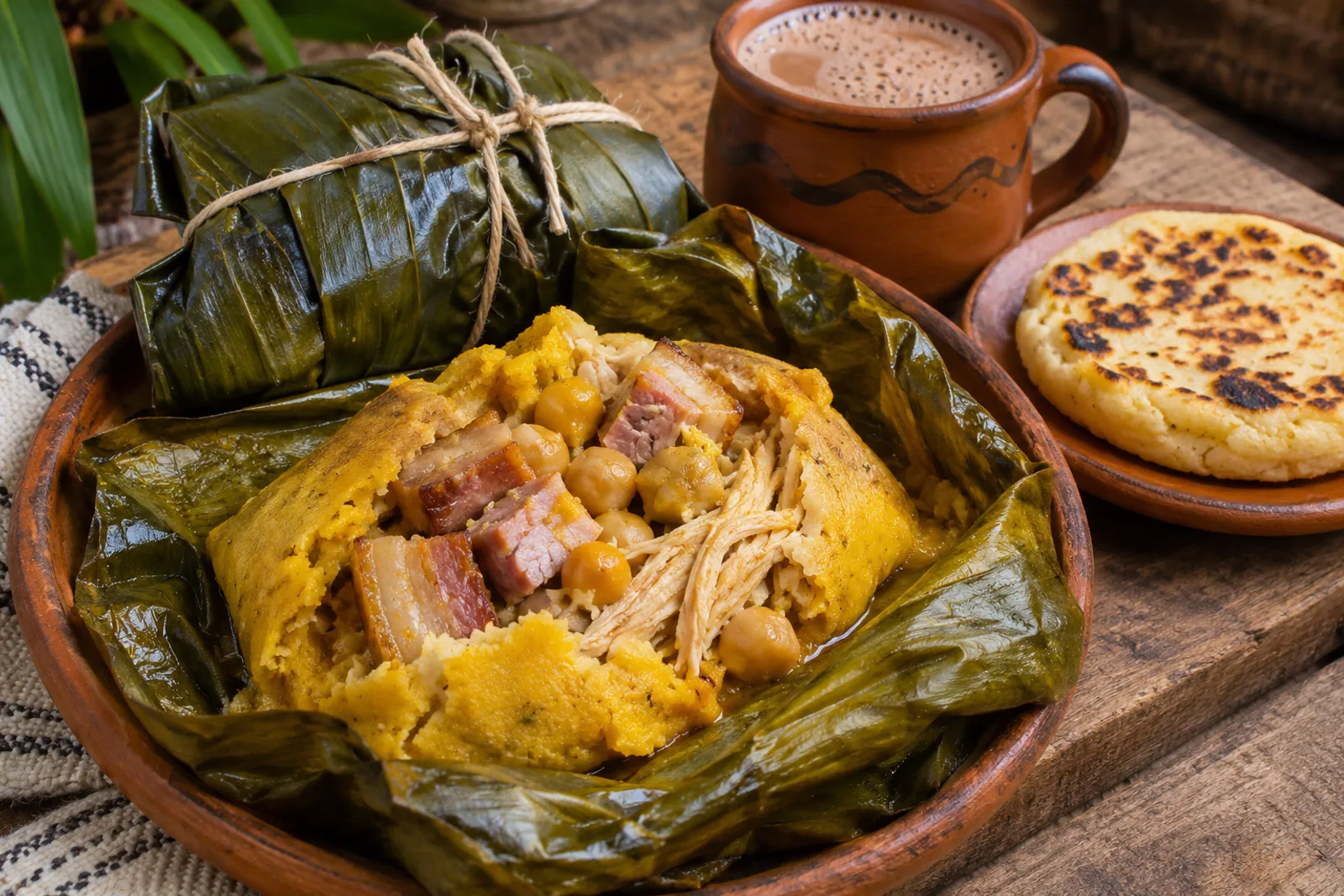

A Santander tamal is built like a sealed pie: chickpeas, chicken, pork and pork belly sit between a bottom and a top layer of corn masa that has already been cooked on the stove with annatto-red lard and ground pork cracklings. The rectangular banana-leaf parcel then steams for 4 hours. It comes from Santander, in northeastern Colombia, and some cooks call it a hallaca santandereana. Below is the recipe for 10, with what to buy in a US or UK store, how to tell the masa is ready and how to keep the steamer from boiling dry.
What makes a Santander tamal different
How do you make Santander-style tamales? Soak hulled corn and chickpeas and marinate the meat in hogao overnight. Next day, simmer and grind the corn, then cook it with annatto lard, garlic and ground cracklings until a spoon stands up in it. Seal chicken, pork, pork belly and chickpeas between two layers of masa, wrap in banana leaves and steam for 4 hours. 425 minutes for 10 servings: 35 minutes of work the night before, not counting the soaking and overnight marinating, and 390 on cooking day, 240 of them steaming.
If you know Mexican tamales, forget the corn husk and the fluffy, beaten masa. This one is bigger, about 400 g (14 oz), denser and eaten with a fork straight off its leaf. The masa tastes of corn and pork, the filling is juicy from the overnight marinade, and the chickpeas are the signature. It is not spicy.
Time. 425 minutes in all, 4 hours of it a covered steamer: 35 minutes the night before and 390 on cooking day. Difficulty, hard. No single step is tricky, but cooking the masa takes a strong arm and assembling ten two-layer tamales takes about an hour.
Colombia has a tamal in nearly every region. Here is how this one compares with three others on the site:
| Santander | Bogotá | Tolima | Valle del Cauca | |
|---|---|---|---|---|
| Masa | Hulled corn cooked with lard, annatto and cracklings | Precooked cornmeal, mixed raw | Ground hulled corn with rice | Hulled corn cooked into a porridge |
| Chickpeas | The defining filling | Yes, among potato and carrot | No | No |
| Masa on top of the filling | Yes | No | No | No |
| Cooking | Steamed 4 hours | Simmered 2 hours | Simmered 150 minutes | Simmered 120 minutes |
For the wider family, from Mexican corn-husk tamales to Venezuelan hallacas, see the tamale guide.
Shopping list for 10 tamales
Here is where the weight of one tamal goes, with the masa and chickpeas already cooked:
Hulled corn or masarepa
In Santander the masa starts with dried hulled yellow corn, sold there as maíz pelado, pilado, peto or porva. It is soaked overnight, simmered, ground and cooked again into a masa. In the US, look for Colombian maíz peto or maíz pilado bags in Latin grocers, or for dried yellow hominy. Be aware that many dried hominy brands need one to several hours of simmering before they turn tender, so cook it until a kernel bites through with no hard center before grinding, or use masarepa instead. In the UK, Latin American shops and online sellers carry it.
The shortcut is masarepa, the precooked cornmeal for arepas (P.A.N. is the common brand), found in the Latin aisle of most US supermarkets and in Latin shops or online in the UK. You cook it the same way, with the same seasoning. Some Santander households use it.
Cornmeal, polenta and Mexican masa harina are not substitutes here: the first two are not precooked and turn gritty, and I have not tested masa harina, which has a distinct tortilla flavor.
The pork, and the cracklings in the masa
- Pork cracklings (chicharrón). Ground and stirred into the masa for fat, salt and a roasted pork flavor. Colombian-style chicharrón is sold in Latin grocers; bagged pork rinds work too, though they are drier. Or fry 100 g (3½ oz) of pork belly until crisp and grind that.
- Pork belly. Fresh and uncured. Bacon would smoke the whole tamal.
- Pork leg. Pork shoulder (Boston butt) is just as good and stays juicier.
- Chicken. Thighs stay moister than breast over 4 hours.
Banana leaves and a steamer setup
You need 20 pieces about 35 cm (14 in) square, two per tamal. Frozen banana leaves come in 1 lb (454 g) packs in Latin and Asian grocers in the US and UK; buy 2 or 3 and thaw them in the fridge overnight. In Santander some cooks also use a local leaf called chisgua.
The tamales cook on steam, not in water. A large stockpot works if something keeps them off the bottom: a wire rack, a steamer insert or a few balls of crumpled foil, plus a lid that fits. What matters is that the water stays below that support: if your rack sits low, use less water and top it up more often, or raise the rack on a couple of foil rings.
The make-ahead plan
The night before takes 35 minutes: put the corn and chickpeas to soak, make the hogao and leave the meat marinating. Cooking day runs like this:
No pressure cooker? Simmer the chickpeas the night before until they squash between your fingers, or use 480 g (about 2 cans of 15 oz, drained) of canned chickpeas.
Cooking the masa until a spoon stands up
This is the step that sets the Santander tamal apart. The ground corn goes into a heavy pot with the remaining water, the red lard, garlic, cumin, cracklings and salt, and cooks over medium heat while you stir without stopping, usually about 25 minutes (sometimes 20). It starts as a loose porridge and ends as a firm, glossy paste. Three signs tell you it is ready:
- A wooden spoon stands upright in the center.
- The masa pulls away from the bottom of the pot as you stir.
- A wet fingertip pressed into it comes away clean.
If it stiffens and cracks before it gets there, add water 60 ml (¼ cup) at a time. Underdone masa sticks to the leaf and splits in the steamer. Rest it 15 minutes under a damp towel: warm masa is easier to shape and does not form a skin.
Building the two-layer tamal
Divide the masa into 10 balls of about 160 g (5½ oz) and halve each one. Toss the onion, pepper and parsley with the marinated meat now, not the night before.
- Brush two crossed banana leaves with a little oil.
- Press half a ball into a shallow cup about 12 cm (5 in) wide, with a slightly raised rim.
- Fill it with one piece each of chicken, pork and pork belly, about 3 tablespoons of chickpeas, onion, pepper and parsley, plus 3 or 4 raisins and 3 capers if you like.
- Flatten the second half between two sheets of plastic wrap, lay it on top and pinch the edges together like a turnover.
- Fold the bottom leaf over like an envelope, tucking in the corners to make a rectangle, fold the top leaf over it and tie crosswise with twine.
Wet hands keep the masa from sticking. Any gap in the top layer lets the meat juices out and the steam in.
Steaming for 4 hours, and how to tell they are done
Set the rack or leaf scraps in the pot, add water to a quarter of its height if your support is tall enough, but always below the base of the tamales, even at a full boil. Stack the tamales flat above it, cover them with more leaves and put the lid on. Bring it to a boil, then steam over medium heat for 4 hours. Check the level at least every 40 minutes, ideally every 30, and pour boiling water down the side of the pot, not over the tamales. A dry pot scorches the bottom layer and stalls the cooking.
The meat goes in raw, so the temperatures that matter are these:
Take one tamal out and give it 15 minutes before opening it: straight from the pot the masa always seems soft. It is done when the masa is firm, peels cleanly off the leaf and is not pasty in the middle, and both the thickest piece of chicken and the center of the filling read above 165°F (74°C); if you can, check one from the bottom layer and one from the top. If not, put it back and try another in 30 minutes.
Raisins and capers, and other versions
Raisins and capers split Santander kitchens: some families always add them, sometimes with olives, and others would never. With them, each bite has a sweet note and a briny one; without them, the tamal tastes more of corn and pork. That is why they are optional here: 3 capers and 3 or 4 raisins per tamal.
- With beef. Many versions use beef alongside the pork. Swap half the pork leg for 225 g (8 oz) of beef chunks, marinated the same way.
- With ribs. Use 10 pieces of bone-in pork spare ribs instead of the pork leg.
- With masarepa. Replace the hulled corn with 450 g (1 lb) of yellow masarepa whisked into 1.25 liters (5¼ cups) of water and cooked with the same seasoning to the same spoon test. It saves the overnight corn soak and about 35 minutes on the day.
- For 20 or 30. Multiply everything and cook the masa in batches of 450 g (1 lb) of corn, since a bigger pot is hard to stir properly. The steaming time stays at 4 hours; you will just need two pots.
Allergens and kids. Gluten-free if your cracklings and annatto are (check the labels), with no dairy, egg or nuts. Not spicy; most children eat it happily without the capers. Cost. The pork leg and pork belly are the expensive part; more chicken and less pork brings the price down.
Serving, storing and reheating
In Santander a tamal is breakfast food and a fixture at christenings, first communions and Christmas gatherings. Open it on a plate on top of its leaf. If you are cooking more from the region, Santander-style mute, a hominy and chickpea soup, shares the same corn and chickpeas, and the Santander arepa uses the same trick of grinding cracklings into the dough.
- Fridge. Still wrapped, within 2 hours of coming out of the pot. Spread them out in shallow containers or on a tray rather than piling the whole batch together, so they cool quickly, and cover once cold. Eat them within 4 days.
- Freezer. Cooked, cooled and still tied, they keep well for up to 4 months.
- Reheating. In Santander the breakfast tamal is warmed in a double boiler. Set it, still wrapped, in a steamer basket or colander over boiling water with a lid: about 40 minutes straight from frozen, with no thawing, or about 20 minutes from the fridge. The center should reach 165°F (74°C).
Frequently asked questions
What is a hallaca santandereana? Another name some cooks and recipe books give the Santander tamal. It is not the Venezuelan hallaca, which uses a raw masarepa dough, a cooked stew filling and about 90 minutes of boiling.
Is it the same as a Mexican tamale? No. Mexican tamales are usually smaller, wrapped in corn husks, with a beaten masa of nixtamalized corn. This one is wrapped in banana leaves, the masa is cooked first and the raw meat and chickpeas are sealed between two layers.
Do I have to cook the chickpeas first? In this recipe, yes, after soaking: 15 to 20 minutes at pressure, about 45 including the time the cooker takes to come up and down. Some cooks add them only soaked and let the 4 hours of steam do the rest; if you do, taste a chickpea from your test tamal before taking the others out.
How many tamales does 1 lb of corn make? Ten, each about 400 g (14 oz), with roughly 160 g (5½ oz) of masa.
Can I freeze them uncooked? I do not. Raw chicken and pork sit inside, and the masa weeps as it thaws. Steam them first, cool them and then freeze.
Nutrition per tamal
Per tamal (1 of 10, with raisins and capers), worked out ingredient by ingredient from the quantities above:
- Calories: 679 kcal
- Protein: 33 g
- Carbohydrates: 56 g
- Fat: 37 g, including 12 g saturated
- Fiber: 8 g
- Sugars: 8 g
- Sodium: 1088 mg
Lard, pork belly and pork leg supply almost half the calories; the corn adds about 164 kcal per tamal. Capers and cracklings push the sodium up, and leaving out the capers saves about 70 mg each.
As a Venezuelan, the raisins and capers were what caught me off guard, because at home those only ever went into hallacas. I add a few and fully understand the families who don’t. The masa is where I don’t compromise: I stir until the spoon stands, sore arm and all, because loose masa means a tamal that bursts in the pot. Josnaisis.