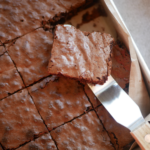
The Palmer House Hotel in Chicago put brownies on its menu in 1893, made for Bertha Palmer, who wanted something for the Columbian Exposition that would travel in a boxed lunch — denser than cake, richer than a cookie. The hotel still sells that original version with walnuts and an apricot glaze. What follows is the home version of the same idea, and it hangs on one thing: pulling the pan before it looks done. Twelve squares at 380 calories each.
How do you make fudgy brownies? Melt 7 oz of dark chocolate with 1½ sticks of butter over a water bath, whip 4 eggs with 1 cup of brown sugar until foamy, fold the two together, fold in the flour and the walnuts, and bake at 350°F until the centre wobbles. Twelve squares, 50 minutes start to finish.
Fudgy or cakey is decided on the scale
The oven does not make a brownie fudgy; the ratio does. Per 100 g of flour, this recipe carries 380 g of fat, counting the butter and the cocoa butter inside the chocolate. With that much fat and no leavening, the batter has too little structure to rise, so it stays dense and damp.
A cakey brownie halves the fat and adds a teaspoon of baking powder. A chocolate sheet cake goes further still. Those are all good things to eat, but they are not what people mean when they ask for fudgy, and most of the time a fudgy recipe turns cakey simply because it stayed in four minutes too long.
Note what is missing from the ingredient list: there is no baking powder and no baking soda. The only air in this batter comes from whipping the eggs with the sugar, and its job is the crust, not the crumb.
Which chocolate to buy
Buy a baking bar at 60 to 70 percent cacao — the kind sold in 4 oz bars in the baking aisle, not the chocolate chips next to them. The bar brings two things the batter needs: the bitterness that balances a cup of brown sugar, and the cocoa butter that binds everything.
Chocolate chips are the most common substitution here and the one that costs the most. They are formulated with stabilisers so they keep their shape inside a cookie, which means they neither melt smoothly nor release fat into the batter. Use them scattered on top if you want, never as the base.
Unsweetened baking chocolate works if you add about ½ cup more sugar to compensate. Cocoa powder alone does not: it brings cocoa solids without cocoa butter, and the crumb comes out noticeably drier.
Why a water bath instead of the microwave
Dark chocolate melts between 113°F and 122°F (45-50°C), and above about 140°F (60°C) the cocoa solids scorch and the mixture goes grainy and splits. Over simmering water the bowl cannot get much past the steam, so the method is nearly foolproof.
A microwave passes that line without warning, because chocolate holds its shape until you stir it. If it is your only option, go in 20-second bursts, stir between each one, and stop while small lumps are still visible — the residual heat finishes them.
Then let it sit 10 minutes. Hot chocolate poured onto whipped eggs cooks them, and you end up with threads of scrambled egg through the batter.
The doneness test, which is the whole recipe
At 20 minutes the middle is raw. At 26 the edges are set and the centre wobbles — that is the pull point. At 30 a toothpick comes out clean and you have a cakey brownie. At 34 it is dry.
The reason to pull it early is carryover: a metal pan at 350°F keeps feeding heat into the middle for several minutes on the counter. That last stretch of baking happens outside the oven, so waiting until it looks finished inside guarantees it will be overdone by the time you eat it.
The 50 minutes, and the 30 after them
Twenty-two minutes of mixing, 26 of baking and 30 of cooling that you cannot skip. While the slab is warm the fat in it is still liquid, so the square gives way under the knife; cooled, the fat sets and the cut comes out square.
For bakery-clean edges, chill the cooled pan for an hour, then cut with a hot dry knife. That is the difference between a dozen identical squares and a dozen pieces.
Make it ahead and store it
Baked brownies keep 4 days at room temperature in an airtight container, and cutting them only when you serve them keeps the edges from drying. They freeze well for up to 3 months wrapped individually, and thaw on the counter in about an hour. The batter itself does not keep — once the flour is in, it goes straight to the oven.
Who this recipe is for
- You want fudgy, not cakey — the ratio here is built for it
- You have been overbaking brownies — the wobble test fixes that in one bake
- You are baking with kids — no leavening, no creaming, one bowl over water
- You want to scale portions — 12 squares at 380 calories, or 16 at 285
- You only have a box mix in the house — this is barely more work and not comparable
What goes wrong
Waiting for a clean toothpick. By then the middle is cooked through and it is cakey.
Pouring hot chocolate onto the eggs. They scramble, and the batter carries threads of cooked egg.
Beating after the flour goes in. That develops gluten and the brownie turns rubbery.
Using chips instead of a bar. They will not melt into the batter or give it fat.
Cutting it warm. It collapses. The 30 minutes of cooling are part of the recipe.
Variations
With dulce de leche. Three tablespoons of Colombian dulce de leche swirled through the batter before baking.
With flaky salt. A pinch over the top straight out of the oven, which cuts the sweetness.
With espresso. A teaspoon of instant coffee into the melted butter; it does not taste of coffee, it deepens the cocoa.
Without walnuts. The usual version in houses with children, and 55 calories less per square.
What to serve with them
A warm square with 2 oz of vanilla ice cream is the classic, and a mug of Colombian hot chocolate — which comes with a piece of salty cheese dropped into it — goes better with brownies than it has any right to. On a dessert table they sit well beside Colombian natilla and a plate of Colombian buñuelos.
If you are ending a long Sunday lunch, say a bowl of Colombian sancocho, these have the advantage of baking while the pot does its work and waiting happily on the counter.
Frequently asked questions
How do I know they are done without a toothpick? The edges look set and matte and the centre wobbles when you move the pan. That is around 26 minutes.
Why is there no shiny crust on mine? The sugar never dissolved. Whip the eggs with the sugar for a full 3 minutes before the chocolate goes in.
Can I use an 8x8 pan? Yes, but the batter is deeper: add about 5 minutes and start checking at 30.
Can I use milk chocolate? It comes out cloying. If it is what you have, cut the sugar to ½ cup.
Why did they turn rubbery? From beating after the flour went in. Fold with a spatula, and only until the streaks disappear.
Nutrition
Per square, one twelfth of the pan, calculated from each ingredient according to the USDA SR Legacy database:
- Calories: 380 kcal
- Protein: 6 g
- Carbohydrates: 32 g, 20 g of it sugar
- Fat: 26 g, 13 g of it saturated
- Fibre: 3 g
- Sodium: 130 mg
The fat splits about evenly between the butter and the chocolate, and the walnuts account for roughly 55 calories a square. Cut the same pan into sixteen and each one lands at 285 calories, which is how I serve them when there are more people than squares.
My son Dylan learned to bake these before anything else, and for months he had the same problem every time: he took them out when the toothpick came clean, the way he had watched people test sponge cakes. The day I told him to watch for the wobble instead of poking them, they came out right. Josnaisis.