

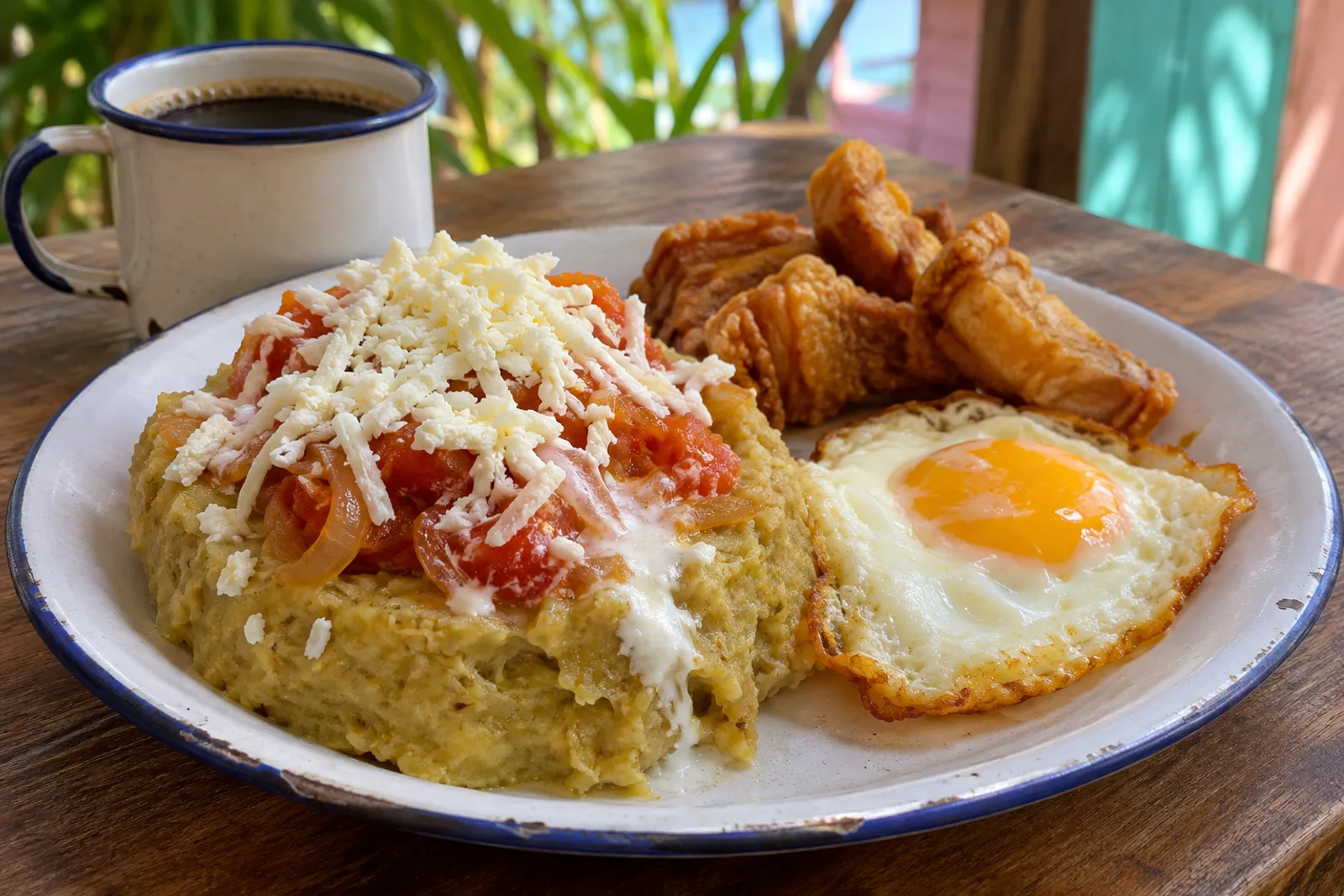

Cayeye (say kah-YEH-yeh) is the Santa Marta breakfast of green bananas boiled for 20 to 30 minutes and mashed hot; this version gets butter, salty white cheese and a tangy cultured cream, under a quick tomato and onion sauté. It comes from the banana-growing towns of Magdalena, on Colombia’s Caribbean coast. For 4 people you need 8 green bananas, about 900 g (2 lb) once peeled, and 200 g (7 oz) of cheese; it is on the table in about 55 minutes. Below: why green bananas and not plantains, what to buy in the US and UK, how much per person, the pork belly and fried egg versions, and how to keep it from going gummy.
What is cayeye
How do you make cayeye? Peel 8 green bananas, cut them into chunks and boil them in salted water for 20 to 30 minutes, until a fork slides in easily. Drain, saving a cup of the water, and mash hot with 60 g (4 tbsp) of butter, 4 tbsp of suero costeño or sour cream and 150 g (5¼ oz) of grated salty cheese. Serve with a tomato topping, more cheese and more cream. 55 minutes for 4 servings.
The bananas in cayeye are ordinary eating bananas picked unripe. Boiled while still green, they taste nothing like dessert: mild, slightly earthy, and starchy like a potato. On the coast of Magdalena, around Santa Marta, Ciénaga, the Zona Bananera, Aracataca and Fundación, they are mashed into cayeye, also called mote de guineo (guineo is the coastal word for banana). It’s eaten mostly at breakfast, with a fried egg, crispy pork belly, meat or fried fish.
If you know Dominican mangú or Puerto Rican mofongo, cayeye is a cousin. The difference is the banana instead of the plantain, and the salty coastal cheese, queso costeño. Bananas, butter and cheese are the base; the tangy suero costeño and the tomato topping depend on the household, and this version has both.
Time and difficulty. About 55 minutes: 15 to peel and chop, around 10 for the water to come to a boil, 20 to 30 of boiling and 5 of mashing, with the topping made while the bananas boil. Easy. The only thing it asks is mashing on time and not overworking it.
Green bananas vs plantains for cayeye
Cayeye is made with green bananas, not plantains. Bananas are smaller, with thinner skins, and mash into a softer, lighter-tasting purée. Make the same dish with green plantains and it gets another name on the Colombian coast, cabeza de gato: starchier, firmer and more strongly flavored, and it needs more cooking water.
- Bananas green from tip to tip. Hard when squeezed, with no yellow at all on the skin. This is what the recipe card uses.
- Bananas starting to turn yellow. They already have sugar: the mash comes out sweet, soft and sticky. Not for cayeye.
- Green plantains. If that’s all you can find, use 1 plantain per person instead of 2 bananas, boil 20 to 25 minutes and expect to add more cooking water. That’s cabeza de gato; good, but a different dish.
Where to buy green bananas and the other ingredients
- Green bananas. In the US, Latin and Caribbean grocers sell them green for cooking, because boiled green bananas are everyday food across the Spanish-speaking Caribbean. In a regular supermarket, pick the greenest, hardest bunch with no yellow. In the UK, look in Caribbean and African grocers, which often sell green bananas for boiling, or the greenest bunch in the supermarket.
- Queso costeño. It is a firm, salty fresh cheese for grating. Salty queso fresco from a Latin grocer is the nearest match; feta soaked in water for 20 minutes to pull out some salt works well; cotija is drier but fine. Grate any of them finely.
- Suero costeño. Some Latin grocers in the US carry it bottled. Otherwise, make suero costeño at home, or use the 5-minute sour cream and yogurt version.
How much cayeye per person
Plan on 2 medium green bananas per person, about 225 g (8 oz) peeled, with 50 g (1¾ oz) of cheese, 15 g (1 tbsp) of butter and 2 tbsp of suero. That’s a full breakfast. With pork belly or fish on top, 1½ bananas per person is plenty. For more than 8, use two pots: crowded in one, the water takes ages to come back to a boil and the bottom pieces cook before the top ones.
How to make cayeye, step by step
- Peel with oiled hands. Trim the ends, slit the skin lengthwise and push it off with your thumb. The sap stains skin, clothes and cutting boards; oil on your hands stops it. Three pieces per banana, into a bowl of water.
- Boil 20 to 30 minutes. Fresh salted water covering by 1¼ in (3 cm), high heat to a boil, then medium. They’re done when a fork goes to the center with no resistance and a piece squashes against the pot. Undercooked bananas leave hard lumps that no amount of mashing fixes.
- The topping, meanwhile. Onion 5 minutes, garlic and sweet pepper 1 minute, tomatoes and salt 8 to 10 minutes, until no loose liquid is left. If you have Colombian hogao in the fridge, warm it and use that instead.
- Mash while hot. Save 1 cup of the water, drain and mash in the same pot with the butter right away. Lukewarm bananas won’t go smooth.
- Cheese and cream, then stop. Suero and 150 g (5¼ oz) of cheese, mashing only until combined. Cooking water 2 tbsp at a time if needed. It’s right when it holds on a spoon, moist but not runny.
- Taste and serve. Salt only if needed, and to the table at once with the topping, cheese and suero.
Why cayeye turns gummy, lumpy or dry
- Gummy or stretchy. It was overworked, or it went through a blender or food processor: green banana starch gets gluey the more you work it. Mash by hand and stop once the cheese is in. There’s no fix; next time, less elbow.
- Hard lumps. Underboiled, or mashed after cooling. Test a piece before draining and mash straight away.
- Dry or heavy. Needs liquid. Hot cooking water 2 tbsp at a time, or a little more suero.
- Sweet and sticky. The bananas had started to ripen. Buy them with no yellow at all.
- Too salty. Salty cheese plus salted water. Don’t salt the mash before tasting; with a very salty cheese, soak it 20 minutes first.
Allergens and heat. Contains dairy (butter, cheese and cream). No gluten, and no egg unless you serve it with a fried egg. Not spicy: ají dulce is an aromatic sweet pepper, not a hot one. Kids usually like it, especially without the topping.
What to serve with cayeye
In Santa Marta, cayeye comes with something fried on top or alongside, and extra suero on the table. The usual combinations:
- With crispy pork belly. A strip of Colombian chicharrón on top, the heartiest version. Cut back to 1½ bananas per person.
- With a fried egg. One or two per plate, yolk runny so it mixes into the mash. The quickest weekday version.
- With fried fish. A whole fried mojarra, beach-lunch style.
- With meat. Shredded beef or a thin steak over the tomato topping.
- On its own, with the topping, cheese and suero. That is already a full breakfast.
For a coastal spread, cayeye sits next to bollo de yuca, cassava boiled in corn husk, and the other dishes in the guide to Colombian Caribbean food. To compare it with its Caribbean cousins, Dominican mangú is green plantain mashed with its cooking water, and Puerto Rican mofongo is fried plantain pounded in a mortar.
Storing and reheating cayeye
It keeps 3 days in the fridge, covered in shallow containers, put away within 2 hours of cooking, or 1 hour if the room is above 90°F (32°C); store the topping separately. It sets very firm once cold, which is normal.
- Reheat in a pot over low heat with 2 to 3 tbsp of water or suero per serving, mashing and stirring until hot in the center, 165°F (74°C) if you have a thermometer. In the microwave, covered with the same splash of liquid, stirring halfway.
- Freezing. I don’t: the cheese and banana change texture when thawed and the mash turns watery.
- Make ahead. The tomato topping can be made the day before and refrigerated; the bananas are best freshly boiled.
Cayeye FAQ
Is cayeye the same as mangú? No. Mangú is Dominican and made with green plantains mashed with butter and cooking water, usually topped with pickled red onion. Cayeye uses green bananas and gets salty cheese and cultured cream mixed in.
Do you boil green bananas with or without the peel? Both ways exist. Peeled and in chunks they cook faster and more evenly, 20 to 30 minutes, which is how I do it. In their skins they stain your hands less, but you have to drain them and pull off the skins with tongs and a fork while they are still hot, before mashing.
Can I use regular yellow bananas? No. Once a banana turns yellow its starch becomes sugar, and the mash comes out sweet and sticky. You need bananas that are fully green and hard.
What cheese can I use instead of queso costeño? A firm, salty white cheese you can grate: salty queso fresco, feta soaked for 20 minutes, or cotija. Mozzarella or any melting cheese won’t work; it goes stringy and makes the mash gummy.
Can I make cayeye without suero costeño? Yes, with a little more butter and cooking water. You lose the tang that balances the salty cheese; a squeeze of lime brings some of it back.
Cayeye nutrition facts
Per serving, a quarter of the recipe with its topping, cheese and suero, worked out ingredient by ingredient:
- Calories: 595 kcal
- Protein: 15 g
- Carbohydrates: 60 g
- Fat: 36 g
- Fiber: 7 g
- Sodium: 854 mg
Two thirds of the fat comes from the cheese and butter. Real sodium depends on the cheese: a very salty one raises it noticeably, and the salt in the cooking water isn’t counted.
In Venezuela I grew up with boiled green plantain next to fried fish, and cayeye struck me as the same idea moved to breakfast. Making it taught me not to fear the cooking water and to put the masher down in time: good cayeye is rustic, not smooth like mashed potatoes. Josnaisis.