

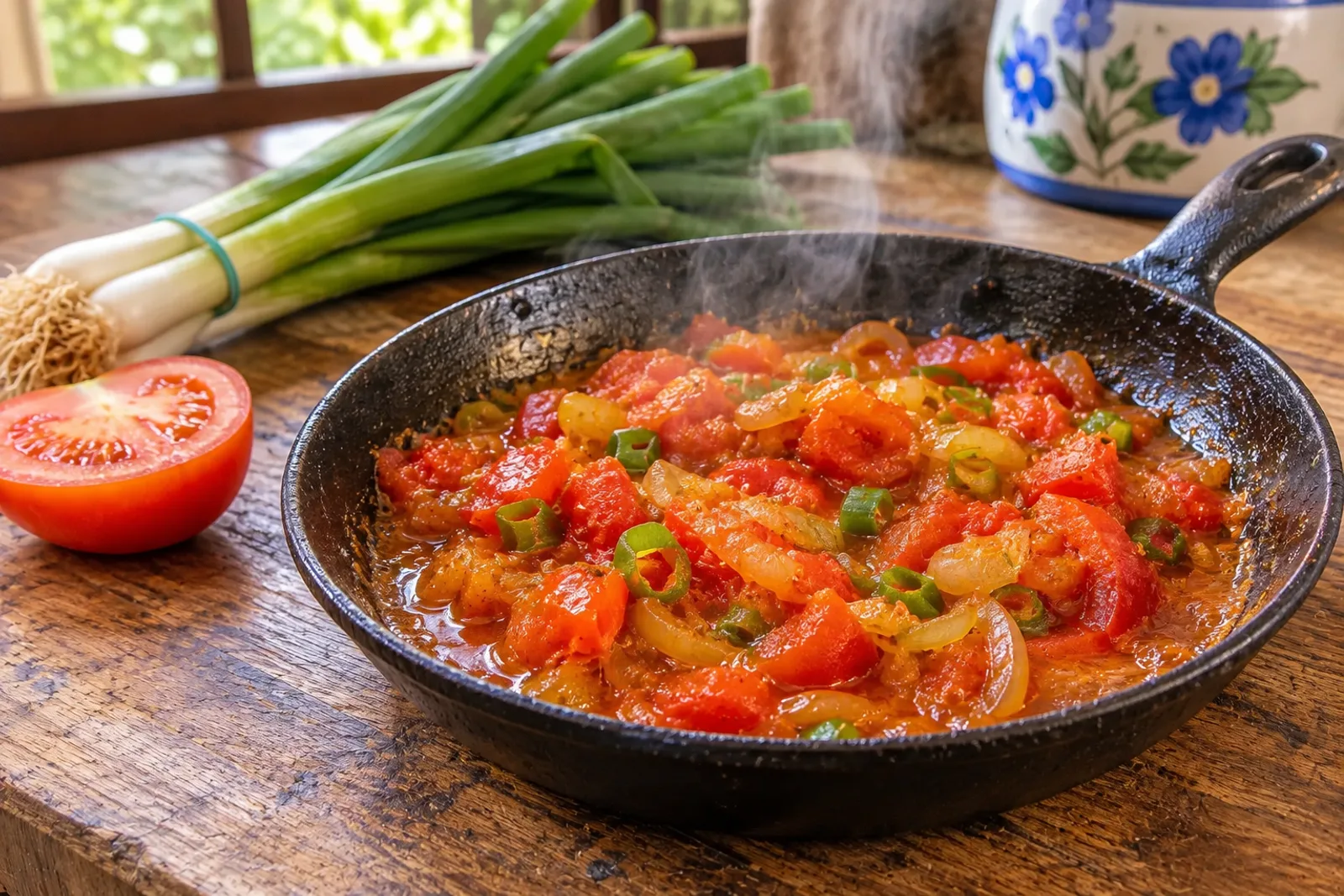

Hogao (say oh-GAH-oh) is Colombia’s everyday tomato and green onion sauce: ripe tomatoes and scallions cooked slowly in oil, about 25 minutes from the moment the tomatoes go in, until the juice has boiled off and the oil separates at the edge of the pan. From 600 g (1 lb 5 oz) of tomatoes and 150 g (5¼ oz) of green onions you get 2 to 2½ cups, enough to season a pot of Colombian beans and a batch of shredded beef. Below is the recipe, how to tell when it is done, what to buy in a US or UK supermarket, how much each dish needs and how long it keeps.
What is hogao
How do you make Colombian hogao? Cook 150 g (5¼ oz) of sliced green onions in 3 tbsp oil for 5 minutes and the garlic for 1. Add 600 g (1 lb 5 oz) of diced ripe tomatoes and ½ tsp cumin, cook 5 minutes over medium and 15 to 20 over medium-low, until no liquid is left and oil shines at the edge. Salt at the end. 40 minutes for 10 servings of 3 to 4 tablespoons.
Hogao is a chunky, unblended sauce that Colombian cooks use two ways: cooked into a dish as its flavor base, and spooned on top at the table. In Antioquia and the coffee region around it (Caldas, Risaralda and Quindío), it is what turns a pot of red beans rich and rust-colored, what seasons the ground beef on a bandeja paisa and what sits in a bowl next to the fried plantains and arepas. It is the backbone of paisa food and of most Colombian stews.
If you know sofrito, hogao is a cousin. Puerto Rican sofrito is a raw blended paste of peppers, onion and herbs; hogao is chopped, not blended, and cooked down until thick. Spanish sofrito is cooked too, slowly, from onion and tomato in olive oil; hogao swaps the bulb onion for green onion and is usually made with a neutral oil. Hogao is the Colombian form of ahogado, Spanish for a dish slowly cooked in its own fat; on Colombia’s Caribbean coast the same base is usually just called guiso.
Time and difficulty. 40 minutes, 10 of chopping and 30 at the stove. It’s easy; the only skill it asks for is not stopping too soon.
Ingredients for Colombian hogao
The ratio is 4 parts tomato to 1 part green onion by weight: 600 g (1 lb 5 oz) of tomatoes to 150 g (5¼ oz) of onion. Measured in cups, that is about 3⅓ cups of diced tomato and 1½ cups of sliced green onion, roughly two to one, because sliced onion is bulky. More onion makes it greener and sweeter; less, and it tastes of tomato alone.
- Tomatoes. In Colombia the tomato is chonto, a medium, firm, round red tomato. In the US and UK, Roma (plum) tomatoes are the closest; vine tomatoes work if they are deep red. Ripe matters more than variety: a pale, hard supermarket tomato has more water and less sugar, takes longer to cook down and stays sour even after 30 minutes. Out of season, see the canned version below.
- Green onions. Colombian cebolla larga is a thick green onion with a small bulb, chunkier than a US scallion. Regular scallions do the same job; you just need more of them, about 2 bunches for 150 g. Use the whole stalk, white and green. Chives are not a substitute: they burn in the oil and add almost nothing.
- Garlic and cumin. The plainest hogao is only tomato and onion, but most kitchens in Antioquia add both. Half a teaspoon of cumin is noticeable without taking over.
- Oil. Any neutral oil. The 3 tbsp (40 g) are what let you see the doneness cue; with less, the oil never separates and the sauce sticks.
- Annatto (achiote). Colombians call it color. It adds orange color, very little flavor, and you can leave it out. Look for it ground in the Latin aisle.
Without green onions and other versions
| Version | What changes | How it turns out | Best for |
|---|---|---|---|
| Paisa, as written | 600 g (1 lb 5 oz) tomatoes, 150 g (5¼ oz) green onions, garlic, cumin | Sweet, green, thick | Beans, patacones, arepas, everything |
| With yellow or white onion | 1 medium onion, 150 g (5¼ oz), instead of green onions, 7 minutes in the oil | Sweeter, more body, less of the fresh green onion flavor | Shredded beef, braises |
| Half and half | 75 g (2½ oz) green onion plus 75 g (2½ oz) onion | In between | When you only have one bunch of scallions |
| With red pepper and annatto | 100 g (3½ oz) diced red bell pepper with the onion, ½ tsp annatto | Redder and sweeter | Rice dishes, braises, fillings |
| Quick canned | 400 g (14 oz) can of crushed tomatoes instead of fresh | Smooth and a bit flat; 10 minutes of simmering instead of 20 | Beans and stews, not as a topping |
Equipment. A heavy 10 to 11 in (26 to 28 cm) skillet and a wooden spoon. In a smaller pan the tomatoes pile up, the water takes twice as long to cook off and the bottom catches.
How to make hogao step by step
Hogao goes through three stages, and it is ready to serve in the last one. In the first 5 minutes the tomatoes release their juice; from 5 to 15 that juice boils off; from 15 to 25 the tomato breaks down and concentrates, the oil separates and the raw tomato taste goes. Stop in the second stage and, as a topping, it tastes raw and soaks whatever it touches; for stirring into a pot, that stage is enough, as explained below. Some acidity can stay if the tomatoes were tart: what matters is that it no longer tastes raw and is as thick as you need.
- Onion first, 5 minutes. Oil over medium heat and the green onions in, stirring, until soft and glossy. They shouldn’t brown; browned onion turns the sauce bitter and dark.
- Garlic, 1 minute. Just until you can smell it. Browned garlic is the most common reason a hogao tastes bitter.
- Tomatoes, 5 minutes over medium. With the cumin and annatto. They soften and flood the pan; at this point it looks like soup.
- Then medium-low, uncovered, for 15 to 20 minutes. Scrape the bottom, where it sticks, every few minutes. No lid: a lid drips the steam back into the pan and the sauce never thickens.
- Salt last. As the sauce reduces it concentrates, so salt that seemed right at the start can end up too much; adding it at the end lets you season to the finished taste. Pepper and cilantro go in off the heat.
For a topping or for cooking. To spoon over patacones, arepas or eggs, take hogao to the dry stage 3, because a wet sauce soaks whatever is underneath. To stir into beans or soup, you can stop around minute 15, since it keeps cooking in the pot.
For a crowd. For 20 or more, double or triple the recipe in a wide 12½ in (32 cm) pot or two skillets. Doubling the tomatoes in the same pan doesn’t double the time, but it does stretch it: allow 30 to 35 minutes and go by the cues, not the clock.
Why hogao turns out sour, watery or bitter
- Sour. If it also tastes raw, it needs time: give it 5 more minutes over medium-low. If it is already thick and still sour, the acidity comes from underripe tomatoes, and more heat will only dry it out. A pinch of sugar (no more than ¼ tsp) takes the edge off, but it won’t taste like ripe tomato.
- Watery. Heat too low, pan too small, too much in the pan or lid on. Uncover, turn up to medium and stir until the oil separates.
- Bitter, with dark specks. The garlic or onion browned, or the bottom scorched. There’s no fixing it; next time, garlic for 1 minute only and scrape the bottom often.
- Bland. It needs salt or more reducing. Adjust the salt at the end, once it has reduced.
- Oily. A film of oil on top at the end is normal; it’s the sign it is done. If there’s too much, tilt the pan and spoon some off.
Allergens and heat. No gluten, dairy, egg or nuts, and it is not spicy. As written, it’s vegan. Kids usually like it, especially without cumin.
How to use hogao, for beans, patacones and shredded beef
Hogao goes in at one of two moments: cooked into a dish, such as beans, shredded beef or soup, or spooned on top to serve, over patacones, arepas or scrambled eggs. The amounts below come from the recipes on this site, given as a share of this 600 g (1 lb 5 oz) batch. Cup measures are approximate, since the batch makes 2 to 2½ cups depending on how far you reduce it.
| Dish | How much hogao | When it goes in |
|---|---|---|
| Colombian red beans, 500 g (1.1 lb) dried beans, serves 8 | Hogao from 300 g (10½ oz) tomatoes, half the batch (1 to 1¼ cups) | In the last 25 minutes, with the plantain and carrot |
| Colombian patacones, 16 for 4 people | Hogao from 500 g (1 lb 2 oz) tomatoes, most of the batch (1⅔ to 2 cups); a heaping tablespoon per patacón | On top, straight from the fryer |
| Colombian shredded beef, 1 kg (2.2 lb) flank steak, serves 6 | Hogao from 300 g (10½ oz) tomatoes, half the batch (1 to 1¼ cups) | The beef simmers in it 15 minutes with a ladle of broth |
| Bandeja paisa for 4 | Hogao from 250 g (9 oz) tomatoes, a bit under half the batch (close to 1 cup) | 4 tbsp into the beans, 2 into the ground beef, the rest at the table |
| Huevos pericos, 8 eggs | Hogao from 250 g (9 oz) tomatoes, a bit under half the batch | The recipe cooks its own base in the pan; with ready-made hogao, warm it until the oil shines at the edge, then add the beaten eggs |
In beans, hogao is what gives them their reddish color and thick broth; without it the pot tastes of beans and water. It goes in at the end, once the beans are soft: tomato acid slows the softening if it goes in from the start. On patacones, use it at its driest, over plantains that are already salted. With shredded beef, the meat goes into the hogao with a ladle of its cooking broth and simmers until the liquid is absorbed; many cooks use the onion version for this.
It also goes on arepas with fresh cheese, into day-old rice, over boiled potatoes and into empanadas. Hogao isn’t hot; if you want heat, put Colombian ají picante on the table alongside it.
How long hogao lasts in the fridge, and how to freeze it
Hogao keeps up to 4 days in the fridge, in a closed jar or container at 40°F (4°C) or below, put away within 2 hours of cooking, or 1 hour if your kitchen is above 90°F (32°C). That’s the standard window for cooked leftovers; some recipes stretch it to a week, but I stop at 4 days. Frozen, it keeps 3 months, and that’s the handiest way to always have some.
- To refrigerate. Spoon it into a clean, shallow container and put it in the fridge as soon as it stops steaming, without waiting for it to reach room temperature. For a double batch, split it between two or three shallow containers rather than one big jar, so the center cools quickly. Take out only what you need each time, with a clean spoon.
- As frozen cubes. Fill an ice cube tray, about 2 tbsp per cube, freeze, then move the cubes to a zip-top bag. One batch makes 16 to 20 cubes. Drop them frozen into a pot of beans or soup that is already boiling; for a topping, reheat them in an open skillet as below.
- Reheating. In a skillet over medium heat, stirring, until it steams and is hot all the way through, 165°F (74°C) if you have a thermometer. A couple of spoonfuls from the fridge take about 3 minutes; several frozen cubes take a good deal longer, so go by the heat in the center, not the clock. If it released water when it thawed, cooking it uncovered thickens it again.
- Left out. Anything that sat on the table more than 2 hours, or more than 1 hour on a day above 90°F (32°C), goes in the bin, not back in the jar.
Everything can be made ahead: a Sunday batch covers Monday’s beans, the week’s eggs and Thursday’s patacones.
Hogao FAQ
Is hogao the same as sofrito? They are related, not the same. Puerto Rican sofrito is a raw, blended paste of peppers, onion, garlic and herbs that gets cooked later; Spanish sofrito is onion, tomato and often pepper cooked in olive oil. Hogao is cooked, chunky and built on green onion and tomato.
What can I use instead of green onions? One medium yellow or white onion, 150 g (5¼ oz), cooked 7 minutes before the garlic. The sauce comes out sweeter and thicker and loses the fresh green onion flavor; half onion and half scallion is the closest compromise.
Can I make hogao in a blender? Yes. You can blend just the tomatoes and keep the green onions sliced by hand, as in the recipe: you get a smoother base without tomato pieces, which works well in beans and soups. Cook it the same way, uncovered, until the oil shines at the edge and it is as thick as you want. Blending the onions too is the step to skip, because it loses the texture that sets hogao apart.
Can I use canned tomatoes? Yes, a 400 g (14 oz) can of crushed tomatoes in place of fresh. It needs only about 10 minutes of simmering because canned tomatoes are already cooked. Check the salt, since many cans are salted.
Hogao nutrition
Per serving of one tenth of the recipe (about 3 to 4 tablespoons), calculated ingredient by ingredient from the amounts above:
- Calories: 53 kcal
- Protein: 1 g
- Carbohydrates: 4 g
- Fat: 4 g
- Fiber: 1 g
- Sugars: 2 g
- Sodium: 180 mg
About two thirds of the calories in each serving come from the oil; tomatoes and onions make up the rest.
I make a double batch on Sundays and half of it goes straight into the ice cube tray. The hardest thing to learn was patience at the halfway point, when it already looks red and pretty and you want to call it done. Hogao happens at the very end, when nothing seems to be going on and the oil starts creeping out at the edge. Josnaisis.