

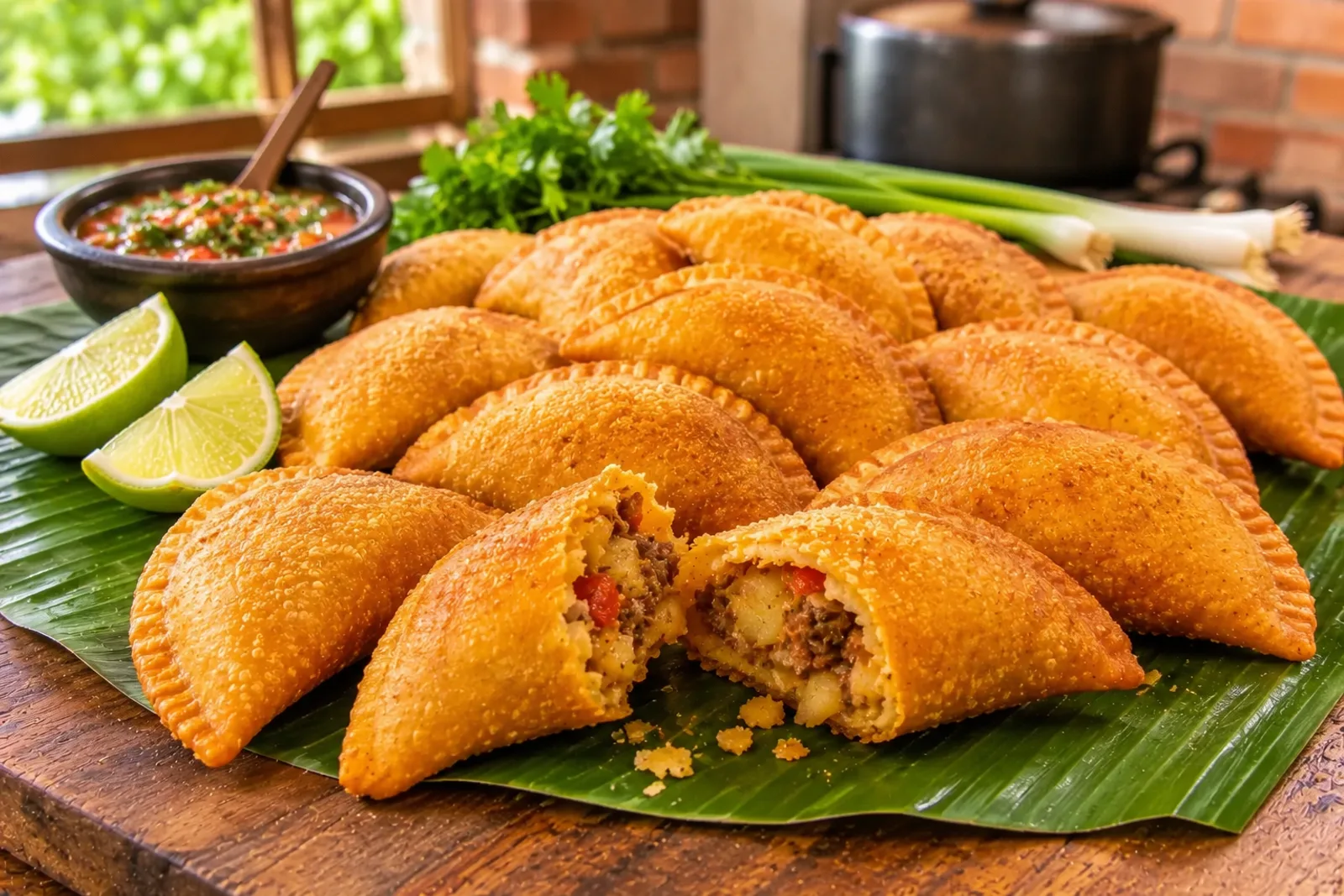

Antioquia-style empanadas are the small fried corn empanadas of Medellín and northwest Colombia: a yellow cornmeal shell pressed to 2 mm (1/16 in), a filling of mashed potato with ground beef and pork cooked in hogao, and 3 to 4 minutes at 350°F (180°C) until they crackle. Each one is two or three bites, and people eat them by the half dozen with a spoonful of ají and a squeeze of lime. This recipe makes 30, takes 135 minutes, and works with what any US supermarket sells.
What are Antioquia-style empanadas?
How do you make Antioquia-style empanadas? Boil 400 g (14 oz) of cubed potato for 20 minutes and mash it roughly. Cook 250 g (9 oz) of ground beef and pork in a quick tomato and scallion sauce with cumin, mix with the potato and chill 30 minutes. Knead 360 g (2⅓ cups) of yellow masarepa with 520 ml (2 cups plus 2 tablespoons) of warm water, press 30 thin disks, fill with 25 g (0.9 oz) each, seal and fry at 350°F (180°C) for 3 to 4 minutes. 135 minutes for 30 empanadas.
People from Antioquia and Colombia’s coffee region are called paisas, so you will also see these called paisa empanadas or empanadas antioqueñas. Two things set them apart from the empanadas most Americans know. The shell is corn, not wheat, made from the same precooked cornmeal as arepas, so they are naturally gluten-free. And the filling is mostly potato: here 400 g (14 oz) of potato to 250 g (9 oz) of meat, roughly 60 to 40.
Colombia has a different empanada in almost every region. The sizes below are the ones from the recipes on this site, not official measurements; street cooks make them bigger or smaller, but the paisa one tends to be the small, thin-shelled one with potato and ground meat. The Cali-style Colombian empanadas with shredded beef are more than twice the size, with a thicker shell and shredded flank steak with yellow potato. The Popayán peanut empanadas are smaller and meatless.
Time and difficulty. 135 minutes in total, about 75 of them hands-on. Medium difficulty: nothing is technical, but shaping 30 thin turnovers takes patience, and the first four or five are always the clumsiest.
Ingredients, and what to buy in a US or UK store
The shopping list is short: yellow masarepa, potatoes, ground beef and pork, Roma tomatoes and scallions. The rest is pantry.
- Yellow masarepa (precooked cornmeal). It is sold as harina de maíz precocida or masarepa amarilla, in the Latin aisle of most US supermarkets and online in the UK. It is not the same as Mexican masa harina, which is treated with lime and tastes like tortillas, and it is not regular cornmeal or polenta, which will not hold together. White masarepa works too: use 1 teaspoon of annatto in the dough water instead of the ½ teaspoon in the recipe, for color.
- Potatoes. A floury potato mashes into a paste that binds the meat: russet or Yukon Gold in the US, Maris Piper or King Edward in the UK.
- Ground beef and ground pork, half and half. The pork keeps the filling juicy. All beef works, but use an 85/15 blend rather than extra-lean.
- Scallions. The stand-in for Colombian cebolla larga, a long green onion. Use the white and light green parts.
- Annatto (achiote). Pure ground annatto is for the golden color, with almost no flavor. Skip it and the empanadas come out pale but taste the same. Sazón with annatto is not the same thing: it is a seasoning blend that usually contains salt and other spices, so read the label, and if you use it, taste the filling before adding its teaspoon of salt and reduce it as needed.
- Frying oil. Canola, vegetable or peanut oil, about 1 liter (1 quart). Strain it after frying and it is good for another batch.
Equipment. An 8 to 9-inch (20 to 22 cm) heavy pot, an 11-inch skillet, two pieces of a zip-top bag or parchment, a flat-bottomed plate, a drinking glass or cup to trim the edges and, ideally, a deep-fry thermometer.
The dough, with masarepa or with whole corn
The recipe uses masarepa because it takes 2 minutes to mix and gives the same result anywhere. The ratio is 1.45 parts warm water to 1 part masarepa by weight, nearly the same as a Colombian arepa paisa, plus a tablespoon of oil that makes the dough flexible enough to fold at 1/16 inch without cracking.
The older way grinds dried, hulled yellow corn, sold in Latin markets as maíz trillado amarillo (not hominy, which is treated with lime and tastes like tortillas): soaked overnight, simmered 1 to 2 hours until the kernels squash between your fingers, then ground in a hand mill with salt, a tablespoon of cornstarch or tapioca starch and a pinch of annatto. It tastes more of corn and needs a grain mill. For the 30 empanadas here you need about 900 g (2 lb) of ground dough, 30 balls of 30 g, so cook extra corn and adjust the ground dough with water or starch until a flattened ball does not crack at the edge. If you want a slightly crisper shell with masarepa, add 1 tablespoon (10 g) tapioca starch to the dry cornmeal.
How to make Antioquia-style empanadas
All seven steps are in the recipe card. The trick is the order: the hogao cooks while the potatoes boil, and the dough is mixed once the filling is already chilling.
Make the filling dry, then chill it
Colombian hogao is the everyday tomato and green onion base of the country’s cooking. It is ready 12 minutes after the tomato goes in, when it stops releasing water and oil appears at the edges. The meat then cooks 10 to 12 minutes, until a spoon dragged across the pan leaves a dry track. Mash the potato with a fork, not a food processor, so it stays a little lumpy. Chill the mixed filling 30 minutes: cold filling holds its shape and does not soften the shell. If it is too dry to clump, add a spoonful of the potato water.
Press the shells to 1/16 inch
Press each 30 g (1 oz) ball between oiled plastic to a disk about 13 cm (5 in) across; at 2 mm (1/16 in) you can almost see the plastic through it. If it only reaches 10 cm (4 in), the shell is still about 3 mm (1/8 in) thick and will take longer to fry. Spoon 25 g (0.9 oz) of filling into the center, keeping 1 cm (⅜ in) clear of the edge, fold using the bottom sheet, press the seam through the plastic and trim off just the excess strip with the rim of a glass. A trimmed edge seals better than a crimped one. Press the scraps back into the covered dough and roll them again, so no dough is wasted. Keep the shaped empanadas under a towel so they do not dry out.
Fry at 350°F (180°C)
The oil should cover them, about 4 cm (1½ in) deep. At 350°F (180°C) they take 3 to 4 minutes in total: turn once when the underside is golden, and they are done when both sides match and the shell sounds hard against the slotted spoon. Six at a time is the limit in an 8-inch pot; more drops the oil below 340°F (170°C) and the shells turn greasy.
No thermometer? Drop in a lentil-sized pinch of dough. At 350°F (180°C) it rises in 2 to 3 seconds surrounded by bubbles. If it sits on the bottom, the oil needs more time; if it browns instantly and the oil smokes, turn the heat down.
Church empanadas, the potato-only version
In Medellín, the best-known empanadas are sold outside parish churches, especially during the meatless days of Holy Week. These empanadas de iglesia, also called vaticanas, are the same small corn turnovers filled with well-seasoned potato only, or with very little meat, and the sales help support the parish.
To make them, replace the meat with 250 g (9 oz) more potato, 650 g (1 lb 7 oz) in total, and keep the hogao, cumin and annatto exactly the same. Some cooks add 100 g (¾ cup) of cooked peas. They come out just as crisp, the filling is softer, they are vegetarian, and they cost less, since the meat is the expensive part of an empanada.
Why empanadas burst, and other fixes
- They split open in the oil. Warm or wet filling, which steams inside the shell, or a seam not pressed firmly. Dry, cold filling and a trimmed edge.
- Greasy and pale. Oil below 340°F (170°C), usually from frying too many at once. Six per batch, and wait for the oil to come back to temperature.
- Brown outside, doughy inside. A shell thicker than 1/16 inch, or oil above 375°F (190°C).
- The dough cracks when folded. It needs more water or more rest. Add a tablespoon of warm water, knead and rest 5 minutes covered.
- It sticks to the plastic. Oil the plastic with a few drops; if it still sticks, the dough is too wet, so knead in a tablespoon of masarepa.
- The filling tastes flat. Potato absorbs salt. Taste after mixing and before chilling.
Allergens and heat. No wheat, dairy or eggs; if you use Sazón instead of pure annatto, check its label if you need them strictly gluten-free. They are not spicy: the heat is in the ají on the side, and kids usually eat them plain with lime.
How many to make for a party
For appetizers, plan on 3 or 4 per person; as a meal with ají and a drink, 6. To scale, every empanada needs 12 g masarepa, 13 g potato and 8 g meat, plus water at 1.45 times the weight of the masarepa.
For 100, make the filling the day before and the dough in three batches of 400 g (14 oz) masarepa, since one huge batch dries and cracks before you finish shaping. For a party, shape and freeze them days ahead and fry straight from the freezer.
Make ahead, freeze and reheat
Raw and shaped. Freeze on a parchment-lined tray, not touching, for 2 hours, then bag them. They keep 3 months. Fry from frozen at 340°F (170°C) for 5 to 6 minutes in total, turning once. Do not thaw them first: the shell gets soggy and tears. Treat the minutes as a guide: the first time, cut one open and check the filling is hot in the center, 165°F (74°C) on a thermometer.
Filling only. 3 days in a covered container in the fridge, 3 months frozen. Thaw overnight in the fridge.
Fried. Best straight from the oil. Refrigerated within 2 hours, they keep 3 days. Re-crisp in a 400°F (200°C) oven for 6 to 8 minutes or an air fryer at 350°F (180°C) for 4 to 5 minutes, until the filling reaches 165°F (74°C) in the center. The microwave makes them soft.
Air fryer or oven empanadas
Brush the shaped empanadas with oil on both sides.
- Air fryer. Preheat to 350°F (180°C), one layer, 10 to 12 minutes, flipping halfway. Golden and dry, with a harder shell than deep-fried.
- Oven. 400°F (200°C) for 15 minutes on parchment, flipping halfway. Paler and less crisp. Without the jolt of hot oil they burst less often, but a wet filling or a loose seam can still split them in the oven.
Both skip most of the frying oil, which is the biggest calorie source in an empanada this small.
What to serve with them
Ají and lime, always, and 3 or 4 per person when they are the appetizer. Colombian ají is a fresh, runny salsa of scallion, tomato, cilantro, chile, lime and water; the Colombian ají picante for empanadas is the classic one. For a bigger spread, add patacones with hogao, and for the rest of the regional table, from bandeja paisa to red beans, see the guide to paisa food from Antioquia and the coffee region.
Antioquia-style empanada questions
Can I use Mexican masa harina instead of masarepa? Not for this recipe. Masa harina is nixtamalized and gives a tortilla flavor and a softer shell. If it is all you can find, the empanadas will hold, but they will taste closer to Mexican empanadas.
Can I bake them instead of frying? Yes, at 400°F (200°C) for 15 minutes, brushed with oil and flipped halfway. They are less crisp and paler, and they usually keep their shape as long as the filling is cold and dry and the seam is well pressed.
What is the difference between paisa and Cali empanadas? Size, shell and filling. Paisa empanadas tend to be small, with a thin shell and ground meat with potato; Cali empanadas are larger, with a thicker shell and shredded beef with yellow potato. In the recipes on this site, the paisa one weighs about 55 g (2 oz) raw with a 2 mm shell and the Cali one about 125 g (4.4 oz) with a 3 mm shell; street sizes vary.
How many calories are in one? About 130 calories per empanada, fried, counting the oil it absorbs.
Nutrition per empanada
Per empanada (55 g / 2 oz raw), calculated ingredient by ingredient from the recipe quantities, counting about 5 g of absorbed frying oil:
- Calories: 130 kcal
- Protein: 3 g
- Carbohydrates: 13 g
- Fat: 8 g, including 2 g saturated
- Fiber: 1 g
- Sugars: 1 g
- Sodium: 160 mg
About a third of the calories comes from the frying oil and another third from the cornmeal. Air-fried and only brushed with oil, they drop to roughly 95 calories each.
The empanadas I grew up with in Venezuela are big, one per person, filled with shredded beef or cheese and no potato. The paisa ones taught me something different: a little meat, plenty of well-seasoned potato and a shell you can almost see through will feed a whole table. When I make them for a crowd now, I shape a double batch, fry half and freeze the rest for another weekend. Josnaisis.