

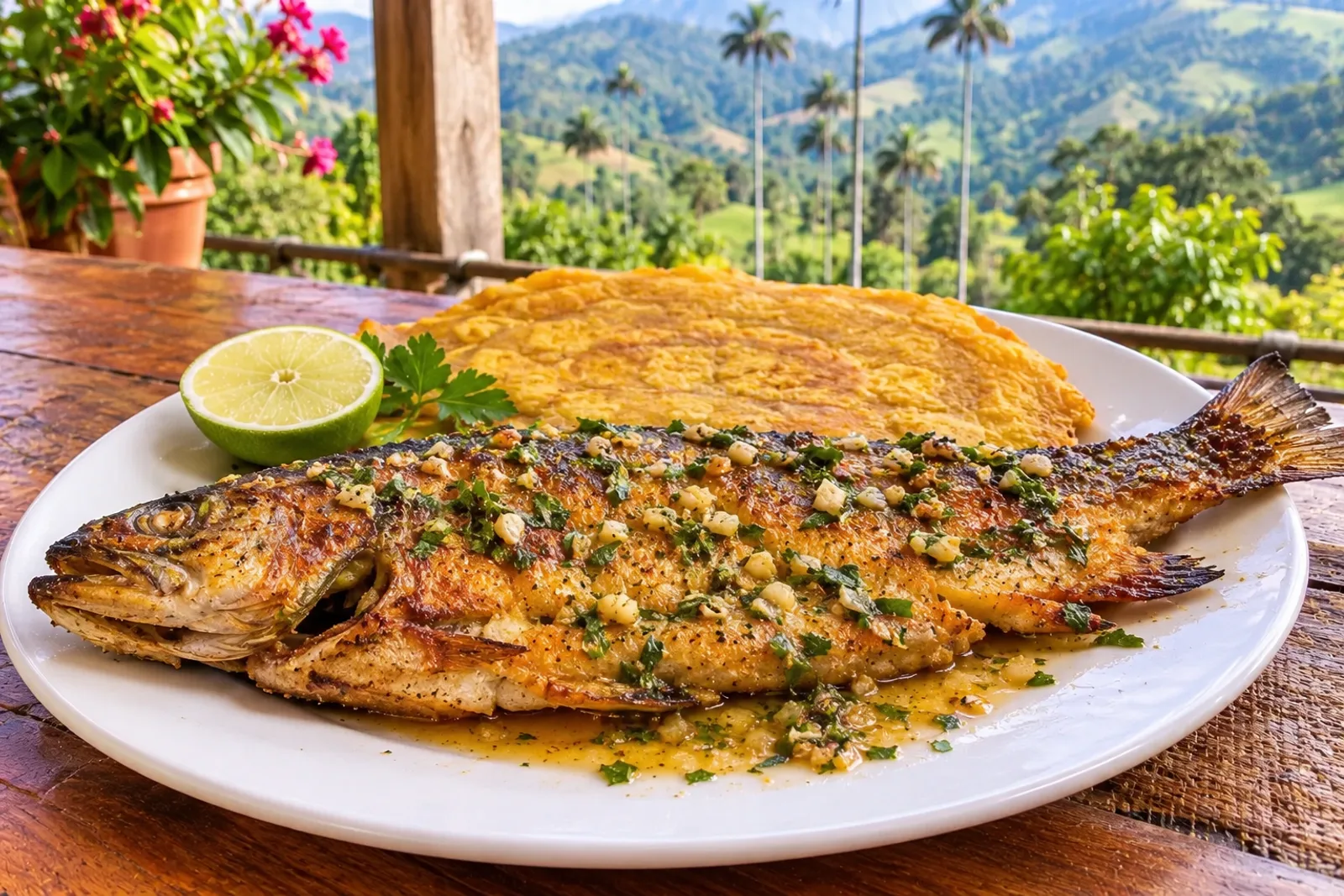

Trucha al ajillo (TROO-chah ahl ah-HEE-yo) is Colombia’s garlic trout: a whole rainbow trout, seared until the skin crackles, drowned in sliced garlic sizzled in butter and lime, and set on a patacón, a crisp, twice-fried disc of smashed green plantain. In Salento, a small town in the coffee-growing Quindío region of the Andes, the patacón is cut big and thin, almost a plate in itself, and that’s the version below for four, with the skillet method plus oven and air fryer timings and the swaps that work in a US or UK kitchen.
What Colombian garlic trout is, and how it tastes
How do you make Colombian garlic trout? Pat dry and salt four 10 to 12 oz (300 to 350 g) rainbow trout, sear them skin side down in a little oil for 5 minutes without moving, then 4 to 5 minutes on the other side, until 145°F (63°C) by the backbone. In the wiped-out pan, cook 12 sliced garlic cloves in 4 tbsp (60 g) butter for 2 to 3 minutes, add lime and parsley, and spoon it over. Serve on fried plantain. 55 minutes for 4 servings.
The trout is mild and rich, with rosy flesh and crisp, salty skin. The sauce is mostly golden garlic, soft and sweet rather than sharp, with lime to cut the butter. Underneath, the patacón is crunchy at the edges and starchy in the middle, closer to a thick potato chip than to a sweet ripe plantain.
Why trout, in a tropical country? Colombia’s Andes have cold mountain streams, and rainbow trout are farmed there in ponds fed by water around 59°F (15°C). Salento averages about 24 metric tons of trout a month, a single farm in the nearby Cocora valley sells around 4,000 kg (8,800 lb), roughly 12,000 fish, a month, and since 2023 the town has held a trout festival every September. Those numbers work out to about 330 g (11½ oz) per fish, exactly the one-per-person size this recipe uses.
Time and effort. 55 minutes in all, 15 of prep and 40 at the stove, plantains included. The trout and sauce alone take 25. I rate it medium only because you’re juggling hot oil and a skillet of fish at the end.
Ingredients, and which trout to buy
Plan on one 10 to 12 oz (300 to 350 g) trout per person, which gives about 6 oz (180 g) of meat once the head and bones are off, and half a large green plantain per patacón.
Rainbow trout in the US and UK
- US. Whole rainbow trout is in the seafood case of most large supermarkets, often farmed in Idaho. Many stores sell it boneless and butterflied; that’s fine, but it cooks much faster: skin side down until the flesh is opaque almost to the top, then about a minute flesh side down, checking for 145°F (63°C). Steelhead is the same species raised bigger and sold as fillets; as a rough guide, cook those 3 to 4 minutes on the skin and 2 on the flesh side depending on thickness, and check for 145°F (63°C) in the thickest part.
- UK. Whole rainbow trout is easy to find at supermarket fish counters and fishmongers. If yours are smaller, around 9 oz (250 g), take a minute off each side.
- No trout? A whole sea bream or branzino (sea bass in the UK) of the same weight takes the same method and similar times, but the shape and thickness differ, so still check for 145°F (63°C) at the thickest part, away from the bone; the flesh is whiter and slightly firmer.
Farmed trout flesh is pink to orange from what the fish are fed, and it stays that color when cooked. Don’t use the color to judge doneness; use the backbone test below.
Plantains, butter and garlic
Green plantains are in the produce section of most US supermarkets, and in the UK at Caribbean and African grocers and in larger supermarkets. They must be fully green and hard: a yellow-spotted plantain browns before the center cooks and tears when you smash it. Bananas won’t work at all.
Twelve garlic cloves sounds like a lot, but sliced and only lightly golden, garlic turns mellow and sweet and becomes half the dish. The butter gives flavor; the spoon of oil keeps it from browning as fast.
Equipment. Two 11 to 12 in (28 to 30 cm) skillets (with one, cook the trout in two batches and add 10 minutes), a deep skillet or wide pot for frying, a thin, wide fish spatula and, ideally, an instant-read thermometer.
The order of work, plantains first and fish last
Fish straight from the pan won’t wait: after 5 minutes off the heat the skin softens and the sauce cools. The patacones hold better, so they go first and wait on a rack in a low oven, uncovered so steam doesn’t soften them.
Make ahead. The day before, you can do the first fry and the smashing, then refrigerate the flattened patacones between sheets of parchment and give them only the second fry at dinner. The trout and sauce are always cooked to order.
How to make the big Salento patacón
It’s a standard Colombian patacón made from half a plantain instead of a thick slice, and pressed thinner, to ¼ in (6 to 7 mm): you get an oval about 6 by 5 in (16 by 13 cm), the size of an open hand, that works as a base for the fish. It’s fried twice, at 320-340°F (160-170°C) to cook it through and at 355°F (180°C) to crisp it, and smashed while hot in between. The reasoning behind both temperatures is in my recipe for Colombian patacones; here’s what changes when they’re big:
- The first fry is longer, 10 to 12 minutes, turning every 3, because a plantain half is thick.
- Press in two or three goes. In one push the edges split. If they crack, pinch the cracks closed through the plastic and press again.
- Two fit per batch in a 12 in (30 cm) skillet, 2 to 3 minutes per side.
- Salt as they come out of the oil, never before.
In Salento the same big patacón is also a meal of its own, topped with beef, chicken, avocado and hogao, the Colombian tomato and green onion sauce.
Pan-seared garlic trout, step by step
Dry fish, hot pan
A wet trout steams instead of searing, and the skin turns rubbery. Dry it well, inside the cavity too. The skillet goes over medium-high with 1 tbsp oil, and the fish goes in when the oil shimmers and flows like water.
Five minutes skin side down, hands off
Lay the trout in and leave them for 5 minutes. The skin grabs the pan at first; once it’s golden and crisp it lets go, and that’s what you’re waiting for. Shake the pan: if the fish doesn’t slide, give it another minute. To flip, slide the spatula under from the back, hold the tail with your other hand, and roll the fish away from you so the oil spits away from you, not at you. The second side takes 4 to 5 minutes.
How to tell when trout is done
The slowest part is the thickest section of the fillet, just behind the head, against the backbone. Push a thermometer in there without touching bone: you want 145°F (63°C). Without one, open the flesh slightly with a knife tip at that spot: it should be opaque all the way to the bone and come apart in flakes, and the dorsal fin should pull out easily.
Garlic sauce without burning the garlic
Make the sauce last, in one of the trout skillets wiped clean, since stuck bits of skin would scorch. That pan has just been over medium-high and holds a lot of heat, especially a heavy one, so pull it off the burner to cool down a little first, or use a small separate pan. Then use medium-low heat, butter and oil, and stir the garlic the whole time. In about 2 to 3 minutes the edges turn gold and it smells sweet: that’s your cue for the lime. Treat the minutes as approximate, since they depend on the pan’s leftover heat and how thin you slice the garlic; the cues are what count: butter not browning, garlic pale, edges barely golden.
The lime drops the temperature at once and halts the browning; the parsley goes in after, with the heat off, so it stays green. If the garlic went dark, start the sauce over. It’s 4 minutes, and bitter garlic ruins all four fish.
Baked or air fryer garlic trout
Both work and save a pan, though the skin is less crisp than in a skillet. Either way, make the garlic sauce in a skillet: sliced garlic on top of the fish burns long before the trout is done.
| Method | Heat | Time for a 10 to 12 oz (300 to 350 g) trout | Skin | Best for |
|---|---|---|---|---|
| Skillet | Medium-high, 1 tbsp oil | 5 min skin side, 4 to 5 on the other | Golden, crackly | Up to 4 fish, the Salento way |
| Oven | 400°F (200°C), oiled parchment | 15 to 20 min, no flipping | Soft, pale | 4 to 8 fish at once |
| Air fryer | 400°F (200°C), oiled basket | 10 to 12 min, no flipping | Toasty, a bit dry | 1 or 2 fish per batch |
Oven. Heat to 400°F (200°C), rub the trout with oil, set them on oiled parchment and bake 15 to 20 minutes, checking by the backbone from minute 14. It’s the easy route for 6 to 8 people.
Air fryer. 400°F (200°C), with the fish and the basket oiled so the skin doesn’t stick. A 10 to 12 oz trout takes 10 to 12 minutes; start checking at 9. Most baskets fit one or two, so four means two batches. The patacones are better fried: in an air fryer they come out dry, without that second-fry crunch.
Troubleshooting
- Skin stuck and tore. Wet fish, a pan not hot enough, or moved before 5 minutes. If your skillet always grabs, dust the trout in flour and shake off the excess; the skin browns more, but the dish is no longer gluten-free.
- Bitter garlic. Too much heat or a minute too long. Medium-low, evenly thin slices, lime as soon as the edges color.
- Dry fish. It went past 145°F (63°C), usually from sitting in the hot pan. Plate it as soon as it’s there.
- Burnt skin, raw by the bone. Heat too high for a thick fish. Drop to medium for the second side and cover the pan for 2 minutes.
- Patacón cracked to pieces. It cooled before smashing, or the plantain had yellow spots. Smash each half straight from the oil.
- Soggy patacón at the table. It was covered in the oven, or the trout sat on it too long. Leave it uncovered and add the fish at the last second.
Allergens. Fish and milk (butter); without flour, it’s gluten-free. Not spicy, and kids usually like it, but flake the flesh and check it for them: small bones can stay in the fillets even after the backbone is out.
Variations
- All butter. Swap the sauce oil for another 1 tbsp (15 g) butter. More flavor, but the garlic browns sooner, so watch it from minute 2.
- Creamy. After the garlic, add ½ cup (120 ml) heavy cream and let it bubble gently 1 to 2 minutes before the parsley. Softer and less tangy.
- With shrimp. Before the lime, add 7 oz (200 g) peeled shrimp and cook 2 to 3 minutes, until pink and opaque. Salento’s trout festival lists it right next to the garlic version.
- With mushrooms. Brown 7 oz (200 g) sliced mushrooms over high heat for 5 minutes before the butter and garlic.
- For 8. Bake 8 trout on two sheet pans at 400°F (200°C), swapping racks halfway, and double the sauce in a large skillet.
Serving, deboning and leftovers
Cooked trout is easy to bone at the table, though not perfectly. Cut along the back, lift off the top fillet, then pull the backbone from the tail toward the head: it comes out in one piece with the ribs attached, leaving the bottom fillet on the patacón. Then run your fingers over both fillets and pull out any small bones left behind with tweezers; for kids, flake the flesh and check every portion. Eat the skin; it’s the best part.
In the coffee region it comes with the patacón under or beside it, a tomato and onion salad, lime wedges and often a bowl of beans or rice; Colombian red beans or Colombian white rice fit. Put a Colombian ají picante on the side for heat. For a coffee-region spread, start with Colombian chorizo from Santa Rosa de Cabal, and the rest of the region’s cooking is in my guide to paisa food. If you want a saucy fish dish instead, Colombian pescado sudado simmers the fish in tomato and onion.
Fridge. Refrigerate cooked trout within 2 hours, covered; it keeps 3 to 4 days. Freezer, up to 4 months, flaked and well wrapped. Reheat covered with foil and 1 tbsp water in a 300°F (150°C) oven, about 10 minutes, to 165°F (74°C); the microwave dries it out. Cold flaked trout on a salad is good too. Patacones don’t keep: they lose their crunch.
Frequently asked questions
Can I use frozen trout? Yes, thawed. Move it to the fridge 12 to 24 hours ahead, in a container, then dry it very well. If it comes vacuum-packed, take it out of the package before thawing (or at least cut the package open) and follow any instructions on the label. Frozen fish leaks water into the pan, the skin won’t brown, and the center lags far behind the edges.
Do I have to cook it with the head on? No. In Colombia it’s served whole, and the cheeks are worth eating, but if it won’t fit your pan, cut the head off first; the timing doesn’t change.
Is it the same as Mexican trucha al mojo de ajo? Same idea, garlic and fat over seared fish. The Mexican version usually uses chopped garlic and more oil; the Colombian one, sliced garlic with butter and lime.
What is a patacón? Colombia’s name for a twice-fried smashed green plantain, called a tostón in the Caribbean. It’s savory and starchy, never sweet.
Nutrition per serving
Per serving (one trout with about 6 oz / 180 g raw meat, its share of sauce, and one large patacón), worked out ingredient by ingredient from the recipe amounts:
- Calories: 770 kcal
- Protein: 38 g
- Carbohydrates: 52 g
- Fat: 45 g, including 15 g saturated
- Fiber: 3 g
- Sugar: 3 g
- Sodium: 915 mg
The trout and garlic sauce alone come to about 465 kcal; the big patacón adds about 305, mostly plantain starch and the oil it soaks up over two fries. Halve the butter and each serving drops about 55 kcal.
I always cook trout whole, head and all, in a skillet, because it holds up better to the heat and stays juicier. I slice the garlic myself rather than mincing it, since slices brown evenly and I can watch them change color, and I have the lime squeezed and in my hand before the sauce pan goes on the heat. Josnaisis.