

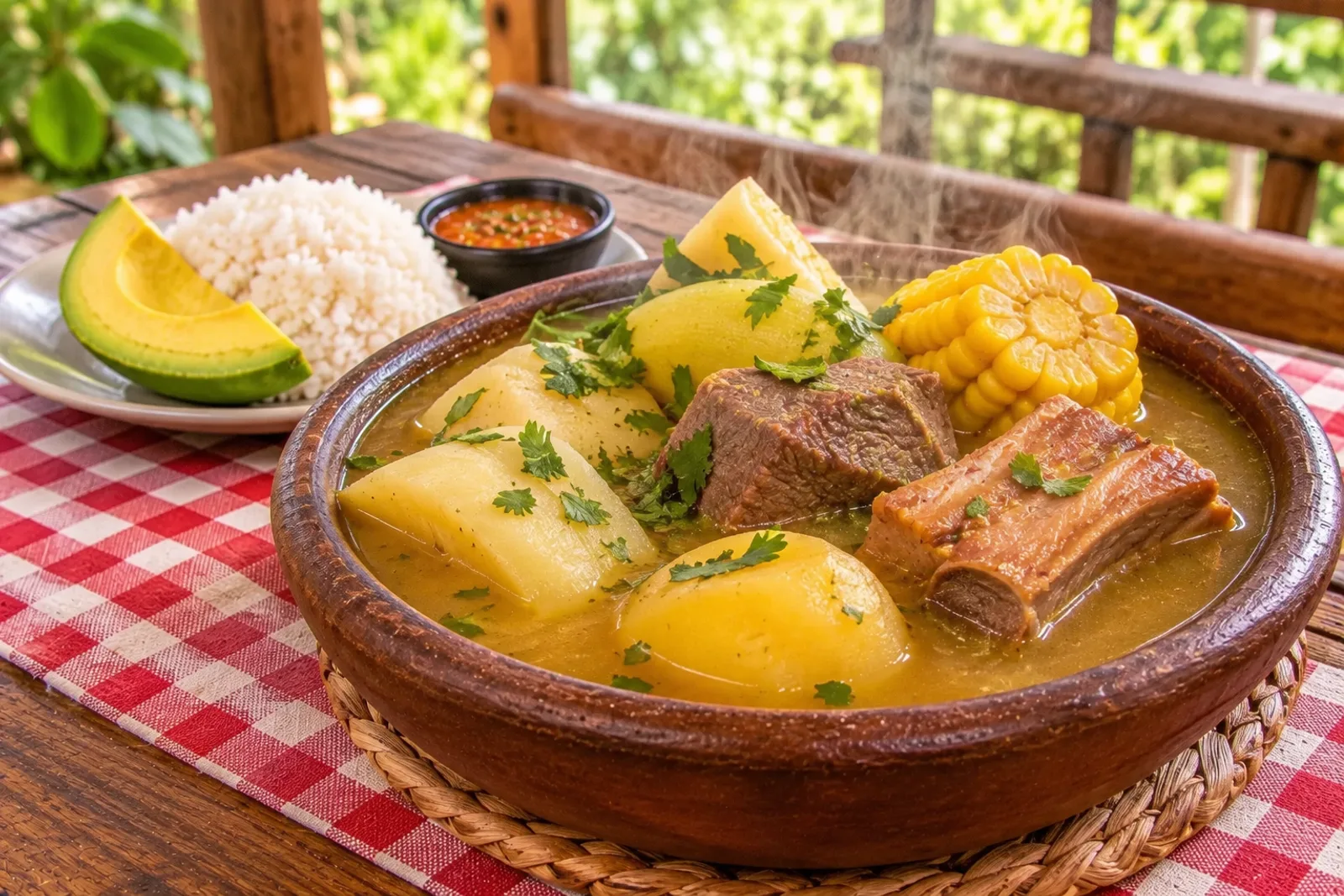

Sancocho antioqueño (sahn-KOH-choh ahn-tee-oh-KEH-nyoh) is the big soup pot of Antioquia, the mountain region around Medellín: 1.1 lb (500 g) each of beef short ribs and pork ribs simmered for 2 hours with green plantain, corn on the cob, cassava and potato, and served with rice and avocado on the side. It is heartier than a soup and thinner than a stew. What sets this version apart is that the broth thickens itself: the green plantain is broken by hand rather than sliced, and its ragged edges slowly dissolve into the pot. Below: the recipe (it serves six), the minute each ingredient goes in, what to buy at a US or UK store, a pressure cooker shortcut and how to scale it for a crowd.
What sancocho antioqueño is, and how it tastes
How do you make sancocho antioqueño? Put 1.1 lb (500 g) of beef short ribs and 1.1 lb (500 g) of pork ribs in 3¼ quarts (3 liters) of cold water with green onion, garlic and cilantro, and skim for 15 minutes. At minute 45 add 2 hand-broken green plantains and 2 ears of corn; at minute 80, the cassava; at minute 95, the potato and carrot. At minute 120 turn off the heat, add cilantro and rest 5 minutes. 150 minutes for 6 servings.
Sancocho is the big one-pot soup of Colombia, and every region makes its own. The Antioquia version, also called sancocho paisa (paisa is what people from Antioquia and the coffee region call themselves), is the two-meat one: beef and pork, no chicken. The broth comes out golden from the annatto and the pork fat, slightly thick, savory and mild, with sweetness from the corn. The cooked plantain, corn, cassava and potato are known in Antioquia as el revuelto, the mix, and every bowl gets some of each.
Time and effort. 150 minutes, of which about 25 are peeling and breaking and 15 are skimming; the rest is a pot on low heat. Medium difficulty: no hard technique, but the order the vegetables go in decides whether the broth thickens and whether the potato survives.
Spice level and allergens. It is not spicy; everyone adds heat at the table with aji. No gluten, dairy or eggs. Kids usually like it for the corn and plantain.
Ingredients, and what to buy in the US and UK
Plan on about 6 oz (170 g) of bone-in ribs per bowl, half beef, half pork. The beef gives depth and a little body; the pork gives the fat that floats golden on top. Beef shank with a piece of bone or pork neck bones also work. Boneless meat makes a flatter broth: if that is all you have, add a 7 oz (200 g) beef soup bone and remove it before serving.
- Green plantains. In the US they sit next to the bananas in most supermarkets. In the UK, look in Caribbean and African grocers and in the world food aisle of large supermarkets. Buy them fully green and hard. Yellow or black-spotted plantains are ripe: they dissolve completely and make the broth sweet, so they are not a substitute here.
- Cassava (yuca). Fresh cassava should be bright white inside and snap cleanly; dark streaks mean it is old and will stay hard. The frozen, already peeled chunks in Latin and Asian freezers cook the same and save the peeling. Add frozen cassava straight from the freezer, no need to thaw.
- Corn. US and UK sweet corn is sweeter than Colombian corn and makes a slightly sweeter broth. Use 1½ ears instead of 2 if that bothers you.
- Potatoes. Yukon Gold in the US, or a floury-waxy all-rounder like Maris Piper in the UK. Russets fall apart faster; cut them bigger.
- Colombian long green onion. It looks like an oversized scallion. Four scallions or spring onions per two long onions do the job.
- Annatto (achiote). It gives the broth its golden color and almost no flavor. In the US, ground annatto or a packet of Sazón con achiote in the Latin aisle (Sazón adds salt, so cut the salt by ½ tsp). In the UK, buy ground annatto online, or leave it out: the soup is paler but tastes nearly the same.
Equipment. A 6 to 8 quart (6 to 8 liter) stockpot or Dutch oven with a lid, a ladle for skimming and a paring knife for nicking the plantain. With a 5 quart pot, make two thirds of the recipe on the same timings.
The pot schedule, minute by minute
Each ingredient goes in with exactly the time it needs to be ready at minute 120. Every minute is counted from when the pot goes on the heat with cold water and the meat; the water takes about 15 minutes to start simmering, so the ribs actually simmer for about 105 minutes. The meat gets a head start on its own because beef short ribs need every one of those 120 minutes. The plantain goes in early, before the cassava, because it has to partly break down. The potato goes in last so it doesn’t turn to mash.
| Minute | What goes in | Cooks for | How you know it’s done |
|---|---|---|---|
| 0 | Beef, pork, green onion, garlic, cilantro stems, cumin, annatto, 1 tsp salt | 120 min on the heat (about 15 to heat up) | Beef pulls away from the bone when pushed with a spoon |
| 45 | Hand-broken green plantain and corn | 75 min | Plantain ends are soft and frayed, centers tender |
| 80 | Cassava | 40 min | Chunks split open down the middle |
| 95 | Potato, carrot, remaining 1 tsp salt | 25 min | A knife slides in with no resistance |
| 120 | Cilantro leaves, heat off | 5 min rest | Broth coats the back of a spoon |
The first 15 minutes. As the ribs heat up they release a gray foam. Skim it until only a thin white froth is left, then turn the heat down. A barely trembling surface keeps the broth clear and golden; a rolling boil emulsifies the pork fat into the liquid and turns it cloudy.
Topping up. With the lid ajar you lose little liquid. If the level drops below the meat, add hot water from the kettle; cold water stalls the cooking and the cassava already in the pot can stay hard.
Thicker broth. If it is still thin at minute 120, mash 2 or 3 pieces of plantain against the side of the pot and simmer 5 minutes uncovered.
Why the plantain is broken by hand
In Antioquia the green plantain for sancocho is traditionally snapped by hand rather than sliced, though plenty of cooks slice it. The ragged, broken ends release starch as they cook and slowly melt into the broth, which helps give sancocho antioqueño its body without flour or cornstarch. A clean knife-cut round tends to keep its shape longer and thicken less.
- Cut off both ends and score the skin lengthwise, without cutting into the flesh.
- Pry the skin off with your thumb, starting at the score. If it clings, soak the plantain in hot water for 2 minutes.
- Nick the flesh all the way around every 1½ to 2 in (4 to 5 cm) with a thumbnail or the tip of a knife.
- Bend the plantain at each nick until it snaps. Uneven pieces are the point.
Some Colombian cooks also add small green cooking bananas, called guineo, in place of part of the plantain, about 7 oz (200 g) for each plantain you swap. They hold their shape and thicken less, so mix them with plantain rather than using guineo alone.
Pressure cooker sancocho in about 110 minutes
Only the meat needs the pressure. Cook the beef and pork with the water and seasonings for 35 minutes at high pressure in a stovetop pressure cooker, over medium-low heat once it reaches pressure. Turn off the heat and let the pressure drop completely, naturally or through the valve as your manual says; open it only once the pressure indicator has dropped and the lid turns without force. Skim and carry on with the lid off: plantain and corn for 20 minutes, then cassava, potato and carrot until the cassava splits, which takes up to half an hour. Plantain under pressure collapses completely instead of thickening gradually, which is why it stays out.
The timing adds up like this: about 15 minutes to come up to pressure, 35 at pressure, 5 to 10 for the pressure to drop and 45 to 50 with the lid off, about 110 minutes of cooking (do the 25 minutes of peeling while the meat is under pressure). One safety rule overrides the recipe: soups and broths must stay under your cooker’s fill limit for liquids, which on many models is half full, not the two-thirds line used for other dishes. The 3 liters of water with 1 kg (2.2 lb) of ribs take up about 4 liters, so you need a pressure cooker of at least 8 liters (8.5 quarts). With a smaller one, pressure-cook the ribs in 2 liters (2 quarts) of water and add the last liter, hot, once you open it. Electric pressure cookers run at slightly lower pressure than stovetop ones: check that the beef is tender before moving on and give it more time if it isn’t.
Antioquia, three-meat and hen sancocho compared
Colombia has dozens of sancochos. These are the three on this site, with the numbers from each recipe:
| Antioquia-style (this recipe) | Three-meat (trifásico) | Valle-style hen | |
|---|---|---|---|
| Meat | Beef and pork ribs | Beef, pork and chicken | Stewing hen |
| When the meat goes in | Both at minute 0 | Beef and pork at 0, chicken at 45 | Browned in sofrito at minute 0 |
| Signature | Hand-broken plantain at minute 45 | Three meats finishing together | Culantro and arracacha |
| Total time | 150 min | 145 min | 140 min |
| Servings | 6 | 8 | 8 |
| Served with | Rice, avocado, aji, banana | Rice, avocado, aji | Rice, avocado, aji; broth first in a cup |
Add chicken to this pot and you have the Colombian three-meat sancocho, where the chicken goes in 45 minutes after the beef and pork. The Valle del Cauca version with a stewing hen and culantro is the Colombian hen sancocho.
Feeding 12 or 20 people
Multiply everything except how long each ingredient cooks. What changes is the heat-up: a pot holding 6 or 10 liters (1½ to 2½ gallons) takes far longer to reach a simmer than the small batch, so in a big pot start the clock when the water begins to simmer and count from there: plantain and corn at 30 minutes, cassava at 65, potato and carrot at 80, heat off at 105. These are the same intervals as the recipe for 6, minus its 15 minutes of heating up.
For 20, two 12 quart pots are easier than one 20 quart pot: they heat faster, they are easier to skim and nobody has to lift close to 40 lb (18 kg) of soup. Over a wood fire, as it is often cooked outdoors in Medellín after a party, the heat is stronger and uneven, so pull the pot back from the flame when it starts to bubble hard.
Serving, storing and reheating
In Antioquia sancocho comes to the table in a deep bowl with a piece of each meat and some of every vegetable in the broth. Alongside go fluffy Colombian white rice to spoon into the bowl, a quarter of an avocado per person, Colombian aji with green onion and cilantro and slices of ripe banana. Some people add an arepa, others a spoonful of hogao, the Colombian tomato and green onion sauce, on top of the meat. With rice it is a full meal. For the rest of the region’s table, from Colombian red beans with pork to corn mazamorra, see the guide to paisa food.
Fridge. Divide it into shallow containers and refrigerate within 2 hours of turning off the heat, or within 1 hour if it is above 90°F (32°C), as it can be at an outdoor wood-fire pot; it keeps 3 to 4 days. It thickens overnight as the plantain and cassava keep releasing starch, so loosen it with ½ cup (120 ml) of hot water when reheating.
Freezer. The broth with the meat keeps 2 to 3 months. Cassava, potato and plantain go spongy once thawed: take them out before freezing and cook fresh ones on the day. Thaw in the fridge, lift out the meat and bring the broth to a simmer; add the plantain and corn, the cassava 35 minutes later, the potato and carrot at 50, and at 60 return the meat so it heats through for 15 minutes with everything else, until the cassava splits. That way the already-cooked meat doesn’t simmer for another hour.
Reheating. Bring it back to a gentle boil all the way through, stirring carefully so the cassava doesn’t break up, and keep the meat in the broth until the center of each piece reaches 165°F (74°C) on a thermometer.
Sancocho antioqueño FAQ
Is sancocho antioqueño the same as sancocho paisa? Yes. Paisa refers to people and food from Antioquia and the coffee region, and both names mean the beef and pork sancocho with plantain, corn, cassava and potato.
How long does sancocho antioqueño take to cook? About two hours on the stove, plus a short 5-minute rest, because beef short ribs take that long to turn tender. With a stovetop pressure cooker, about 110 minutes of cooking: 15 to reach pressure, 35 at pressure, 5 to 10 for the pressure to drop and about 50 with the lid off.
Can I make it with chicken? Adding chicken to the beef and pork turns it into three-meat sancocho, a different recipe in which the chicken goes in 45 minutes later so it doesn’t fall apart.
Can I make it ahead? Yes, up to minute 80: meat, plantain and corn. The next day bring it back to a simmer and add the cassava, potato and carrot, so they don’t overcook when you reheat.
Why serve banana with sancocho? It isn’t cooked in the pot. Ripe banana slices go on the side, and the sweet fruit offsets the salty, rich broth the same way avocado offsets the pork fat.
Sancocho antioqueño nutrition
Per bowl, one sixth of the pot with broth, both meats and vegetables, without rice, avocado or banana, calculated from the recipe amounts and counting 30% of the rib weight as bone:
- Calories: 700 kcal
- Protein: 23 g
- Carbohydrates: 73 g
- Fat: 36 g, of which 14 g saturated
- Fiber: 6 g
- Sugars: 8 g
- Sodium: 900 mg
Close to half the calories are from rib fat. Chill the broth and lift off the layer of fat that sets on top and the bowl gets noticeably lighter; beef shank instead of short ribs helps too. Almost all the sodium is from the salt: use 1½ tsp instead of 2 and it drops to about 700 mg.
I always break the plantain by hand, and not out of respect for tradition: the ragged ends break down sooner and my broth clings to the spoon better than with neat rounds, and it costs nothing. The only thing I change depending on who is eating is the corn, because it is the first thing to go, so for 6 I add an extra ear. Josnaisis.