

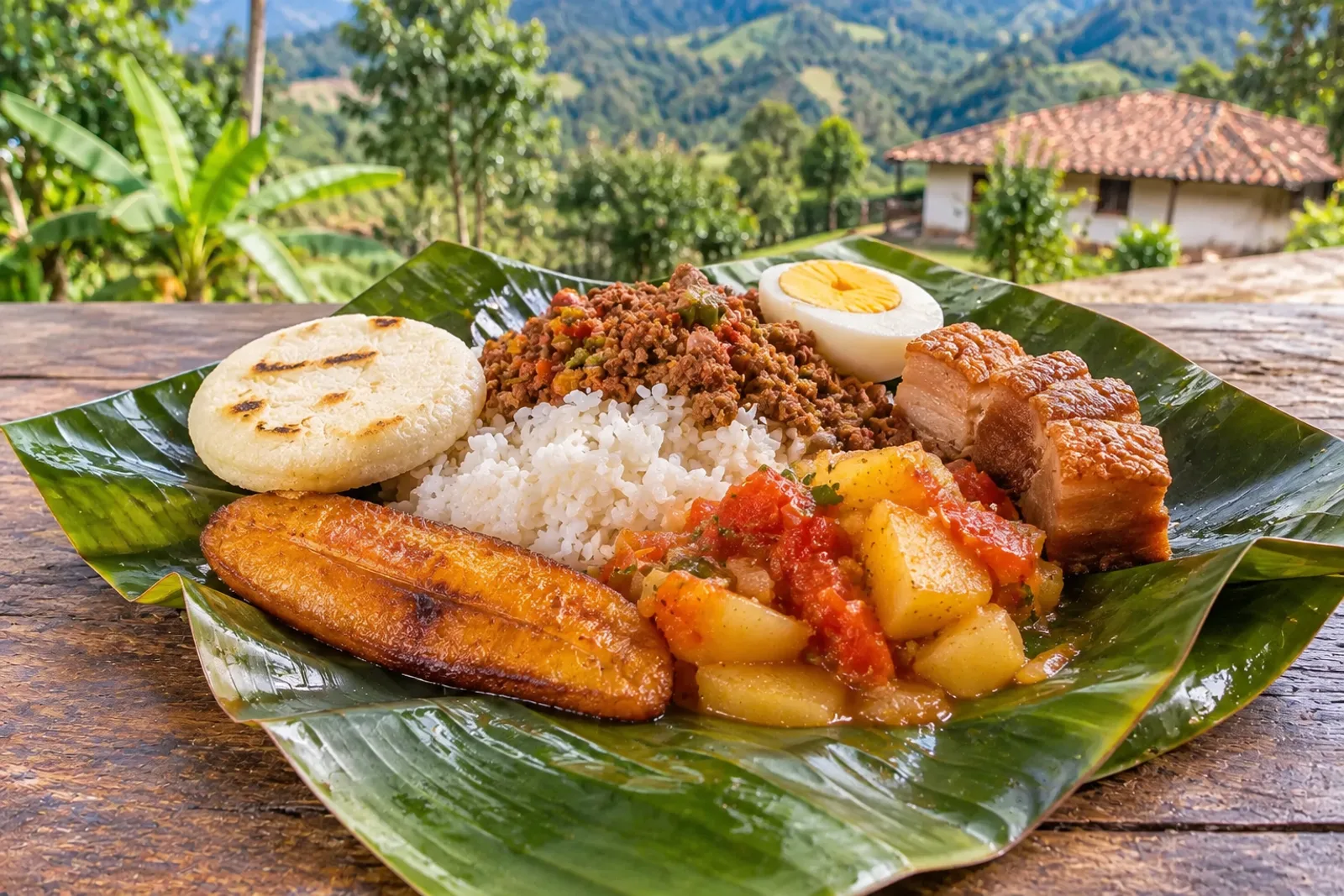

Colombian fiambre (fee-AHM-breh) is the packed lunch of Antioquia, tied up in two singed banana leaves: rice, ground beef, potatoes in tomato and scallion sauce, fried sweet plantains, crackling pork belly, a hard-boiled egg and a thin corn arepa, all in one packet that you open on your lap by a river or at the side of the road. It belongs to the paisa region, Antioquia and the Coffee Region in northwest Colombia, around Medellín. This recipe makes 4, gives the weight of each component, the order to cook it all in 100 minutes, how to fold the leaf so it holds, and the part most write-ups skip: cooked food like this can sit out 2 hours at most, or 1 hour above 90°F (32°C).
What Colombian fiambre is and what goes in it
How do you make Colombian fiambre? Cook rice, pork belly chicharrón, ground beef with hogao sauce, potatoes tossed in hogao, fried ripe plantains and hard-boiled eggs separately. Singe banana leaves over a flame, cross two per packet, mound rice in the middle with everything else around it and an arepa on top, then fold and tie with twine. Eat within 2 hours of the first component leaving the stove, or wrap it cold for a cooler. 100 minutes for 4 servings.
If you searched for fiambre and found a cold salad, that’s a different dish. In Guatemala, fiambre is a chilled salad of cold cuts, cheeses and pickled vegetables made for the first of November. The Colombian fiambre has nothing in common with it except the name, which in both cases means food made ahead to be eaten away from the stove.
In Colombia it’s tied to the muleteers, farm hands and coffee pickers of Antioquia and the Coffee Region who carried their lunch on the trail. Today it’s the family lunch for a day at the river, a road trip or a weekend on a farm. Each part is cooked on its own and nothing is saucy, which is why the packet survives the trip without turning to mush.
How it differs from bandeja paisa
The bandeja paisa is the same family of food served hot on a platter, centred on a bowl of red beans. The fiambre is the travelling version.
| Colombian fiambre | Bandeja paisa | Santander-style fiambre | |
|---|---|---|---|
| Served | Wrapped in leaf, to go | On a platter, at the table | Wrapped in leaf |
| Beans | No, they’d soak the rice | Yes, the centre of the plate | No |
| Meat | Ground beef and chicharrón | Ground beef, chicharrón, chorizo, blood sausage | Chicken |
| Potato | Tossed with hogao | No | Two kinds |
| Egg | Hard-boiled | Fried | Boiled |
| Avocado | Not inside | Yes | No |
Other regions swap the meat or the starch, but the idea holds: a cooked lunch wrapped in a leaf. For the rest of the region’s dishes, see the guide to paisa food from Antioquia and the Coffee Region.
Time and difficulty. 100 minutes for 4, and you’re busy most of it: while the rice and pork simmer on their own you make the hogao, beef and potatoes. Medium: no single step is hard, but seven things are cooking at once.
What you need, per person
Each fiambre takes about 50 g (¼ cup) raw rice, 125 g (4½ oz) potato, 100 g (3½ oz) raw ground beef, half a large ripe plantain, a 100 g (3½ oz) piece of pork belly, one egg and one thin arepa. It’s a big lunch, meant for a day on your feet. For children, halve everything.
Banana leaves and where to buy them
In the US and UK, banana leaves are sold frozen in Latin American and Asian grocers, usually in 1 lb (454 g) packs. One pack covers 4 fiambres, but buy two: some leaves split as you unfold them. Thaw them in the fridge overnight. In Colombia people also use bijao leaves, which are thicker, but you won’t find them abroad. Foil works if you have no leaves; the food travels just as well, but you lose the toasted-leaf smell that makes the dish.
Swaps and what they change
- Pork belly. Buy skin-on fresh belly (UK: belly pork with rind). Smoked bacon gives a saltier result with no puffed skin.
- Potatoes. Yukon Gold in the US, Maris Piper or Charlotte in the UK. Russets break down too much when you toss them in the sauce.
- Plantains. They must be plantains, not bananas, with black-spotted to fully black skins and still firm. Yellow ones are starchy and won’t caramelize.
- Arepas. Thin white-corn arepas made from precooked corn flour (masarepa). The arepa paisa recipe makes 8 of 90 g (3¼ oz). Thick cheese arepas get dry on the road.
- Ground beef. Colombian cooks also use carne en polvo, beef cooked and then ground to a fine, dry crumble, or a cooked chorizo cut into rounds.
Equipment. Three pots (pork, rice, potatoes and eggs), two skillets (beef and plantains), an instant-read thermometer, the only way to check the beef’s 160°F (71°C) and the cooler’s 40°F (4°C), and for the cold plan, a cooler with two ice packs or frozen water bottles.
How to make Colombian fiambre step by step
Start with what takes longest, the pork belly, and leave for last what goes soft if it waits: the plantains and the wrapping. Work in this order and everything is ready in 100 minutes.
Watch the rice clock. In this order the rice is done at minute 30 and the packets are tied at minute 100, so by then the rice has been off the heat for about 70 minutes. If you didn’t keep it hot, that leaves about 50 minutes to get where you’re going and eat, and on a day above 90°F (32°C) there is no margin left. For a warm fiambre, keep the rice, beef and potatoes covered in their pots over the lowest heat until you wrap, checking with a thermometer that they stay at 140°F (60°C) or above, or cook the rice later, while the chicharrón fries. If you can’t do either, use the cold plan.
Chicharrón with no added oil
The pork simmers in water first, 20 minutes covered and 20 to 25 uncovered, until the water is gone and you hear it start to fry. From then on it fries in the fat it released, 18 to 20 minutes, finishing skin side down until the skin blisters and puffs. The full method with every cue is in the Colombian chicharrón recipe.
Beef and potatoes, almost dry
This decides whether the fiambre arrives in good shape. Brown the beef 8 to 10 minutes over medium-high heat until it reaches 160°F (71°C) in the center on an instant-read thermometer. Color is no proof: ground beef can look browned before it gets there, or stay a little pink after it has. Give it only 2 minutes with the hogao, the Colombian tomato and scallion sauce. If juice pools in the pan, leave it uncovered a few minutes more. Same with the potatoes: 5 minutes, until the bottom of the pan is nearly dry.
Properly hard-boiled eggs
10 to 12 minutes from the boil, then cold water. The yolk should be firm all the way through. A fried egg with a runny yolk has no place in a packet that’s going to wait.
Plantains last
Oil at 350°F (175°C), slices ⅜ in (1 cm) thick on the diagonal, small batches, 2 to 3 minutes per side until the edges turn mahogany. Fried first, they go limp and leak oil onto the rice. The fried sweet plantains recipe covers ripeness and oil temperature in detail.
How to wrap food in banana leaves
Use two 16 × 20 in (40 × 50 cm) leaves crossed for each packet, singed so they fold without tearing. Singeing means a few seconds over a flame: the leaf turns from dull to glossy green, smells like toasted grass and goes soft as cloth. On an electric stove, a dry hot skillet does the same, or a 3 to 5 minute dip in boiling water.
- Wipe and singe. Damp cloth on both sides, then a few seconds over the flame, keeping it moving. If the centre rib is thick, cut it out; that’s where leaves split.
- Cross two leaves shiny side up, one lengthwise and one across.
- Rice in the centre in a bed about 5 × 6 in (12 × 15 cm), with the beef, potatoes, plantains, chicharrón and whole egg around it. The arepa goes on top, covering everything.
- Fold the long sides of the bottom leaf over the food, then the short sides, and repeat with the top leaf until you have a tight packet.
- Tie in a cross with twine, two turns each way. If anything shifts when you lift it by the string, add a third leaf. The same crossed-leaf fold wraps the Antioquia-style tamales.
How long can a fiambre sit out
Two hours at most from the time the first component leaves the stove, and one hour if the air is above 90°F (32°C). Everything in a fiambre is cooked, perishable food, and between 40 and 140°F (4 and 60°C) bacteria multiply fast. The leaf holds some warmth for a while, but it won’t keep food at 140°F (60°C) for hours, so don’t count on it to stretch the limit. The only things that stop the clock are keeping the food at 140°F (60°C) or above in the pot, or at 40°F (4°C) or below in the fridge or cooler. After that, throw out whatever is left, even if it looks and smells fine.
Cooked rice deserves extra care: it can carry spores that survive cooking and, if it sits warm for hours, produce a toxin that reheating doesn’t destroy. A warm fiambre is for eating soon. One that has to wait must travel cold.
The cold plan for long trips
If more than 2 hours will pass between the stove and lunch, change the order:
- The day before, cook everything the same way, spread each component in shallow containers so it cools quickly, and refrigerate it as soon as it stops steaming, without waiting for it to reach room temperature: always within 2 hours, or 1 hour if the kitchen is above 90°F (32°C).
- In the morning, singe the leaves, let them cool and wrap the fiambres with everything straight from the fridge, quickly and in batches, so each component spends as little time out as possible. You can also wrap them the night before, but only once everything is fridge-cold, and keep the tied packets refrigerated.
- On the way, keep them in a cooler at 40°F (4°C) or below, with at least two cold sources (ice packs or frozen water bottles) above and below the packets, in the shade. A cooler keeps cold food cold; it can’t chill food that goes in warm. Ice helps, but temperature is what counts: a thermometer in the cooler tells you whether it is still at 40°F (4°C) or below.
- Once out of the cooler, the clock doesn’t reset: add the time the food spent out while you wrapped it and loaded the cooler, and eat it within 2 hours in total, or 1 above 90°F (32°C).
Cold, it tastes different: the chicharrón loses its crunch and the rice firms up. If there’s a grill where you’re going, you can heat the packet in its leaf until the centre is steaming hot, 165°F (74°C) in the middle of the rice.
What not to put inside
- Eggs with runny yolks. Hard-boiled only.
- Avocado. It turns brown and slimy in the packet. Bring it whole and cut it at lunch.
- Beans and saucy stews. They soak the rice. Carry beans separately in a vacuum flask: fill it with boiling water first, empty it, add the beans piping hot and keep it closed until lunch.
- Hot sauce, dairy or mayonnaise dips inside the packet. They go separately, in the cooler.
Common fiambre mistakes
- The packet tears or opens. The leaf wasn’t singed, or there was only one. Two crossed leaves, singed until glossy, tied in a cross.
- Soggy rice. The beef or potatoes went in wet. Cook them until the pan is nearly dry.
- Limp, greasy plantains. Fried too early or in oil that wasn’t hot enough. Last, at 350°F (175°C), drained on a rack.
- Chicharrón tough as leather. It skipped the water stage or fried on high heat from the start. Water until it evaporates, then its own fat.
- Wrapping it hot to eat 4 hours later. The most common safety mistake. If it has to wait, use the cold plan.
Variations
- From leftovers. Rice, beef and plantains from yesterday’s dinner, refrigerated straight away, wrapped cold in the morning. Anything that sat out more than 2 hours doesn’t qualify.
- With chorizo. One cooked Colombian chorizo per person instead of, or alongside, the beef. If it is fresh pork or beef chorizo, cook it to 160°F (71°C) in the centre on a thermometer; color alone isn’t enough.
- With chicken, Santander style. One stewed, boned chicken thigh per person in place of the beef and chicharrón; lighter.
- No pork. Skip the chicharrón and double the beef (200 g / 7 oz raw per packet); that cuts about 260 kcal per packet. Skip the chicharrón without adding beef and it cuts about 520 kcal.
- For 10 or 20. Multiply by 2½ or 5. The bottleneck is frying plantains and wrapping: use two skillets and set up an assembly line, one person on leaves, one on food, one on twine. Count 20 or 40 leaf rectangles plus a spare pack.
Cost. Pork belly and beef are what make it expensive; rice, potatoes, plantains and leaves are cheap. To bring it down, add potato and rice and give everyone half a piece of chicharrón.
Colombian fiambre FAQ
Can I wrap fiambre the night before? Yes. Refrigerate each component as soon as it stops steaming, spread in shallow containers, without waiting for it to reach room temperature and always within 2 hours of the stove. Wrap the packets only once everything is fridge-cold, keep them in the fridge and move them straight into a cooler at 40°F (4°C) or below.
What do I do with leftovers at the end of the day? If a packet was out of the fridge more than 2 hours, or more than 1 above 90°F (32°C), throw it out. If it spent the day in a cooler, a thermometer shows it stayed at 40°F (4°C) or below, and it only came out long enough to eat, it can go back in your fridge and be eaten the next day reheated to 165°F (74°C). If you don’t know how cold it stayed, don’t keep it.
Can I make it with less frying? The plantains can be baked at 400°F (200°C) on a greased lined sheet, brushed with 1 tbsp oil: 12 minutes, flip, then 6 to 10 more. They come out drier, without the caramelized edge. The chicharrón uses no added oil, since it fries in its own fat; leave it out if you prefer and it’s still a fiambre.
Is Colombian fiambre the same as Guatemalan fiambre? No. The Guatemalan dish is a cold salad of cured meats and vegetables eaten on the first of November. The Colombian one is a cooked lunch wrapped in a banana leaf.
Colombian fiambre nutrition
Per fiambre (1 of 4), calculated ingredient by ingredient from the recipe amounts:
- Calories: 1713 kcal
- Protein: 46 g
- Carbohydrates: 139 g
- Fat: 107 g, of which 34 g saturated
- Fiber: 10 g
- Sugars: 26 g
- Sodium: 1877 mg
That’s a ceiling: the chicharrón is counted as raw pork belly, about 518 kcal, and some of that fat stays in the pot. Without it, a fiambre comes to about 1,195 kcal. Too much for the couch, about right for a day of hiking.
I make the rice a little drier than usual, because it’s what catches every drop of juice in the packet, and the arepa always goes on top, never underneath, so it doesn’t go soft. When I know the day out will be long, I don’t argue with myself: I cook the night before and pack it on ice, even if the chicharrón arrives less crisp. Josnaisis.