

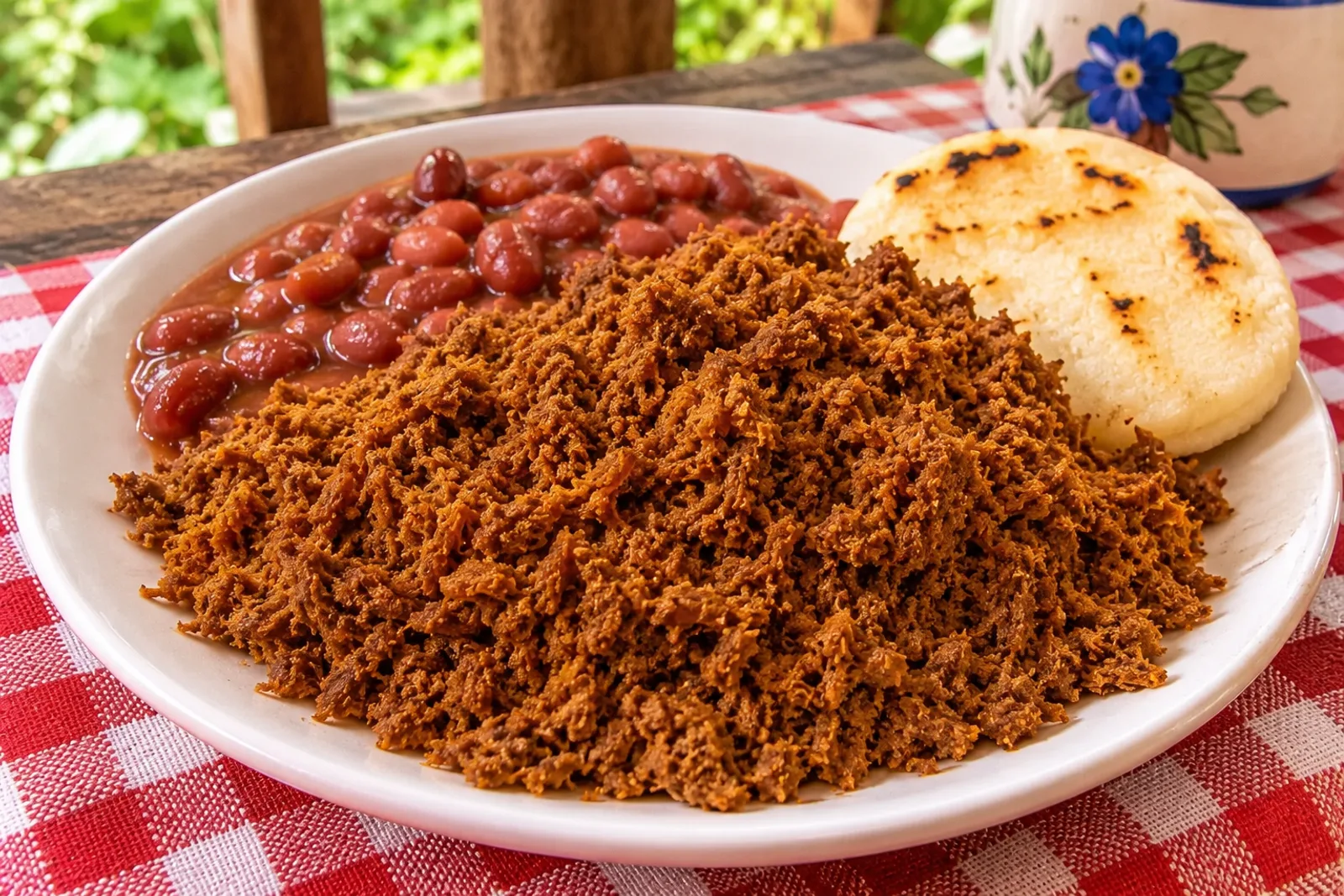

Carne en polvo, literally “powdered beef,” is the beef that sits next to the beans on a bandeja paisa, the big platter from Antioquia and Colombia’s coffee region. A piece of flank steak simmers whole for 1 hour with scallions, garlic and cumin, cools, gets ground into a fine dry crumb and spends a few minutes in a skillet. It is not raw ground beef browned in a pan: the beef is cooked first and ground afterwards, which is why it ends up loose and dry rather than juicy.
What carne en polvo is and what to expect
How do you make carne en polvo? Simmer 500 g (1.1 lb) of whole flank steak with water, scallions, garlic, cumin and salt for 60 minutes, lift it out of the broth and let it cool for about 20 minutes, until it stops steaming and feels dry outside. Cut it into chunks, grind it in a food processor or blender in batches until it is a fine crumb, then toss it in a skillet with oil for 8 to 10 minutes until loose and dry. 115 minutes for 4 servings.
You get a fine, dry, light-brown crumb that tastes of simmered beef, cumin and onion. On its own it can seem plain, and that is the point: in Medellín it is eaten next to something wet, like beans in their broth, hogao or the yolk of a fried egg, and it soaks them up.
Time. About 115 minutes, only 25 of them hands-on: seasoning, grinding and the skillet. The rest is the pot and the cooling, and the cooling can run longer with a thick piece. Difficulty, easy. The one thing to get right is grinding the beef cold and dry.
Carne en polvo vs. ground beef
Carne en polvo is cooked whole and ground afterwards; ground beef is bought raw and minced and then browned. That gives the first a fine, dry, loose texture and the second juicy clumps. Both turn up on a bandeja paisa: many families in Antioquia even call carne en polvo “carne molida,” the Spanish for ground beef. The bandeja paisa recipe on this site uses browned ground beef with hogao, which is the quick version. Colombia’s third everyday beef, shredded beef, cooks longer and gets pulled into strands.
| Carne en polvo | Ground beef | Shredded beef | |
|---|---|---|---|
| Cut | flank or skirt, whole | lean round, ground raw | flank or brisket, whole |
| Cooking | 60 min simmered, ground, 8 to 10 min in a skillet | browned raw for about 8 min | 2 hours simmered, then stewed with hogao |
| Texture | fine, dry, loose crumb | juicy clumps | long strands |
| Where it goes | bandeja paisa, rice and eggs, soups | quick bandeja, pasta | arepas, empanadas, patacones |
For strands to stuff arepas, the recipe you want is Colombian shredded beef.
Ingredients and the best cut
Half a kilo of raw beef, a little over a pound, makes 4 bandeja servings. The full list is in the recipe card; here is what matters about each item.
The cut. In Colombia it is made with falda or tabla, lean cuts that cook in an hour and grind into a clean crumb, without sinew to wrap around the blades. In a US supermarket, flank steak or skirt steak are the closest. Chuck roast is cheaper and full of flavor, but it carries more fat and connective tissue; trim the thick seams before grinding. The beef is the only real expense in this dish, and chuck is how you bring it down. In the UK, ask for flank (bavette) or use braising steak.
The aromatics. Scallions (green onions; spring onions in the UK) stand in for Colombian cebolla larga, a thicker, longer green onion. They go into the water with the white onion and garlic and perfume both the beef and the broth. Cumin and salt get rubbed straight onto the meat; in the water alone, they stay in the broth.
Equipment. A medium pot with a lid, a cutting board, a 10 to 11 in (26 to 28 cm) skillet and something to grind with: a food processor, a blender or a hand-crank meat grinder.
How to make carne en polvo step by step
Simmer the beef whole
Bring it to a boil over medium-high heat, about 10 minutes, skimming the foam, then cover and simmer 60 minutes over medium-low. It is done when a fork slides into the thickest part with little resistance and the piece still holds together. Undercooked, it grinds into chewy bits; overcooked to the point of shredding, it holds more water and packs into a paste.
In a pressure cooker, 30 minutes at high pressure, then let the pressure drop before opening. Count separately the time your cooker takes to come up to pressure and to release it, which varies a lot from one model to another. Everything else stays the same.
Cool and drain before grinding
Move the beef from the broth to a board and wait about 20 minutes. That is a guide, not a rule: what matters is that it stops steaming, the surface feels dry and it is no longer hot inside when you cut it. A thick piece may need longer; if so, finish cooling it covered in the fridge. This is the step that decides the texture. Warm, wet beef turns to paste on the blades; cold, dry beef breaks into crumbs.
Strain the broth and keep it. There is no salt in the water, so it is a plain beef broth ready for a rice soup or a pot of beans. Don’t leave the whole pot to cool on the stove: divide it into shallow containers and refrigerate it within 2 hours of turning off the heat, or 1 hour if your kitchen is above 90°F (32°C).
Grind it to a powder
Cut the beef into ¾ to 1¼ in (2 to 3 cm) chunks across the grain. In a food processor, fill it halfway, pulse in short bursts and scrape down the sides between pulses. Stop when it looks like coarse sand: a fine, loose crumb with no visible chunks and no ball forming around the blade.
Toast it dry in the skillet
One tablespoon of oil over medium heat, the ground beef and the rest of the salt, 8 to 10 minutes, stirring and scraping the bottom. It starts out damp and a little clumpy and ends loose, dry and golden in spots. If it smokes or darkens, turn the heat down.
With hogao. Stir in 2 to 4 tablespoons for the last 2 minutes, just until it is evenly mixed. It adds color and moisture, and it is the best way to eat carne en polvo over plain rice. Hogao, the slow-cooked tomato and scallion sauce of Colombian cooking, has its own Colombian hogao recipe, with how to freeze it in cubes so it is always on hand.
Carne en polvo in a blender
Yes, you can make carne en polvo in a blender, in 1-cup batches with 2 to 3 second pulses and with the beef cold and well drained. If the jar is full or the beef is wet, the blades spin in an air pocket, the bottom packs down and the top never grinds. Between batches, switch off, loosen what is stuck at the bottom with a spatula, and don’t run it for more than a minute at a stretch.
The hand-crank grinder is the traditional tool and gives the loosest crumb; the food processor is the most practical at home.
How much carne en polvo 1.1 lb (500 g) of beef makes
In the pot the beef loses 35 to 42 percent of its weight: 500 g (1.1 lb) of raw flank leaves 290 to 325 g (10¼ to 11½ oz) of cooked, ground beef, depending on the cut, the simmering time and how far you dry it in the skillet. That is 4 servings of 70 to 80 g (2½ to 2¾ oz) for a bandeja paisa, or 6 of about 50 g (1¾ oz) as a side for rice or on top of soup. To portion it exactly, weigh it after the skillet.
For a crowd. For 8, use 1 kg (2.2 lb) of beef and 2.5 liters (10½ cups) of water in the same pot for the same time, as long as the pieces are no thicker; grind in more batches and toast in two skillets or two rounds. For 12, 1.5 kg (3.3 lb). The skillet is the one thing that doesn’t scale: if the beef is piled more than ¾ to 1¼ in (2 to 3 cm) deep, it steams instead of drying.
Why carne en polvo turns pasty or dry
- Pasty or in a ball. It was ground warm or wet, or the beef was overcooked. Let it cool and dry on the surface, about 20 minutes or longer for a thick piece, and grind in small batches. If it is already pasty, spread it in the skillet over medium heat a few minutes longer, scraping, until it loosens.
- Chewy bits or threads. Undercooked, or the cut had sinew. Trim the sinew before grinding and give it 10 more minutes in the pot next time.
- Dry as sawdust. Toasted too long, or reheated without liquid. A tablespoon or two of broth or hogao brings it back.
- Bland. The salt and cumin go on the meat before cooking; if they only go in the water, they stay in the broth. Taste in the skillet and adjust.
Allergens and heat. No gluten, dairy or egg, and no chile heat at all. Kids tend to like it, especially with rice and a spoonful of hogao.
Ways to make carne en polvo
- Pressure cooker. 30 minutes at pressure instead of 60 minutes of simmering. Add the time your cooker takes to build and release pressure, so the real saving depends on the model.
- Without the water. Season the beef in chunks, brown it in the pot with a little oil and finish it covered over low heat until cooked and the liquid has evaporated; then grind it and reheat it in the same pot. It tastes more toasted, and there is no broth to keep.
- With hogao. The home version in Antioquia for eating over white rice: 2 to 4 tablespoons at the end. For a bandeja, use little or none, because the beans already carry hogao.
- Pork. Pork loin or leg in one piece, same method. Milder and a little richer.
How to serve and store carne en polvo
On a bandeja paisa, next to Colombian red beans in their broth, Colombian white rice, chicharrón, a fried egg and an arepa. It also goes over rice with a fried egg, inside Colombian fiambre, a banana-leaf-wrapped lunch, or on top of a rice soup. It is one of the pieces of paisa food that you can make a day ahead.
Fridge. In a closed container within 2 hours of coming off the heat (1 hour if the kitchen is above 90°F / 32°C), 3 to 4 days. The broth, 3 to 4 days as well, divided into shallow containers and refrigerated within that same 2 hours of turning off the pot.
Freezer. 2 to 3 months, in flat bags by the serving. Because it is cooked and loose, it breaks apart with your fingers before it fully thaws.
Reheating. In a skillet over medium heat with 1 to 2 tablespoons of broth or water, stirring for 3 to 5 minutes, until it steams and reaches 165°F (74°C). Without liquid it dries out. In the microwave, covered, with the same splash of broth, in 1-minute rounds.
Carne en polvo FAQ
Can I make carne en polvo from store-bought ground beef? Not really. Browned raw ground beef stays in juicy clumps, which is the quick bandeja version. For the fine, dry crumb, the beef has to be cooked whole first and ground afterwards.
How long does carne en polvo keep? 3 to 4 days in the fridge, covered, and 2 to 3 months in the freezer. Reheat it with a splash of broth to 165°F (74°C).
Why did mine turn into a paste? It was ground warm, wet or in an overfilled jar. Spread it in the skillet over medium heat and keep stirring until it loosens; next time, cool it out of the broth until it stops steaming and feels dry outside, about 20 minutes, and grind smaller batches.
Do I have to toast it, or can I serve it straight from the processor? You can eat it as soon as it is ground, since it is already cooked, but it is damp and a bit flat. The 8 to 10 minutes in the skillet dry it, loosen it and give it golden spots.
Carne en polvo nutrition
Per serving (one of 4, 70 to 80 g / 2½ to 2¾ oz of carne en polvo made from 125 g / 4½ oz of raw flank steak, without hogao), calculated ingredient by ingredient:
- Calories: 237 kcal
- Protein: 27 g
- Carbohydrates: 0 g
- Fat: 14 g, 5 g of it saturated
- Fiber: 0 g
- Sugars: 0 g
- Sodium: 505 mg
The numbers count all the fat in the raw beef and all the salt, although some of both ends up in the broth, so a real serving may come in a little lower. The onions and garlic in the pot stay in the broth too.
I always make it the day before a bandeja: the next day it only needs a few minutes in the skillet with a splash of broth while everything else fries, and the broth takes care of soup later in the week. And I never grind it in a hurry. If it goes into the processor hot from the pot, it comes out as paste, and then it takes half an hour of skillet to fix. Josnaisis.