

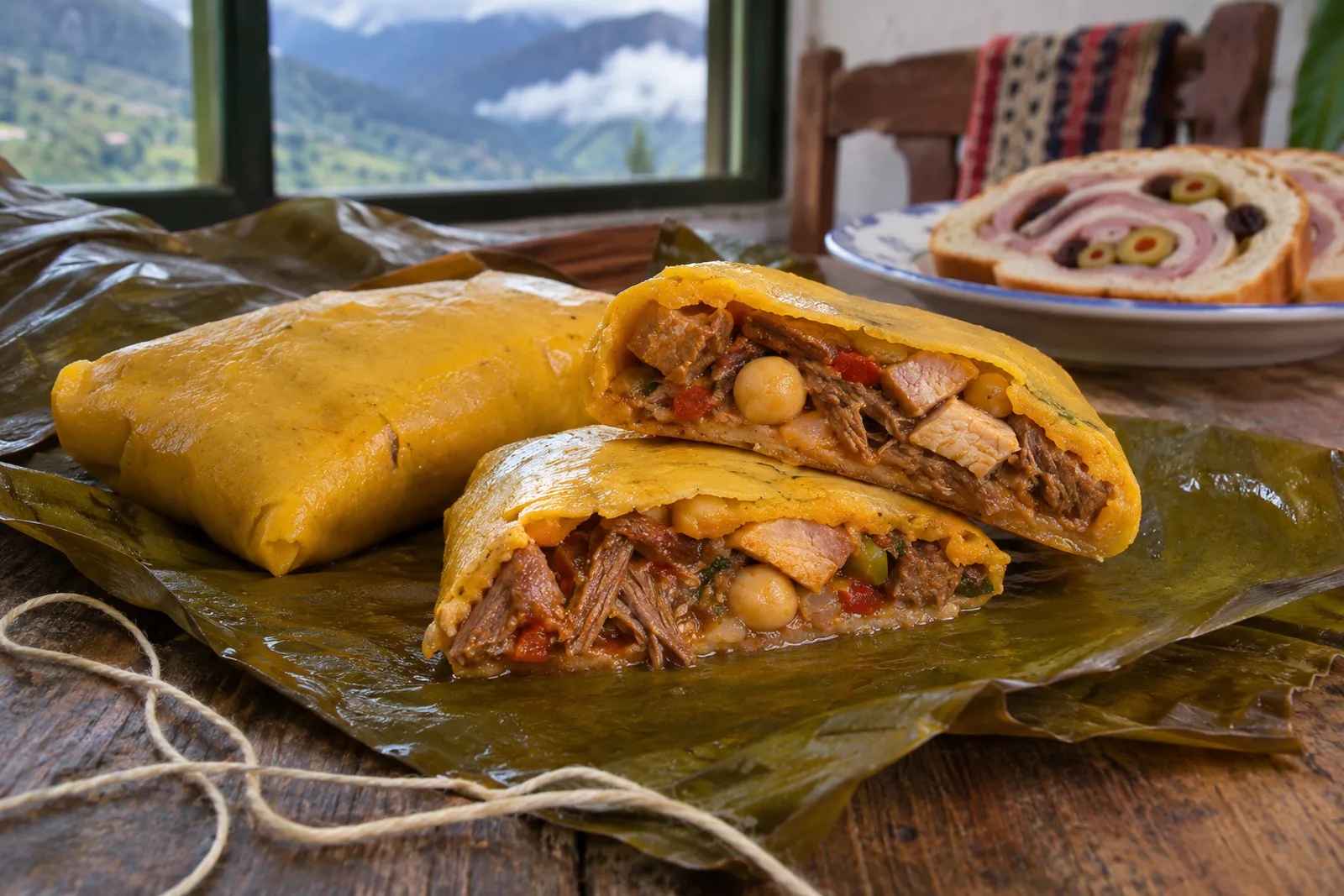

A hallaca is Venezuela’s Christmas tamale: corn dough tinted orange with annatto, filled with a meat stew and olives, raisins and capers, wrapped in banana leaf and boiled. In the Andean states of Táchira, Mérida and Trujillo the stew goes in raw. Diced beef and pork marinate overnight with chickpeas, wine and vinegar, then cook inside the dough while the hallacas boil for at least 2 hours, until the filling reaches 165°F (74°C). This batch makes 20.
Andean hallacas vs. Caracas-style hallacas
How do you make Venezuelan Andean hallacas? Marinate diced beef and pork overnight in the fridge with onion, leek, ají dulce, cooked chickpeas, raisins, capers, wine, vinegar and annatto oil. The next day, knead precooked white cornmeal with chicken stock and annatto oil, spread it on banana leaves, add the raw filling and garnish, tie and boil for 2 hours or more, until the center hits 165°F (74°C). 310 minutes for 20 servings, plus the overnight marinating.
The Andean hallaca puts the filling in raw; the Caracas-style Venezuelan hallaca cooks its stew first and wraps it cold and dry. In practice that trades an hour of stovetop work the day before for a longer boil, 2 hours minimum instead of the 90 minutes in our Caracas-style recipe. The Andean one also has chickpeas, which the Caracas version doesn’t.
Families in the three Andean states share the raw filling and the chickpeas and vary the rest. This recipe follows the Mérida style: beef and pork marinated in wine and vinegar, with cooked shredded hen added as a garnish.
Ingredients for 20 Andean hallacas
There are three components plus the garnish. Exact amounts are in the recipe card above; this is what matters about each one.
- Raw filling, 1 kg (2.2 lb) of meat. Beef and pork diced to 1 cm (½ in) and no bigger, so the center cooks through inside the dough. You end up with about 2.2 kg (4¾ lb) of filling, roughly 110 g (4 oz) per hallaca.
- Dough, 1.2 kg (2 lb 10 oz) of masarepa and 1.6 liters (6¾ cups) of stock. It divides into 20 balls of about 145 g (5 oz).
- Annatto oil, 400 ml (1⅔ cups). Made once, used three ways: 100 ml in the filling, 100 ml in the dough, the rest for greasing leaves and hands.
- Garnish. Shredded hen, bacon, 2 olives per hallaca, raisins, bell pepper and onion.
What to buy in the US and UK
| Ingredient | Where to find it | Swap and what changes |
|---|---|---|
| Masarepa (precooked white cornmeal) | Latin aisle of large supermarkets, Latin grocers, online | Masa harina won’t work: it’s nixtamalized corn and gives a different dough |
| Banana leaves | Frozen, in Latin and Asian grocers | Thaw overnight in the fridge; they still need a pass over the flame |
| Annatto (achiote) seeds | Latin aisle, spice shops | None needed; this is the same seed |
| Ají dulce | Latin grocers, sometimes frozen | Red bell pepper, same weight. Neither is hot, but you lose the ají’s floral smell |
| Stewing hen (UK boiling fowl) | Some butchers and Latin or Asian markets | Chicken thighs; the stock comes out milder |
| Leek and scallions | Any supermarket | No change |
Meat and the jars of olives and capers are what drive the cost. If you need to trim the budget, drop the capers first: the chickpeas and raisins are what make it Andean.
Is the raw filling safe?
Yes, if you follow three rules, and they’re the whole point of this method:
- Marinate in the fridge, not on the counter, at 40°F (4°C) or below, for no more than 24 hours. Vinegar and wine add flavor; they don’t make raw meat safe.
- Wrapped hallacas go into boiling water within 2 hours. Raw meat shouldn’t spend longer than that at room temperature, or 1 hour if the kitchen is above 90°F (32°C), which is easy next to a row of boiling pots. The clock counts from when the filling leaves the fridge. Wrap one pot’s worth, start it, then wrap the next.
- Check the center with a thermometer and aim for 165°F (74°C). Diced beef and pork on their own would be safe at 160°F (71°C), but the shredded hen in the garnish was cooked the day before and chilled, and anything cooked and then reheated needs 165°F (74°C). One reading at 165°F covers both, and it’s also the target if you put raw chicken in the filling.
The night before
Everything except the dough and the leaves gets done the night before: about 1 hour of work for the annatto oil and the filling, plus the stock and chickpeas.
- Stock and hen. If you make your own, simmer the hen until the meat falls off the bone. The stock goes into the dough and the meat, shredded, into the garnish.
- Chickpeas. Soak them overnight and simmer in salted water until you can bite through them but they’re still firm. Canned chickpeas, drained, also work and come out a little softer.
- Annatto oil. Low heat, 5 to 7 minutes, until deep red-orange. If it smokes, the seeds scorch and taste bitter, so start over.
- Filling. Dice, mix, cover and refrigerate.
How to make Andean hallacas
Wrapping day takes about 4 hours: 110 minutes of hands-on work, 2 hours of boiling and a 20-minute rest. Add the hour of work the night before and it’s 310 minutes from start to table, not counting the 12 to 24 hours of marinating or cooking the stock, hen and chickpeas if you make them from scratch. That assumes one pot and two or three people wrapping; for 50 or 100, every extra pot adds its own boil.
The dough
Add the warm stock to the masarepa gradually and knead for 10 minutes before adding the annatto oil. It’s ready when the color is even, it doesn’t stick to your hands and a ball squashed between your fingers doesn’t crack at the edge. If it cracks, it’s short of liquid: knead in 2 or 3 tablespoons more stock.
Filling and wrapping
Spread the dough thin, about 20 cm (8 in) across, on an oiled leaf. Lift the filling out with a slotted spoon so the marinade stays in the bowl: liquid trapped in the hallaca turns to steam during the boil and splits the dough. Garnish, fold, add the second strip of leaf and tie.
The folding and tying are the same as for any hallaca, and the step-by-step Venezuelan hallacas recipe walks through them in detail. With two or three people at the table, 20 hallacas take about 1 hour to wrap.
How long to boil hallacas with raw filling
Boil them for 2 hours minimum, timed from when the water comes back to a boil after the hallacas go in. That’s 30 minutes longer than our Caracas-style recipe with a cooked stew, because the meat has to cook through the dough. Many Andean families boil them 3 or even 4 hours; that doesn’t ruin them, but the water draws out some salt, so season the filling generously.
Keep the hallacas submerged in salted water with the lid on, and have a kettle of boiling water ready. Topping up with cold water stops the boil, and the clock stops with it.
How to tell they’re cooked through
Take one from the middle of the pot, open it and push a thermometer into the center of the filling: 165°F (74°C) or higher. Color can’t tell you whether meat is safe, since meat can turn gray before it’s hot enough, so trust the thermometer. The other signs are about texture, not safety: the chickpeas should squash between your fingers and the meat should be tender. If it isn’t there yet, give the pot 30 more minutes and test another one. Drain them upright and rest 20 minutes before unwrapping; straight from the pot the dough is soft and falls apart.
Scaling up for 50 or 100
The ratio holds as you scale: 1 kg (2.2 lb) of meat and 1.2 kg (2 lb 10 oz) of masarepa per 20 hallacas.
| Hallacas | Beef | Pork | Cooked chickpeas | Masarepa | Stock | Annatto oil | Cooked hen | Banana leaves |
|---|---|---|---|---|---|---|---|---|
| 20 | 600 g (1⅓ lb) | 400 g (14 oz) | 200 g (7 oz) | 1.2 kg (2⅔ lb) | 1.6 L (6¾ cups) | 400 ml (1⅔ cups) | 600 g (1⅓ lb) | 1.2 kg (2⅔ lb) |
| 50 | 1.5 kg (3⅓ lb) | 1 kg (2.2 lb) | 500 g (1.1 lb) | 3 kg (6.6 lb) | 4 L (17 cups) | 1 L (4¼ cups) | 1.5 kg (3⅓ lb) | 3 kg (6.6 lb) |
| 100 | 3 kg (6.6 lb) | 2 kg (4.4 lb) | 1 kg (2.2 lb) | 6 kg (13.2 lb) | 8 L (34 cups) | 2 L (8½ cups) | 3 kg (6.6 lb) | 6 kg (13.2 lb) |
At 50 or more you’ll be boiling in batches, so the 2-hour rule matters more than ever: keep the filling in the fridge and wrap only what the next pot can take.
Mistakes that matter with a raw filling
- Boiling for 90 minutes. That’s the time for our Caracas-style recipe, with a cooked stew. Raw filling needs 2 hours and a thermometer.
- Wrapping the whole batch before boiling. Raw meat can’t wait more than 2 hours out of the fridge, or 1 hour above 90°F (32°C). Wrapped hallacas that can’t go in yet go into the fridge and get boiled the same day.
- Big chunks of meat. A 3 cm (1¼ in) cube can stay raw in the middle when the dough is done. Dice to 1 cm (½ in).
- Spooning in the marinade. Use a slotted spoon.
- Tasting the raw filling. Don’t. Fry a teaspoon of it in a skillet until fully cooked and taste that.
- Uncooked chickpeas. Even soaked, they can stay hard after 2 hours inside the dough.
Variations from Táchira, Mérida and Trujillo
- Mérida style, this recipe. Beef and pork filling with wine and vinegar, cooked hen as a garnish.
- Pork and chicken filling. Other Andean families skip the beef and make the raw filling with pork and hen or chicken. With raw poultry inside, the target is still 165°F (74°C); check it in the thickest piece of chicken you can find.
- With potato and carrot. Some Andean cooks, in Trujillo among others, add 1 medium potato and 1 medium carrot per 20 hallacas, diced very small, about 5 mm (¼ in), so they cook inside.
- No olives or capers. The plainest and cheapest version: chickpeas and raisins as the garnish.
Back home in the Andes the Christmas table often starts the next morning with pastelitos andinos in a wheat-flour crust, and the rest of the country’s dishes are in this guide to traditional Venezuelan food.
Storing, freezing and reheating
Cooked Andean hallacas keep 3 to 4 days in the fridge and 3 months in the freezer, whole and in their leaves. Get them cold within 2 hours of leaving the pot, or 1 hour if the kitchen is above 90°F (32°C), by spreading them out in a single layer.
- From the fridge: 20 minutes in boiling water.
- From frozen: 30 minutes in boiling water, no thawing.
- Done when: the center reads 165°F (74°C).
For this recipe I recommend freezing them cooked, not raw: wrap and boil on the same day, so the raw filling spends as little time as possible uncooked. While you’re wrapping, the ones waiting for the next pot stay in the fridge, not on the counter.
On Christmas Eve they share the plate with Venezuelan ham bread, Venezuelan chicken salad and slow-roasted pernil, and the Venezuelan Christmas menu shows what to make on which day.
Frequently asked questions
Can I use masa harina instead of masarepa? No. Masa harina is made from nixtamalized corn and behaves differently. Hallacas need precooked white cornmeal, sold as masarepa or harina de maíz precocida.
Can I wrap hallacas in foil if I can’t find banana leaves? Banana leaf is what gives the hallaca its aroma, so use it at least for the inner layer. If you’re short, foil can replace the second, outer wrap.
Are hallacas the same as tamales? They’re cousins. A hallaca is flatter and rectangular, wrapped in banana leaf, and its filling is a stew with olives, raisins and capers. It’s made for Christmas in Venezuela.
How many calories are in an Andean hallaca? About 600 kcal for a large hallaca from this recipe, with 27 g of protein. It’s a full meal on its own.
Nutrition
Per hallaca, one twentieth of the batch, calculated from the meat, masarepa, stock, the oil that stays in the dough and filling, the hen, olives and raisins:
- Calories: 600 kcal
- Carbohydrates: 62 g
- Fat: 28 g, of which 6 g saturated
- Protein: 27 g
- Fiber: 6 g
- Sugar: 10 g (raisins and vegetables)
- Sodium: 970 mg
Most of the sodium comes from the salt in the filling, the stock, olives and capers. Homemade unsalted stock brings it down noticeably.
A note from my kitchen
I grew up with cooked-stew hallacas, and putting raw meat into the dough felt wrong the first time. A thermometer changed my mind. Now the Andean version gives me a juicier filling than my old one, because the meat cooks once, in its own juices, inside the leaf. What I never cut is the boil: 2 hours at least, and I open one before I pull the rest. Josnaisis.