

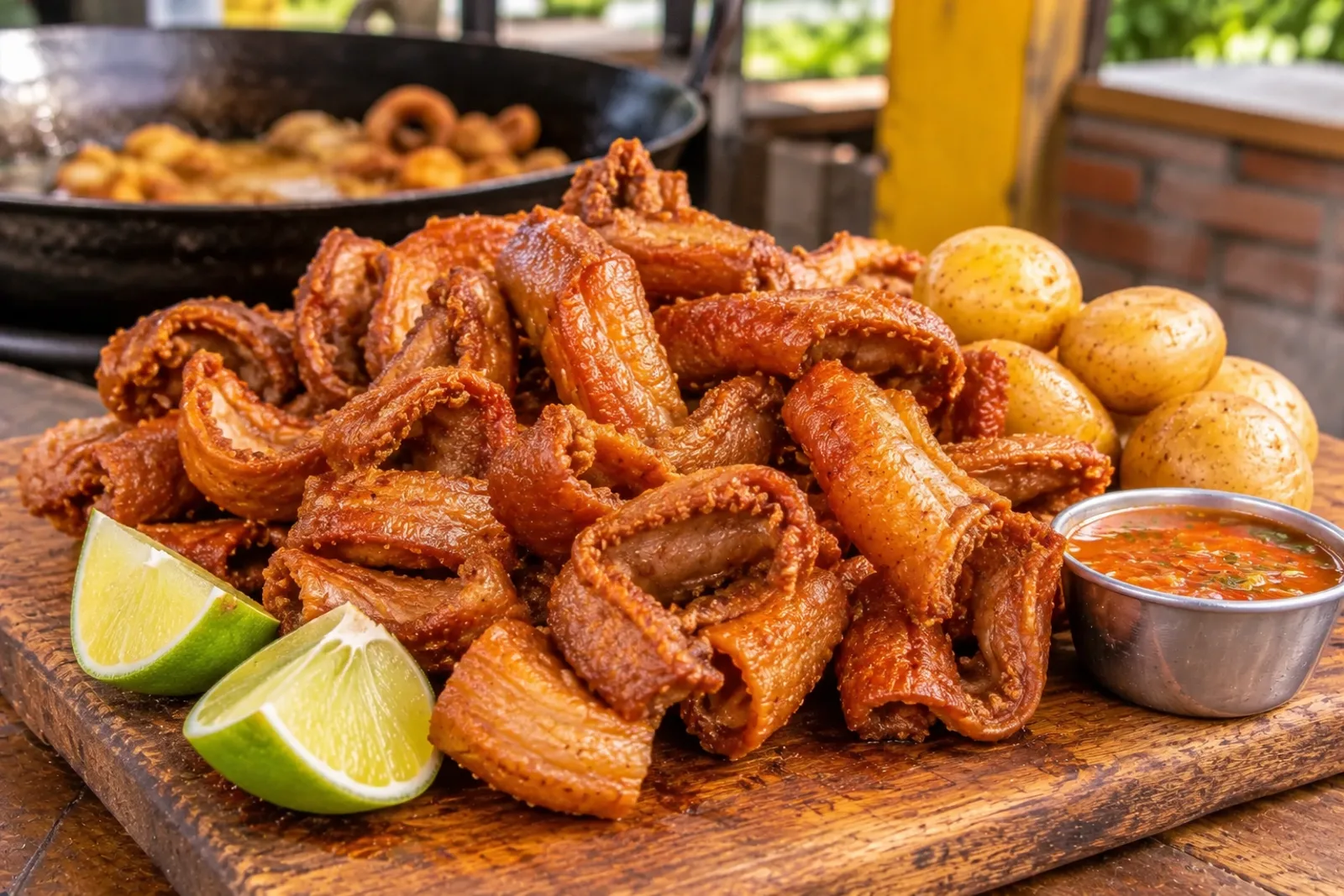

Chunchullo is beef small intestine, boiled until tender and then fried until the fat around it turns deep brown and crackles, and it is one of the pieces Colombians pick first off a fritanga platter. The method is three steps: a 5-minute boil before you clean it, 25 minutes in a pressure cooker, then 12 to 15 minutes in a skillet. One kilo (2.2 lb) raw serves 4 with potatoes and arepas, or 8 as a snack. Below is how to clean it safely, how to tell it is cooked, where to buy it outside Latin America, and how to finish it on the grill or in the air fryer.
What is chunchullo?
How do you make chunchullo? Boil the raw intestine for 5 minutes, flush and rub it clean with lime and salt, simmer it 25 minutes in a pressure cooker with green onion, garlic and thyme, then pat it dry and fry it in 2 tbsp oil for 12 to 15 minutes until it crackles. About 110 minutes for 4 servings, counting the time the pressure cooker takes to come up and release.
Chunchullo is the small intestine of the cow: a thin, chewy tube wrapped in white fat. On its own it is tough, so Colombian home cooks usually simmer it in seasoned water first and only then fry or grill it, which is the method here. Done right it eats like a cross between crackling and a well-cooked sausage casing, rich, savory and a little chewy in the middle. It is not tripe: tripe (mondongo in Colombia) is the stomach, which goes into soup.
It is a fixture of the fritangas of Bogotá and Boyacá, served in small rounds with lime, aji and salted boiled potatoes, and it shows up on the platter of the Colombian fritanga and on picada boards. In Venezuela, where I grew up, the same cut is called chinchurria.
Effort. About 110 minutes total, about 40 of them hands-on. That is an estimate: how long the water takes to boil and the pressure cooker takes to come up and release varies with your cooker and stove. Medium difficulty: nothing is technically hard, but it needs a careful cleaning routine and patience with the simmer.
Where to buy beef small intestine
You need 1 kg (2.2 lb) raw, about 9 oz (250 g) per person before cooking. It loses a lot of water and fat on the way, so the skillet will look less full than you expect.
| Where you shop | Ask for | Notes |
|---|---|---|
| Korean market (US, UK) | gopchang, beef small intestine | Buy it plain and raw or frozen, not the pre-marinated kind in sauce |
| Mexican carnicería (US) | tripa de leche, tripitas de res | Often sold by the pound, sometimes already rinsed |
| Argentine or Uruguayan butcher | chinchulines | Same cut, the Argentine name |
| US supermarket freezer | pork chitterlings | Pork, not beef: thinner, milder, less fat; often needs 2 hours or more of simmering, so cook until fully tender and follow the package |
Frozen intestine thaws in the fridge, inside a covered container so nothing drips, and should be cooked within 2 days of thawing. Raw, it keeps only 1 to 2 days in the fridge; freeze it if you won’t get to it.
About the other ingredients. Colombian green onion (cebolla larga) is a thick, long scallion; two or three regular scallions or one small leek do the same job in the pot. Use regular limes for the cleaning rub and for serving.
Cleaning chunchullo safely, in order
Raw intestine carries gut bacteria, so the order matters: a short boil first, cleaning second, full cooking third. A 5-minute boil before you clean it cuts down the germs that end up on your hands, board and sink, the same step recommended for pork chitterlings in the US.
- Boil it whole for 5 minutes in 2 liters (8½ cups) of water, timed from when the water returns to a boil. It turns gray and firm. The boil reduces germs but does not get rid of them, so keep handling it like raw meat while you clean it. Drain and let it cool 5 minutes.
- Cut it into 12-inch (30 cm) lengths and run cold tap water through each one until it comes out clear.
- Trim the loose fat dangling off the outside, but keep a thin layer. That fat is what browns and crackles later.
- Rub for 5 minutes with the juice of 1 lime and 2 tbsp coarse salt, then rinse well.
Kitchen hygiene. Keep children out of the kitchen while you work and don’t prepare other food at the same time. Afterward, wash the board, knife, colander and sink in hot soapy water, then wipe the counter with 1 tablespoon of bleach per gallon (3.8 liters) of water, leave it a few minutes and rinse. Wash your hands with soap for at least 20 seconds.
If your butcher sells it already cleaned and cooked, skip the first boil and the cleaning, but still simmer it until fork-tender before you crisp it.
How to cook chunchullo
Think of it as two cooks: a wet one that makes it tender and safe, and a dry one that makes it crisp. The first does the real work; the second only adds color and crunch.
Simmer until fork-tender
Cover the cleaned intestine by 1 inch (3 cm) of water in a pressure cooker with the green onion, 3 crushed garlic cloves, thyme and 2 tsp salt. Cook 25 minutes at high pressure and let it release naturally. Counting the time to come up to pressure and release, plan on 45 to 55 minutes for this stage, though it varies with the cooker and the burner. No pressure cooker? Simmer in a covered pot for 30 to 45 minutes.
How to tell it’s done. A fork pushed into the thickest piece should slide in with no resistance, and the inside should be evenly gray with no pink. After that long at a boil it is well past 160°F (71°C), the safe internal temperature for variety meats. If the fork bounces back, give it 5 to 10 more minutes; frying won’t soften it. Discard the cooking water, which is greasy and strong-smelling.
Dry, season and crisp
Pat every piece dry with paper towels, then cut into 3 to 4 inch (8 to 10 cm) lengths and rub with 3 minced garlic cloves, ½ tsp cumin and 1 tsp salt.
Heat 2 tbsp oil in a large skillet over medium-high and lay the pieces in a single layer. Fry 12 to 15 minutes, turning every 3 to 4 minutes. It spits at first as the fat renders, so a splatter screen helps. It is ready when it is deep brown on every side and crackles when you cut it. Drain on paper towels and slice into ½ to ¾ inch (1 to 2 cm) rounds.
Skillet, grill or air fryer chunchullo
The times for all three methods are for intestine that is already simmered and dry; do not use them to cook it from raw. The skillet gives an even crunch in 12 to 15 minutes, the grill adds smoke in 15 to 25, and the air fryer at 400°F (200°C) does it in 12 to 15 minutes with almost no oil.
On the grill. Over medium coals on a hot, clean grate, 15 to 25 minutes, turning often until deep brown on both sides. Dripping fat causes flare-ups, so keep a cooler zone to move it to. At a cookout it is the first thing off the grill, to snack on while the steaks cook.
In the air fryer. Preheat to 400°F (200°C), brush the simmered, dried and seasoned pieces lightly with oil and arrange them in a single layer. Cook 12 to 15 minutes, turning halfway, and add 3-minute rounds if they are not crisp yet. Slightly less greasy than the skillet, and no spatter on the stove.
Troubleshooting chewy or smelly chunchullo
- Rubbery or tough after frying. It was under-simmered. Give it the full 25 minutes under pressure, or 30 to 45 in a pot, and check with a fork before it goes in the skillet.
- Strong smell. Cleaning was rushed, or it simmered in the first-boil water. Always use fresh water with green onion, garlic and thyme.
- Oil spitting everywhere. It went into the pan wet. Pat each piece dry and let excess water drain out of the tubes.
- Soft instead of crisp. Crowded pan or low heat. One layer, medium-high, 12 to 15 minutes.
- Dry and bland. All the fat was trimmed off. Leave a thin layer.
Heat, kids and allergens. Not spicy at all; the heat comes from the aji on the side. The flavor is strong and not every child takes to it, though thin, very crisp rounds go down best. Free of gluten, dairy and egg.
Serving, storing and reheating chunchullo
Serve it straight from the skillet, sliced, with lime wedges, Colombian aji picante, salted boiled potatoes or papas criollas, and arepas. It loses its crunch as it cools, so crisp it right before eating. For a full spread, add Colombian chicharrón and blood sausage on a Colombian picada board. The dishes of Antioquia and the coffee region that share those tables are gathered in paisa food.
- Make ahead. Clean and simmer it the day before. Drain it, divide it into shallow containers and refrigerate promptly, within 2 hours (within 1 hour if it is above 90°F / 32°C). Covered, simmered chunchullo keeps 3 to 4 days in the fridge.
- Leftovers. Don’t leave fried chunchullo out more than 2 hours. Covered in the fridge, 3 to 4 days.
- Freezing. Best frozen simmered but not fried, in flat bags, for up to 3 months for quality. Thaw in the fridge.
- Reheating. Air fryer at 400°F (200°C) for 4 to 5 minutes, or a hot dry skillet, until it crackles again and reaches 165°F (74°C) inside. The microwave makes it soft.
Frequently asked questions
What part of the cow is chunchullo? The small intestine. The stomach is tripe, which Colombians cook in mondongo soup, and the large intestine is a different, thicker cut.
Can chunchullo be eaten undercooked? No. Like any variety meat it is always eaten fully cooked and tender, above 160°F (71°C). The skillet and grill times in this recipe won’t cook it from raw, which is why it is simmered until tender first here.
Is chunchullo the same as gopchang or chinchulín? Same cut, beef small intestine, different kitchens. Korean gopchang is usually grilled or stewed with seasonings, Argentine chinchulín goes on the parrilla, and Colombian chunchullo is simmered and then fried or grilled.
Can I use pork chitterlings instead? Yes, but the simmering time changes. They are thinner and milder, yet in a regular pot they often need 2 hours or more to get fully cooked and tender; go by the fork test and the package instructions. Keep the 5-minute boil before cleaning.
Nutrition
Per serving (9 oz / 250 g raw intestine, fried with its share of oil, without potatoes or arepas), worked out ingredient by ingredient:
- Calories: 425 kcal
- Protein: 19 g
- Carbohydrates: 2 g
- Fat: 38 g, of which 16 g saturated
- Fiber: 0 g
- Sugars: 0 g
- Sodium: 515 mg
There is no reliable nutrition profile I trust for beef small intestine, so these figures use cooked pork intestine, the closest match; read them as a guide. Most of the calories come from fat, which depends on how much you trim. The salt in the cooking water isn’t counted because that water is discarded.
What helps most with chunchullo is not fearing the cleaning but doing it in order, the day before and with a clear counter: boil, rinse, simmer, chill. Then on the day the kitchen doesn’t smell of anything but garlic, and it reaches the table still sizzling, which is the only time it truly crackles. Josnaisis.