

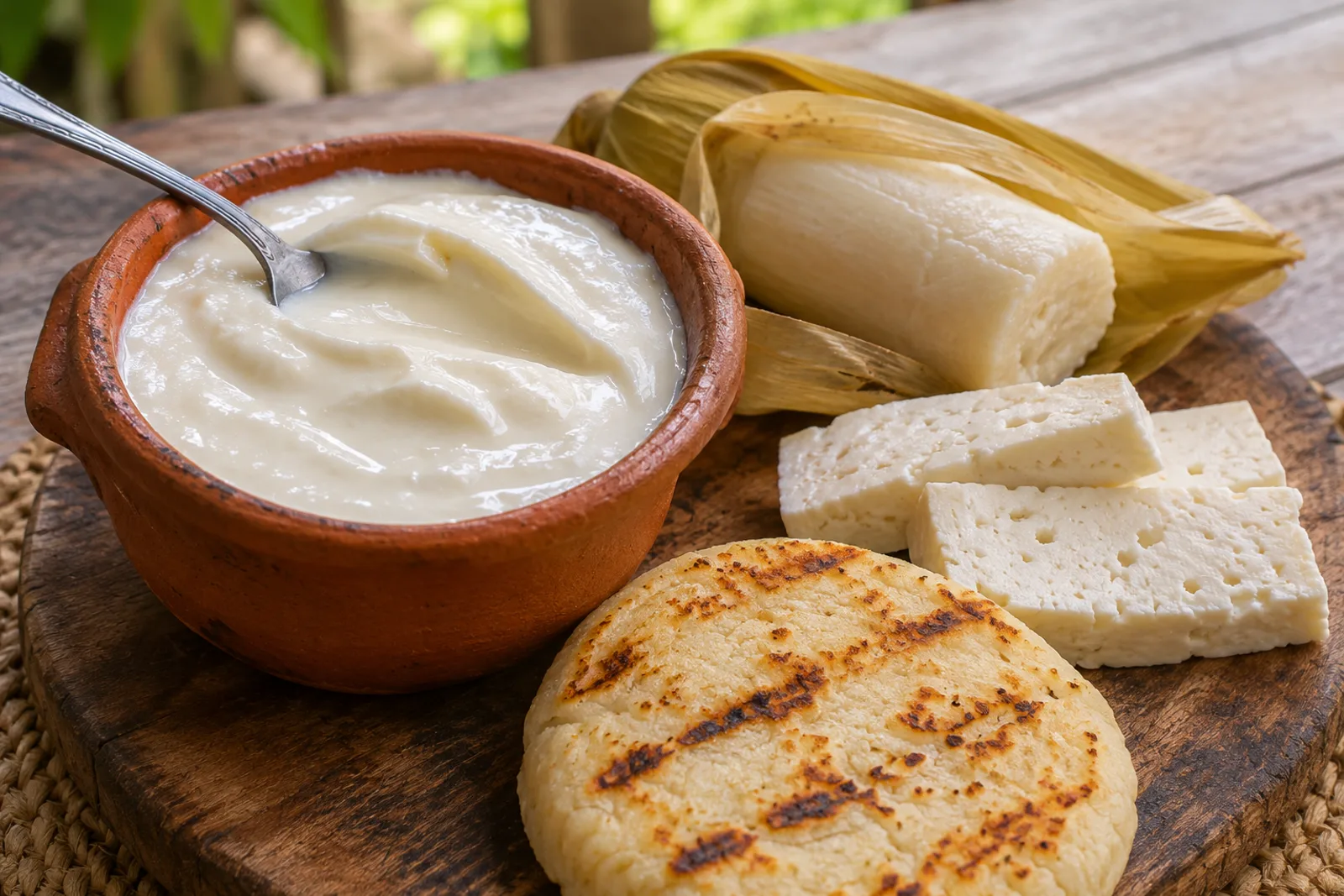

Suero costeño (say SWEH-roh kohs-TEH-nyoh) is the salted, tangy cultured cream of Colombia’s Caribbean coast, spooned cold beside fried egg arepas, cassava fritters and boiled yuca. The quickest and safest way to make it at home is to stir 1 cup of full-fat sour cream with ½ cup of whole-milk yogurt, salt and lime: 5 minutes plus half an hour in the fridge, with nothing to ferment. Further down there is a buttermilk-cultured version for anyone after the taste of the original, with its safety check, plus which US and UK products come closest, how much to make per person and how long it keeps.
What is suero costeño
How do you make suero costeño at home? Stir 240 ml (1 cup) of full-fat sour cream with 120 ml (½ cup) of plain whole-milk yogurt, ½ tsp salt and 2 tsp lime juice. Loosen with a few spoonfuls of milk if you like it pourable, then chill 30 minutes. 5 minutes of work for 12 servings of 2 tablespoons.
The word suero means whey, but suero costeño is the opposite of the thin liquid that drains from cheese: it is the thick part, a fermented dairy spread that sits somewhere between sour cream and labneh, and it is salted. It is made by small producers mostly in the Colombian departments of Córdoba, Sucre and Bolívar, and it is on the breakfast table across the coast, from Barranquilla and Cartagena to Montería and Santa Marta. Some areas call it suero atollabuey.
Why the traditional method isn’t the one to copy. On the coast it is made from raw milk or the cream skimmed off it, left to ferment on its own at room temperature, usually for 24 to 48 hours, in plastic tubs or dried gourds that carry over bacteria from the batch before. The thick part is then salted and beaten smooth. That spontaneous ferment runs with no control of acidity or temperature, and raw milk can carry dangerous bacteria that a slow ferment doesn’t reliably stop. That’s why the main recipe here doesn’t ferment anything: it starts from dairy that is already cultured and pasteurized.
Time and difficulty. Quick version, 5 minutes plus 30 in the fridge. Cultured version, 10 minutes of work and 12 to 24 hours of waiting. Both are easy.
Ingredients for quick suero costeño
For about 360 ml (1½ cups), 12 servings of 2 tablespoons:
- Full-fat sour cream, 1 cup. Richness and body. Light sour cream turns watery and too sharp. In the UK, look for soured cream.
- Whole-milk yogurt, ½ cup. Plain, unsweetened. It brings the brighter tang suero has and sour cream alone lacks. With Greek yogurt, use the same ½ cup and add 2 to 3 tbsp of milk.
- Salt, ½ tsp. This is what turns sour cream into suero. Start there and taste.
- Lime juice, 2 tsp. For brightness.
- Milk, optional. 1 to 3 tbsp, for the pourable texture of the coastal one.
All you need is a bowl, a spoon and a clean jar with a lid.
How to make quick suero costeño
- Mix cold. Sour cream and yogurt straight from the fridge, 30 seconds, until smooth.
- Salt and lime, then taste. It should taste clearly sour and salty. Adjust little by little.
- Loosen if you want. Milk a tablespoon at a time until it falls from the spoon in a thick ribbon.
- Half an hour in the fridge, in the covered jar, before serving.
What I don’t recommend for the table is milk curdled with vinegar or lime and blended. It is basically whipped ricotta, tastes of vinegar and lacks the cream that gives suero its body. Fine in a pinch, but it is a different thing.
Cultured suero costeño, for the traditional taste
The cultured version has a rounder sourness and a silkier texture than the quick one, closer to what you get on the coast. It is pasteurized cream soured on the counter by a culture that works at room temperature. Only that kind of culture: cultured buttermilk, or a powdered mesophilic culture sold for sour cream or crème fraîche, used as its packet directs. Yogurt is not a starter for this: its bacteria work at about 110°F (43°C) and won’t sour cream properly on a kitchen counter. Yogurt belongs in the quick version, which is made cold.
Ingredients, for about 540 ml (2¼ cups):
- 480 ml (2 cups) pasteurized heavy cream or whipping cream, 30 to 36% fat, from the chiller. Avoid ultra-pasteurized (UHT) cream and cream with thickeners or stabilizers on the label: it may not set. In the UK, whipping cream (about 35%) is the match; double cream, at around 48%, turns out much thicker and richer.
- 4 tbsp (60 ml) cultured buttermilk, the ratio of 2 tablespoons per cup of cream. Or a mesophilic culture at the packet dose.
- 1 level tsp (5 g) fine salt, at the end.
Method:
- Clean everything. A 25 fl oz (750 ml) glass jar and spoon washed in hot soapy water, rinsed and dried.
- Mix without salt. The cream, out of the fridge for 30 minutes, with the buttermilk or culture.
- Cover with something that breathes. A clean cloth or paper towel with a rubber band.
- 12 to 24 hours at about 75°F (24°C), away from sun, the stove and the back of the fridge. A cooler kitchen takes longer.
- Check the acidity. With food pH test strips, sold by cheesemaking suppliers and online: it’s ready at pH 4.6 or below. If it is still above that two hours past the time you expected, throw out the whole batch.
- Salt, lid and fridge right away, at least 2 hours, where it finishes thickening. Keeps 3 days.
Signs a batch has gone wrong
Thickness, a sour smell and a tangy taste tell you the culture has been working, but they don’t prove it’s safe: dairy can carry harmful bacteria and still look and smell fine. That’s why the check that counts is pH. These, though, mean straight into the trash without testing anything:
- Mold of any color on the surface or the rim: fuzzy white, green, black, pink or orange. Soft dairy with mold can’t be scraped and saved.
- A rotten, sulfurous or strongly yeasty smell.
- No thickening at all in the expected time: the culture never started.
No pH strips? Make the quick version. A little yellowish liquid on top is normal in both; it’s whey separating, so stir it back in.
Suero costeño substitutes in the US and UK
Sour cream stirred with whole-milk yogurt, salt and lime is the closest match, which is why it’s the main recipe on this page. The one thing no substitute brings on its own is salt; suero has it and almost none of these do, so always season.
- In the US. Sour cream is everywhere. Latin grocery stores often carry bottled suero costeño in the dairy case, along with Central American cream (crema salvadoreña or hondureña), which is salted and tangy and very close. Mexican crema is milder and runnier; it lacks the sourness.
- In the UK. Soured cream and crème fraîche are in every supermarket’s chiller, and Greek-style yogurt too. Labneh is in Middle Eastern and Turkish shops and some larger supermarkets.
- For cooking with heat (a cheese and yam soup, a sauce), use full-fat sour cream or crème fraîche: the high fat keeps it from splitting. Yogurt, especially low-fat, curdles if it boils.
How much suero costeño per person, and what to eat it with
For the table, plan on 2 tablespoons (30 ml) per person, the amount that goes next to one fried arepa or a couple of fritters. A quick batch, 360 ml (1½ cups), covers 12 people; a cultured batch, about 540 ml (2¼ cups), covers 18. For 20, make two quick batches. For a household of two or three, half a quick batch is plenty for the 3 days it keeps.
Where suero goes in Colombian coastal cooking:
- Cold, on the side of fried food. Colombian egg arepas, carimañolas, cassava fritters stuffed with meat, fried yuca and Barranquilla-style fried kibbeh.
- With the coastal bread. A bollo de yuca, cassava wrapped and boiled in corn husk, opened at the table with grated cheese and suero.
- Cooked into the dish. Mote de queso, the cheese and yam soup, takes 7 tbsp (100 ml) of suero for 6, stirred in with the cheese for the last 10 minutes without boiling. Cayeye, mashed green bananas with cheese, gets it in the mash and on top.
All of these dishes are gathered in the guide to Colombian Caribbean food.
How long suero costeño keeps
Homemade suero keeps 3 days in the fridge, quick or cultured, in its covered jar at 40°F (4°C) or below. The quick one, also never past the earliest date on the sour cream or yogurt you used. Store-bought suero lasts as long as its label says once opened.
- Scoop with a clean spoon, never the one you’re eating with.
- Out of the fridge, 2 hours at most, 1 hour if the room is above 90°F (32°C). What sat on the table doesn’t go back in the jar.
- Freezing isn’t worth it. It separates and turns grainy once thawed: fine stirred into a hot dish, not for the table.
- If you buy it, check that the label says pasteurized milk, especially for anyone pregnant, small children and older adults.
Suero costeño FAQ
Is suero costeño the same as sour cream? Close, but no. Both are cultured cream; suero is looser, sourer and salted, and sour cream is thicker, milder and unsalted. Stir in yogurt, salt and lime and sour cream gets very near.
Can I just let milk sour on the counter? Not store milk. Pasteurized milk left out doesn’t sour cleanly; it spoils. Raw milk, the way the traditional one is made, brings the risk of the bacteria in the milk itself. At home, make the quick version or the cultured one with a starter and a pH check.
Can I culture it with yogurt instead of buttermilk? Not at room temperature. Yogurt bacteria need about 110°F (43°C) and won’t sour cream properly on the counter. Use cultured buttermilk or a mesophilic culture, or make the quick version, which does use yogurt.
Is suero costeño gluten-free? Yes, and egg-free. It is dairy, so it’s out for anyone with a milk allergy. It isn’t spicy; on the coast the heat comes from a separate bowl of chile sauce.
Nutrition facts for suero costeño
Per 2-tablespoon (30 ml) serving of the quick version, one twelfth of the recipe, worked out ingredient by ingredient:
- Calories: 44 kcal
- Protein: 1 g
- Carbohydrates: 1 g
- Fat: 4 g
- Fiber: 0 g
- Sugars: 1 g
- Sodium: 108 mg
The cultured version, made only with cream, comes to about 93 kcal per 2 tablespoons, more than double, because heavy cream has nearly twice the fat of sour cream.
I didn’t grow up with suero; in Venezuela the cream on the table is nata. I came to love it here, and my everyday one is the quick version, ready in 5 minutes with nothing to second-guess. I make the cultured one when I have buttermilk and time, with the pH strips next to the jar. Josnaisis.