

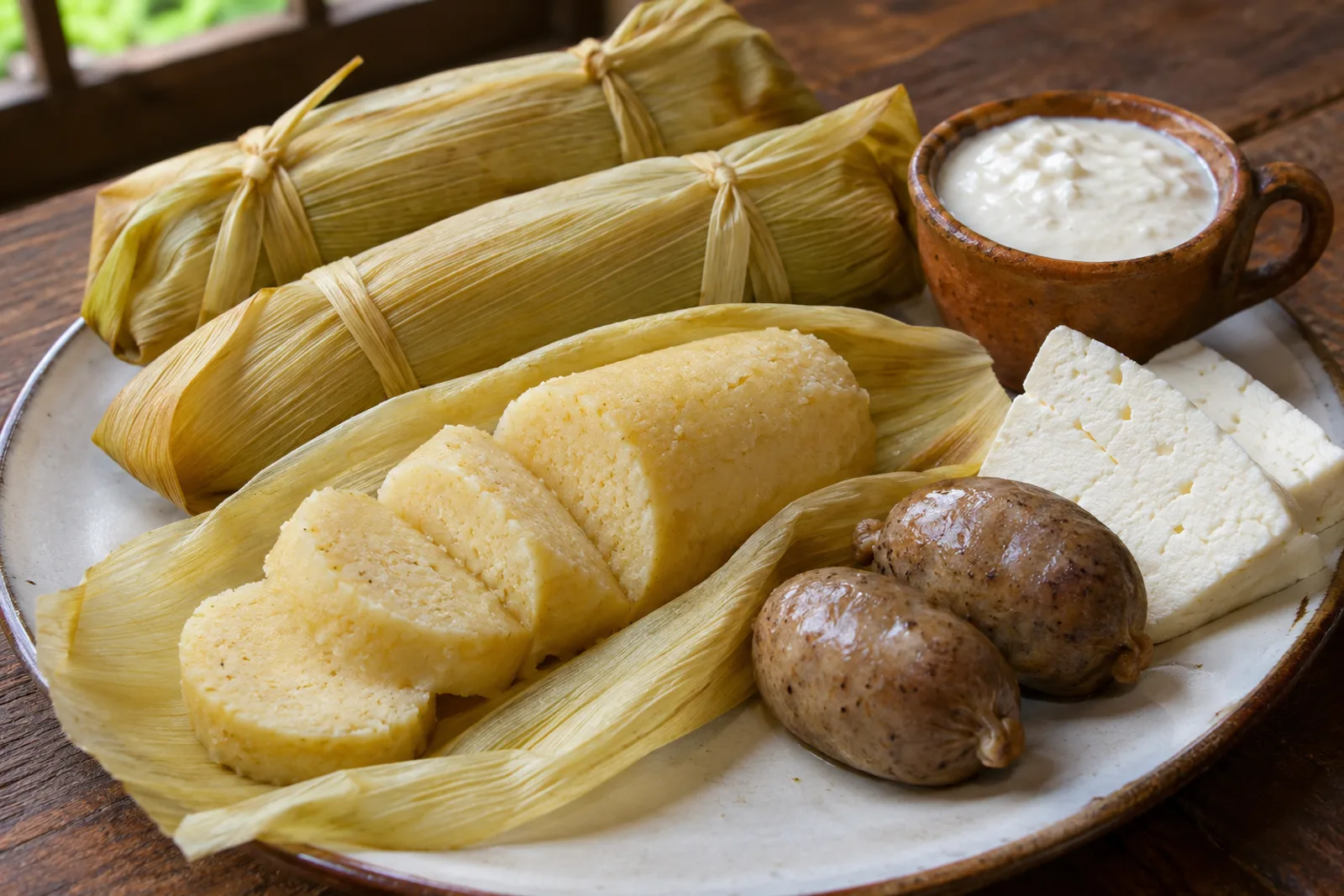

Bollo limpio, clean roll in Spanish, takes 2 ingredients: hulled white corn and salt, ground into a dough, wrapped in corn husks and boiled 40 minutes, until a knife comes out of the center clean. On Colombia’s Caribbean coast, in Barranquilla, Cartagena and Santa Marta, it is the everyday starch on the plate, the slice of something plain that goes with salty white cheese, sausage, eggs or fried fish. It is gluten-free and dairy-free as written. This version turns 1 kg (2.2 lb) of dried corn into 12 rolls of roughly 150 g (5.3 oz), with what to buy in the US and UK and how to freeze them.
What is bollo limpio?
How do you make bollo limpio? Soak 1 kg (2.2 lb) of dried hulled white corn overnight, simmer it about 45 minutes until the kernels give between your fingers, grind it twice and knead in 10 g (2 tsp) of salt. Shape 12 logs, wrap each in corn husks, tie the ends and boil covered for 40 minutes. About 160 minutes for 12 servings, plus the overnight soak.
Think of it as a cousin of the tamale with nothing inside. Where a Mexican tamale has fat beaten into the masa and a filling, bollo limpio is only corn and salt, so it comes out dense, smooth and firm enough to slice into rounds. The flavor is gently corny and savory, closer to plain grits set into a loaf than to cornbread. It belongs to the wider family of Colombian Caribbean food, where wrapped, boiled bollos take the place bread takes in other kitchens.
The coast makes several bollos, and the dough is what tells them apart:
| Bollo | Dough | Texture |
|---|---|---|
| Bollo limpio | dried hulled corn, cooked then ground, salt | dense, plain, savory |
| Bollo de mazorca | fresh corn ground raw, a little sugar or salt | softer, sweeter, yellow |
| Bollo de yuca | cassava boiled and ground hot | chewy, slightly translucent |
| Bollo de angelito | white corn with grated coconut, anise and sugar | sweet |
The fresh-corn version is the same idea as the Colombian corn envueltos, where the full method lives. For filled corn parcels from Mexico, Colombia and Venezuela, see the tamale guide.
Time and effort. About 160 minutes on the day, including the time pots take to boil, of which roughly 50 are hands-on, plus the overnight soak. Medium difficulty: judging the corn and tying the first half dozen rolls take practice.
Ingredients and where to find them in the US and UK
The corn
You need dried hulled white corn: corn kernels with the skin and germ removed, sold whole or cracked. In Colombian shops it is labeled maíz trillado, maíz peto or, on the coast, maíz pilado. It is the same corn used for Colombian mazamorra, but for the rolls you stop cooking far earlier: about 45 minutes, when the kernel yields but holds together, against the 2 hours that make it fall apart for mazamorra.
- US. Latin groceries with a Colombian or Central American shelf, and online. Check the bag says dried white corn, not flour.
- UK. Latin American food shops, mostly online.
- Dried pozole corn or canned hominy. Both are nixtamalized, treated with lime like Mexican masa, and they work, but the rolls taste like tamales or posole rather than the Colombian original. Canned hominy is already cooked: drain, rinse and grind it straight away, skipping the simmer. It holds more water than corn you cook yourself, so grind it dry, weigh the dough you get and divide it into portions of about 150 g (5.3 oz); if it feels soft, leave it uncovered for 15 minutes before shaping.
Shortcuts with corn flour
- Precooked white cornmeal (masarepa), the flour for arepas. The ratio is equal volumes of flour and warm water, a little firmer than arepa dough. For 12 rolls the size of the recipe card: 5 cups masarepa, 5 cups (1.2 liters) warm water and 2 tsp (10 g) salt. Dissolve the salt in the water, work in the flour gradually, knead until smooth and rest 10 minutes before shaping. A single cup of each makes 6 small rolls that boil in about 25 minutes; full-size rolls take about 40, until a fork comes out clean. They come out smoother and taste like arepas.
- Masa harina, the nixtamalized flour for tortillas, absorbs water differently. Start with 5 cups masa harina, 1 liter (4¼ cups) warm water and the salt, then add water by the tablespoon until the dough feels like soft modeling clay that does not crack. Wrap and boil the same way. The flavor is that of a Mexican tamale.
Neither is the real thing, but either one gets plain corn rolls on the table the same day.
Wrappers
Colombians wrap bollo limpio in dried corn husks; the older wrapper is bijao, a broad tropical leaf you will not find abroad. Here is what works instead:
Equipment. A large pot for the corn and another wide enough to keep 12 rolls under water; a hand-crank grain mill or a food processor; a colander and a sheet pan. A blender does not work: without water the dough will not move, and with water it turns into batter.
Step-by-step, with a timeline
1. Soak the night before
Rinse the corn until the water runs nearly clear and leave it under 5 cm (2 in) of cold water for 12 hours. Under 8 hours, the kernels soften unevenly. Discard the soaking water.
2. Simmer to the grinding point
This decides the texture of the rolls. Over medium heat, soaked corn takes about 45 minutes. From minute 30, fish out a kernel, let it cool for a moment and pinch it:
- Hard, with a chalky white center. Keep going and test every 5 minutes.
- Squashes flat with a little resistance and stays whole. Drain now.
- Bursts open or crumbles. Overcooked. The dough will be soft; grind it without adding any water.
A pressure cooker softens the corn much faster, and since you cannot taste without opening it, overshooting is easy. If you use one, undercook on purpose, turn off the heat, let the pressure release completely as your manufacturer directs, and only then open it and test a kernel; finish in an open pot, where you can keep checking. I prefer an ordinary pot for this step. Save 240 ml (1 cup) of the cooking water before draining.
3. Grind twice and knead
The first pass through the mill or processor gives crumbs; the second, a smooth dough that holds together when squeezed. Work the processor in batches of about 2 cups. Knead in the salt for 3 to 5 minutes until the dough feels like soft modeling clay. Taste a pinch raw: it should be lightly salty, because the salt in the boiling water barely gets in. Divide it into 12 equal portions; with 1 kg (2.2 lb) of corn they land around 150 g (5.3 oz) each, depending on how much water the kernels took up. For exact rolls, weigh the dough and divide by 12.
4. Wrap and tie
Shape logs 12 to 14 cm (5 to 5½ in) long and no thicker than 5 cm (2 in). Overlap the husks with the tips pointing opposite ways, roll the dough up tightly, fold the ends under and tie both ends. If a husk splits, add another on top: water that gets in makes the outside pasty.
5. Boil and check
Salted water at a boil, rolls submerged, lid on, 40 minutes at a gentle simmer. Squeeze one with tongs: it should feel firm. Push a knife into the center: it should come out clean. If dough clings to it, give them 10 more minutes. Drain 5 minutes in a colander; they firm up as they cool slightly.
Troubleshooting
Bland rolls? The salt belongs in the dough. Wet dough? Rest it uncovered 15 minutes, or knead in 1 tablespoon of precooked cornmeal. Rolls that split? Use one extra husk and tie both ends. Gritty dough? If the kernels were soft, grind again on a finer setting; if they still had hard, chalky centers when you drained them, grinding will not fix it, so return them to the pot and keep simmering before you grind.
Variations and batch sizes
- Richer rolls. Knead 3 tbsp (45 g) melted butter into the dough, and if you like, 200 g (7 oz) grated salty white cheese: Colombian queso costeño, or a mild feta in the US and UK. Taste before adding the rest of the salt. They come out softer and no longer plain.
- Sweet, coconut and anise. That is bollo de angelito, a different roll.
- Half batch, 6 rolls. 500 g (1.1 lb) corn and 5 g (1 tsp) salt; start testing the corn at 25 minutes.
- Double batch, 24 rolls. 2 kg (4.4 lb) corn, 20 g (4 tsp) salt, about 72 tamale husks. Cook the corn in a 10-liter (10-quart) pot or two smaller ones, and boil the rolls in two batches if they do not fit submerged. The boiling time stays at 40 minutes.
How to serve bollo limpio
On the Colombian coast it sits next to grated queso costeño and suero costeño, a tangy cultured cream, which get spread over each round. Outside Colombia, feta and a thick sour cream thinned with a spoonful of yogurt come close. It goes with Colombian butifarras, chorizo, fried eggs, crispy chicharrón or a whole Colombian fried mojarra. Allow 1 roll per person as a side and 2 for breakfast. Leftovers are best sliced into 1 cm (½ in) rounds and browned in a pan with a little oil or butter, 2 to 3 minutes per side.
Make ahead, storing and reheating
- Fridge. Cool, still in their husks, in a closed container within 2 hours of cooking: 3 to 4 days at 4°C (40°F) or below.
- Freezer. Cooked, in their husks and wrapped in plastic, 3 to 4 months for best quality. Freeze them apart on a tray, then bag them.
- Reheat. In their husks in boiling water, 10 to 15 minutes from the fridge and about 25 from frozen, without thawing, until the center reaches 74°C (165°F). Steaming takes the same time. In the microwave, unwrapped and covered with a damp towel, in 1-minute bursts; too long and they harden.
Bollo limpio FAQ
Is bollo limpio the same as a tamale? It is wrapped and boiled like one, but there is no fat in the dough and no filling. It is closer to a plain loaf of cooked corn.
Can I use yellow corn? Yes, dried hulled yellow corn works with the same method and gives yellow rolls.
Is it gluten-free? Corn and salt contain no gluten. If you cook for someone with celiac disease, buy corn or flour that is not processed alongside wheat.
How many calories are in one roll? About 308 kcal per roll, one twelfth of the batch, almost all from carbohydrates, before any cheese or cream.
Nutrition per roll
Per roll, one twelfth of the batch (about 150 g / 5.3 oz), based on 1 kg (2.2 lb) dried hulled corn and the 10 g of salt in the dough; the salt in the boiling water and the optional sugar are not counted:
- Calories: 308 kcal
- Protein: 6 g
- Carbohydrates: 66 g
- Fat: 1.5 g (0.2 g saturated)
- Fiber: 3 g
- Sugars: 1 g
- Sodium: 329 mg
I always make 24 at a time, because tying 24 takes barely longer than tying 12, and half go straight into the freezer. The test I trust is the kernel between my fingers, not the clock: when it still pushes back a little, it is ready for the mill. My favorite way to eat them is the next morning, in browned rounds with grated cheese melting on top. Josnaisis.