

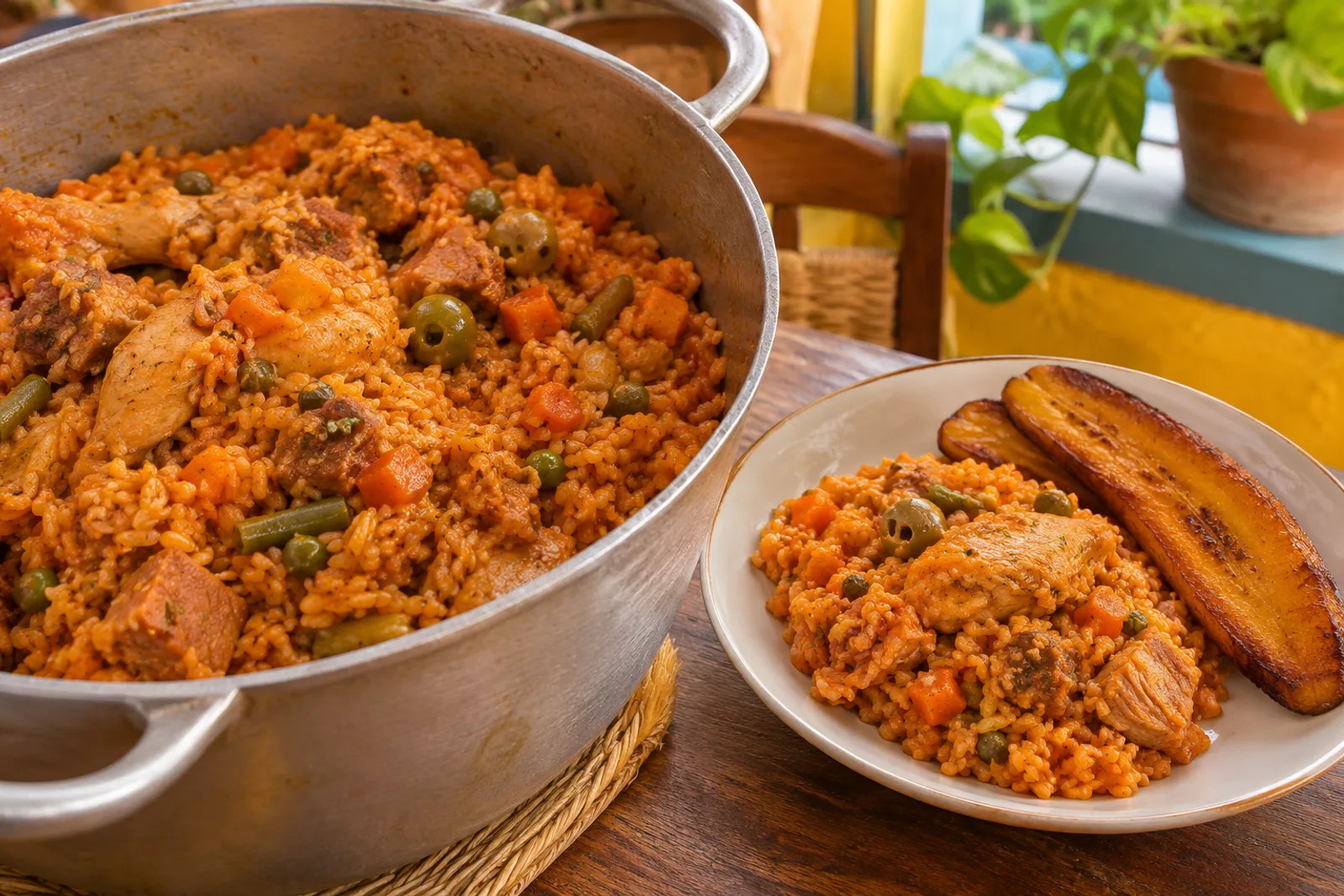

Arroz apastelado is what cooks on Colombia’s Caribbean coast make when 10 or 40 people are coming: 1 kg (2.2 lb) of rice simmered with chunks of pork and chicken in a red sofrito of tomato, annatto and cumin, finished with green olives and capers. It comes out moist and clinging, somewhere between a fluffy pilaf and a soupy risotto, and it feeds a crowd from one pot. Below you will find the base recipe for 10, plus exact amounts and pot sizes for 40 or 20 guests, and how to cool leftovers safely, which matters more with cooked rice than with most dishes.
What is arroz apastelado?
How do you make arroz apastelado? Brown 1 kg (2.2 lb) each of seasoned pork and chicken, build a sofrito of onion, peppers, tomato, tomato paste and annatto, and simmer the meat 20 minutes in 2.3 liters (9¾ cups) of liquid, with up to 300 ml (1¼ cups) more in reserve. Add 1 kg (2.2 lb) of rice and carrots, boil uncovered until steam holes appear, add peas, olives and capers, and cook covered on the lowest heat for 20 minutes. 120 minutes for 10 servings.
Picture Spanish-style chicken and rice, then make it tangier and more savory. The annatto turns it orange, the vinegar, olives and capers keep it bright, and allspice and cumin give it warmth without heat. It shares its seasoning with the coast’s Colombian rice pasteles, the leaf-wrapped Christmas parcels, but here everything stays loose in the pot, so it takes 2 hours instead of an afternoon. Every family makes it differently: pork only, chicken only, with bacon, with tomato sauce. This version uses both meats, which stretches furthest at a party.
It is easy to confuse with two other Colombian rice dishes:
Colombian chicken rice uses shredded breast and stays fluffy; arroz atollado from Cali adds potato and chorizo and comes out creamier and looser. This version of apastelado finishes moist, with no free broth in the pot.
Time and effort. 120 minutes, about 60 hands-on. Medium difficulty: the one moment that needs you is deciding when to cover the rice.
Ingredients and US and UK substitutes
The recipe uses 1 kg (2.2 lb) of rice and 2 kg (4.4 lb) of meat for 10, a generous party portion of about 100 g (3½ oz) raw rice and 200 g (7 oz) raw meat each.
| Colombian ingredient | What to buy in the US or UK | What changes |
|---|---|---|
| Cerdo de paleta | Pork shoulder or Boston butt | Nothing; it needs some fat to stay tender |
| Muslo de pollo | Boneless, skinless chicken thighs | Nothing; breast turns dry in this time |
| Color or bija | Ground annatto (achiote) in the Latin aisle or online; or 2 tbsp annatto oil plus 2 tbsp neutral oil, skipping the ground annatto, so the meat still browns in 4 tbsp of fat | Nothing; turmeric gives yellow color and a different flavor |
| Pimienta de olor | Allspice berries, or ¼ tsp ground allspice | Without it, it tastes closer to chicken rice |
| Ají dulce | 60 g (2 oz) more red bell pepper, the same weight | Less perfume, same sweetness |
| Arroz de grano largo | Long-grain white rice, unrinsed | Jasmine works but goes softer; skip basmati and parboiled rice |
| Hoja de bijao | Banana leaf, a clean towel or foil under the lid | Only the leaf adds aroma |
Liquid. Apastelado starts with 2.3 liters (9¾ cups) per kilo of rice, with up to 300 ml (1¼ cups) held in reserve, a little more than plain white rice, which is what keeps it moist. The reserve is for correcting, not a fixed addition: how much you need depends on your burner and on how much water the tomatoes and vegetables release. Water works because the meat makes its own broth; unsalted homemade chicken stock makes it rounder. If you use bouillon cubes, count their salt and skip the 1½ tsp for the rice.
Pot. A heavy Dutch oven of 30 to 32 cm (12 to 13 in), 10 to 12 liters (11 to 13 quarts), with a tight lid. Thin pots scorch on the bottom before the top cooks.
How to make arroz apastelado
Sear the meat in batches
High heat, two batches, about 7 minutes each. Crowd 2 kg (4.4 lb) of meat into the pot and it releases water, boils instead of browning, and the rice loses color and depth. The browned film it leaves behind is flavor; the sofrito lifts it.
Cook the sofrito until it darkens
Give the onion and peppers 7 minutes, then add tomato, then the paste and spices, each for 3 minutes. It is ready when it shifts from bright red to brick red and colored fat beads at the edges. Undercooked sofrito leaves a raw, sour tomato taste.
Read the rice
The meat simmers 20 minutes first, then the rice goes in and boils uncovered over high heat for 8 to 12 minutes. Watch the surface: the liquid sinks below the rice and small holes open where steam escapes. Colombians call them ojitos, little eyes. That is your signal to turn the rice over once, from the bottom up, and cover it.
- Covered too early, with broth on top: soft, with loose broth in the bottom.
- Waited until it was bone dry: the bottom sticks and the rice turns looser than it should.
- Stirred it several times: broken grains and a pasty texture.
Once covered, it needs 20 minutes on the lowest heat, then a 10-minute rest with the burner off. Liquid still pooling in the bottom? Uncover it over low heat for a few minutes.
Making it for 20 or 40 people
Everything scales in proportion, liquid and reserve included. What changes is the load in each pot: with 1 kg (2.2 lb) of rice per Dutch oven the covered time stays about 20 minutes; with 2 kg (4.4 lb) in one big pot, allow about 25. Treat big-pot times as a guide and let tender grains decide.
- For 20: 2 kg (4.4 lb) rice, 4.6 liters (19½ cups) liquid plus up to 600 ml (2½ cups) reserve, 2 kg (4.4 lb) each of chicken and pork, everything else doubled. A 20 to 24 liter (5 to 6 gallon) stockpot, about 25 minutes covered, or two Dutch ovens each holding the base recipe, about 20. Brown the meat in 4 batches.
- For 40: 4 kg (8.8 lb) rice, 9.2 liters (2½ gallons) liquid plus up to 1.2 liters (5 cups) reserve, 4 kg (8.8 lb) of each meat, split between two 20 to 24 liter stockpots with 2 kg (4.4 lb) of rice each, about 25 minutes covered, each on its own large burner, rather than one giant pot: in a huge pot the bottom burns before the top cooks, and turning the rice becomes nearly impossible.
- Reserve in big pots: keep it at a boil in a separate pot. When you turn the rice, if the grains are hard and the surface looks dry, add 150 ml (⅔ cup) per kilo of rice in that pot, and repeat halfway through the covered time only if it still looks the same.
- Make ahead: season the meat and chop the vegetables the day before and refrigerate them covered. The base recipe takes the 2 hours before serving; for 20 or 40, browning 4 batches per pot and heating that much liquid stretches the work, so I start at least an hour earlier, depending on how strong the burners are. Do not cook it a day ahead to reheat in bulk: 10 kg (22 lb) of cold rice reheats slowly and unevenly.
Budget. Meat accounts for much of the cost. More pork shoulder than chicken, and skipping the olives, brings it down without losing the character of the dish.
Serving a crowd and keeping leftovers safe
Cooked rice carries its own risk: Bacillus cereus, a bacterium whose spores survive cooking and, if the rice sits warm for hours, produce a toxin that reheating does not destroy. At a party, time on the table is what counts.
- On the buffet: keep it at 135°F (57°C) or above, in the covered pot on the lowest heat or in a chafing dish. If you cannot keep it hot, limit it to 2 hours out, or 1 hour above 90°F (32°C), as at an outdoor summer party.
- Cooling leftovers: as soon as serving ends, spread the rice in pans no deeper than 5 cm (2 in) and refrigerate them right away, uncovered or with the lid resting on top until cool, spaced apart so air circulates. Small portions can go into the fridge hot. With many pans, chill them first over a bowl of ice water, stirring the rice, so you do not overload the fridge. The target is 135°F to 70°F (57°C to 21°C) within 2 hours and 41°F (5°C) or below within 6 hours total. A full 20-liter pot set in the fridge stays warm in the middle far longer than that. In the UK the advice for rice is stricter: cool it within 1 hour and eat it within 24 hours.
- Fridge: covered at 40°F (4°C) or below, 3 to 4 days. That is the general limit for cooked leftovers; with rice I follow the stricter rule and finish it within 24 hours.
- Freezer: in flat bags or single portions, 3 to 4 months for best quality.
- Reheating: only what you will eat, once, with 2 or 3 tablespoons of water, covered, in a pan over medium-low or in the microwave, stirring halfway, until steaming and 165°F (74°C) in the center.
Allergens and heat. No gluten, dairy or egg, provided your stock or bouillon contains none. Ají dulce is a sweet, aromatic pepper, so the dish has no chili heat and suits children.
What to serve with arroz apastelado
On the coast it comes with Colombian patacones or fried cassava, sliced avocado and a fresh salad, often cucumber with red onion, cilantro and lime. Plan on half an avocado for every two guests and about 5 patacones for every 2 guests. For a bigger spread, Colombian coconut rice with fried fish is the coast’s other celebration rice, and the guide to Colombian Caribbean food and the Latin party food collection fill out the menu.
Arroz apastelado FAQ
What does apastelado mean? I cannot give you a documented origin for the name with confidence. What the plate shows is that it tastes like the coast’s rice pasteles, with the same annatto, cumin, vinegar and capers, and that it sets moist and compact.
Can I use only chicken or only pork? Yes, 2 kg (4.4 lb) of a single meat. With chicken only, use thighs. With pork only, small pieces of rib add flavor.
Can I make it in a rice cooker or Instant Pot? A home rice cooker cannot hold 10 servings or let you turn the rice. In a pressure cooker you cannot see the steam holes and it overcooks easily. I always use a heavy pot.
Can I use brown rice? Not with these times and liquid: brown rice needs longer and more water, and the texture changes completely.
Nutrition per serving
Each of the 10 servings, worked out ingredient by ingredient with water as the cooking liquid and no sides, provides:
- Calories: 858 kcal
- Protein: 48 g
- Carbohydrates: 96 g
- Fat: 30 g (8 g saturated)
- Fiber: 6 g
- Sugars: 8 g
- Sodium: 1,040 mg
The rice provides about 365 kcal per serving and the two meats together about 357. Homemade stock instead of water adds roughly 90 kcal per serving. Olives, capers and salt account for most of the sodium; to cut it, leave the salt out of the meat seasoning.
What I like about this rice is that a party runs itself: the sofrito and the meat take care of themselves, and the only moment I keep for myself is the ojitos, when I turn the rice once and put the lid on. And whatever is left goes into shallow pans before I sit down to eat, not at the end of the night. Josnaisis.