

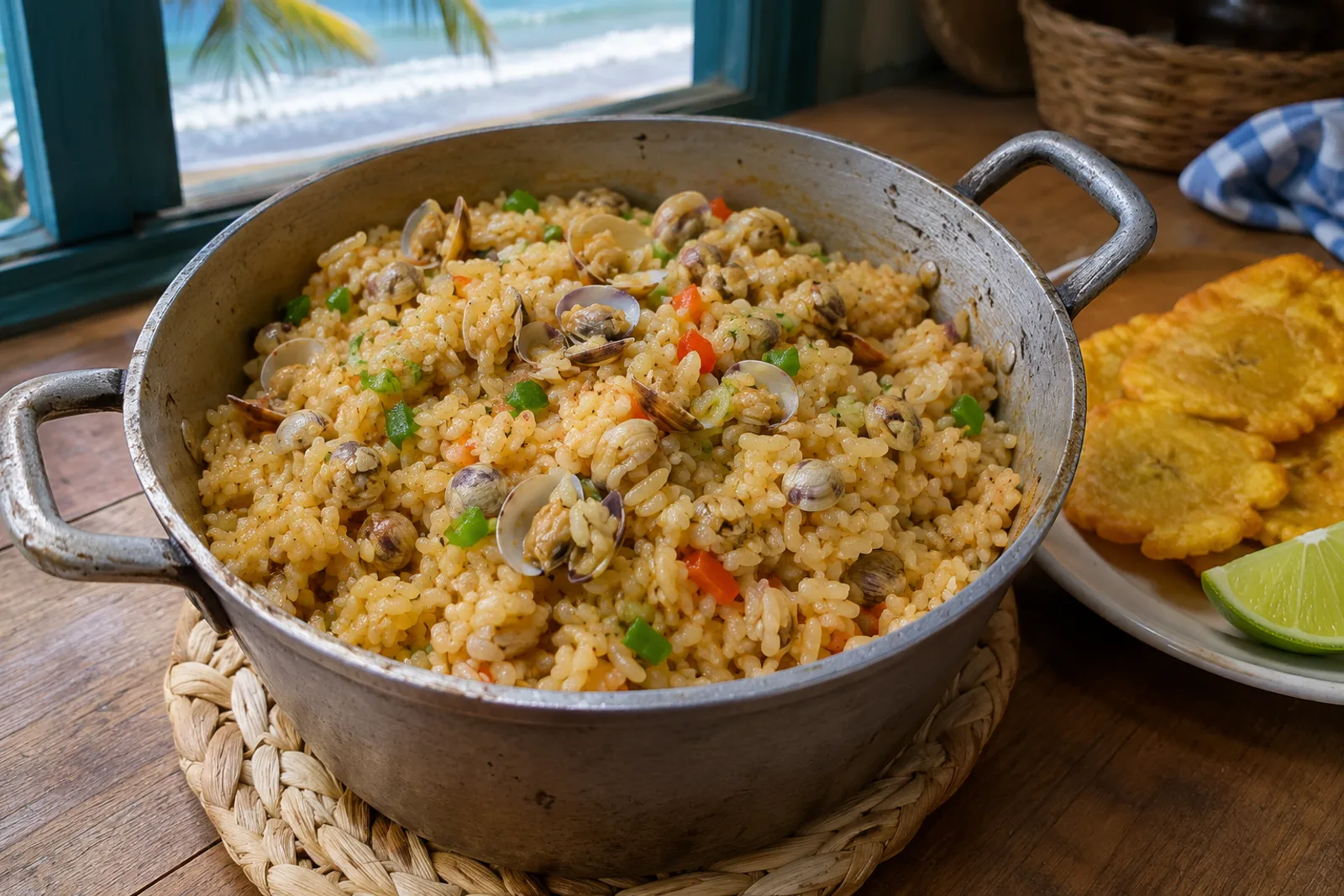

Arroz con chipi chipi (CHEE-pee CHEE-pee) is Colombian rice with clams from the Caribbean coast, and the clams do two jobs: their meat goes on top, and their steaming liquid is the cooking broth for the rice. Chipi chipi are tiny beach clams, so the dish is built around 3.3 lb (1.5 kg) of them, purged for an hour in salted water, steamed open in 3 cups of water, with that broth strained through cloth so no grit reaches the pot. Here’s the recipe for 4, how to purge them, which to discard before and after cooking, what to buy outside Colombia, and the coconut milk version.
What arroz con chipi chipi is
How do you make Colombian rice with clams? Purge 3.3 lb (1.5 kg) of small clams for an hour in water with 35 g of salt per liter (about 2 tbsp of fine salt per quart). Steam them open in 3 cups of boiling water, strain the broth through cloth and shell them. Soften an onion, sweet pepper, tomato and annatto sofrito, toast 2 cups of rice in it, cook it in 4 cups of the broth and lay the clam meat on top for the last 5 minutes. 70 minutes for 4 plates, plus the hour of purging.
Chipi chipi are small beach clams, ¾ to 1¼ inches (2 to 3 cm) across, with smooth, glossy shells, that bury themselves in the sand at the waterline. On Colombia’s Caribbean coast they’re eaten mostly in rice, a dish known in Barranquilla and Santa Marta. They yield little meat per pound: the dish lives on their broth, which tastes of the sea. It’s one of the dishes of Colombian Caribbean food.
It isn’t the Colombian shrimp rice, made with a broth of shrimp heads and big pieces of shellfish, or the creamy, soupy Colombian seafood stew. Nor is it the Barranquilla mullet rice, made with salted fish. This one is a dry rice, loose and moist, with a tiny clam in every spoonful.
Time. 70 minutes, plus 1 hour of purging beforehand that needs no attention. Medium difficulty: not for technique, but because the purging has to be thorough and shelling takes 15 to 20 minutes.
Ingredients, and which clams to use outside Colombia
Full amounts are in the recipe card. For 4 plates: 3.3 lb (1.5 kg) of clams in the shell, 2 cups (370 g) of rice and 4 cups (960 ml) of broth, the coastal ratio of two parts liquid to one of long-grain rice.
Buying good clams
Buy them only from a fishmonger who can tell you where they came from: tagged, certified shellfish from approved harvest areas, never clams you dig yourself from closed beaches or near outfalls. Clams filter seawater and can carry contaminants and toxins that neither purging nor cooking removes. They must also be alive: shells shut, or closing on their own when you tap them, and a clean, sea smell. Throw out:
- Any with cracked or broken shells.
- Open ones that don’t close when tapped. They’re dead.
- A batch that smells of ammonia or sour.
At home, keep them in the fridge in an open container or a colander set over a plate, covered with a damp cloth. Never in a sealed bag or in fresh water: they suffocate. Cook them the day you buy them, or the next.
Substitutes in the US and UK
- Manila clams. Sold at many US fish counters and online. Slightly larger, meatier and a little sweeter, but the closest match. Same weight in the shell.
- Littlenecks. The smallest hard-shell clams in US stores. They take longer to open and give more meat per clam. Same weight.
- Cockles (UK). Meatier, with more grit. Purge 2 hours, changing the water after the first.
- Coquinas. The closest relatives of chipi chipi, same size and flavor, but rarely sold in the US. If you find them at a Spanish or Portuguese fishmonger, use them exactly as in the recipe.
- Canned clams. About 10 oz (300 g) of drained clams in all (check the drained weight on the label; usually two 10 oz / 280 g cans net weight). Drain the juice and use it as part of the 4 cups of liquid, topping up with water. The meat goes on top of the rice for the last 5 minutes, without boiling. Softer and saltier: taste the liquid before salting.
- Frozen cooked clam meat. 10 oz (300 g), thawed in the fridge, added at the end like canned. With no steaming broth, cook the rice in water with 1 tsp salt or in fish stock; it tastes less of the sea.
Equipment. A wide bowl for purging, a lidded pot for steaming, a sieve lined with fine cloth or a coffee filter, and a 10 to 11 in (26 to 28 cm) heavy pot with a tight lid.
How to purge clams and get rid of the sand
Clams spit out their grit on their own if you leave them in water as salty as the sea: 35 g of salt per liter, which is 70 g (¼ cup of fine table salt) in 2 quarts, for one hour, cold, with a change of water halfway; that second bath is a fresh batch, so it’s 4 liters and 140 g of salt in all. In fresh water they die without releasing anything, and too much salt makes them purge less well. How long they take depends on the species and whether they were purged before sale. Purging removes sand; it doesn’t make clams of unknown origin safe.
- Cold water, in the fridge or a cool spot. Warm water weakens them and they spoil sooner.
- A wide bowl, so they sit in one or two layers rather than piled up.
- Lift them out by hand; never pour them into a colander: the sand is on the bottom, and pouring tips it back over the shells.
The broth is your second line of defense. However well you purge, a little sand stays in the shells, and when they open it all ends up in the water. That’s why the broth is strained through fine cloth or a coffee filter, and why the shelled meat gets a quick rinse in some of the strained broth. With both steps, nothing crunches.
How to make Colombian rice with clams, step by step
Steaming the clams open
Boiling water, clams in, lid on: in about 5 minutes they start opening. Shake the pot to move them around, and once they open, give them 3 to 5 more minutes at a boil, covered; bigger clams like littlenecks need the longer end. Discard any that don’t open, and don’t pry them with a knife. The cloudy, grayish liquid is the base of the rice: keep every drop.
Shelling
The meat slides out of the open shells with your fingers. It’s 15 to 20 minutes of work for 3.3 lb; with a helper, half that. Keep about 12 whole clams for the top so it looks like what it is.
Sofrito and rice
The sofrito cooks 6 minutes with onion, scallions, garlic, bell pepper and ají dulce, then 4 more with tomato and cumin, until there’s no loose liquid. If you’ve made Colombian hogao ahead, ½ cup does the same job. Toast the rice 2 minutes in the sofrito before the broth goes in; it keeps the grains separate.
When the rice is done
Clam rice is served loose but moist, not as dry as plain white rice.
- After 10 minutes uncovered → no visible liquid, small holes on the surface. Time to cover and drop the heat to its lowest.
- After 10 minutes covered → the grains are almost tender. The clams go on top.
- To serve → grains tender and glossy, and no liquid runs when you tilt the pot. Fluffed with a fork, they separate.
- Still firm → sprinkle ¼ cup of hot water over the top, cover and give it 5 minutes more on the lowest heat.
- Too wet → uncover for 3 or 4 minutes on the lowest heat.
Mistakes to avoid with clam rice
- Gritty. Not purged enough, or the broth wasn’t strained through cloth. Purging alone isn’t enough: always strain.
- Rubbery clams. They cooked with the rice from the start. The meat is cooked once the shells open; it only needs warming on top of the rice for the last 5 minutes and the rest.
- Too salty. Salted before tasting the broth. Clams release seawater, and purging adds a little more. Taste first.
- Mushy rice. Stirred after covering, or too much liquid. One stir when it boils, then hands off.
- Burned bottom. High heat with the lid on. Covered means lowest heat.
Heat: none, since ají dulce isn’t hot. Kids usually eat it like any savory rice, though some balk at the clams. Allergens: it contains shellfish (mollusks), so anyone with a shellfish allergy should skip it; no swap gives the same dish. It’s gluten-free and dairy-free.
Colombian rice with clams and coconut milk
Seafood rice on the Colombian coast is also made with coconut. Here a 13.5 fl oz (400 ml) can of coconut milk replaces the same amount of broth: 2⅓ cups (560 ml) of broth plus the can. The rice turns creamier and a little sweet, and the sea flavor softens.
To keep it from sticking, stir the coconut milk into the broth before it goes into the pot, and watch the bottom during the uncovered stretch: with coconut it browns sooner. If you like coconut but want to taste the clams, serve plain clam rice next to Colombian coconut rice instead of mixing them.
For 8 to 10. Double the recipe in a 12½ in (32 cm) pot or two pots. Steam the clams in two batches: in a crowded pot the bottom ones overcook before the top ones open.
What to serve it with, and how to store it
Serving. With patacones, a tomato and onion salad dressed with lime, avocado, and lime wedges to squeeze over. To drink, an ice-cold Colombian coconut lemonade.
Fridge. Divide leftovers into small, shallow containers so they cool fast, and refrigerate at 40°F (4°C) or below within the first hour, never after 2 hours (1 hour at most above 90°F / 32°C). With rice and shellfish together, eat it within 24 hours.
Freezer. I don’t freeze it: thawed clams turn tough and the rice goes watery.
Reheating. In a covered skillet over low heat with 2 or 3 tbsp of water, stirring, until steaming and 165°F (74°C) in the center. In the microwave, covered, in 1-minute bursts. Reheat only once.
Colombian rice with clams FAQs
What are chipi chipi clams? Tiny clams, about an inch (2 to 3 cm) across, dug from sandy beaches on Colombia’s Caribbean coast. Their closest relative sold in Europe is the coquina.
What do I do with clams that didn’t open? Throw them away. A clam that doesn’t open when cooked was dead or damaged. Don’t force it open.
Can I use the purging water in the rice? No. It holds the sand and grit the clams spat out. The broth you want is the steaming liquid, always strained.
Can I use frozen clams? If they’re whole and raw, thaw them in the fridge, discard any with broken shells and steam them the same way; any that stay shut go in the trash. If they’re already cooked and shelled, treat them like canned and add them at the end.
Nutrition for Colombian rice with clams
Per plate (a quarter of the pot), calculated ingredient by ingredient from the recipe card, counting about 7 oz (200 g) of clam meat in the 3.3 lb of clams in the shell, without patacones:
- Calories: 480 kcal
- Protein: 16 g
- Carbohydrates: 85 g
- Fat: 8 g, of which 1 g saturated
- Fiber: 3 g
- Sugars: 4 g
The rice accounts for about 340 of those calories. The clams add little energy and much of the protein. Sodium isn’t given as a number because it depends on how salty the clams’ broth turns out. The coconut milk version adds about 197 kcal and 19 g of saturated fat per plate.
I purge clams in two changes of water even when the fishmonger says they’re clean, and I strain the broth through a coffee filter, which catches the most grit. The meat goes on top of the rice at the end and isn’t stirred in until serving, and I always taste the broth before salting: with clams it often needs none at all. Josnaisis.