

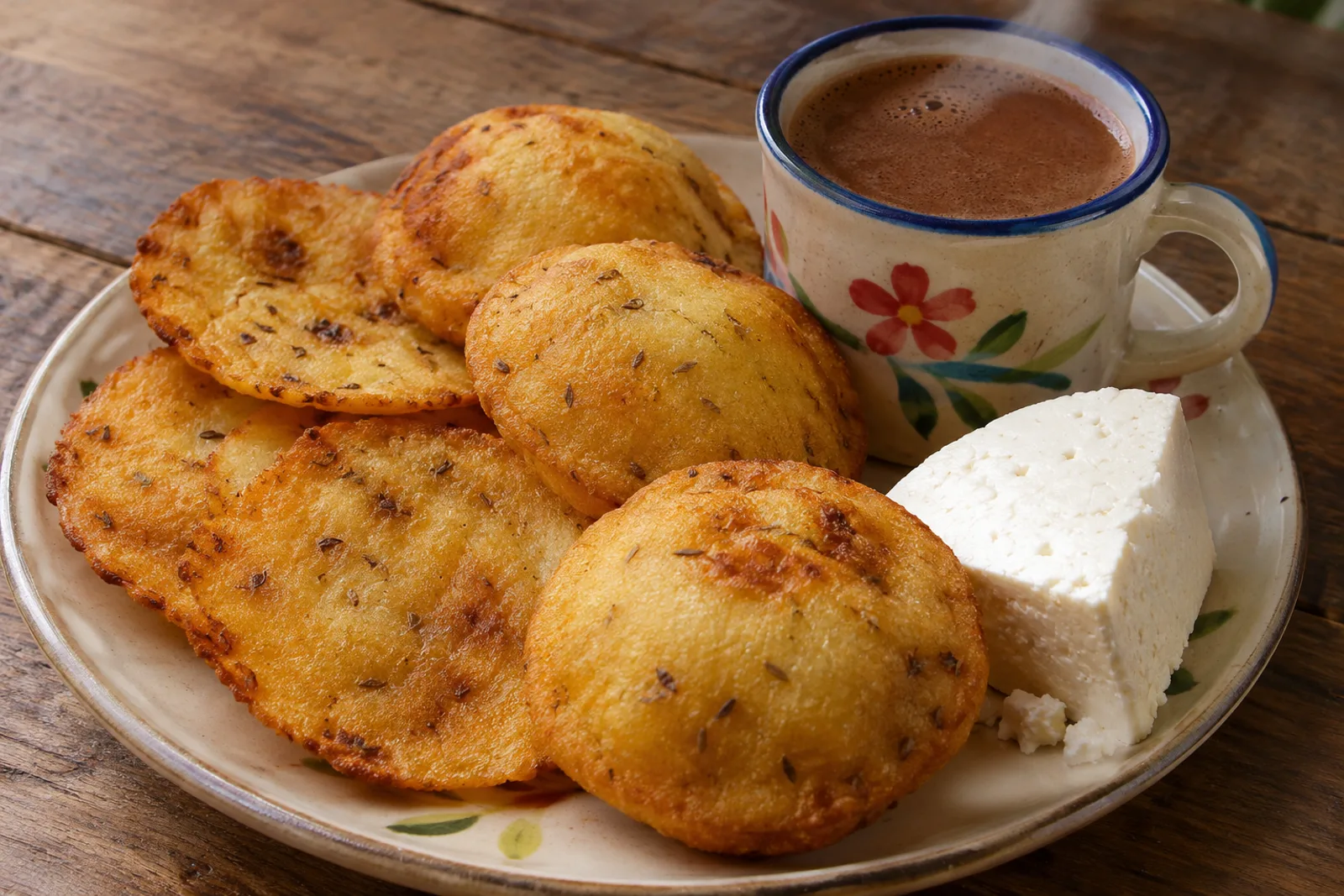

The Colombian anise arepa is a sweet fried corn cake from the Caribbean coast, made with panela and anise seed and served with salty white cheese, and its texture depends mostly on a ⅜-inch (1 cm) hole in the middle: it lets the steam out, so the disc stays flat, golden and brittle. Without it, if the dough is well hydrated, the edge has no cracks and the oil holds its heat, the steam can stay trapped and the arepa swells like a little pillow. You’ll find both styles at street fry stands, eaten with salty white cheese or tangy Colombian sour cream. This recipe makes 24 small arepas sweetened with panela and scented with anise seed, with the exact oil temperature, how to fry safely at home and how to freeze them raw.
What anise arepas are and how they’re eaten
How do you make Colombian anise arepas? Dissolve 2.8 oz (80 g) panela with 2 tsp anise seed in 1 cup (240 ml) hot water, add 1½ cups (360 ml) cold water and knead it into 2 cups (240 g) precooked white corn flour with a pinch of salt. Shape 24 discs 3/16 inch (4 to 5 mm) thick and fry them at 350°F (175°C), 3 minutes per batch, with a hole in the center if you want them crisp. 60 minutes for 6 servings.
These are small white-corn arepas, sweetened with panela or sugar and flavored with anise seed, fried until golden. The outside is crisp, the inside soft, and they are only lightly sweet, since they are meant to be eaten with something salty. Depending on the town they’re called arepa dulce, arepa de anís, arepuela or anisita.
Arepas are corn cakes, and this recipe uses masarepa, the precooked corn flour sold for them. It is not cornmeal and not the masa harina used for tortillas; neither will hold together the same way. On the coast the traditional dough is ground from cooked white corn, sometimes with a little cheese worked in, but masarepa gives a very close result in an hour and is easy to find in the US and UK. They’re eaten for breakfast or as an afternoon snack, with salty cheese, sour cream or a cup of Colombian hot chocolate.
How they differ from Venezuelan sweet arepitas and egg arepas
- Venezuelan sweet arepitas. Our version uses more raw cane sugar (5.3 oz / 150 g per 2 cups of flour, nearly double) and 20% wheat flour so the dough holds its steam pocket, and they’re split and stuffed with white cheese and cream; in Venezuela they’re also made with corn alone, and sweetness and filling vary from home to home. This coastal Colombian anise arepa is all corn, less sweet, and the cheese usually goes on the side, though a fresh one is also split and filled.
- Colombian egg arepa. Savory, made with yellow corn flour, bigger and thicker, and fried twice so a raw egg can be slipped inside. Same coast and same oil, different snack.
- For where these fit among the coast’s fried snacks, rice dishes and sweets, see the guide to Colombian Caribbean food.
Time. 60 minutes: 30 to make, rest and shape the dough, 30 to fry 6 batches. Difficulty, easy. The one thing that takes practice is keeping the oil at 350°F (175°C) between batches.
Ingredients and how much panela to use
The recipe makes 24 arepas of about 1.3 oz (38 g), 4 per person. The dough ratio is the standard arepa one, 2½ cups of water to 2 cups of flour, with the panela dissolved in the water.
Precooked white corn flour
Look for bags labeled precooked white corn meal, harina de maíz precocida or masarepa in the Latin aisle in the US, and in the world food aisle of large UK supermarkets or Latin shops online. The yellow kind works the same but gives a deeper color and more corn flavor.
Panela, piloncillo or sugar
2.8 oz (80 g) gives a cake that is sweet but not dessert-sweet, so salty cheese still stands out. Homestyle versions run from about 1.8 oz (50 g), barely sweet, to about 3.9 oz (110 g) for this much flour. More sugar browns faster: if you add more and the crust darkens before the center is cooked, lower the heat slightly and test another arepa. Panela is sold as piloncillo in Mexican shops; in the UK, dark muscovado sugar is the easiest swap. White sugar works at the same weight but the arepas come out paler, without the molasses note.
Anise seed
The small, ridged seed of green anise, sold as anise seed or aniseed. Heating it with the water and panela spreads its flavor through the whole dough. Star anise is a different plant, much stronger, and isn’t used here. For a stronger anise flavor, crush half the seeds in a mortar first.
With cheese in the dough
Some street cooks knead grated salty cheese into the dough, roughly 4 oz per 2.2 lb of dough (110 g per kilo): for this batch that’s 3.5 oz (100 g) of crumbled feta or queso costeño. You get a sweet-and-salty arepa that browns sooner. Work the cheese in at the end and hold the oil at 350°F (175°C).
Equipment. A deep skillet or Dutch oven about 9½ inches (24 cm) wide, a deep-fry or instant-read thermometer if you have one, two sheets of plastic (an opened zip-top bag works), a flat-bottomed plate for pressing and a slotted spoon or spider.
How to make anise arepas, step by step
A soft dough with no cracks
The dough is right when a ball pressed between your fingers has a smooth edge. If it cracks, it needs more liquid: add water a tablespoon at a time. If it feels sticky, let it rest the full 10 minutes before adding flour, because precooked corn flour keeps absorbing water.
Shaping the discs
Press each 1.3 oz (38 g) ball between the plastic sheets to 3/16 inch (4 to 5 mm) thick and about 3½ inches (9 cm) across. The edge matters: a crack lets the steam out and the arepa won’t puff. For crisp ones, poke the hole with a finger or a bottle cap just before frying.
Frying at 350°F (175°C)
At 350°F (175°C) each batch takes about 3 minutes; the time is a guide, and what matters is golden on both sides and cooked through (break the first one open to check). Cooler oil gives pale, greasy arepas that don’t puff; hotter oil darkens them before they’re done inside.
Fry 4 at a time in a 9½-inch (24 cm) pan. Crowd the pan and the oil temperature drops sharply, which makes them greasy. Let the oil come back to 350°F (175°C) between batches.
Puffed or crisp, what decides it
To puff them, leave the disc whole with a smooth edge and, as soon as it goes into the oil, spoon hot oil over the top for 20 to 30 seconds. The top heats at the same time as the bottom, the water in the dough turns to steam and the arepa can swell. Not every one will: slightly dry dough, a hairline crack or oil that has cooled is enough to keep it flat, and it still tastes good. For crisp arepas, the center hole lets that steam out, so they stay flat, brown evenly on both sides and stay crunchy longer.
Frying safely at home
Oil at 350°F (175°C) burns on contact, and a drop of water makes it spit. A few rules cover it:
- Shallow oil, deep pan. ¾ to 1 inch (2 to 3 cm) of oil, well below the rim. Discs this thin float at that depth.
- Dry dough going in. Dry your hands and never fry discs that are wet or frosty from the freezer: the water flashes to steam and throws oil.
- Lay them in away from you, setting the near edge in the oil first, and lift them out with a slotted spoon, not a fork.
- Never leave the stove while the oil is on, and keep kids back while you fry.
- If the oil catches fire, turn off the heat and cover the pan with a metal lid or a sheet pan, and leave it covered until it cools. Never throw water on it.
- If it smokes, it’s too hot: turn off the heat and wait before carrying on.
Why they don’t puff, or come out greasy
- They don’t puff. A cracked edge, oil under 350°F (175°C), or you didn’t spoon oil over the top. Smooth the edges with a damp finger and let the oil recover.
- They’re greasy. Oil too cool or too many in the pan. Batches of 4 at 350°F (175°C).
- Golden outside, raw inside. Oil too hot or too much sugar. Bring it down to 340-350°F (170-175°C) and give each batch its full 3 minutes.
- They break in the oil. The dough was dry or didn’t rest. Add water a tablespoon at a time and rest it 10 minutes.
- Hard the next day. That’s normal; reheat them as below and they crisp up again.
Allergens. Gluten-free if your corn flour is (check the label), and dairy- and egg-free unless you add cheese. Not spicy. Most kids love them; just keep them away from the pan.
Make ahead, freeze and reheat
Dough, a day ahead. Wrapped in plastic, it keeps up to 24 hours in the fridge. Take it out 15 minutes before shaping and knead in a few drops of water, since it dries a little.
Freezing raw discs. Lay shaped discs on a parchment-lined tray without touching and freeze for 2 hours, then move them to a freezer bag with parchment between layers. They keep up to 2 months. Thaw them in the fridge, pat them dry with paper towels and fry as usual; fried straight from frozen, the ice crystals make the oil spit.
Already fried. In a sealed container in the fridge for 3 to 4 days. Reheat in a dry skillet over medium heat for 3 to 4 minutes per side, or in a 350°F (175°C) oven for about 8 minutes, until crisp. The microwave makes them soft.
For a crowd. For 12 people, double the recipe (4 cups / 480 g flour, 5.6 oz / 160 g panela, 5 cups / 1.2 liters water) for 48 arepas. For 18, triple it (72 arepas); for 20, make 80 arepas with about 6⅔ cups (800 g) flour, 9.5 oz (270 g) panela, 8½ cups (2 liters) water, 7 tsp anise seed and just under 1 tsp salt. Use two pans, or shape all the discs first and fry while the first batches are being eaten.
Frequently asked questions
Can I make them in an air fryer? Yes, brushed with a little oil, but they won’t puff or get a fried crust. They come out like a dry, toasted sweet arepa.
Is this the same as a Venezuelan arepita? Close cousins. Our Venezuelan version is sweeter, has some wheat flour and is stuffed with cheese, though recipes vary there too; the coastal Colombian one here is all corn and the cheese usually goes on the side.
Can I skip the sugar? You can leave out the 2.8 oz (80 g) of panela, but then it’s a plain anise corn cake: it won’t brown the same and you lose the sweet-salty contrast with the cheese.
Nutrition
Per serving of 4 arepas (1/6 of the recipe), without cheese or cream, calculated from the recipe amounts with about 2 oz (60 g) of oil absorbed in total:
- Calories: 291 kcal
- Protein: 2 g
- Carbohydrates: 47 g
- Fat: 11 g, of which 1 g saturated
- Fiber: 1 g
- Sugars: 13 g
- Sodium: 101 mg
Each arepa comes to about 73 kcal, nearly a third of it from the oil it soaks up. A 1 oz (30 g) slice of white cheese adds about 90 kcal and a fair amount of salt.
I almost always make them with the hole, because I fry them for the afternoon and the crisp ones hold up on the table without going soft. The puffed ones I save for when they’ll be eaten straight from the pan, split open with a little cheese inside. Josnaisis.