
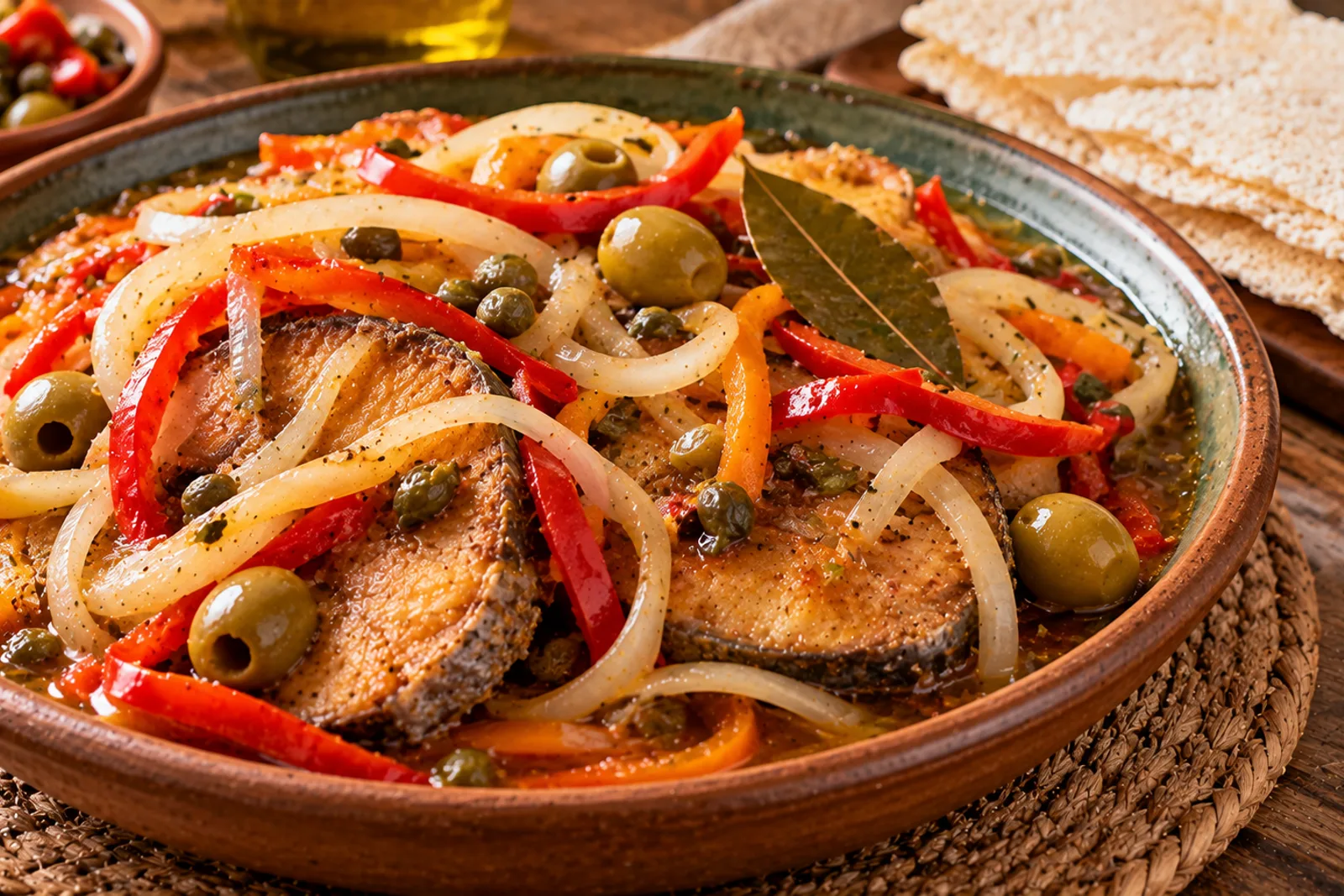

Venezuelan escabeche fish is ¾-inch (2 cm) mackerel steaks, floured and pan-fried, then covered with a hot dressing of onions, bell peppers, garlic, vinegar and oil and left in the fridge overnight. It is a cold dish, which is why Venezuelan families make it for Holy Week: you cook it ahead and on Good Friday you just bring it to the table. Below is the recipe for 6, which fish to buy in the US and UK, how much oil and vinegar to use, and how many days it keeps safely.
What Venezuelan escabeche fish is like
How do you make Venezuelan escabeche fish? Season 2.6 lb (1.2 kg) of mackerel steaks, flour them and fry at 350-355°F (175-180°C) for 4 minutes per side. Soften onions, bell peppers, garlic and spices in ¾ cup (180 ml) of oil, add ¾ cup (180 ml) of vinegar, boil 2 minutes and pour it hot over the fish. Chill 12 to 24 hours. 60 minutes of cooking for 6 servings.
You get a steak with a golden crust and firm, moist flesh that the vinegar seasons without cooking it again, under onions and peppers that still crunch a little. It tastes sharp and clean, with clove and bay in the background and the saltiness of olives and capers. If you know Jamaican escovitch fish, it’s a cousin: same idea of fried fish under a vinegar dressing, but without the hot Scotch bonnet. In Venezuela it belongs to the coast, and in Coro, in Falcón state, it counts as a local classic.
Time. 60 minutes of cooking, plus 12 to 24 hours in the fridge. Difficulty, medium: the only tricky part is frying without breaking the steaks.
Ingredients and which fish to buy
Amounts are in the recipe card. Plan on about 7 oz (200 g) of raw fish per person, one bone-in steak ¾ inch (2 cm) thick, skin on. A steak held together by its backbone survives days in vinegar; a thin fillet tends to break when you turn it.
King mackerel, Spanish mackerel and other options
The Venezuelan fish is carite. “Carite sierra” or “carite lucio” is the fish sold in the US as king mackerel; “carite pintado” is a smaller cousin, close to the Spanish mackerel of the US Atlantic and Gulf coasts. Both have firm, slightly oily flesh, which is what escabeche wants. Venezuelans also use snapper and grouper, which come out whiter and milder.
One thing matters here. King mackerel is on the federal list of fish with the highest mercury levels, and pregnant or breastfeeding women and young children are advised not to eat it. If any of them are at the table, use Spanish mackerel, snapper or Atlantic mackerel.
- In the US, Spanish mackerel is the closest match, sold whole or as steaks. Red snapper steaks work too. Ask the fish counter to cut ¾-inch (2 cm) steaks through the bone.
- In the UK, Atlantic mackerel is the easy swap. It’s smaller, so cut whole fish into thick bone-in pieces and plan on more than one piece each.
- What I wouldn’t use is thin cod, hake or tilapia fillets: they flake when you turn them and go soft in the vinegar. Thick cod loin works if you handle it gently.
The dressing, the vegetables and the spices
- Onions and bell peppers are the body of the dish, and there are a lot of them: 1.1 lb (500 g) of onion for 2.6 lb (1.2 kg) of fish. One red and one green pepper is the Venezuelan look.
- Ají dulce. A small Caribbean pepper, a mild relative of the habanero with its fruity scent but almost no heat. Latin grocers in the US sell it frozen. Without it, add 3.5 oz (100 g) more red bell pepper: same color, a little less perfume.
- Cloves, bay and black peppercorns. These are the coastal escabeche spices. Clove shows up quickly, so don’t go past 6.
- Capers and olives are optional, but their salt balances the vinegar. With them in, don’t add more salt to the dressing.
- Distilled white vinegar at the usual 5% acidity. Apple cider vinegar works and tastes softer and fruitier. In the UK, use white wine vinegar rather than malt.
Equipment. An 11-inch (28 cm) skillet for frying, a second pan for the escabeche, a wire rack and a glass or ceramic dish about 8 x 12 inches (20 x 30 cm); a 9 x 13-inch baking dish is fine.
How to make it step by step
The order is simple: dry the fish while you slice the vegetables, fry in two batches and make the escabeche last so it goes on hot.
Frying the steaks without breaking them
Flour only sticks properly to dry fish. Leftover lime juice turns the flour into paste, which spits in the oil and peels away. Pat the steaks dry twice, the second time right before flouring, and shake off the excess.
Heat the oil to 350-355°F (175-180°C). No thermometer? Drop in a pinch of flour: it should sizzle at once without darkening. Cooler than that and the steak soaks up oil and stays pale; hotter and the crust browns before the middle is cooked. Fry no more than 3 steaks in an 11-inch (28 cm) pan and leave them alone for 4 minutes: the crust releases by itself once it’s golden. Turn once, with a spatula and a fork.
When it’s done. The flesh next to the bone is white and opaque and pulls away with the tip of a knife, or reads 145°F (63°C). Drain the steaks on a rack, not flat on paper, so the underside doesn’t go soggy. The frying method is the same as for Colombian fried mojarra, with less oil because a steak is flat.
The escabeche and the oil to vinegar ratio
Cook the vegetables 5 to 6 minutes over medium heat and stop while the onion is translucent outside but still firm. Soft onions in the pan turn to mush after a night in vinegar. Once the vinegar goes in, 2 minutes at a boil is enough to bring it together with the oil and take the harsh edge off.
This recipe uses equal parts, ¾ cup (180 ml) oil to ¾ cup (180 ml) vinegar, for a frank, sharp escabeche, the one people expect at Holy Week. Venezuelan home cooks also make it with twice as much oil as vinegar, which is softer, or with no oil at all, using vinegar cut with water and a pinch of sugar.
Covering, cooling and resting
Pour the escabeche on hot while the fish is still warm, so the steaks take in the liquid as they cool. Spread the onions and peppers over the top and lift each steak so the liquid runs underneath. The fish doesn’t have to be submerged: turning the steaks once in the fridge gets both sides.
Let it cool uncovered for 1 hour at most, then cover and refrigerate. At 12 hours it’s good; at 24 hours the vinegar has reached the middle of the steak and the onions have picked up the pepper’s color.
How long it keeps, and why it goes in the fridge
Plenty of Venezuelan family recipes leave escabeche out on the counter under a cloth and eat it over several days. I don’t. The vinegar here is mixed with oil and the juices of the fish, and that acidity isn’t enough to keep cooked fish safe at room temperature.
- Fridge. At 40°F (4°C) or below, in the same covered dish or in glass jars, 3 to 4 days from cooking.
- Out of the fridge. No more than 2 hours in total, counting the cooling time and the time on the table. That’s why it cools for 1 hour at most and comes out only 20 to 30 minutes before eating.
- Freezer. I don’t freeze it: the onions and the flour crust go soggy when thawed and the steak loses the firmness that makes this dish.
- Serve it cold or at room temperature, never reheated.
Common mistakes and how to fix them
- The crust falls off and the steak breaks → the fish was damp, or you moved it before 4 minutes. Dry it twice and wait for the crust to release.
- Greasy and pale → the oil was below 350°F (175°C) or the pan was crowded. Fry 3 at a time and give the oil 1 minute to recover between batches.
- Soft onions → they cooked too long. Take them off firm; the vinegar keeps working.
- Too sharp → drizzle a little olive oil over each serving. Next time, use 2 parts oil to 1 part vinegar.
- Tastes fishy → the fish should smell of the sea when you buy it. Vinegar hides a little, but it won’t rescue fish past its best.
How to serve it, and for a crowd
Serve it cold, one steak each with its onions and peppers and a spoonful of the liquid on top. It goes with plain white rice, cold sliced boiled potatoes, avocado, or on a bed of soft cornmeal, which Venezuelans call funche. It’s also good in a crusty roll.
For a Good Friday lunch, make the escabeche the day before and cook only the rice on the day. For a second Venezuelan meatless dish, cazón guisado is stewed ahead too and fills arepas or empanadas, pastel de chucho is layered the night before and only baked, and Venezuelan fish soup is the hot starter. For more ideas, see our Lent and Holy Week recipes.
For 12 people double everything: 5.2 lb (2.4 kg) of fish in 12 steaks, fried in 4 batches, and two 8 x 12-inch (20 x 30 cm) dishes. Make the escabeche in a 3-quart (3-liter) pot with the same 2-minute boil.
Venezuelan escabeche fish FAQ
Can I make it without frying? Yes, grilled or baked, but without the flour crust the vinegar softens the surface and the steak tastes drier. Fried is the Venezuelan way.
Can I use fillets instead of steaks? Yes, if they’re thick, at least ¾ inch (2 cm), with skin. They cook a little faster than steaks: take them out when the center is opaque or reads 145°F (63°C), and turn them only once.
Why did the liquid go cloudy in the fridge? That’s the oil firming up in the cold, especially olive oil. It clears after 20 to 30 minutes out of the fridge.
Can I eat it the same day? Yes. After about 3 hours in the fridge the outside tastes of escabeche, but the center still tastes like plain fried fish. If you can, wait until the next morning.
Nutrition facts for Venezuelan escabeche fish
Per serving (one 7 oz / 200 g raw steak with its share of vegetables and dressing, no sides), worked out from the recipe amounts and assuming you eat half of the escabeche oil:
- Calories: 460 kcal
- Protein: 37 g
- Carbohydrates: 16 g
- Fat: 27 g, of which 3 g saturated
- Fiber: 3 g
- Sugars: 7 g
- Sodium: 1065 mg
Almost half the fat is the oil in the dressing, so leaving the liquid in the dish cuts it a lot. Olives and capers raise the sodium; without them, add another ¼ teaspoon of salt to the escabeche.
I like it best after one night rather than two, when the fish tastes of vinegar but still tastes of fish. And I always use bone-in steaks: I’ve tried fillets, and they fell apart in the dish every time I turned them. Josnaisis.