
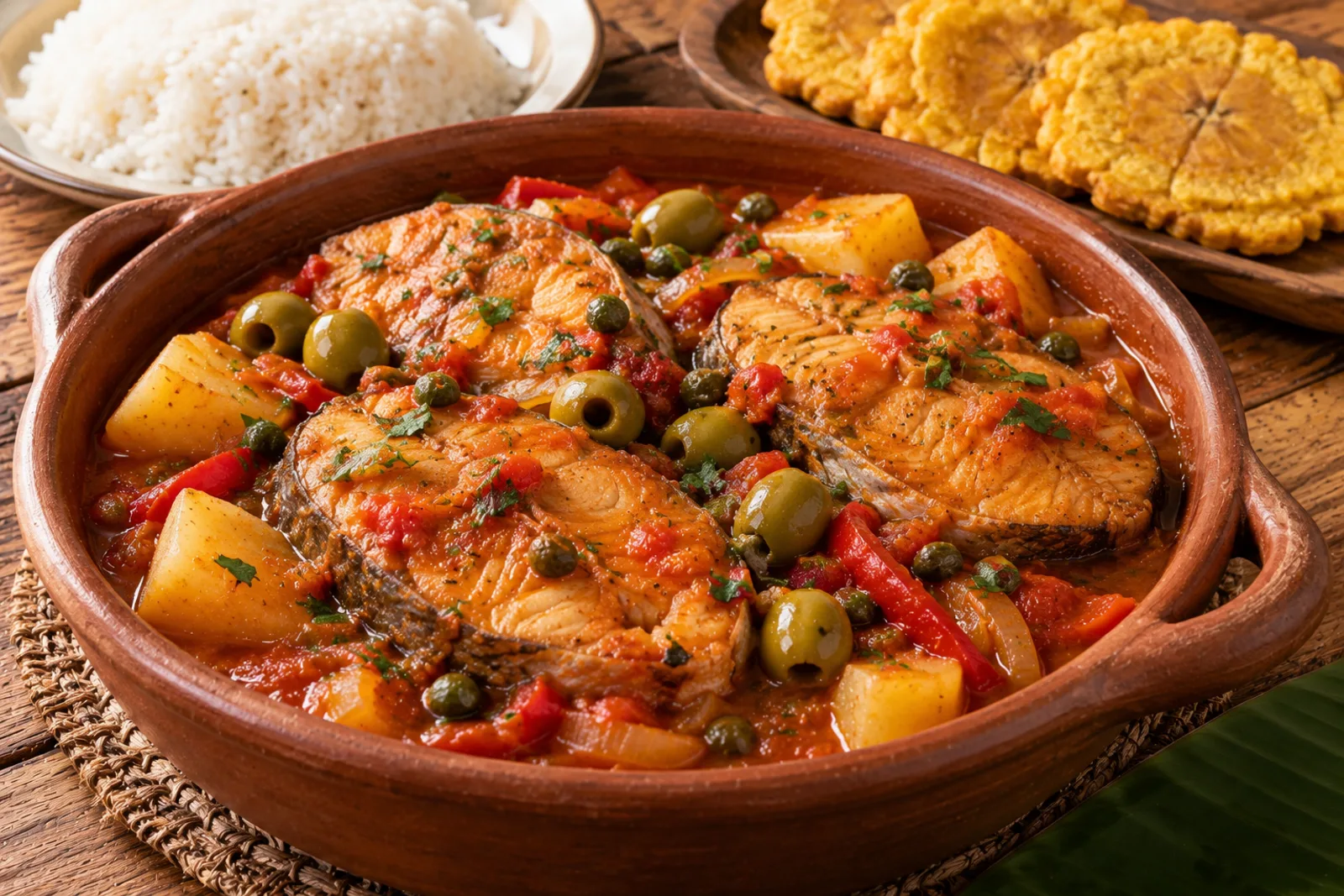

Corbullón de mero is grouper stewed the Venezuelan way: big chunks seared in oil, then finished in a sauce of tomatoes, red bell pepper, mild ají dulce and red wine, with olives, capers, potatoes and small cornmeal dumplings that cook right in the pot. If you’ve had fish Veracruz-style or a Louisiana courtbouillon, you’re in the same family, but with wine and corn. Here’s how to make it for 6, which fish to buy in the US and UK, how to keep the chunks whole, and how to scale it for a crowd.
What corbullón is and what you’ll get
How do you make Venezuelan corbullón de mero? Marinate 2.6 lb (1.2 kg) of grouper chunks briefly in lime, salt and pepper, sear the outside and set aside. In the same pan, cook onion, bell pepper, ají dulce and tomato into a thick sauce, add red wine, olives, capers and boiled potatoes, then return the fish with cornmeal dumplings for 10 minutes covered, until it reaches 145°F (63°C). 80 minutes for 6 servings.
The fish comes out white and moist, breaking into large flakes, in a thick red sauce that’s a little sharp from the tomato and wine and salty from the olives. The corn dumplings, flavored with ají dulce, soak up the sauce and do the job of bread. It’s a dish of eastern Venezuela, from the coast of Sucre to Margarita Island, where it is one of the most typical ways to eat grouper. Corbullón is the Venezuelan spelling of the French court-bouillon.
Time. 80 minutes, about 30 of them hands-off while the fish marinates. Difficulty, medium: the only tricky part is keeping the fish in one piece. There’s no meat in it, so it works for Lent and Good Friday.
Ingredients, and what to buy in the US and UK
Amounts are in the recipe card. Plan on 7 oz (200 g) of trimmed fish per person, skinless and boneless, in 1½ to 2-inch (4-5 cm) chunks. Size matters here: small pieces cook through before the sauce flavors them and break up when you serve.
Grouper and the fish that work instead
The Venezuelan original uses mero, which is grouper, and pargo, which is snapper. What the stew needs is a white fish with firm flesh that can sit 10 minutes covered in sauce and still be served in chunks.
- In the US, red grouper and black grouper are sold fresh or frozen at fish counters, and Latin markets often carry them. Red snapper is the closest swap, and amberjack works too.
- In the UK, grouper is a fishmonger order. Meagre (sold as corvina in Spanish shops) is firm enough and easier to find. Skip cod, haddock and hake fillets: they flake apart in a stew.
- Buying a whole fish? Keep the head and frame for stock, which you’ll want for the no-wine version.
- For pregnant women and young kids, grouper and snapper are on the federal list of fish to limit to one serving a week because of mercury.
Ají dulce, masarepa and the rest of the pot
- Ají dulce is a small Caribbean pepper with the fruity smell of a habanero and almost no heat. Latin grocers sell it frozen. Without it, add 1.75 oz (50 g) more red bell pepper and make the dumplings plain: still good, less perfume.
- Masarepa is precooked cornmeal, the arepa flour sold as P.A.N. or Goya Masarepa. Mexican masa harina and polenta won’t work: one tastes of tortilla and the other is raw. The dumplings are the same dough as Venezuelan bollitos pelones, just smaller and unfilled.
- Dry red wine, 1 cup (240 ml). White wine tastes just as good and gives a lighter-colored sauce. Some Venezuelan cooks add a small glass of sherry as well; it’s optional.
- Olives and capers salt the sauce for you, so taste before adding more.
- Potatoes are boiled separately so they go in cooked and the fish doesn’t have to wait for them.
Equipment. A 12-inch (30 cm) deep skillet or Dutch oven with a lid, wide enough for the fish in one layer, a pot for the potatoes, another for the dumplings, a slotted spoon and a wide spatula.
The plan, and what you can make ahead
The order is the whole recipe: potatoes and dumplings get done while the fish marinates, and the fish doesn’t go back in until the sauce is finished.
Make ahead. Cook the sauce through the wine step the day before and refrigerate it covered, along with the boiled potatoes. On the day, bring the sauce back to a boil, add the potatoes, sear the fish and finish it with the dumplings: about 30 minutes of stove time.
How to make corbullón de mero
Marinate briefly and sear only the outside
Venezuelan family recipes leave the fish in lime for up to 2 hours. I stop at 30 minutes: the acid starts turning the surface white and the chunks come out drier. Drain and pat them dry again before searing; wet fish steams, sticks and tears when you try to turn it.
Sear in two batches over medium-high heat. Each side needs 90 seconds to 2 minutes, and the pieces shouldn’t be touched until they release on their own. You only want color. The middle stays raw and finishes in the sauce.
Finish the sauce before the fish goes back
The sauce takes about 20 minutes in all: onions until translucent, garlic and peppers a few minutes more, then the tomatoes for a full 10 minutes uncovered. The sauce is ready when the tomatoes have collapsed and the oil glistens around the edges. Pour in the wine and let it boil 3 minutes uncovered so the raw alcohol smell fades, then add the olives, capers and potatoes.
Boil the dumplings separately in salted water while the sauce cooks and lift them out as soon as they float. That way they don’t cloud or thicken the sauce, and they don’t split in the pot.
Cooking the fish so it stays in chunks
Nestle the fish in a single layer, pressed into the sauce, and spoon sauce over the top. From here on, no spoon: to move anything, shake the pan by its handles. Lid on, low heat, 10 minutes in all, with the dumplings scattered on top at the halfway mark.
When it’s done. The center of the thickest piece is opaque, white all the way through, and flakes when you push it with a fork. On a thermometer, 145°F (63°C). Still translucent? Give it 2 to 3 more minutes covered. The 5-minute rest off the heat finishes it without overcooking.
Without wine, and other versions
Alcohol-free. Replace the wine with 1 cup (240 ml) of fish stock or water plus 1 tablespoon of red wine vinegar for acidity. That’s how I make it when kids are eating: after about 15 minutes of cooking once the wine goes in, roughly 40% of the alcohol is still in the sauce, or a bit more since much of that time the pot is covered.
- With snapper, the most common variation after grouper. Same times.
- With seafood. On the Paria coast it’s also made with crab, shrimp or squid, and some versions use coconut milk or curry. Add shrimp with the dumplings: 5 minutes is plenty.
- No dumplings. Without masarepa, serve it over plain white rice and double the potatoes.
- Not the same as fish Veracruz-style: it shares the tomatoes, olives and capers, but the Mexican dish has pickled güero chiles and no wine or corn dough.
What goes wrong, and the fix
- The fish falls apart → pieces too small, a soft fish, or stirring. Cut 1½ to 2-inch (4-5 cm) chunks, sear only the outside and shake the pan instead of stirring.
- It sticks when searing → it went in wet or you moved it too soon. Dry it after the marinade and wait until it releases.
- Dry, stringy fish → overcooked, or hours in lime. Pull it as soon as the center turns opaque.
- Watery or sharp sauce → the tomatoes didn’t get their 10 minutes or the wine didn’t boil. Finish the sauce before the fish goes in, never with it.
- Dumplings split → the dough was too dry. If a ball cracks when you press it, knead in a tablespoon of water.
- Too salty → salt in the marinade, salt in the sauce, olives and capers all add up. Taste the sauce before the ½ teaspoon and skip it if it’s already salty.
Feeding a crowd
Count 7 oz (200 g) of trimmed fish per person and scale everything else by the same factor. The real limit is the pan: a 12-inch (30 cm) one holds fish for 6 in a single layer, so for more people cook in several pans at once or in one very wide one.
- For 12: 5.3 lb (2.4 kg) fish, 2.6 lb (1.2 kg) potatoes, 2 cups (480 ml) wine, 2 cups masarepa and two 12-inch (30 cm) pans.
- For 20: 8.8 lb (4 kg) fish, 4.4 lb (2 kg) potatoes, 3⅓ cups (800 ml) wine, 3⅓ cups masarepa and three 12-inch (30 cm) pans.
For a Good Friday spread, Venezuelan escabeche fish and pastel de chucho are also made ahead, Venezuelan fish soup is the hot starter, and cazón guisado fills empanadas. More ideas in our Lent and Holy Week recipes.
Serving, storing and reheating
Serve it piping hot in shallow bowls, three or four chunks of fish each with potatoes, dumplings and plenty of sauce, and cilantro on top. With the dumplings it needs nothing else; if you want a side, rice or boiled cassava.
- Fridge. 3 to 4 days, covered, refrigerated within 2 hours of coming off the heat.
- Reheat covered over low heat with 2 to 3 tablespoons of water and no stirring, until the sauce bubbles and the center reaches 165°F (74°C). The microwave at half power works too.
- Freezer. Freeze only the fish and sauce; I don’t keep it more than 3 months. Potatoes turn grainy and dumplings crack after thawing, so make those fresh on the day.
Corbullón de mero FAQ
Is it the same as Louisiana courtbouillon? Same French root and the same idea of fish in tomato sauce, but the Louisiana version is usually redfish with celery and green pepper, and it never has corn dumplings; many versions skip the wine too.
Can I use frozen grouper? Yes. Thaw it in the fridge overnight, about 24 hours, and dry it very well before the lime and again before searing, because it releases more water than fresh. Same cooking times.
Is it spicy? No. Ají dulce adds aroma, not heat. If you like it hot, put hot sauce on the table.
Nutrition facts for corbullón de mero
Per serving (one sixth of the recipe, with potatoes and dumplings, no sides), worked out from the recipe amounts:
- Calories: 540 kcal
- Protein: 44 g
- Carbohydrates: 54 g
- Fat: 15 g, of which 3 g saturated
- Fiber: 6 g
- Sugars: 7 g
- Sodium: 1080 mg
Olives and capers account for a good share of the sodium. Leave out the potatoes and a serving drops to about 455 kcal.
I always cut the grouper bigger than looks right for a stew, close to 2 inches, because it shrinks a little as it cooks and small pieces end up as loose flakes. And I take it out of the pan before making the sauce: it’s the only way to give the tomatoes their 10 minutes without overcooking the fish. Josnaisis.