
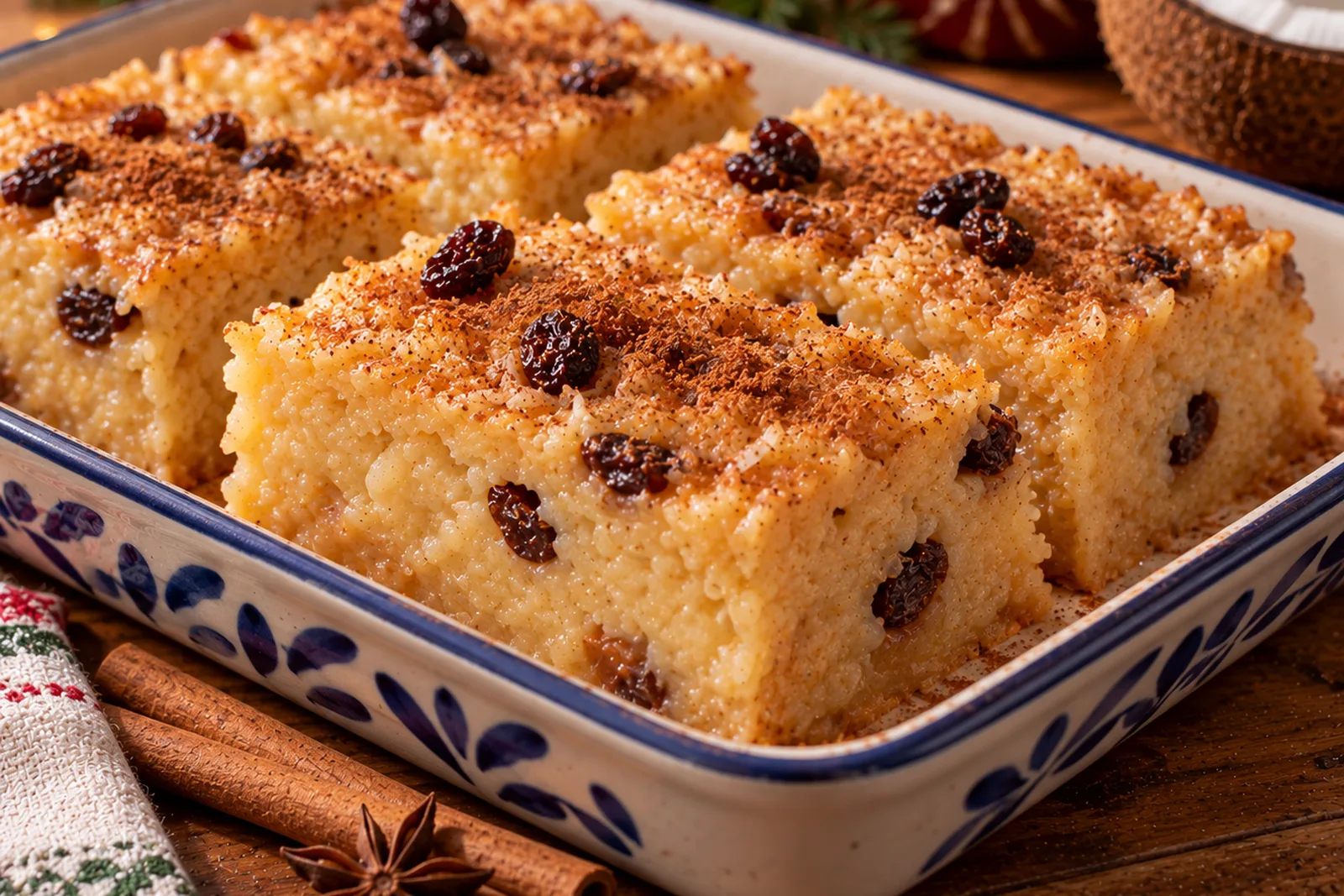

Arroz con dulce (ah-ROHS kohn DOOL-seh, “sweet rice”) is Puerto Rico’s Christmas rice pudding: short-grain rice simmered in coconut milk and a tea of ginger, cloves, cinnamon and star anise, sweetened with cream of coconut and studded with raisins. Unlike most rice puddings, it’s usually cooked thick enough to press into a pan and slice into squares once cold. There’s no milk, cream or egg in it, so it’s naturally dairy-free if you grease the pan with coconut oil. The one thing that decides whether it turns out right is when you take it off the heat, and that’s explained step by step below.
How to make arroz con dulce
How do you make Puerto Rican arroz con dulce? Soak 2 cups (400 g) of short-grain rice for at least 4 hours. Simmer a tea of cinnamon, cloves, ginger and star anise for 15 minutes, strain it, and cook the rice in 2 cups (480 ml) of that tea plus two cans of coconut milk, covered, for 20 minutes. Add cream of coconut, sugar and raisins and cook 15 to 20 minutes more, until the rice is tender, then press into a pan and chill 4 hours. 550 minutes for 12 servings, almost all of it soaking and chilling.
About 15 minutes of hands-on work and an hour at the stove, plus 4 hours of soaking and 4 hours in the fridge. Easy, as long as you keep scraping the bottom of the pot.
What it tastes like, and how it differs from other rice puddings
Cold, it’s dense and moist, a little chewy, with ginger and clove up front and coconut underneath; the cinnamon is mostly on top. It’s sweet, but less so than condensed-milk puddings.
- Classic rice pudding, and the Colombian rice pudding with cinnamon and condensed milk, are cooked in cow’s milk with nearly twice the liquid per cup of rice, and are eaten loose with a spoon.
- Tembleque, Puerto Rico’s coconut pudding, shares the table at Christmas but has no rice: it’s coconut milk set with cornstarch.
- Venezuelan majarete is coconut milk thickened with corn flour, smooth rather than grainy.
On a Puerto Rican holiday table it comes after the pasteles, the island’s plantain-dough tamales, and arroz con gandules, usually alongside a glass of coquito, the coconut eggnog.
Ingredients, and what to buy in the US and UK
| Ingredient | Metric | US | Shopping notes |
|---|---|---|---|
| Short- or medium-grain rice | 400 g | 2 cups | US: medium-grain in the Hispanic aisle, or Calrose. UK: pudding rice or risotto rice |
| Water for the spice tea | 720 ml | 3 cups | |
| Cinnamon sticks, cloves, star anise | 3, 8, 2 | 3, 8, 2 | Star anise is in the spice aisle or Asian section |
| Fresh ginger | 30 g | 1 oz, a 2 inch piece | |
| Coconut milk, full-fat, unsweetened | 800 ml | two 13.5 fl oz cans | UK: standard 400 ml cans |
| Cream of coconut, sweetened | 425 g | one 15 oz can | Cocktail aisle (it’s the piña colada can). UK: online or Caribbean shops |
| Sugar | 75 g | ⅓ cup | White or light brown |
| Salt | 3 g | ½ tsp | |
| Raisins | 75 g | ½ cup | Optional |
Which rice works
Short- and medium-grain rice release starch as they cook, which is what turns the coconut milk into something that sets. Long-grain, basmati and jasmine stay separate and the pudding won’t hold together or slice, so skip them. In the UK, a bag of pudding rice is the easy answer; arborio is fine too.
Soak it. Four hours to overnight lets the grains hydrate before they hit the pot, so they cook evenly and soak up the coconut milk. You can skip it, but the rice takes longer to soften and drinks more liquid, so keep 1 cup (240 ml) of hot water or coconut milk nearby and keep tasting.
Coconut milk, cream of coconut, and how sweet it ends up
These cans look alike and do different jobs.
- Coconut milk, canned, full-fat. The base. The fat separates and goes solid in the can; shake it or whisk it smooth before measuring. Light coconut milk gives a softer, thinner pudding, and the coconut drink in a carton doesn’t work.
- Cream of coconut (Coco López and similar). Thick, sweet coconut syrup, about half of it sugar, roughly 7½ oz (220 g) in a 15 oz can. That’s why the recipe adds only ⅓ cup of sugar.
- Coconut cream is unsweetened, thicker coconut milk. It’s not a substitute for cream of coconut: if that’s what you have, follow the version below.
- No cream of coconut? Use a third 13.5 fl oz (400 ml) can of coconut milk instead and raise the sugar to 1½ cups (300 g). It’s a little paler and less coconut-candy sweet.
Equipment. A heavy 4- to 5-quart pot (a Dutch oven is ideal), a flat spatula that reaches the corners, a strainer and an 8 x 8 inch pan. The three cans of coconut are what make this dessert cost more than plain rice pudding; the version without cream of coconut is a little cheaper.
Step by step, and the moment to stop cooking
The spice tea
The spices are simmered in water and strained out, so the pudding is fragrant without cloves or chunks of ginger in every bite. Smashing the ginger with the flat of a knife releases far more flavor than slicing alone. After 15 minutes covered you’ll have about 2 cups (500 ml) of tea; use 2 cups (480 ml).
Covered first, then uncovered
The rice goes into boiling tea and coconut milk and cooks covered on low for 20 minutes. Every 5 minutes, lift the lid and scrape the whole bottom: the starch settles and sticks before you can smell it. Then the cream of coconut, sugar and raisins go in and the lid comes off for 15 to 20 minutes, stirring often, because now it thickens fast.
How to tell it’s done
Two signs, both at once:
- The rice is fully tender. Bite three or four grains from different spots: no white, chalky center. This matters more than anything else, because cooked rice firms up in the fridge, and a grain that’s slightly al dente in the pot is hard the next day.
- A line drawn across the bottom of the pot with the spoon closes slowly, and there’s almost no loose liquid on top. Hot, it will look too soft to slice. Cold, it will slice.
If the rice is still firm and the liquid is gone, add ½ cup (120 ml) of hot water or coconut milk and keep going. If the rice is tender but it’s still soupy, keep cooking uncovered, stirring, a few minutes more.
Sliceable or spoonable
Same pot, one difference. For a spoonable pudding, stir in one more 13.5 fl oz (400 ml) can of coconut milk at the end, cook 5 minutes and stop when it moves like a thick risotto. It firms in the fridge but still scoops. You can also make the sliceable one and loosen a few servings the next day with a splash of coconut milk.
Into the pan, and how long it takes to set
Grease the pan, spoon in the hot pudding and press it level with the back of a spoon so there are no gaps and the squares cut clean. Dust with cinnamon, lay the cinnamon sticks on top and let it cool no more than 1 hour. Press plastic wrap onto the surface so it doesn’t form a skin, then refrigerate at least 4 hours to slice, overnight for the cleanest cut. A knife dipped in cold water helps.
Troubleshooting
- Hard the next day. It came off the heat with the rice al dente or too little liquid. Warm the servings you need in a small pan over low heat with a splash of coconut milk, stirring, until the rice softens; they’ll be creamier than sliceable.
- Won’t slice. Too much liquid at the end, or not enough time in the fridge. Give it the whole night; if it’s still soft, serve it in cups as the spoonable version.
- Scorched bottom. The heat was too high or the bottom wasn’t scraped after the cream of coconut went in. Don’t scrape the burnt layer: tip the rest into a clean pot and finish there.
- Not much spice flavor. The tea was too short, or the ginger wasn’t smashed. Fifteen minutes covered, ginger crushed.
- Loose grains that won’t bind. Long-grain rice. There’s no fixing that batch; use short- or medium-grain next time.
Allergens and kids. Contains coconut. No gluten, no eggs, and no dairy if you grease the pan with coconut oil. It isn’t spicy; the ginger is warm, not hot, and most kids like it. Each square has about 29 g of sugar, so cut smaller pieces for children.
Variations and scaling
- Half batch, for 6. Halve everything, use a 3-quart pot and a loaf pan or 6 cups. Timings barely change.
- Double batch, for 24. An 8-quart pot and two 8 x 8 inch pans. With twice the rice it takes a few minutes longer to soften: go by the grain, not the clock.
- With shredded coconut. Add 50 g (⅔ cup) unsweetened shredded coconut with the raisins for more texture.
- With evaporated milk. Some families swap one can of coconut milk for 1½ cups (360 ml) evaporated milk. Paler, milkier, and no longer dairy-free.
- Rum raisins. Soak the raisins overnight in 2 tbsp dark rum, for adults.
Make ahead and storage
Make ahead. Soak the rice the night before and cook it the next morning, or make the whole pan a day or two ahead. I think it tastes best on day two, once the spices have settled in.
Fridge. Refrigerate within 2 hours of cooking, covered, for 3 to 4 days. Keep it in the pan and cut squares as you serve them.
Freezer. It can be frozen in well-sealed portions for 2 to 3 months, but the rice comes back firmer and the coconut fat a little grainy. Thaw in the fridge and warm it with a splash of coconut milk to bring it back. For the sliceable pan, I’d rather make it fresh.
Reheating. It’s normally served cold. To serve it warm, heat it in a pan over low heat with 1 to 2 tbsp coconut milk, or in the microwave in 30-second bursts, stirring, until steaming hot, 165°F (74°C) for leftovers that are a few days old.
FAQs
Is arroz con dulce served hot or cold? Usually cold, cut into squares after at least 4 hours in the fridge. The spoonable version is also eaten warm on the day it’s made, but warm it won’t slice.
Can I use regular rice from my pantry? Only if it’s short- or medium-grain. Long-grain rice gives separate grains in sweet coconut milk rather than a pudding that sets.
How is it different from arroz con leche? Arroz con leche uses cow’s milk, cinnamon and often condensed milk, and stays loose. Arroz con dulce uses coconut milk and a ginger and clove tea, and is cooked down until it holds its shape.
Can I make it less sweet? Yes. Leave out the ⅓ cup of sugar entirely; the cream of coconut alone still makes it a dessert.
Nutrition per serving
Per serving, one-twelfth of the pan (one square), calculated ingredient by ingredient with full-fat canned coconut milk and sweetened cream of coconut:
- Calories: 412 kcal
- Protein: 4 g
- Carbohydrates: 58 g, of which 29 g sugars
- Fat: 19 g, of which 17 g saturated
- Sodium: 120 mg
The rice, the coconut milk and the cream of coconut each bring about 120 kcal per square, and the cream of coconut carries most of the sugar. The spoonable version, with one more can of coconut milk, comes to about 474 kcal.
My habit is a firm pan, chilled overnight and cut into squares that can be handed round on napkins. If you take one thing from this recipe, make it the tasting: before the heat goes off I bite grains from the middle and from the edges of the pot, because rice that seems nearly done while it’s hot turns hard by morning. Josnaisis.