

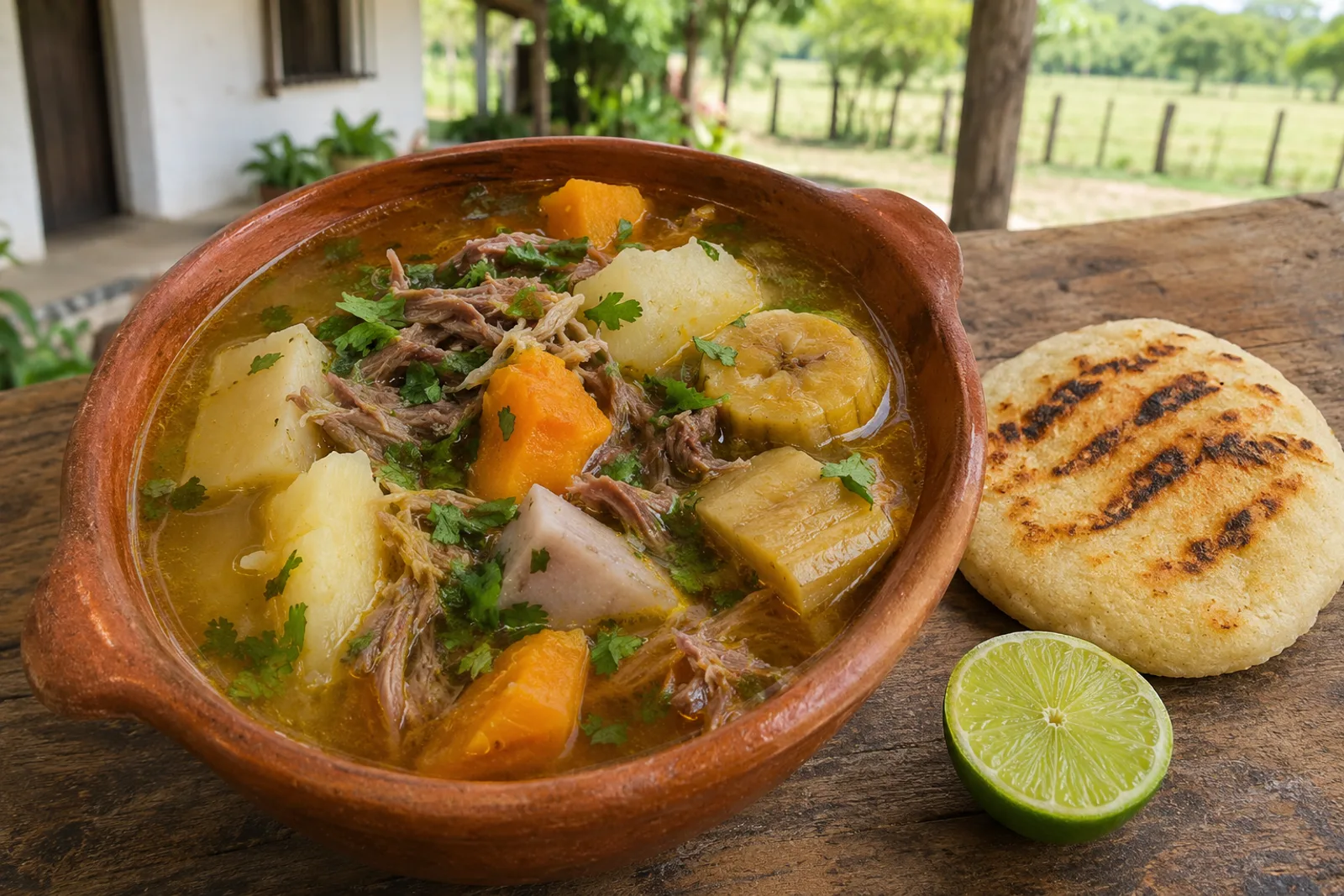

In Barinas, on the cattle plains of western Venezuela, picadillo llanero is a beef soup where nothing is bigger than a sugar cube: tender beef, cassava, white yam, malanga, green plantain and squash, all diced to about 1 cm (⅜ in) and simmered in a broth thick enough to eat with a spoon. Barinas cooks make it with fresh beef; in neighboring Apure it is made with salted beef. This version makes 8 bowls with fresh brisket, plus the salted-beef method and a shopping guide for US and UK stores.
What picadillo llanero is
How do you make Venezuelan picadillo llanero? Simmer 2.2 lb (1 kg) of diced brisket with garlic and leek in 8½ cups (2 liters) of water until tender, strain, and cook the beef 15 minutes with onion, scallions, sweet peppers and garlic. Add the broth with cassava and yam, then plantain and malanga 5 minutes later, then squash, cilantro and mint. 150 minutes for 8 servings.
Llanero means “from the plains,” the flat ranch country that runs across Venezuela and into eastern Colombia. In Arauca, on the Colombian side, a version with air-dried beef is served with fried green plantains and rice. The soup grew up as a way to use whatever beef was left from the week, and it is filling enough to be the whole meal. For the rest of that ranch-country table, see this guide to llanero food from Venezuela and Colombia.
If you are thinking of Cuban or Mexican picadillo, this is a different dish entirely. The Mexican picadillo with ground beef and potato is a juicy skillet hash with no broth; here “picadillo” just means everything is chopped small. It is also not the Venezuelan beef hervido, which uses bone-in beef and big chunks of root vegetables in a clear broth. Picadillo is boneless, diced, and thick.
Time and effort. 150 minutes, about 80 of them hands-on, mostly peeling and dicing. Medium difficulty: nothing tricky, but the order the vegetables go in matters.
Ingredients and where to shop in the US and UK
For 8 deep bowls you need 2.2 lb (1 kg) of beef and about 3¾ lb (1.7 kg) of vegetables. The full list with amounts is in the recipe card at the bottom. The beef and the squash define the dish; everything else can flex.
The beef
- Brisket or chuck. Brisket (pecho in Venezuela) is a little fatty and stays juicy; chuck is leaner. Trim the thick fat cap but not every bit of fat. Dicing is easier when the meat is very cold, or ask the butcher to cube it for stew and then cut each piece smaller.
- Leftover grilled or roast beef. Dice it, skip the hour of simmering, start at the aromatics step and use 1.5 liters (6¼ cups) of beef stock instead of homemade broth. The soup comes out smokier.
- Salted beef. The Apure version. It needs an overnight soak, below.
Salted beef, the night before
Cut it into 4-5 cm (1½-2 in) pieces, cover with cold water and refrigerate 8 to 12 hours, changing the water every 3 to 4 hours. Boil it 10 minutes in fresh water and throw that water away, then simmer it in the recipe’s 2 liters with no salt for 60 to 90 minutes and dice it once cooked, because raw salted beef won’t dice neatly. Taste a small piece boiled for 5 minutes: if it is already salty, skip the salt later. In the US, Brazilian carne seca from Brazilian or Latin markets is the closest match. In the UK it is hard to find, so fresh brisket is the better choice. Do not try sun-drying beef at home: without temperature control it is not safe.
The roots and the peppers
- Malanga (ocumo). A hairy brown tuber with white flesh that turns creamy in the soup. US Latin markets sell it as malanga or yautía; UK Caribbean and African grocers sell it as eddoes. A floury potato such as a russet or Maris Piper is the fallback, a little less creamy.
- White yam (ñame). A big, thick-skinned root with firm white flesh, found in Latin and African grocers. The orange “yam” in US supermarkets is a sweet potato and would sweeten the soup; use more cassava instead.
- Green plantain. Buy them fully green and firm. Peel by cutting off the ends, scoring the skin lengthwise and prying it off with your thumb.
- Squash. Calabaza in US Latin markets, butternut anywhere. Don’t leave it out: it is what thickens the broth.
- Ají dulce. Small, aromatic and with no heat. Look in Caribbean markets, sometimes as ají cachucha. Half a red bell pepper gives color and sweetness but not the perfume.
- Fresh mint. Spearmint, the ordinary garden kind. It is typical of the Barinas version; leave it out if you must, but try it once.
Equipment. A 6-quart (6-liter) pot with a lid, a large strainer, a pitcher for the broth and a sharp knife. With a smaller pot, make half.
Cost. The beef is the expensive part; the roots are cheap. Chuck instead of brisket, or leftover roast beef, brings it down a lot.
How to make it, step by step
Dice everything the same size. Aim for 1 cm (⅜ in) cubes. Mixed sizes mean the small bits turn to mush while the big ones are still hard. Keep the cut cassava, yam, plantain and malanga in cold water: plantain darkens in the air and malanga gets slimy, and the water rinses that off.
Know when the beef is ready. Diced beef takes 50 to 60 minutes at a gentle simmer. Press a cube against the side of the pot with a fork; it should give without springing back. If it resists, give it 10 more minutes. Keep the surface barely bubbling, since a hard boil clouds the broth and evaporates too much of it.
Don’t skip the 15 minutes with the aromatics. The cooked beef goes back into the pot with the onion, scallions, sweet peppers and garlic for 15 minutes, stirring and scraping. The browned bits on the bottom dissolve into the broth later and give it color and depth. Some cooks add the aromatics straight to the broth instead, but this step is where most of the flavor comes from.
Add the vegetables in order.
Cassava and yam first, plantain and malanga 5 minutes later, squash for the last 10 minutes. Some squash cubes hold their shape and some melt, turning the broth orange and thick.
What done looks like. The cassava mashes under a spoon, the plantain is soft but whole, and the thick orange broth barely covers the vegetables. Too dry, add reserved broth; too thin, uncover and simmer 5 minutes more. Then let it rest 8 minutes covered so the mint releases its aroma.
Common problems and fixes
- Mushy vegetables. Everything went in at once, or it boiled hard. Follow the order and keep it at a gentle simmer.
- Watery soup. Too little squash, or all the broth went in at once. Start with 1 liter (4¼ cups) and add more only if needed.
- Tough beef. It was strained too early. Test a cube first; 30 minutes with the vegetables won’t fix it.
- Too salty. With salted beef, the soak was too short. Add hot water and a few more cubes of cassava or potato, then cook until soft.
Heat, kids and allergens. Zero heat, since ají dulce is a sweet pepper. Kids usually like it. No gluten, dairy, egg or nuts.
Variations and scaling
- Barinas style, fresh beef. The recipe above.
- Apure style, salted beef. Soaked overnight, no salt until you taste.
- With ripe plantain. Swap in yellow-black plantain and add it with the squash, since it softens fast. Sweeter.
- Cumin or no cumin. Optional; families split on it.
- Want beef and chicken together? That is a different Sunday soup, the Venezuelan cruzado with beef and hen, with chunky vegetables and 10 bowls.
- For 16. Double everything and use a 12-quart (12-liter) pot or two pots. The beef takes the same time; fry the beef with the aromatics in two batches so it doesn’t crowd.
Serving, storing and reheating
Serve in deep bowls with plenty of broth. In Barinas it comes with fluffy white rice on the side and a glass of Venezuelan papelón con limón, a raw-sugar lemonade. Eight generous bowls need nothing else.
Fridge. Don’t wait for the whole pot to cool: divide the leftovers into small, shallow containers, cover and refrigerate within 2 hours (1 hour if it is above 90°F / 32°C). It keeps 3 to 4 days and tastes better on day two.
Freezer. 2 to 3 months. Cassava and plantain soften a bit after thawing; the flavor holds. Thaw in the fridge overnight.
Reheat. It thickens a lot as it cools, because the squash and roots release starch. Reheat over medium-low with ½ cup (120 ml) of water or broth per 4 bowls, stirring, until it simmers and reaches 165°F (74°C). In the microwave, use medium power and stir every minute.
Picadillo llanero FAQ
Is picadillo llanero spicy? No. Ají dulce has no heat. Put hot sauce on the table if you like.
Can I use ground beef? You can, but it becomes a different soup: ground beef breaks up in the broth and you lose the firm little cubes that define it. Dice the beef by hand.
Can I make it in a pressure cooker or Instant Pot? For the beef, yes. With the recipe’s 2 liters (8½ cups) of water, and the pot no more than two-thirds full, the diced beef needs about 15 to 20 minutes at high pressure plus about 10 minutes of natural release. Open it and press a cube; if it still resists, give it 5 more minutes at pressure before you strain. Cook the vegetables in the open pot afterward: cubes this small turn to mush under pressure.
What is the difference between picadillo llanero and Venezuelan pisillo? Both come from the plains. Venezuelan pisillo, the dry-fried shredded beef, is beef shredded very fine and fried dry in a skillet, with no broth. Picadillo is a soup.
Nutrition per serving
Per bowl (⅛ of the recipe, without rice), worked out ingredient by ingredient from the recipe amounts:
- Calories: 600 kcal
- Protein: 27 g
- Carbohydrates: 61 g
- Fat: 28 g, 10 g saturated
- Fiber: 5 g
- Sugars: 6 g
- Sodium: 550 mg
Most of the fat comes from the brisket; chuck with the fat trimmed lowers it. With salted beef the sodium goes up by an amount nobody can calculate, since it depends on how much salt the soak pulls out.
I dice everything while the beef simmers, so the waiting time is never wasted, and I never leave out the mint, even if it’s only eight leaves. When I can, I make it the day before: reheated, with the broth a little thicker, is how I like it best. Josnaisis.