

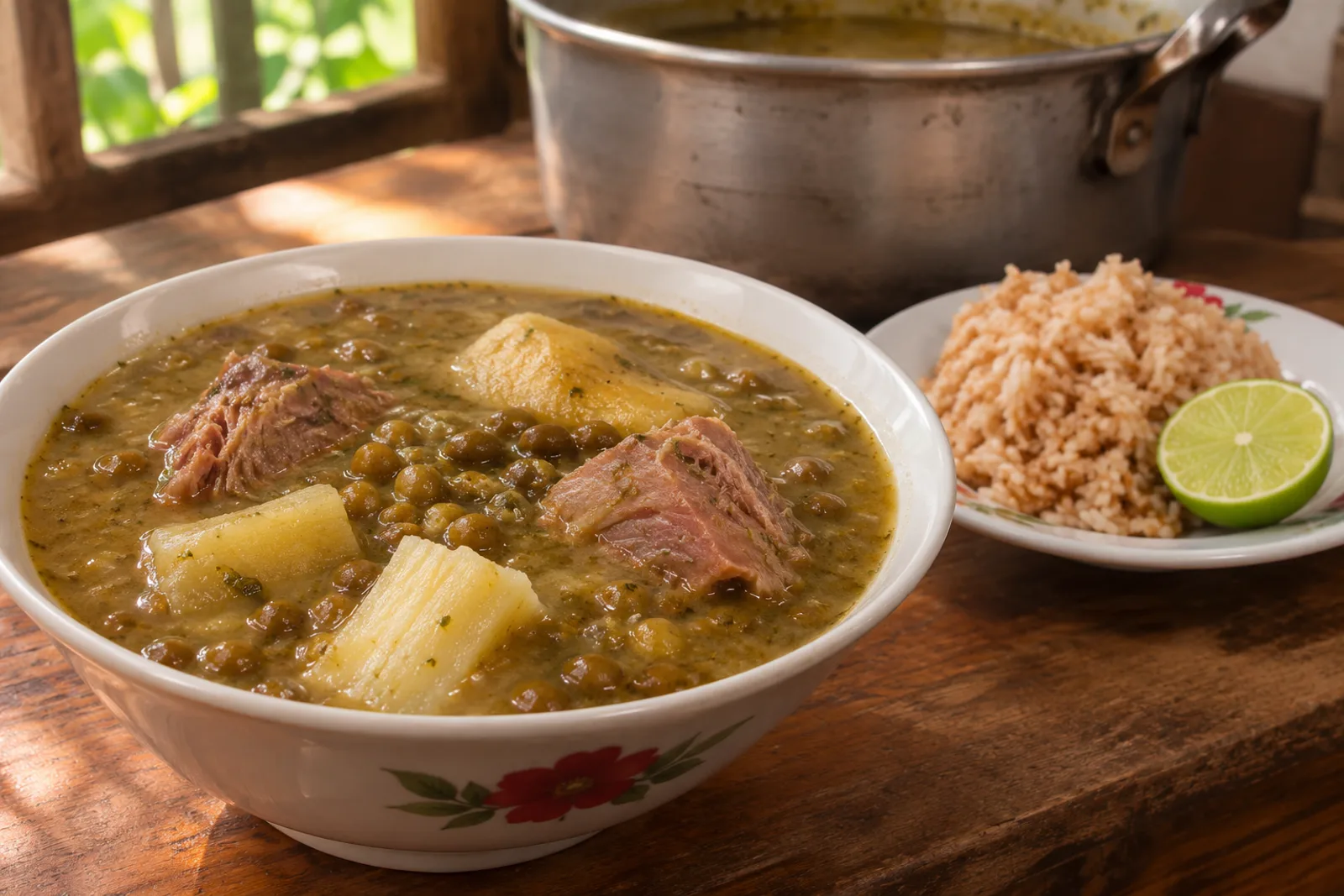

Colombian guandú soup (gwahn-DOO) is the everyday soup of Barranquilla, on Colombia’s Caribbean coast: pigeon peas simmered with salt beef and pork ribs until the broth turns thick, then white yam, cassava and a ripe plantain for sweetness. The one thing to get right is the salt. Colombian salt beef has to soak 8 to 12 hours in the fridge, and a 3-minute test on a small boiled piece tells you whether it’s ready. Here’s the recipe for 8, how to handle the beef, which pigeon peas to buy, and what to use when there’s no salt beef at your store.
What Colombian guandú soup is
How do you make Colombian guandú soup? Soak 1⅓ lb (600 g) of salt beef and 14 oz (400 g) of dried pigeon peas overnight in the fridge. Simmer them with pork ribs in 3¾ quarts (3.5 liters) of water for 60 minutes, add white yam, cassava and an onion, pepper and tomato sofrito for 15 minutes, then a ripe plantain for 15 more. Finish with cilantro and salt only if needed. 115 minutes for 8 bowls.
In the Atlántico department it’s called both sopa and sancocho de guandú, and it’s the dish people link to the Barranquilla Carnival, because fresh green pigeon peas are harvested around that time. The rest of the year it’s a one-bowl lunch with rice on the side. It comes out thick and golden from the annatto, with soft, nutty peas, shreds of salt beef and yam half dissolved into the broth. It’s one of the core dishes of Colombian Caribbean food.
Not the same as the Venezuelan pigeon pea soup, which uses fresh pork, taro and pumpkin and boils the peas separately first, or the Dominican moro de guandules, which is a dry rice dish. Salt beef, white yam and ripe plantain are what make this one Colombian.
Time. 115 minutes on the day, about 45 of them hands-on, plus the overnight soak. Easy: the only thing that needs care is the salt. Makes 8 large bowls, a full meal each.
Ingredients, and which pigeon peas to buy
Full amounts are in the recipe card. For 8 bowls you need 14 oz (400 g) of dried peas, about 2½ lb (1.1 kg) of meat between salt beef and ribs, and 2¾ lb (1.25 kg) of yam, cassava and plantain.
Dried, fresh, frozen or canned pigeon peas
Pigeon peas are sold as gandules in Latin aisles in the US, as gungo peas in Caribbean shops in the UK, and as whole toor in Indian grocers (not toor dal, which is split and turns to mush). On the Colombian coast cooks prefer them fresh and green when they’re in season; the rest of the year, dried, which is what this recipe uses.
- Dried. Beige or speckled. Soak 8 to 12 hours and simmer about 60 minutes. They give the broth the most body.
- Fresh green or frozen. No soaking. Use 2.2 lb (1 kg), the amount I use in this pot in place of 14 oz of dried; it’s an approximate swap, since green peas hold a lot of water. Add them after the meat has simmered 30 minutes and cook 30 to 40 minutes.
- Canned. Already cooked. Count roughly 2.4 lb (1.1 kg) drained as an approximate amount for this pot; check the drained weight on the label for how many cans. Simmer the meat alone 60 minutes, add the rinsed peas with the yam and use 2 cups (500 ml) less water. The broth comes out thinner.
Salt beef, and what to use instead
Colombian carne salada is beef brisket or flank that’s been salted and air-dried, sold that way at butchers and markets on the coast. It gives the soup its cured flavor and nearly all of its salt. Fresh pork ribs balance that salt and add fat to the broth.
- Fresh beef plus smoked pork ribs. The safest swap: 1⅓ lb (600 g) fresh brisket or flank instead of the salt beef, with the ribs split into 9 oz (250 g) fresh and 9 oz (250 g) smoked. No soaking, but smoked ribs bring salt of their own: taste the broth once the vegetables are in and add salt only then, ½ tsp at a time, up to 1½ tsp at most. Milder, less cured.
- Barrel salt beef. Sold in West Indian and Caribbean groceries in the US and UK, in brine. The closest match: soak it the same way and do the boiled-piece test.
- Raw corned beef brisket. From the supermarket, uncooked, spice packet thrown away. It works, but stays pink and tastes faintly of pickling spice. Rinse it and do the same test.
White yam, cassava and ripe plantain
- White yam (ñame). A brown-skinned tuber with white flesh, and the soup’s thickener: the outside dissolves and the center stays firm. It is not the orange sweet potato that US stores label “yam”. Ask for ñame or white yam at Latin, Caribbean or African grocers. If you can’t find it, use 2.2 lb (1 kg) of cassava and mash a few pieces at the end.
- Cassava (yuca). Fresh or frozen; frozen comes peeled and goes in straight from the freezer.
- Ripe plantain. Yellow with black spots. Its sweetness offsets the salt beef. Some cooks leave it out or use green plantain, which makes the soup firmer and less sweet.
- Ají dulce. A small Caribbean pepper with no heat, often frozen in Latin stores. Swap in ½ red bell pepper (80 g / 3 oz).
Equipment. An 8-quart (8-liter) pot with a lid, a bowl for soaking that fits in your fridge, and a skimmer.
How long to soak salt beef
Salt beef needs 8 to 12 hours in cold water in the refrigerator, with the water changed at least twice. It goes in the fridge because it’s raw meat sitting off the heat all night; at room temperature, especially in a warm kitchen, the water won’t stay cold. Thicker pieces take longer, so cut it into 2-inch (5 cm) chunks before soaking, not after.
The boiled-piece test. Every batch of salt beef carries a different amount of salt, and you can’t see it. Before cooking, cut off a ½-inch (1 cm) piece, boil it 3 minutes in unsalted water and taste:
- Tastes like ham, salty but pleasant → ready. The soup will need little or no salt.
- Makes your mouth pucker → boil all the beef for 10 minutes in fresh water, discard the water and test another piece. Still very salty? Back into cold water in the fridge for 2 or 3 hours, changing the water, and test again.
- Tastes of nothing → it soaked too long. No harm done: salt the soup at the end.
The test tells you about salt, not tenderness: the beef softens later, during the hour in the pot.
Forgot to soak it? Rinse the beef twice, rubbing it, boil it 15 minutes in water, throw the water away and do the test. It will still be saltier than after an overnight soak, so taste the soup with the vegetables in before adding any salt.
How to make guandú soup, step by step
Beef and peas, one hour on low
Salt beef, ribs, soaked peas and 3¾ quarts of water go in together. As it comes to a boil, gray foam rises: skim it off, or the broth turns cloudy. Then low heat, lid ajar, 60 minutes with the surface barely trembling. A hard boil splits the peas before they soften and evaporates too much water.
At 60 minutes, taste three peas, since they don’t all soften at once. They’re done when they squash between two fingers with no resistance. The beef should give to a fork; if the peas are ready and the beef isn’t, go another 15 minutes.
The sofrito
While the peas cook, use a separate skillet: oil and annatto 1 minute for color, then onion, scallion whites, garlic and ají dulce for 6 minutes until soft. Tomato and cumin go in last, 4 minutes, until the tomato breaks down.
Yam, cassava and plantain, in that order
- Yam, cassava and sofrito → once the peas are tender. 15 minutes.
- Ripe plantain → 15 minutes later, for another 15 minutes. Added earlier, it falls apart and sweetens the whole pot.
- Cilantro and scallion greens → with the heat off.
How to tell it’s ready
- Peas → you can crush them against the roof of your mouth.
- Cassava → a knife slides in and it starts to split.
- Yam → the edges have melted and the broth looks cloudy and thick.
- Broth → coats a spoon. Too thin: press 2 or 3 pieces of yam against the pot and simmer 10 minutes uncovered. Too thick: add hot water ½ cup at a time.
- Salt → only now, after tasting.
Common mistakes with guandú soup
- Too salty. The beef wasn’t soaked long enough, or salt went in before tasting. Add 1 quart (1 liter) of water and 10 oz (300 g) more cassava or yam and simmer 20 minutes: that doesn’t remove salt, it spreads it over more soup.
- Peas won’t soften. Old peas or a short soak. If they’re still hard at 90 minutes, finish them in a pressure cooker for 15 minutes.
- Cassava stays hard. Some cassava never softens, however long it boils. Next time choose roots that look white and moist when cut, with no dark streaks.
- Thin soup. Not enough yam, or it came off the heat too soon. Mash yam against the pot and simmer 10 minutes uncovered.
- Plantain dissolved. It went in with the yam. It goes in 15 minutes later.
Heat level: none. Ají dulce isn’t hot; pass hot sauce at the table. Kids usually like it for the sweet plantain, though salt beef is a strong flavor. Allergens: no gluten, dairy, egg or nuts; pigeon peas are a legume.
Guandú soup for 12 or 20, and what to make ahead
For 12, multiply the recipe by 1½ in a 12-quart pot. For 20, multiply by 2½ and split it between two 10-quart pots: in one huge pot the bottom scorches and the top peas lag behind.
Make ahead. Besides the overnight soak, the sofrito can be made the day before and kept covered in the fridge. Peel the yam and cassava on the day and keep them in cold water so they don’t darken. To get most of it done in advance, cook the beef and peas the day before, divide them among small, shallow containers and refrigerate them as soon as possible, within 2 hours at most (1 hour if your kitchen is above 90°F / 32°C): a big pot left whole takes too long to cool in the fridge; the next day, once it’s boiling again, the vegetables need 35 minutes.
Pressure cooker. Soaked beef and soaked peas with 2 quarts (2 liters) of water: 25 minutes at high pressure, then let it release naturally for 10 minutes. Check the beef; if it’s still firm, 5 minutes more. Then, lid off, add the rest of the water hot and carry on with the vegetables. Don’t fill the cooker past halfway: the peas foam and can block the valve.
Other versions of guandú soup
- Meatless days and Lent, with fish. Cook the peas with the sofrito and vegetables, and add fried fish at the end instead of the beef and ribs; some Barranquilla cooks make it with a freshwater fish called moncholo. For a coastal fish soup with more tradition behind it, try the Colombian fish sancocho.
- Vegan. Peas, sofrito with 3 tbsp of oil, yam, cassava and plantain, and 1½ tsp of salt. The yam supplies the body.
- Pork only. Fresh pork ribs instead of the salt beef. Milder, and also sold as a guandú soup in Atlántico.
- With corn. Some cooks add 2 ears of corn, cut in rounds, with the yam.
What to serve with guandú soup, and how to store it
Serving. In a deep bowl, with a piece of each meat, yam, cassava, plantain and plenty of peas. On the side, Colombian coconut rice or plain white rice, which softens the salt, sliced avocado and, if you like, a bollo de yuca. To drink, iced aguapanela.
Fridge. 3 to 4 days at 40°F (4°C) or below. Divide it into small, shallow containers and refrigerate within 2 hours of cooking, or within 1 hour if it’s above 90°F (32°C). With the batch for 20, never refrigerate the pot whole. It thickens overnight.
Freezer. 2 to 3 months. Peas, meat and broth hold up well; yam and cassava come out softer and a little mealy.
Reheating. Over low heat, covered, with ½ cup of water for every 2 cups of soup, stirring so the yam doesn’t stick, until it simmers and reaches 165°F (74°C).
Guandú soup FAQs
Are pigeon peas, gandules and gungo peas the same thing? Yes. Same legume: guandú in Colombia and Panama, gandules in Puerto Rico and the Dominican Republic, quinchoncho in Venezuela, gungo peas in Jamaica and the UK, and toor in Indian shops.
Can I use split toor dal? Not for this soup. It’s hulled and split, so it collapses into a purée instead of staying as whole peas.
Do I throw out the soaking water? Yes, for both. The peas cook in fresh water, and the beef’s soaking water is where the salt went.
Can I skip soaking the dried peas? Yes, in a pressure cooker: unsoaked peas and soaked beef for 30 minutes at high pressure plus 10 minutes natural release. On the stovetop, unsoaked peas take much longer and soften unevenly.
Guandú soup nutrition
Per bowl (one eighth of the pot), worked out ingredient by ingredient from the recipe card, counting the salt beef as raw brisket, 12 oz (350 g) of meat on the ribs and dried peas, without rice:
- Calories: 742 kcal
- Protein: 34 g
- Carbohydrates: 87 g
- Fat: 29 g, of which 10 g saturated
- Fiber: 13 g
- Sugars: 8 g
Sodium isn’t given as a number because it depends on how much salt the beef releases while soaking, which is why any added salt goes in only at the end. Each bowl has 1¾ oz (50 g) of dried peas, which supply nearly a third of the protein and half the fiber.
I always soak the salt beef overnight in the fridge and never skip the boiled piece: two cuts from the same shop can carry very different amounts of salt, and those 3 minutes have saved more than one pot. The plantain goes in last, even when everyone’s hungry. And when I can’t find salt beef, I’d rather use fresh brisket with smoked ribs than risk an overly salty corned beef. Josnaisis.