

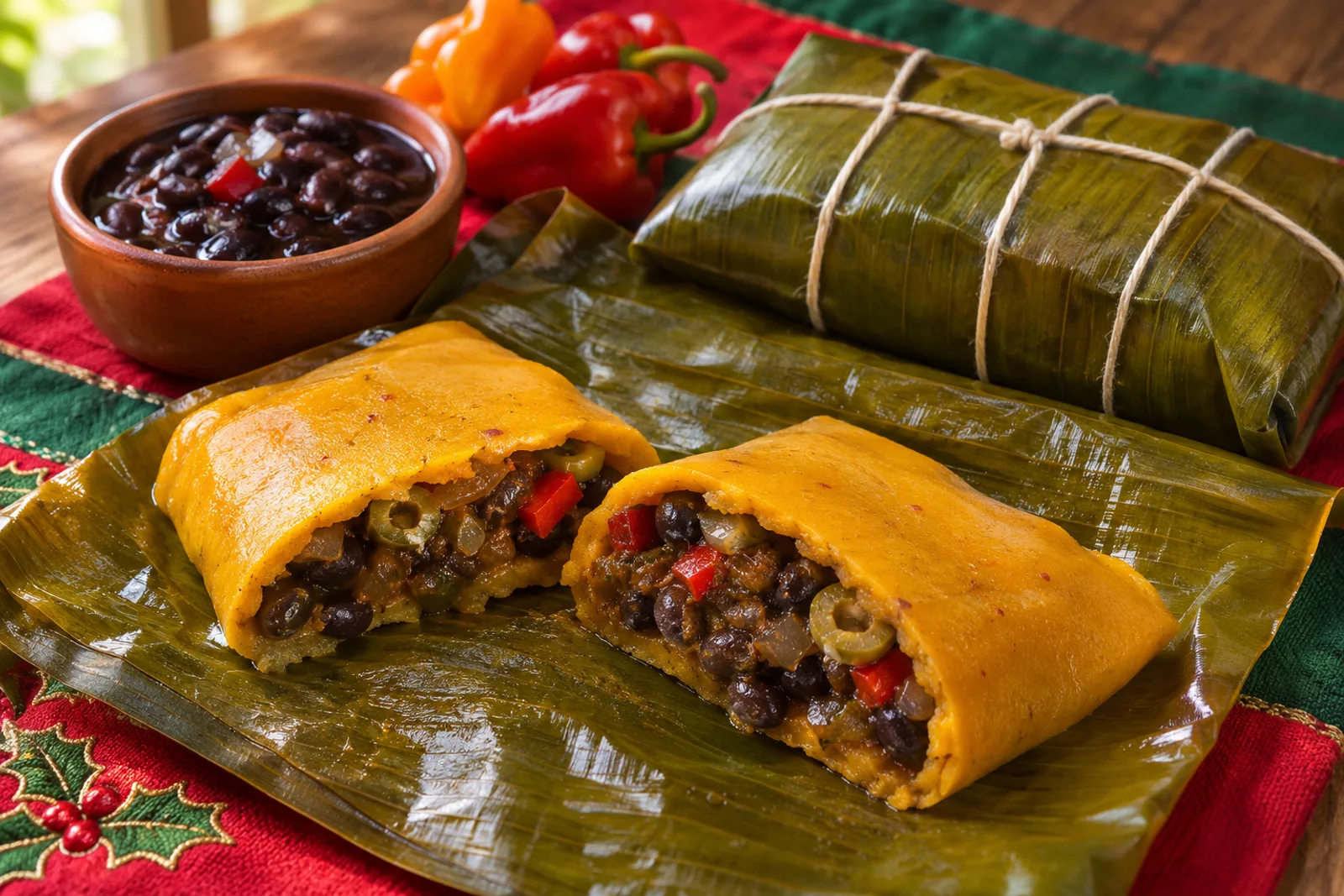

Hallacas (ah-YAH-kahs) are Venezuela’s Christmas tamales: a thin layer of annatto-orange corn dough folded around a slow-cooked stew, olives, capers and raisins, wrapped in banana leaves, tied with string and boiled. This version swaps the usual beef, pork and chicken for a thick black bean stew and makes the dough with vegetable broth and shortening, so nothing in it comes from an animal. It makes 20 hallacas at 492 calories each, with 8 g of fiber, and the work splits neatly into the bean filling the day before and a single afternoon of wrapping and boiling.
Vegetarian hallacas at a glance
How do you make vegetarian hallacas? The day before, simmer 1.1 lb (500 g) of soaked black beans until soft, cook them with a sofrito of onion, leek, bell pepper and ají dulce, plus wine, tomato paste and raw cane sugar, until completely dry, then chill. The next day, mix 2 lb 12 oz (1.25 kg) of precooked cornmeal with up to 8 cups (1.9 liters) of vegetable broth and annatto-colored shortening, wrap each portion with filling, olives, capers and raisins in a banana leaf, tie and boil for 60 minutes. 315 minutes for 20 servings, plus soaking, chilling the filling and a 20-minute rest before unwrapping.
What you get. Each hallaca is a flat, rectangular parcel. Inside, the dough is tender and slightly springy, and the filling is dark, savory and gently sweet, with salty bursts from the olives and capers. It’s eaten on its own, unwrapped on the plate, as the main event of the Christmas Eve table.
Is it authentic? The hallaca is a holiday dish built around meat, but bean hallacas have a home in Venezuela too. In Trujillo state, in the Venezuelan Andes, the carabina is a hallaca filled with soft-cooked black beans, sometimes with a little rice, and it’s eaten year-round with the local hot sauce. The other hallaca of that region, with a raw meat filling and chickpeas, is the Andean hallaca from Táchira and Mérida. The method here follows the family recipe for Venezuelan hallacas with three meats, which has more detail on folding and tying if you’ve never wrapped one.
How hard is it? Medium. The hands-on work is the same as for a meat hallaca: about 2 hours of active time and 3¼ hours of cooking, most of it unattended. The one thing that decides success is drying the filling properly.
Ingredients and where to find them in the US and UK
The batch is 20 hallacas: 1.1 lb (500 g) dried black beans for the filling and 2 lb 12 oz (1.25 kg) cornmeal for the dough, at 1.5 liters of broth per kilo of cornmeal (about 6⅓ cups per 2.2 lb), added gradually because every brand absorbs a little differently.
| Venezuelan ingredient | What it is | In the US | In the UK | What changes |
|---|---|---|---|---|
| Harina precocida | Precooked white cornmeal (masarepa) | Hispanic aisle | Latin American shops, online | Nothing. Regular cornmeal and Mexican masa harina won’t form the same dough |
| Hojas de plátano | Banana or plantain leaves | Frozen, at Latin and Asian grocers | Frozen, at Asian supermarkets | Nothing, once thawed and passed over a flame |
| Ají dulce | Small, aromatic, sweet pepper with no heat | Mini sweet peppers plus a pinch of sugar per 3 | Mini or sweet pointed peppers plus a pinch of sugar | Less floral aroma |
| Onoto | Annatto seeds, also sold as achiote | Hispanic aisle | Latin shops, online | 1 tbsp sweet paprika in the fat gives color but not the flavor, and burns faster |
| Papelón | Unrefined cane sugar | Piloncillo or panela | Dark muscovado sugar | Very little, same weight |
| Manteca vegetal | Vegetable shortening | Baking aisle | White vegetable fat, baking aisle | Nothing |
Keeping it vegan
The recipe as written is vegan. If you’re adapting a family recipe instead, these are the usual hidden animal products:
- Chicken broth in the dough. Use vegetable broth.
- Lard in the annatto fat. Use vegetable shortening, or annatto oil, though the dough is a little less tender with oil.
- Hard-boiled egg on top of the filling. Leave it out.
- Worcestershire sauce in the stew. The standard kind contains anchovies.
- Wine. Some wines are fined with animal products. Choose one labeled vegan, or use 2 tbsp red wine vinegar instead.
Allergens. No dairy, eggs or nuts. Precooked cornmeal is naturally gluten free, so the hallacas are too as long as your broth is; check the label on the broth or stock cube. Wine contains sulfites, and the TVP filling below contains soy.
The black bean filling, and two other fillings
Black beans make the best meatless filling because they behave like the meat stew does inside the leaf: dense, held together by their own starch, and stable through an hour of boiling. The two alternatives use the same dough and garnishes and replace only the beans:
- Vegetables and chickpeas. Instead of the beans, use two 15-oz (425 g) cans of chickpeas, drained (about 480 g / 1 lb), plus 300 g (10½ oz) each of carrot, butternut squash and zucchini (UK courgette), all in 1 cm (⅜ in) dice. Add the carrot to the sofrito first for 8 to 10 minutes, then the squash for 5, then the zucchini, chickpeas and seasonings. Cook uncovered until the carrot is tender but holds its shape and there’s no liquid left, about 30 to 40 minutes. It’s the brightest and freshest of the three, and the wettest, so give it the full night in the fridge.
- TVP (textured vegetable protein). Instead of the beans, soak 200 g (7 oz) dry TVP in 400 ml (1⅔ cups) hot vegetable broth for 10 to 15 minutes, then squeeze it dry by hand. Add it to the sofrito with the seasonings and cook uncovered about 20 minutes, until dry. It’s the closest in texture to the classic chopped-meat stew, but it tastes of nothing on its own, so taste and raise the cumin, salt and sugar.
- Carabina style. Stir 100 g (½ cup) cooked white rice into the finished bean filling. It firms it up and makes wrapping easier.
Whichever filling you make, weigh it once it’s cold: 20 hallacas need about 1.4 kg (3 lb), at 70 g (2½ oz) each. TVP shrinks the most, since it’s squeezed and then cooked dry. If you come up short, make fewer hallacas or use a little less in each, but don’t stretch it with broth, which only makes it wet.
How dry is dry enough
Cook the beans as for Venezuelan black beans: 8 hours soaking, then 90 minutes at a simmer with the lid ajar, or 35 minutes in a pressure cooker, until a bean crushes between your fingers. Wine and tomato paste go in only once the beans are soft. Acid in the cooking water toughens the skins and they stay firm however long you cook them.
Once everything is in the pot, mash a third of the beans against the side with a potato masher. That released starch binds the filling the way fat and gelatin do in a meat stew. It’s ready when:
- no liquid pools when you tilt the pot;
- a spoon drawn through it leaves a trail that stays open;
- a spoonful on a plate holds its shape without a ring of water around it.
Season it a touch more than tastes right from the spoon. Wrapped in a layer of corn dough, it will taste less salty and less sweet.
Spread it in shallow trays and refrigerate within 2 hours. It needs at least 3 hours to firm up, and overnight is better. Covered, it keeps 3 to 4 days in the fridge, so you can make it the weekend before.
Mixing the dough and wrapping
Set up the table first: leaves cut to size, dough balls under a damp towel, cold filling, garnishes in small bowls, string cut, and a dish of annatto fat with a pastry brush.
The annatto fat. It’s made the day before, ahead of the sofrito, because the filling takes a tablespoon: shortening and annatto seeds over low heat for 5 to 7 minutes, until deep orange, then strained. If it smokes, the annatto scorches and turns bitter. Keep it covered and melt it over low heat on wrapping day, before the dough.
The dough. Mix the cornmeal and salt, then work in the warm, not boiling broth a little at a time, along with 125 g (4½ oz) of the annatto fat: 1.5 liters (6⅓ cups) first, the rest only if the dough asks for it. Very hot broth makes lumps. It’s right when it feels like soft modeling clay: it doesn’t stick to your hands and a folded piece doesn’t crack at the edge. Cracks mean a splash more broth; sticky means a spoonful more cornmeal. Divide into 20 balls of about 160 g (5½ oz).
Wrapping. Brush a leaf square with annatto fat. With damp fingers, press a ball into an even 20 to 22 cm (8 to 8½ in) circle, about 3 to 4 mm (⅛ in) thick, with no cracks. Spoon 2 heaped tablespoons of filling into the middle, top with the garnishes and keep a 3 cm (1¼ in) border clear. Fold the leaf so the dough closes over the filling, fold in the ends, wrap with a strip running the other way and tie firmly with string, three turns each direction. At about 3 minutes a hallaca, the 20 take an hour.
How long to boil hallacas, and how to tell they’re done
Boil them 60 minutes, lid on, in salted water that covers them. The filling is already cooked and the cornmeal is precooked, so they don’t need the 90 minutes of a meat hallaca. Give them their own pot and fresh water even if you’re boiling meat hallacas the same day: leaves and string don’t seal completely, and shared water carries broth and fat from the meat ones, which is exactly what a vegan hallaca can’t have.
Lift them out, drain them standing up and leave them wrapped for 20 minutes; straight from the pot the dough is soft and falls apart. Then open a test one. The dough should be firm, peel cleanly away from the leaf and not be sticky or raw next to the filling. If it is, return the rest to the pot for 10 minutes more.
Why hallacas split or come out soggy
- Wet or warm filling. The most common problem with meatless hallacas, because beans and vegetables release more water than meat. That water turns to steam inside the leaf and splits the dough. Cold, with a trail that stays open.
- Whole beans only. Unmashed beans roll out as you fold. Mashing a third is what holds the filling together.
- Big zucchini pieces. In the vegetable version, zucchini cut larger than 1 cm (⅜ in) keeps weeping water during the boil.
- Uneven or cracked dough. Thin or cracked patches tear in the pot and let water in, and very thick edges stay pasty. Spread it evenly to 3 to 4 mm (⅛ in) and pinch a little dough over any crack before you fold.
- Leaves not flamed, or loose string. Raw leaves crack at the first fold, and a loose tie lets water in within 20 minutes.
- Bland filling. The dough mutes it. If it tastes just right from the spoon, it will taste flat in the hallaca.
Scaling the batch for 10, 20 or 40
With 1 kg (2.2 lb) of cornmeal you get about 16 hallacas of 160 g (5½ oz) dough, and 500 g (1.1 lb) of dried beans fills 20.
| Hallacas | Dried black beans | Precooked cornmeal | Vegetable broth | Shortening | Large leaves |
|---|---|---|---|---|---|
| 10 | 250 g (9 oz) | 625 g (1 lb 6 oz) | 950 ml (4 cups) | 100 g (3½ oz) | 3 |
| 20 | 500 g (1.1 lb) | 1.25 kg (2 lb 12 oz) | 1.9 l (8 cups) | 200 g (7 oz) | 6 |
| 40 | 1 kg (2.2 lb) | 2.5 kg (5½ lb) | 3.75 l (15¾ cups) | 400 g (14 oz) | 12 |
For 40, cook the beans in two pots or two pressure-cooker batches, so the bottom layer doesn’t turn to mush before the top softens.
Making meat and vegetarian hallacas on the same day? Wrap the vegetarian ones first with clean bowls and utensils, boil them in their own pot, and tie them with different-colored string or a different knot. Frozen, they look identical.
Storing, freezing and reheating
- Fridge. Cooked, whole and still in the leaf, 3 to 4 days. Get them into the fridge within 2 hours of coming out of the pot, in a single layer so they cool quickly.
- Freezer. Up to 3 months, cooked and whole, leaf on. This is the best way to keep them through the holidays.
- Reheating. In boiling water, 20 minutes from the fridge or 30 minutes straight from frozen. In the microwave, 3 minutes with the leaf on and a cup of water alongside, though the dough dries a little. The center should reach 165°F (74°C).
Leftover dough and filling become Venezuelan Christmas bollos: mix them, wrap in leaf and boil for 30 minutes. The rest of the Christmas Eve spread is in the guide to a Venezuelan Christmas dinner, and how hallacas compare with Mexican and Colombian tamales is in the tamales guide.
Frequently asked questions
What’s the difference between a hallaca and a tamale? Both are corn dough with a filling, wrapped and cooked. A hallaca is flatter and rectangular, wrapped in banana leaf rather than corn husk, colored with annatto, and carries its garnishes of olives, capers and raisins on top of the filling. It’s a Christmas dish in Venezuela, not an everyday one.
Can I use foil if I can’t find banana leaves? You can, as a last resort. The hallaca holds together, but the leaf perfumes the dough as it boils, and with foil that aroma is gone.
Can I freeze them uncooked? Yes, but the dough sometimes cracks in the freezer, and they then need a longer boil. Boiling first and freezing them cooked is more reliable, and they reheat in 30 minutes.
Are vegetarian hallacas lighter than the meat ones? Slightly: 492 calories against 513 for a three-meat hallaca, with 8 g of fiber instead of 3. Protein is lower, 11 g against 18. The calories barely move because the dough is identical and provides more than half of them.
Nutrition
Per hallaca, one twentieth of the black bean recipe, worked out from the weight of each ingredient and counting all of the annatto fat:
- Calories: 492 kcal
- Protein: 11 g
- Carbohydrates: 78 g
- Fat: 15 g, of which 3 g saturated
- Fiber: 8 g
- Sugars: 10 g (raisins, papelón and vegetables)
- Sodium: 756 mg
The cornmeal accounts for about 231 calories, the shortening about 88 and the beans about 85. Sodium depends heavily on your broth; with a salted store-bought one, cut back the salt in the dough.
I don’t treat these as second-best hallacas. They’re the ones I make when someone at the table doesn’t eat meat and I don’t want them staring at the platter. What they taught me is that the filling has to be seasoned past the point that feels right, because the dough swallows half the flavor, and that the raw cane sugar is not optional. Josnaisis.